Wireless Health Market Size, Share & Industry Analysis, By Product (WLAN/Wi-Fi, WPAN), By Component (Hardware, Software, Services), By Application, By End-use and Regional Forecast, 2026-2034
 Download Free Sample
Wireless Health Market Overview
The wireless health market size was valued at USD 289.30 billion in 2025. The market is projected to grow from USD 343.86 billion in 2026 to USD 1370.07 billion by 2034, exhibiting a CAGR of 18.86% during the forecast period.

The wireless health market is experiencing rapid expansion due to increasing adoption of connected healthcare technologies, remote patient monitoring systems, wearable medical devices, and digital health platforms. Wireless health solutions enable real-time communication between healthcare providers, patients, and medical devices through advanced wireless communication technologies. Growing demand for telemedicine, home healthcare, chronic disease management, and mobile health applications is significantly supporting market development. Wireless health market analysis highlights increasing integration of IoT-enabled medical devices, cloud-based patient monitoring systems, and AI-powered healthcare analytics platforms. Rising healthcare digitalization, demand for continuous patient monitoring, and expansion of smart healthcare infrastructure continue to strengthen wireless health market growth globally.
The USA wireless health market is witnessing strong growth because of rising investments in telehealth infrastructure, wearable health technologies, and connected patient monitoring systems. Healthcare providers across the United States are increasingly implementing wireless medical devices and digital health platforms to improve patient care, operational efficiency, and remote healthcare delivery. Wireless health market research report findings reveal growing demand for wireless cardiac monitoring systems, smart insulin devices, and AI-driven healthcare analytics solutions. Government support for telemedicine adoption and expansion of digital healthcare reimbursement policies are also accelerating market development. The increasing prevalence of chronic diseases and aging populations continues to create substantial wireless health market opportunities across the USA.
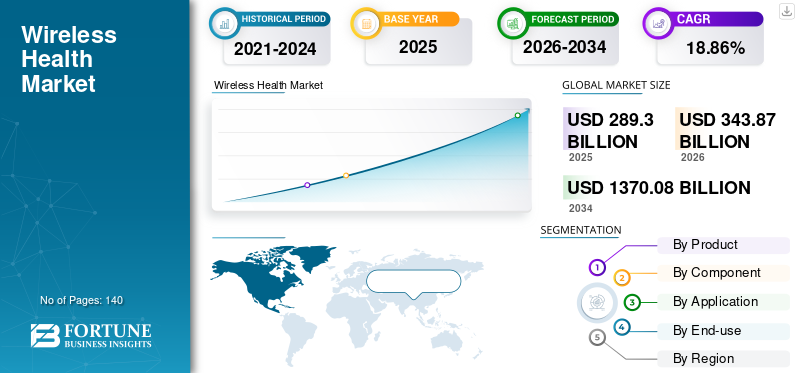
Download Free sample to learn more about this report.
Wireless Health Market Key Takeaways
 Global Market Size & Forecast
- 2025 Market Size: USD 289.30 Billion
- 2026 Market Size: USD 343.86 Billion
- 2034 Forecast Market Size: USD 1,370.07 Billion
- CAGR: 18.86% from 2026-2034
 Market Share
- North America dominated with a revenue share of 41% in 2025.
- WLAN/Wi-Fi solutions accounted for approximately 61% of the market share.
- Hospitals and clinics held approximately 49% of the market share.
 Key Regional Highlights
North America
North America led the market with a 41% regional share in 2025.
Europe
Europe accounted for 28% of the global wireless health market.
Asia-Pacific
Asia-Pacific represented 24% of the market, supported by expanding connected healthcare infrastructure.
U.S
Strong adoption of wireless health technologies across hospitals, home healthcare, and remote patient monitoring.
Japan
Accounted for 18% of the Asia-Pacific wireless health market.
Read More

Wireless Health Market Latest Trends
The wireless health market trends are strongly influenced by advancements in wearable healthcare technologies, remote monitoring systems, and AI-powered digital healthcare platforms. Healthcare providers are increasingly adopting wireless patient monitoring devices capable of tracking heart rate, blood glucose levels, oxygen saturation, and sleep patterns in real time. Smart wearable devices integrated with mobile applications and cloud-based analytics systems are improving personalized healthcare management and preventive care services. Wireless health market Insights also indicate rising demand for home healthcare technologies that support remote consultations and continuous patient monitoring.
Download Free sample to learn more about this report.
Another major trend within the wireless health industry analysis is the increasing use of 5G-enabled healthcare infrastructure and IoT-connected medical devices. Healthcare organizations are integrating wireless communication systems with electronic health records, predictive analytics tools, and AI-based diagnostic platforms to improve clinical decision-making. Demand for wireless healthcare solutions in elderly care, chronic disease management, and rehabilitation services is also increasing significantly. Additionally, cybersecurity integration and secure wireless data transmission technologies are becoming essential as digital healthcare ecosystems continue to expand globally.
Wireless Health Market Dynamics
DRIVER
Growing Demand for Remote Patient Monitoring and Telehealth Services
The increasing demand for remote patient monitoring and telehealth services is a major driver supporting the wireless health market growth. Healthcare providers and patients are increasingly relying on wireless technologies to support continuous health monitoring, virtual consultations, and remote diagnostics. Wireless healthcare systems help reduce hospital visits, improve patient engagement, and support real-time medical data transmission between patients and healthcare professionals.
wireless health market analysis indicates rising adoption of wearable medical devices, smart health sensors, and mobile health applications for chronic disease management and elderly care. The growing prevalence of cardiovascular diseases, diabetes, respiratory disorders, and hypertension is increasing demand for wireless monitoring technologies capable of providing continuous health tracking. Healthcare institutions are also investing heavily in digital healthcare infrastructure, cloud-based medical analytics, and AI-powered patient management systems. Government support for telemedicine expansion and digital healthcare modernization is further strengthening market demand globally.
RESTRAINT
Concerns Regarding Data Privacy and Cybersecurity
Data privacy and cybersecurity concerns remain major restraints affecting the wireless health market size because wireless healthcare systems manage highly sensitive patient information and medical records. Unauthorized access, cyberattacks, and data breaches can compromise patient confidentiality and disrupt healthcare operations. Healthcare providers must comply with strict regulatory standards related to medical data protection and secure communication systems.
Wireless health market research report findings reveal that implementing secure wireless infrastructure and cybersecurity frameworks requires significant investments from healthcare organizations. Smaller healthcare facilities and clinics may face financial and technical challenges in deploying advanced data protection systems. Additionally, interoperability issues between different healthcare technologies and communication platforms can affect operational efficiency. Concerns related to network reliability, device compatibility, and wireless connectivity stability also continue to influence adoption decisions across healthcare providers.
OPPORTUNITY
Expansion of AI-Enabled Wearable Healthcare Technologies
The rapid expansion of AI-enabled wearable healthcare technologies presents major opportunities within the wireless health market Outlook. Smart wearable devices equipped with AI-powered analytics capabilities can provide personalized health insights, predictive diagnostics, and continuous patient monitoring. Consumers are increasingly adopting smartwatches, wireless biosensors, and connected fitness devices for preventive healthcare management.
wireless health market opportunities are also growing due to increasing demand for home healthcare services and personalized medical solutions. Healthcare providers are investing in connected health ecosystems that integrate wearable devices, cloud-based patient management systems, and predictive healthcare analytics. Expansion of 5G communication networks and IoT-enabled healthcare infrastructure is further supporting wireless healthcare innovation. Companies developing secure, user-friendly, and AI-driven wireless medical technologies are expected to strengthen their market positioning significantly.
CHALLENGE
Integration Complexity Across Healthcare Systems
Integration complexity across healthcare systems remains one of the biggest challenges for the wireless health market. Healthcare providers often operate multiple legacy systems, electronic medical records, and communication platforms that may not integrate seamlessly with advanced wireless healthcare technologies. Ensuring interoperability between wireless medical devices, cloud-based analytics systems, and hospital management platforms requires substantial technical coordination.
Wireless health industry report findings indicate that healthcare organizations also face challenges related to workforce training, operational adaptation, and infrastructure modernization. Maintaining consistent wireless connectivity across hospitals, clinics, and remote healthcare environments can be difficult, especially in rural regions with limited network coverage. Additionally, healthcare providers must balance technological innovation with regulatory compliance and patient safety standards. The increasing complexity of connected healthcare ecosystems continues to create operational and technical challenges for market participants.
Wireless Health Market Segmentation
By Product
WLAN/Wi-Fi solutions account for approximately 61% of the wireless health market share because hospitals, clinics, and healthcare institutions widely use Wi-Fi-enabled systems for patient monitoring, electronic health records access, and wireless communication between medical devices. Wi-Fi connectivity supports efficient data transmission, mobility, and integration across healthcare environments. wireless health market trends indicate increasing deployment of advanced hospital Wi-Fi infrastructure capable of supporting telemedicine platforms, wireless diagnostic equipment, and AI-driven healthcare analytics systems. Healthcare providers are investing in secure Wi-Fi networks to improve operational efficiency, patient monitoring accuracy, and communication capabilities. Expansion of smart hospitals and connected healthcare facilities continues to strengthen demand for WLAN-based wireless health technologies.
WPAN solutions hold nearly 39% of the wireless health market size because wearable medical devices, wireless biosensors, and personal health monitoring systems increasingly depend on short-range wireless communication technologies such as Bluetooth and Zigbee. WPAN systems support low-power communication and seamless connectivity between wearable healthcare devices and mobile applications. wireless health market analysis highlights growing demand for wireless fitness trackers, glucose monitoring systems, and connected rehabilitation devices integrated with WPAN technologies. Consumers and healthcare providers increasingly prefer portable and energy-efficient health monitoring solutions capable of supporting continuous patient care and preventive health management.
By Component
Hardware components account for approximately 47% of the wireless health market share because wireless healthcare devices, wearable sensors, patient monitoring systems, and communication infrastructure form the foundation of connected healthcare ecosystems. Hospitals and healthcare providers are increasingly investing in wireless medical devices capable of delivering real-time patient data. wireless health market Insights reveal growing demand for wireless ECG monitors, smart insulin pumps, wearable cardiac devices, and wireless diagnostic equipment. Expansion of remote patient monitoring and telehealth services continues to support strong demand for advanced healthcare hardware solutions.
Software solutions represent nearly 33% of the wireless health market size due to increasing adoption of healthcare analytics platforms, telemedicine applications, cloud-based patient management systems, and AI-driven diagnostic tools. Healthcare software enables efficient management of patient data, wireless communication, and predictive healthcare analytics. wireless health market Forecast indicates strong demand for cybersecurity-enabled healthcare software platforms and mobile health applications. Integration of AI and machine learning technologies into healthcare software systems is improving patient monitoring accuracy and healthcare decision-making capabilities.
Services contribute approximately 20% of the wireless health market share because healthcare organizations increasingly require consulting, implementation, maintenance, and technical support services for wireless healthcare infrastructure deployment. Service providers support healthcare institutions in integrating wireless technologies into clinical operations. wireless health market opportunities are expanding in managed healthcare IT services, remote technical support, and cloud-based healthcare infrastructure management. Hospitals and clinics are increasingly outsourcing wireless health system maintenance and cybersecurity management services.
By Application
Remote patient monitoring applications account for approximately 36% of the wireless health market size because healthcare providers increasingly rely on wireless monitoring systems to track patient conditions outside traditional hospital settings. Wireless monitoring devices help manage chronic diseases and support elderly care services. wireless health market Research Report findings indicate rising demand for connected blood pressure monitors, glucose tracking devices, and cardiac monitoring systems. Healthcare organizations are prioritizing remote monitoring technologies to improve patient outcomes and reduce hospital readmission rates.
Fitness and wellness applications represent nearly 28% of the wireless health market share due to increasing consumer adoption of wearable fitness trackers, smartwatches, and health monitoring applications. Consumers are actively using wireless health devices to monitor physical activity, sleep quality, and overall wellness. wireless health market analysis highlights strong demand for AI-powered fitness analytics and personalized wellness applications. Integration of mobile health platforms with wearable devices is further strengthening segment growth.
Chronic disease management applications hold approximately 22% of the wireless health market size because wireless healthcare technologies play a critical role in managing diabetes, cardiovascular diseases, respiratory disorders, and hypertension. Continuous wireless monitoring improves treatment adherence and early intervention. wireless health market trends show increasing use of smart inhalers, connected insulin delivery systems, and wireless cardiac monitoring technologies in chronic disease management programs.
Emergency medical response applications contribute nearly 14% of the wireless health market share because healthcare providers increasingly use wireless communication systems for ambulance coordination, emergency diagnostics, and rapid patient data transmission. wireless health market Outlook indicates growing demand for portable wireless diagnostic devices and real-time emergency communication technologies across hospitals and emergency response networks.
By End-use
Hospitals and clinics account for approximately 49% of the wireless health market size because healthcare institutions increasingly implement wireless communication systems, patient monitoring platforms, and connected medical devices to improve clinical efficiency and patient care quality. wireless health market Insights reveal rising investments in smart hospital infrastructure and wireless patient management technologies. Hospitals are integrating wireless healthcare solutions into emergency care, intensive care, and outpatient management operations.
Home healthcare represents nearly 31% of the wireless health market share due to increasing demand for remote patient care, elderly assistance, and chronic disease monitoring services. Wireless healthcare technologies enable patients to receive continuous monitoring without hospital visits. wireless health market opportunities are increasing significantly in home-based telemedicine and wearable health monitoring applications. Aging populations and rising healthcare costs continue to support segment expansion.
Ambulatory care centers contribute approximately 20% of the wireless health market size because outpatient healthcare facilities increasingly adopt wireless diagnostic and patient management systems to improve operational efficiency and patient care delivery. wireless health market Forecast highlights increasing investments in mobile healthcare technologies and wireless communication systems across outpatient healthcare environments.
wireless health market Regional Outlook
North America
North America accounts for approximately 41% of the wireless health market share due to advanced healthcare infrastructure, strong digital healthcare adoption, and rising investments in telemedicine and wearable health technologies. The United States and Canada are major contributors to regional market growth because healthcare providers increasingly implement connected healthcare systems and AI-driven patient monitoring technologies.
wireless health market analysis in North America highlights growing demand for remote patient monitoring, wireless cardiac devices, and cloud-based healthcare analytics platforms. Government support for telehealth expansion and increasing healthcare digitalization initiatives continue to strengthen regional market development.
Europe
Europe represents nearly 28% of the wireless health market size because healthcare providers across the region are increasingly investing in connected healthcare technologies, telemedicine infrastructure, and smart hospital systems. Countries such as Germany, the United Kingdom, and France are leading adoption of wireless patient monitoring systems and digital healthcare platforms.
wireless health market trends in Europe are influenced by aging populations, rising chronic disease prevalence, and healthcare modernization initiatives. Hospitals and clinics are integrating wireless communication systems and AI-driven healthcare analytics to improve patient care quality and operational efficiency.
Germany Wireless Health Market
Germany contributes approximately 30% of the European wireless health market because of strong healthcare infrastructure, advanced medical technology adoption, and increasing investments in digital healthcare modernization. German hospitals and healthcare providers are implementing wireless patient monitoring systems, connected diagnostic equipment, and AI-powered healthcare analytics platforms.
wireless health market Research Report findings indicate growing demand for wearable healthcare devices, remote diagnostics technologies, and cloud-based patient management systems in Germany. Government support for healthcare digitalization and telemedicine expansion continues to strengthen market growth.
United Kingdom Wireless Health Market
The United Kingdom accounts for nearly 21% of the European wireless health market share because healthcare providers increasingly adopt telehealth platforms, wearable medical devices, and wireless patient monitoring technologies. The country’s healthcare system is focusing heavily on digital transformation and remote healthcare accessibility.
wireless health market opportunities in the United Kingdom are expanding due to increasing demand for AI-driven healthcare applications, smart hospital infrastructure, and home healthcare monitoring technologies. Healthcare institutions are investing in connected healthcare ecosystems to improve patient engagement and clinical efficiency.
Asia-Pacific
Asia-Pacific holds approximately 24% of the wireless health market share because of rapid healthcare digitalization, rising smartphone penetration, and expanding investments in connected healthcare technologies across China, Japan, India, and South Korea. Governments and healthcare organizations are increasingly adopting telemedicine and wireless patient monitoring systems.
wireless health market Outlook in Asia-Pacific is supported by growing demand for affordable healthcare solutions, remote diagnostics, and wearable health technologies. Expansion of healthcare infrastructure and digital communication networks continues to create substantial market opportunities.
Japan Wireless Health Market
Japan contributes approximately 18% of the Asia-Pacific wireless health market because of its aging population, advanced healthcare infrastructure, and strong adoption of robotics and digital healthcare technologies. Japanese healthcare providers are increasingly implementing wireless monitoring systems and AI-powered healthcare applications.
wireless health market Insights in Japan indicate rising demand for wearable medical devices, elderly care monitoring technologies, and connected rehabilitation systems. Investments in smart healthcare infrastructure continue to support market expansion.
China Wireless Health Market
China accounts for nearly 39% of the Asia-Pacific wireless health market share because of rapid healthcare digitalization, rising telemedicine adoption, and increasing investments in connected healthcare infrastructure. Chinese healthcare providers are expanding wireless patient monitoring systems and mobile health applications significantly.
wireless health market Forecast for China highlights strong demand for wearable healthcare devices, cloud-based healthcare platforms, and AI-driven diagnostics systems. Government initiatives promoting healthcare modernization and digital medical services continue to accelerate market growth.
Rest of World
The Rest of World region represents approximately 7% of the wireless health market size due to growing investments in healthcare infrastructure and telemedicine services across Latin America, the Middle East, and Africa. Healthcare organizations in these regions increasingly adopt wireless patient monitoring systems and mobile health technologies.
Wireless Health Industry analysis indicates rising demand for affordable digital healthcare solutions, wearable monitoring devices, and remote healthcare communication platforms. Expansion of healthcare accessibility and mobile connectivity is expected to strengthen future market opportunities.
List of Top Wireless Health Companies
- IBM
- Epic Systems Corporation
- Oracle
- OMRON Corporation
- Qualcomm Technologies, Inc
- Veradigm LLC
- Koninklijke Philips N.V.
- Stryker
- Alcatel-Lucent
Top Two Companies with the Highest Market Share
- IBM – 17% market share
- Koninklijke Philips N.V. – 14% market share
Investment Analysis and Opportunities
The wireless health market is attracting substantial investments due to increasing demand for connected healthcare systems, wearable medical devices, and telemedicine infrastructure. Healthcare providers, technology companies, and investors are focusing on digital healthcare platforms capable of improving patient monitoring, operational efficiency, and healthcare accessibility. Investments in AI-powered healthcare analytics, wireless communication systems, and cloud-based patient management platforms are accelerating rapidly.
wireless health market opportunities are increasing significantly in home healthcare, chronic disease monitoring, and wearable health technologies. Expansion of 5G healthcare infrastructure and IoT-enabled medical devices is creating strong demand for advanced wireless communication solutions. Investors are also focusing on cybersecurity technologies, predictive healthcare analytics, and AI-driven diagnostic platforms. Companies capable of integrating secure wireless communication systems with personalized healthcare applications are expected to strengthen their competitive positioning within the global digital healthcare industry.
New Product Development
New product development in the wireless health market is increasingly focused on wearable healthcare devices, AI-driven monitoring systems, and secure wireless communication technologies. Healthcare technology companies are introducing smart biosensors, wireless glucose monitoring systems, and connected cardiac devices designed for continuous patient monitoring and preventive healthcare management.
Wireless health market trends also reveal increasing innovation in mobile health applications, cloud-based healthcare analytics platforms, and remote diagnostics systems. Manufacturers are integrating machine learning algorithms, predictive healthcare analytics, and IoT-enabled communication technologies into wireless medical devices. Compact wearable devices capable of monitoring multiple health parameters simultaneously are gaining strong consumer demand. Advanced cybersecurity integration and secure wireless data transmission technologies are also becoming critical product development priorities.
Recent Developments (2023-2025)
- IBM expanded AI-powered wireless healthcare analytics solutions for remote patient monitoring systems.
- Oracle introduced advanced cloud-based wireless healthcare management platforms for hospitals and clinics.
- OMRON Corporation launched smart wearable blood pressure monitoring devices integrated with mobile health applications.
- Qualcomm Technologies, Inc enhanced 5G-enabled healthcare communication systems for connected medical devices.
- Koninklijke Philips N.V. expanded wireless patient monitoring technologies for home healthcare and telemedicine services.
Report Coverage of the Wireless Health Market
The wireless health market report provides comprehensive coverage of connected healthcare technologies, digital health innovations, competitive developments, and wireless communication advancements shaping the global healthcare industry. The report evaluates demand across wireless patient monitoring systems, wearable healthcare devices, telemedicine platforms, and mobile health applications. It also analyzes developments in Wi-Fi healthcare systems, short-range wireless communication technologies, and AI-powered healthcare analytics.
Request for Customization to gain extensive market insights.
wireless health market analysis included in the report covers regional healthcare digitalization trends, investment activities, telemedicine adoption, and operational challenges affecting healthcare providers globally. The report provides insights regarding market share distribution, connected healthcare infrastructure, cloud-based patient management systems, and cybersecurity integration strategies. Detailed evaluation of wearable medical technologies, AI-enabled diagnostics platforms, and remote patient monitoring solutions is also included. Competitive benchmarking, technological innovation, and expansion opportunities across hospitals, home healthcare, and ambulatory care environments are further highlighted within the report scope.
Frequently Asked Questions
Fortune Business Insights says that the global market value stood at USD 289.30 billion in 2025 and is projected to reach USD 1,370.07 billion by 2034.
The market is expected to exhibit a CAGR of 18.86% during the forecast period of 2026-2034.
Remote patient monitoring was the leading application segment, accounting for approximately 36% of the market, driven by growing use of wireless monitoring systems for chronic disease and elderly care.
Key players include IBM, Epic Systems Corporation, Oracle, OMRON Corporation, Qualcomm Technologies, Inc., and Veradigm LLC.
Major trends include the growing adoption of AI-enabled wearable healthcare technologies and remote monitoring, along with increasing use of 5G and IoT-connected medical devices. North America leads regionally with approximately 41% market share.



- 2021-2034
- 2025
- 2021-2024
- 140
-

(Offer valid till 30th Sep 2026)
Get 30-60 hrs Free Customization
Expand Regional and Country Coverage, Segments Analysis, Company Profiles, Competitive Benchmarking, and End-user Insights.













.webp)






-
US +1 833 909 2966 ( Toll Free )
-
Get In Touch With Us