Wood Utility Poles Market Size, Share & Industry Analysis, By Pole Size (Below 40 ft, Between 40 ft and 70 ft, and Above 70 ft), By Application (Transmission Line, Distribution Line, Telecommunication, and Others), and Regional Forecast, 2025-2032
 Download Free Sample
KEY MARKET INSIGHTS
 Listen to Audio Version
The global wood utility poles market size was valued at USD 22.84 billion in 2024. The market is projected to grow from USD 23.71 billion in 2025 to USD 32.20 billion by 2032, exhibiting a CAGR of 4.47% during the forecast period. Asia Pacific dominated the global market with a share of 39.44% in 2024.
Wood utility poles are posts made of treated wood that support public utilities such as telephone wires and overhead power lines. They offer an accessible and reasonably priced option for infrastructure development. The market for wooden poles is primarily driven by rising demand for telecom and energy services and the development of electric grid infrastructure in developing nations.
Stella-Jones dominates the market because of its wide network of treatment facilities and existing connections with important utility providers.
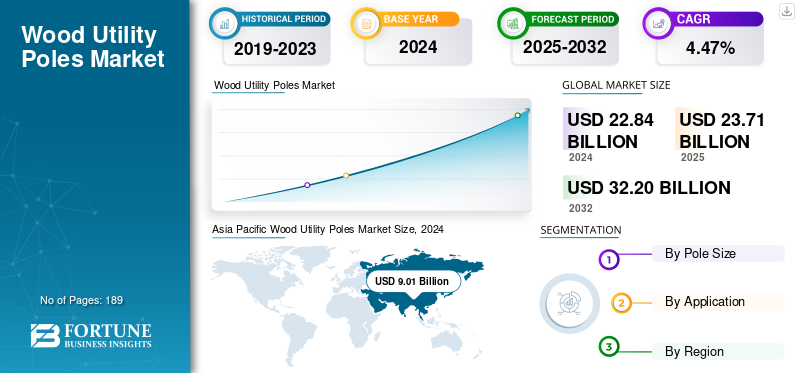
Download Free sample to learn more about this report.
Wood Utility Poles Market Key Takeaways
 Global Market Size & Forecast
- 2024 Market Size: USD 22.84 billion
- 2025 Market Size: USD 23.71 billion
- 2032 Forecast Market Size: USD 32.20 billion
- CAGR: 4.47% during the forecast period
 Market Share
- Asia Pacific dominated the global market with a share of 39.44% in 2024.
- Between 40 ft and 70 ft, wood pole size holds the majority share of the market.
- The distribution lines hold the majority share of the market.
 Key Regional Highlights
North America
Strong demand is supported by grid expansion, infrastructure upgrades, and replacement of aging utility poles, while utilities continue evaluating more resilient pole solutions.
Europe
Market growth remains at a nascent stage due to strict environmental regulations and competition from steel and concrete poles, although rural electrification and network modernization continue to create opportunities.
Asia Pacific
The region is among the fastest-growing markets, driven by abundant timber resources, expanding rural electrification, and rising electricity demand across developing economies.
U.S.
Ongoing investments in grid modernization, maintenance, and replacement of aging pole infrastructure continue to support steady demand for wood utility poles.
Japan
Growing emphasis on resilient and reliable power infrastructure is expected to support demand for durable utility pole solutions as the country continues to strengthen its electricity networks.
Read More

MARKET DYNAMICS
MARKET DRIVERS
Cost-Effectiveness and Availability is Driving the Demand for Wood Utility Poles
Wood utility poles are a long-established and relatively inexpensive alternative to steel or concrete, particularly in areas where timber supplies are readily available. Wood poles are especially appealing to utilities because of their cost advantage, which enables them to maintain and grow their infrastructure while staying within financial limits, particularly in rural and developing nations. Furthermore, wood poles are generally more cost-effective for various utility applications due to their simplicity of installation and replacement.
- In September 2022, Stella-Jones Inc. announced that it reached a final agreement to buy nearly all of the assets used in Texas Electric Cooperatives, Inc.'s (“TEC”) wood utility pole manufacturing business for a total purchase price of more than USD 28 million with about USD 4 million in inventory. This expansion indicates the continued energy demand and profitability associated with wood pole production and distribution.
MARKET RESTRAINTS
Regulations and Environmental Issues May Hamper the Market Growth
Growing environmental concerns and stricter regulations on using wood preservatives are impeding the global wood utility poles market growth. The usage of chemicals used to cure wood, such as creosote and pentachlorophenol (PCP), is being limited in some places because of environmental concerns. Adopting substitute materials or wood treatment methods with less of an adverse environmental impact can increase the cost of treated poles or reduce their lifespan.
- In October 2023, the U.S. Environmental Protection Agency (EPA) approved a rule governing creosote usage, with the goal of lowering possible hazards to the environment and public health. Although the law does not completely prohibit creosote, it does set more stringent guidelines for its handling and application in wood treatment, which is expected to make utilizing creosote-treated poles more expensive and complicated.
MARKET OPPORTUNITIES
Development of Advanced Wood Preservation Technologies
Wood utility poles have a significant opportunity to grow in the market because of developments in wood preservation. Research toward less hazardous, more resilient, and environmentally friendly wood preservatives is fueled by increased environmental awareness and stricter laws. Technological advancements, including borate treatments, bio-based substitutes, and micronized copper-based preservatives, extend pole lifespan, lower lifecycle costs, and reduce environmental damage.
- In 2019, Viance, a pioneer in the wood preservation sector, launched its UltraPoleTM NXT. This new launch provides utility companies with an alternative to Penta and other preservative systems thanks to UltraPole NXT, an environmentally friendly preservative that has undergone extensive testing.
WOOD UTILITY POLE MARKET TRENDS
Fire Resisting Coating on Wooden Pole is one of the Latest Trends in the Market
Utility companies are concentrating on protecting both new and existing wood poles, as millions are in the ground. Wooden poles can now be effectively and affordably protected from fire with pole coverings. Both new poles and poles already in the field can have these wraps put. Pole wraps are made of fiberglass mesh or wire coated with intumescent material. Heat causes the intumescent layer to expand, forming an insulating and fire-resistant barrier between the wood and the flames. After installation, the coverings are strong and resistant to severe weather.
- In 2022, the California Department of Forestry and Fire Protection placed poles covered in Hexion's Armorbuilt Wildfire Shield in a high-intensity fire-risk location close to Salinas, California, and then put them through a controlled burn. Poles in the controlled burn experienced temperatures as high as 1,700 degrees Fahrenheit and flames up to 45 feet high. Following the removal of the coverings, post-fire inspections revealed that the poles had no damage, superficial charring, or appearance alteration.
Download Free sample to learn more about this report.
Segmentation Analysis
By Pole Size
Between 40 ft and 70 ft is the Dominant Segment as It Caters to a Broad Range of Existing Distribution Poles in Power Line
Based on pole size, the market is classified into below 40 ft, between 40 ft and 70 ft, and above 70 ft.
Between 40 ft and 70 ft, wood pole size holds the majority share of the market as they are the backbone of power delivery networks in most regions. They provide a reasonable compromise between cost-effectiveness and height for clearance.
In situations where space is limited, pole sizes under 40 feet are frequently utilized for low-voltage distribution in residential areas and to support smaller infrastructure, such as street lighting.
The requirement for more clearance in electricity transmission lines, particularly where they cross roads, railroads, or other impediments, and where longer spans are needed to reduce the number of poles. This further drives the demand for pole sizes exceeding 70 feet.
By Application
Distribution Line is the Largest Application Segment, as These Lines Account for the Majority of the Pole Infrastructure for Electricity
Based on applications, the market is segmented into transmission line, distribution line, telecommunication, and others.
The distribution lines hold the majority share of the market as they are the most extensive part of the electrical grid, reaching homes and businesses. This creates a high demand for wood poles as a cost-effective and readily available solution.
For transmission line applications, demand for wood utility poles is driven by investments in grid upgrades and expansion to support renewable energy integration and increased power demand for utility poles, requiring robust and tall pole structures.
In the telecommunication sector, the demand is driven by the ongoing expansion of broadband networks, including 5G infrastructure, which requires new pole installations or the use of existing poles for fiber optic cables and other equipment.
Wood Utility Poles Market Regional Outlook
By region, the market is categorized into North America, Europe, Asia Pacific, Latin America, and Middle East & Africa. Asia Pacific dominates the wood utility poles market share due to the easy availability of timber and low-cost infrastructure development in remote areas.
North America
Asia Pacific Wood Utility Poles Market Size, 2024 (USD Billion)
To get more information on the regional analysis of this market, Download Free sample
Wood poles are an essential part of North America's vast electrical infrastructure, especially in the U.S., where expansion, grid upgrades, and replacements drive the market demand. Utilities are investigating treated wood and composites due to concerns about wildfires and storms. The market demand is further driven owing to maintenance or upgrading existing pole infrastructure.
- In June 2023, Osmose Utilities Services, Inc., a prominent supplier of wood utility poles and infrastructure management services, announced that it acquired Power Line Services. Osmose's inspection and restoration services are expanded by this acquisition to better serve North American utility customers.
Europe
The market for wood utility poles in Europe is at a nascent stage. The strict environmental laws and the availability of steel and concrete substitutes constrain the market growth. Projects to electrify rural areas and the requirement to strengthen current networks are significant motivators. In this area, the lifespan assessment of wood poles and sustainable procurement are prioritized.
- For instance, in September 2022, the Irish electrical transmission and distribution networks' operator, ESB (electrical Supply Board) Networks, announced a large investment in network upgrades, including substituting more sustainable and long-lasting alternatives for old wood poles.
Asia Pacific
The Asia Pacific region is one of the fastest-growing markets for wood utility poles. Abundant timber resources, increasing electricity demand, and expanding rural electrification programs are fueling market growth, particularly in countries such as India, China, and Southeast Asia. Cost-effectiveness is a key factor favoring wood poles over alternatives in many developing areas.
- In June 2024, China’s National Energy Administration announced accelerating transmission projects, with the goal of completing 37 major power lines and starting construction on another 33 by the end of 2025. It follows a State Council directive to increase the national target for battery storage capacity by 2025.
Latin America
In Latin America, the electrical infrastructure of many countries is still being developed, and wood poles provide an affordable option. The primary drivers are grid expansion and rural electrification initiatives. Inconsistent quality and possible deforestation issues are obstacles.
- In September 2023, ISA Cteep announced plans to invest over USD 3 billion in energy transmission projects in the nation by 2028. By 2028, ISA Cteep expects to have seven transmission projects in Brazil completed, with disbursements totaling more than USD 2 billion. Projects that are already operational would receive the remaining USD 1 billion.
Middle East & Africa
The demand for wood utility poles in the region is not uniform. For economic reasons, some countries rely largely on wood, but others are investing in more durable infrastructure made of steel or concrete. Demand in some regions is mainly driven by rural electrification initiatives and power infrastructure development in quickly expanding economies.
- In November 2023, Saudi Arabia and Egypt signed an agreement to build new transmission lines and improve grid connectivity for power. The agreement emphasizes the need for poles and other infrastructure components. It is expected to be the first large-scale high-voltage direct current interconnection link in the Middle East and North Africa, covering over 1,350km.
COMPETITIVE LANDSCAPE
Key Industry Players
Numerous Regional and Few Global Players Competing across Material Type & Geographic Needs
The global wood utility poles market is concentrated with companies such as Stella-Jones and Koppers Inc., among others, accounting for a significant market share.
Stella-Jones is a major player that offers a variety of wood poles with an emphasis on superior durability and preservation by utilizing its vast timber resources and treatment capabilities. Their market dominance results from their solid supply chain and long-standing connections with utility companies.
Koppers Inc. is another major company in the market. It focuses on cutting-edge wood treatment techniques and sustainable sourcing methods. They are renowned for their long-term pole performance and tailored solutions.
Additionally, Universal Forest Products, Bell Lumber & Pole Co., Viance, and Cobb Lumber are among the other major players in the market. Focus on product innovation, strategic partnerships, and geographic expansion are some of the major strategies of leading players.
LIST OF KEY WOOD UTILITY POLES COMPANIES PROFILED
- Stella-Jones (Canada)
- Universal Forest Products (U.S.)
- Bell Lumber & Pole Co (U.S.)
- Koppers Inc. (U.S.)
- Viance (U.S.)
- Cobb Lumber (U.S.)
- Poles Inc (U.S.)
- Lantmännen (Sweden)
- Baldwin Pole (U.S.)
- Hill & Smith PLC (UK)
- Thomasson Company (U.S.)
KEY INDUSTRY DEVELOPMENTS
- January 2025- UFP Industries announced the acquisition of C&L Wood Products, Inc. (C&L), a Hartselle, Alabama-based pallet and mulch producer.
- July 2023- Stella-Jones Inc. acquired All of the Assets of Baldwin Pole and Piling Company, Inc.'s Wood Utility Pole Manufacturing Business worth USD 46 million.
- September 2022- Bell Lumber & Pole Company acquired the assets of The Oeser Company, which is a utility pole manufacturer and supplier located in Bellingham, Wash. This acquisition enables Bell to expand its business as a leading supplier of utility poles in North America, thus advancing its presence in the Pacific Northwest.
- July 2022- Viance announced that Baldwin Pole & Piling Company started the production of UltraPole NXT with DCOI in their Wiggins, Mississippi plant. UltraPole NXT are durable poles that offer high performance, with benefits to utility customers and their linemen.
- January 2022- Stella-Jones Inc. announced that it reached a final agreement to buy Cahaba Timber, Inc.’s shares through its U.S. subsidiary for USD 36.5 million, including working capital, which is currently estimated to be USD 4 million. Cahaba Timber is a reputable manufacturer of treated poles and pilings that procures raw materials for its treatment operations in Brierfield, AL.
REPORT COVERAGE
The global wood utility poles market analysis provides market size & forecast by all the segments included in the report. It contains detail on the market dynamics and trends expected to drive the market in the forecast period. It offers information on the prevalence of malocclusion in key regions/countries, key industry developments, new product launches, and details on partnerships, mergers & acquisitions. The report covers a detailed competitive landscape with information on the market share and profiles of key players.
Request for Customization to gain extensive market insights.
Report Scope & Segmentation
|
ATTRIBUTE |
DETAILS |
|
Study Period |
2019-2032 |
|
Base Year |
2024 |
|
Estimated Year |
2025 |
|
Forecast Period |
2025-2032 |
|
Historical Period |
2019-2023 |
|
Growth Rate |
CAGR of 4.47% from 2025-2032 |
|
Unit |
Value (USD Billion) |
|
Segmentation
|
By Pole Size
|
|
By Application
|
|
|
By Region
|
Frequently Asked Questions
Fortune Business Insights says that the global market value stood at USD 22.84 billion in 2024 and is projected to reach USD 32.20 billion by 2032.
In 2024, the market value stood at USD 9.01 billion.
The market is expected to exhibit a CAGR of 4.47% during the forecast period.
The distribution segment led the market, by application.
The key factor driving the market is the cost-effectiveness and availability of wood.
Stella-Jones, Koppers Inc., and Bell Lumber & Pole Co. are the top players in the market.
Asia Pacific dominated the global market share in 2024.
The development of advanced wood preservation technologies is expected to favor product adoption.



- 2019-2032
- 2024
- 2019-2023
- 189
Get 30-60 hrs Free Customization
Expand Regional and Country Coverage, Segments Analysis, Company Profiles, Competitive Benchmarking, and End-user Insights.



















Related Reports
-
US +1 833 909 2966 ( Toll Free )
-
Get In Touch With Us