Wooden Decking Market Size, Share & Industry Analysis, By Type (Pressure-treated Wood, Redwood, Tropical Hardwood, Cedar, WPC, and Others), By Type of Construction, By Application, By End-Use, and Regional Forecast, 2026-2034
 Download Free Sample
Wooden Decking Market Overview
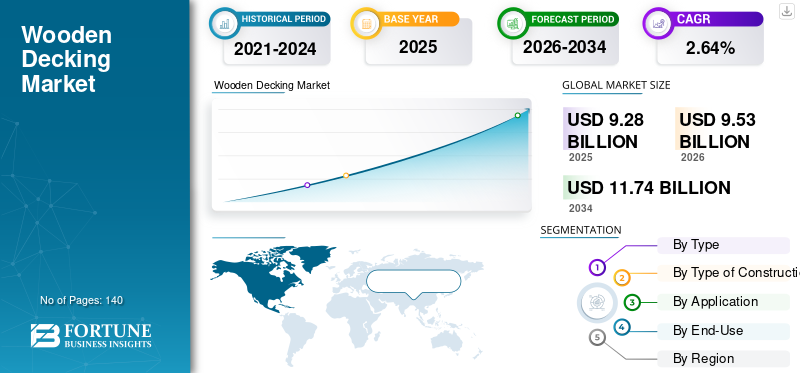
The global wooden decking market size was valued at USD 9.28 billion in 2025. The market is projected to grow from USD 9.53 billion in 2026 to USD 11.74 billion by 2034, exhibiting a CAGR of 2.64% during the forecast period.

The wooden decking market is expanding steadily due to increasing residential renovation activities, outdoor living trends, and commercial infrastructure development worldwide. Wooden decking materials are widely used in patios, balconies, poolside flooring, landscaping, rooftop spaces, and hospitality construction because of their aesthetic appeal and structural durability. Manufacturers are increasingly focusing on sustainable forestry practices, moisture-resistant coatings, and engineered wood solutions to improve product lifespan and environmental performance. wooden decking market Analysis indicates growing adoption of pressure-treated wood, tropical hardwood, cedar, and wood-plastic composite decking across residential and commercial sectors. Rising demand for eco-friendly outdoor construction materials continues supporting market expansion globally.
The USA wooden decking market remains one of the largest regional sectors due to high residential remodeling activity and strong demand for outdoor entertainment spaces. More than 63% of newly renovated suburban homes in the United States include upgraded deck installations or patio expansion projects. wooden decking market Research Report findings show increasing consumer preference for low-maintenance decking systems, pressure-treated lumber, and composite alternatives designed for weather resistance. Construction companies and landscape contractors are expanding use of durable decking materials in hospitality, tourism, and waterfront infrastructure projects. Growing investment in backyard renovation, outdoor kitchens, and luxury residential construction continues strengthening demand for wooden decking products throughout the United States.
Download Free sample to learn more about this report.
Wooden Decking Market Key Takeaways
 Global Market Size & Forecast
- 2025 Market Size: USD 9.28 Billion
- 2026 Market Size: USD 9.53 Billion
- 2034 Forecast Market Size: USD 11.74 Billion
- CAGR: 2.64% from 2026-2034
 Market Share
- North America dominated with a revenue share of 38% in 2025.
- Pressure-treated wood accounted for nearly 31% of the market share.
- Wood-plastic composite decking held nearly 21% of the market share.
 Key Regional Highlights
North America
North America led the market with a 38% regional share in 2025.
Europe
Europe accounted for 29% of the global wooden decking market.
Asia-Pacific
Asia-Pacific represented 24% of the market, supported by residential and commercial construction activity.
U.S
Strong demand for wooden decking driven by residential renovations, landscaping, and outdoor living projects.
Japan
Accounted for 27% of the Asia-Pacific wooden decking market.
Read More

Wooden Decking Market Latest Trends
The wooden decking market Trends reveal increasing consumer preference for sustainable and low-maintenance outdoor construction materials. More than 54% of newly introduced decking products now include weather-resistant coatings, UV protection layers, and anti-slip surface technologies. Manufacturers are increasingly utilizing certified timber sources and recycled wood fiber composites to align with environmental sustainability standards. Demand for wood-plastic composite decking is rising significantly because consumers seek products with lower maintenance requirements and extended durability.
Download Free sample to learn more about this report.
Wooden Decking Industry Analysis also highlights growing popularity of modular decking systems and pre-fabricated installation kits for residential renovation projects. Builders and contractors are adopting hidden fastening systems and engineered deck boards that improve structural appearance and installation efficiency. Smart outdoor living concepts, including integrated lighting and moisture-resistant deck surfaces, are becoming increasingly common in luxury residential developments.
Wooden Decking Market Dynamics
DRIVER
Rising Demand for Outdoor Living and Residential Renovation
The increasing popularity of outdoor living spaces and residential remodeling is a major growth driver for the wooden decking market. More than 67% of homeowners in developed housing markets now prioritize outdoor entertainment areas such as patios, decks, rooftop lounges, and garden walkways during renovation projects. wooden decking market Growth is strongly supported by rising investment in landscaping, luxury housing, and hospitality infrastructure. Construction companies are increasingly utilizing pressure-treated wood, cedar, and composite decking materials to improve outdoor aesthetics and structural longevity. Demand for eco-friendly and moisture-resistant decking products is also rising among environmentally conscious consumers. wooden decking market Forecast studies indicate continued expansion in residential deck replacement projects and backyard improvement programs across North America, Europe, and Asia-Pacific construction sectors.
RESTRAINT
High Maintenance and Moisture-Related Deterioration
One of the major restraints affecting the wooden decking market is the ongoing maintenance requirement associated with natural wood decking materials. More than 46% of property owners report concerns regarding moisture damage, warping, fading, and termite infestation in traditional wood structures. wooden decking market Insights indicate that untreated wood products often require regular sealing, staining, and surface repairs to maintain structural quality and visual appearance. Tropical climate exposure and fluctuating weather conditions further increase maintenance costs for residential and commercial property owners. Manufacturers face pressure to develop advanced coatings and treatment technologies capable of improving moisture resistance and reducing long-term maintenance expenses. These operational concerns encourage some consumers to shift toward synthetic alternatives, limiting demand growth for traditional wood decking products in certain regions.
OPPORTUNITY
Expansion of Sustainable Construction and Eco-Friendly Materials
The increasing adoption of sustainable construction practices presents strong opportunities for the wooden decking market. More than 58% of architects and construction firms now prioritize certified timber products and recycled composite materials in outdoor infrastructure projects. wooden decking market Opportunities are growing because environmentally conscious consumers increasingly prefer renewable and responsibly sourced building materials. Manufacturers are investing heavily in thermally modified wood, recycled wood-plastic composites, and biodegradable protective coatings to improve sustainability performance. Green building certifications and eco-resort developments are also supporting demand for environmentally friendly decking systems. Urban landscaping projects, rooftop gardens, and waterfront recreational infrastructure continue creating long-term growth opportunities for premium decking manufacturers. Expansion of smart city projects and sustainable residential communities is expected to strengthen product adoption globally.
CHALLENGE
Volatility in Raw Material Supply and Pricing
Raw material supply fluctuations and timber pricing instability remain major challenges for the wooden decking market. More than 41% of decking manufacturers identify timber procurement and transportation costs as critical operational concerns. Climate-related forestry disruptions, trade restrictions, and rising fuel expenses continue affecting supply chain efficiency across global construction markets. Wooden Decking Industry Report findings indicate that shortages of high-quality cedar, redwood, and tropical hardwood products can delay large-scale commercial projects. Manufacturers are also facing increased pressure to comply with sustainable forestry regulations and certification requirements. Competition from alternative construction materials such as aluminum decking and synthetic flooring systems further intensifies market pressure. These factors collectively increase operational uncertainty and affect profit margins for decking manufacturers and distributors worldwide.
Wooden Decking Market Segmentation
By Type
Pressure-treated wood accounts for nearly 31% market share in the wooden decking market due to its affordability, durability, and widespread availability. These decking materials are chemically treated to resist termites, fungal growth, and moisture damage, making them highly suitable for residential outdoor construction. wooden decking market Analysis indicates strong demand for pressure-treated lumber in backyard decks, patios, and landscaping projects across suburban housing developments. More than 57% of entry-level residential decking installations utilize pressure-treated wood because of lower upfront costs compared to premium hardwood alternatives. Manufacturers are increasingly improving preservative treatment technologies and weather-resistant coatings to extend product lifespan.
Redwood holds approximately 14% market share in the wooden decking market because of its natural resistance to decay, insect damage, and moisture exposure. The material is widely preferred in premium residential construction due to its rich appearance and dimensional stability. wooden decking market Trends indicate rising use of redwood decking in luxury landscaping projects, rooftop terraces, and outdoor entertainment areas. More than 43% of high-end residential outdoor renovations in selected North American regions incorporate redwood materials for aesthetic appeal and long-lasting durability. Manufacturers are introducing advanced protective coatings and UV-resistant treatments to improve color retention and weather performance. Environmental sustainability certifications and responsible forestry management practices continue influencing purchasing decisions within the redwood decking segment.
Tropical hardwood accounts for nearly 18% market share in the wooden decking market due to its exceptional density, strength, and weather resistance properties. Materials such as ipe, teak, and cumaru are widely utilized in luxury commercial projects, marinas, hospitality infrastructure, and waterfront developments. wooden decking market Research Report findings indicate strong demand for tropical hardwood decking in premium outdoor environments exposed to heavy moisture and temperature fluctuations. More than 49% of luxury resort construction projects prefer tropical hardwood because of its superior structural performance and visual appeal. Manufacturers are increasingly emphasizing sustainable forestry certifications and traceability standards to address environmental concerns associated with exotic timber sourcing. High durability and low warping characteristics continue supporting segment expansion globally.
Cedar represents approximately 12% market share in the wooden decking market because of its lightweight structure, natural oils, and resistance to decay. Residential property owners frequently choose cedar decking for patios, garden walkways, and outdoor relaxation spaces due to its smooth texture and aromatic characteristics. wooden decking market Insights reveal increasing demand for cedar products in eco-friendly housing projects and sustainable landscape architecture applications. More than 39% of consumers selecting natural wood decking prefer cedar because of its lower density and ease of installation. Manufacturers are focusing on kiln-dried cedar boards and enhanced sealant technologies to improve weather protection and structural stability. Growth in suburban residential remodeling continues supporting steady demand for cedar decking materials.
Wood-plastic composite decking holds nearly 21% market share in the wooden decking market and is expanding rapidly because of low maintenance requirements and enhanced moisture resistance. WPC products combine recycled wood fibers with plastic polymers to create durable and weather-resistant decking systems. wooden decking market Forecast studies indicate increasing consumer preference for composite decking due to reduced staining, splintering, and fading risks. More than 52% of newly developed premium residential projects now utilize WPC materials for long-term outdoor durability. Manufacturers are introducing textured surfaces, hidden fastening systems, and UV-resistant finishes to improve product aesthetics and functionality.
Other decking materials account for nearly 4% market share in the wooden decking market and include thermally modified wood, bamboo decking, engineered timber, and hybrid outdoor flooring systems. These materials are increasingly used in eco-friendly construction projects and specialized architectural applications. wooden decking market Opportunities are growing for thermally treated wood because of improved moisture resistance and dimensional stability without chemical preservatives. Bamboo decking is also gaining traction among environmentally conscious consumers due to rapid renewability and strong tensile properties. Manufacturers are investing in innovative engineered decking systems designed for lightweight commercial installations and urban rooftop developments. Increasing experimentation with sustainable and alternative outdoor flooring materials continues supporting niche segment growth worldwide.
By Type of Construction
Construction type applications account for nearly 38% market share in the wooden decking market due to rising demand from residential renovation and commercial infrastructure projects. New residential housing developments continue driving installation of patios, balconies, and outdoor entertainment decks. wooden decking market Analysis indicates increasing use of premium hardwood and WPC decking materials in hospitality construction and mixed-use urban developments. More than 61% of luxury housing projects now include customized outdoor decking structures as part of architectural planning. Contractors are increasingly utilizing modular deck systems and engineered fastening technologies to improve installation efficiency and long-term structural performance. Expansion of eco-resorts and tourism infrastructure also continues strengthening demand for high-quality decking solutions worldwide.
By Application
Application-based segmentation represents approximately 34% market share in the wooden decking market and includes landscaping, poolside flooring, rooftop terraces, marinas, and public recreational spaces. Landscape architects and urban planners are increasingly utilizing decking systems to improve outdoor functionality and aesthetic value in commercial developments. wooden decking market Trends indicate growing adoption of anti-slip and weather-resistant surfaces in waterfront and hospitality applications. More than 47% of luxury hotel renovation projects now integrate premium decking materials for outdoor dining and relaxation spaces. Public infrastructure modernization and urban beautification projects are also supporting increased demand for durable decking products. Sustainable urban landscaping concepts continue driving innovation in outdoor flooring materials and installation systems.
By End-Use
End-use applications account for nearly 28% market share in the wooden decking market due to strong demand from residential homeowners, commercial developers, hospitality operators, and public infrastructure agencies. Residential end-users remain dominant because of increasing investment in outdoor renovation and backyard improvement projects. wooden decking market Growth is also supported by rising adoption of premium decking systems in hotels, resorts, restaurants, and entertainment venues. Commercial property owners increasingly prioritize weather-resistant and low-maintenance decking materials for long-term operational efficiency. Public parks, boardwalks, and recreational facilities are utilizing sustainable decking products to improve environmental performance and visitor experience. Increasing urbanization and lifestyle-focused construction trends continue strengthening demand across diverse end-use sectors globally.
Wooden Decking Market Regional Outlook
North America
North America holds the largest position in the wooden decking market, with about 38% market share, driven by strong residential renovation activity and high outdoor living adoption. The region shows consistent demand for backyard decks, patio extensions, rooftop leisure spaces, and waterfront construction. Homeowners in the United States and Canada increasingly prefer pressure-treated wood, cedar, and WPC decking for durability and appearance. Contractors are also emphasizing weather-resistant coatings, hidden fastening systems, and low-maintenance finishes to improve long-term performance. Retail home improvement chains and landscape suppliers continue expanding product visibility across suburban markets. Hospitality developments and luxury housing projects add another layer of demand. Canada is also seeing steady uptake of thermally modified wood and eco-certified materials. Outdoor lifestyle construction remains a key growth engine.
Europe
Europe accounts for nearly 29% market share in the wooden decking market, supported by sustainable construction practices and strong landscaping investment. The region has a clear preference for certified timber, recyclable decking systems, and environmentally responsible outdoor construction materials. Architects and developers across Western Europe increasingly specify tropical hardwood, thermally modified wood, and WPC for both residential and commercial projects. Modular deck systems, rooftop terraces, and public recreation spaces are becoming more common in urban developments. Manufacturers are responding with recyclable materials and low-impact surface treatments that align with green building certification goals. The hospitality and tourism sectors are also contributing to demand, especially in scenic and waterfront locations. Public park upgrades and urban outdoor living concepts are reinforcing market performance. Europe remains highly quality-driven and sustainability-focused.
Germany Wooden Decking Market
Germany represents around 31% of the Europe wooden decking market, supported by strict sustainability standards and a strong base of residential outdoor renovation activity. Demand is rising for thermally modified wood and WPC decking because both options align well with environmental regulation and performance expectations. More newly developed housing communities now include landscaped decks, rooftop terraces, and private garden platforms. Commercial developers also use certified timber in hospitality, civic, and public-use projects. Weather-resistant coatings and engineered boards are gaining importance because they improve lifespan in variable climate conditions. German buyers often prioritize premium materials that combine durability, efficiency, and clean visual design. As a result, the market is shaped by quality, regulation, and long-term value. Germany remains a key innovation and consumption center in Europe.
United Kingdom Wooden Decking Market
The United Kingdom holds about 24% share within the Europe wooden decking market, driven by renovation activity and strong consumer interest in garden landscaping. Decking is widely used for patios, family entertainment areas, outdoor dining spaces, and compact urban gardens. Demand is especially strong for pressure-treated wood and low-maintenance composite products that reduce upkeep for homeowners. Modular deck kits are gaining traction among contractors because they shorten installation time and simplify project execution. Hospitality properties and rooftop commercial spaces are also adopting premium decking materials to enhance outdoor usability. Retail suppliers continue promoting products that balance affordability, durability, and appearance. The UK market is also influenced by weather tolerance and maintenance requirements. Outdoor living continues to be a major influence on product selection.
Asia-Pacific
Asia-Pacific holds approximately 24% market share in the wooden decking market and is among the fastest expanding regions because of urbanization and infrastructure growth. Rising residential construction, tourism projects, and commercial leisure developments are creating strong demand for decking systems. More than half of new hospitality and resort projects in major markets now include outdoor decking installations. Developers increasingly use moisture-resistant and anti-slip products because many projects are located in humid or tropical environments. China, Japan, India, and Australia remain major demand centers. Retail suppliers are broadening access to WPC and engineered wood solutions in urban areas. Government-backed tourism modernization and public recreation infrastructure also support the market. Lifestyle-oriented housing designs are increasing interest in balconies, rooftop terraces, and landscaped outdoor zones. The region combines volume growth with design innovation.
Japan Wooden Decking Market
Japan accounts for about 27% of the Asia-Pacific wooden decking market, supported by compact urban living and advanced outdoor design preferences. Decking is commonly used in balcony spaces, rooftop relaxation areas, and small residential gardens where efficient use of space matters. Demand is rising for thermally modified wood and lightweight composite decking because these products suit modern urban housing formats. Commercial developers are also using modular deck systems in hotels, retail complexes, and mixed-use projects. Manufacturers focus on anti-moisture performance, neat installation, and earthquake-resistant construction methods. Japanese buyers often expect high visual quality and practical durability, which shapes product development. The market is also influenced by premium aesthetics and limited-space architecture. Japan continues to favor refined, efficient, and technically advanced decking solutions.
China Wooden Decking Market
China represents about 18% share within the Asia-Pacific wooden decking market because of fast-paced urban construction and a large base of residential and commercial projects. Outdoor decking is increasingly used in luxury housing, hotels, public parks, and waterfront developments. Demand is especially strong for WPC and pressure-treated wood because these products offer a practical mix of affordability and durability. Domestic manufacturers are increasing production of recyclable materials and engineered outdoor flooring systems to match rising demand. Government spending on tourism, public amenities, and city beautification also supports market expansion. Growing disposable income is encouraging more homeowners and developers to invest in outdoor lifestyle spaces. The market benefits from scale, speed, and broad application diversity. China remains a major manufacturing and consumption hub for decking materials.
Rest of World
The Rest of World region accounts for roughly 9% market share in the wooden decking market, with demand supported by tourism infrastructure and commercial outdoor development. Latin America, the Middle East, and Africa are increasingly using decking in resorts, waterfront facilities, public leisure zones, and high-end hospitality projects. Tropical hardwood and moisture-resistant composite materials are especially relevant in hotter climates and coastal environments. More than one-third of premium hospitality developments in these regions now include outdoor decking elements as part of luxury landscape design. Commercial property developers are also using engineered decking products in rooftop lounges and entertainment areas. Access to certified timber and modular systems is improving through expanding retail and distributor networks. Tourism growth and smart city planning are both supporting future market development. The region is still emerging but shows clear opportunity.
List of Top Wooden Decking Companies
- UPM Kymmene Corporation
- Trex Company Inc.
- Weyerhaeuser Company
- Setra Group AG
- Metsä Group
- UFP Industries Inc.
- Latham PLC
- VETEDY
Top Two Companies with Highest Market Share
- Trex Company Inc. – 18% market share
- UPM Kymmene Corporation – 14% market share
Investment Analysis and Opportunities
The wooden decking market is attracting increasing investment from construction companies, landscape developers, and sustainable building material manufacturers due to rising demand for outdoor living infrastructure. More than 55% of newly funded residential construction projects now include outdoor decking and landscaped entertainment areas. wooden decking market Opportunities are expanding significantly because consumers increasingly prefer eco-friendly and low-maintenance outdoor flooring systems.
Manufacturers are investing heavily in recyclable wood-plastic composites, thermally modified timber, and advanced protective coating technologies. Hospitality operators and tourism developers are increasing spending on premium decking materials for resorts, rooftop lounges, and waterfront leisure projects. wooden decking market Research Report findings indicate strong investor interest in modular decking systems and hidden fastening technologies designed to reduce installation complexity. Urban landscaping and smart city infrastructure programs are also creating long-term opportunities for engineered decking manufacturers. Expansion of green building certification programs and sustainable architecture initiatives continues strengthening investment potential throughout the global decking industry.
New Product Development
New product development within the wooden decking market is increasingly focused on weather resistance, sustainability, and low-maintenance performance. Manufacturers are launching advanced WPC decking boards with UV-resistant coatings, anti-slip surfaces, and moisture-protection technologies. More than 48% of recently introduced decking products now utilize recycled wood fibers and recyclable polymer materials to improve environmental sustainability.
wooden decking market Trends also indicate rising innovation in hidden fastening systems and modular deck installation technologies designed for faster construction efficiency. Thermally modified wood products are gaining popularity because they improve durability without requiring chemical preservatives. Manufacturers are introducing textured surfaces and realistic wood-grain finishes to enhance visual appeal in residential and commercial projects. Smart outdoor living integration, including embedded lighting systems and drainage-compatible decking designs, is also becoming increasingly common. Demand for lightweight engineered decking products suitable for rooftop applications and urban landscaping continues driving product innovation globally.
Five Recent Developments (2023-2025)
- In 2023, Trex Company Inc. expanded its recycled composite decking portfolio with enhanced UV-resistant outdoor flooring products.
- In 2023, UPM Kymmene Corporation introduced sustainable wood composite decking systems utilizing certified renewable materials.
- In 2024, Weyerhaeuser Company increased production capacity for pressure-treated decking lumber across North American markets.
- In 2024, Metsä Group launched thermally modified decking boards designed for moisture-intensive outdoor environments.
- In 2025, VETEDY introduced modular hidden fastening technologies for premium hardwood decking installations in hospitality infrastructure projects.
Report Coverage of Wooden Decking Market
The wooden decking market Report provides comprehensive analysis of market trends, competitive landscape, material innovations, regional developments, and construction demand patterns influencing industry expansion. The report evaluates pressure-treated wood, redwood, tropical hardwood, cedar, WPC, and engineered decking systems used across residential, commercial, hospitality, and landscaping applications. wooden decking market Analysis also examines sustainable forestry practices, recyclable composite technologies, and advanced protective coating developments shaping future market performance.
Request for Customization to gain extensive market insights.
The report covers regional market dynamics across North America, Europe, Asia-Pacific, and Rest of World while providing country-level insights for the United States, Germany, United Kingdom, Japan, and China. wooden decking market Insights further assess investment activities, urban landscaping trends, modular construction technologies, and eco-friendly outdoor infrastructure development. Competitive analysis highlights leading manufacturers focusing on moisture-resistant decking systems, recyclable materials, and hidden fastening technologies. The study also evaluates raw material supply trends, distribution strategies, product innovation, and emerging opportunities associated with luxury residential construction and tourism infrastructure modernization worldwide.
Frequently Asked Questions
Fortune Business Insights says that the global market value stood at USD 9.28 billion in 2025 and is projected to reach USD 11.73 billion by 2034.
The market is expected to exhibit a CAGR of 2.64% during the forecast period of 2026-2034.
Pressure-treated wood was the leading type segment, accounting for nearly 31% of the market, due to its affordability, durability, and resistance to termites, fungi, and moisture.
Key players include UPM Kymmene Corporation, Trex Company Inc., Weyerhaeuser Company, Setra Group AG, Metsä Group, and UFP Industries Inc.
Major trends include rising demand for sustainable, low-maintenance, and weather-resistant decking materials and growing adoption of WPC, modular systems, and hidden fastening technologies. North America leads regionally with about 38% market share.



- 2021-2034
- 2025
- 2021-2024
- 140
-

(Offer valid till 30th Sep 2026)
Get 30-60 hrs Free Customization
Expand Regional and Country Coverage, Segments Analysis, Company Profiles, Competitive Benchmarking, and End-user Insights.


















-
US +1 833 909 2966 ( Toll Free )
-
Get In Touch With Us