X-Ray Photoelectron Spectroscopy Market Size, Share & Industry Analysis, By End-user (Food & Beverages, Agriculture, Healthcare, Manufacturing, Oil & Gas, Chemical, and Others), By Component (Hardware and Software), and Regional Forecast, 2026-2034
 Download Free Sample
X-Ray Photoelectron Spectroscopy Market Size and Industry Overview
 Listen to Audio Version
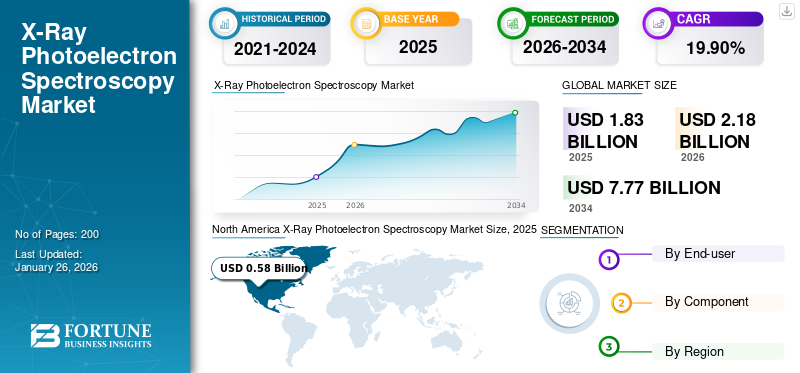
The global X-ray photoelectron spectroscopy market size was valued at USD 1.83 billion in 2025 and is projected to grow from USD 2.18 billion in 2026 to USD 7.77 billion by 2034, exhibiting a CAGR of 19.90% during the forecast period. North America dominated the x-ray photoelectron spectroscopy market with a market share of 6.81% in 2025.
X-Ray Photoelectron Spectroscopy (XPS) or Electron Spectroscopy for Chemical Analysis (ESCA) is a surface-sensitive analytical technique and tool that has increasingly taken center stage in the process spectroscopy market. Its use is propelled by its singular advantage of both quantitative elemental composition and chemical state information of the outermost atomic layers of materials. This paper delves into the driver behind the use of X-ray photoelectron spectroscopy, its process spectroscopy applications, as well as the hurdles, and where it is headed.
X-ray photoelectron spectroscopy is the photoelectric effect, where a sample is irradiated with monochromatic X-rays and results in photoejection of electrons. Their kinetic energies are measured to find their binding energies, which give information regarding the elements, their chemical state, and electronic structure. X-ray photoelectron spectroscopy is extremely efficient for the analysis of the surface up to 10 nm deep, and hence it cannot be avoided in surface chemistry and the determination of the material interface.
Download Free sample to learn more about this report.
X-Ray Photoelectron Spectroscopy Market Key Takeaways
 Global Market Size & Forecast
- 2025 Market Size: USD 1.83 billion
- 2026 Market Size: USD 2.18 billion
- 2034 Forecast Market Size: USD 7.77 billion
- CAGR: 19.90% from 2026–2034
 Market Share
- North America dominated the X-ray photoelectron spectroscopy market with a market share of 6.81% in 2025.
- The food and beverages segment accounted for a dominating X-ray photoelectron spectroscopy market share in 2025.
- The hardware segment accounted for the dominating market share in 2025.
 Key Regional Highlights
North America
The region generated USD 0.58 billion in 2025 and is projected to reach USD 0.70 billion in 2026, supported by strong healthcare infrastructure, R&D investments, and growing industrial adoption.
Europe
The market reached USD 0.55 billion in 2025 and is expected to grow to USD 0.66 billion in 2026, driven by government investments and the presence of leading industry participants.
Asia Pacific
Valued at USD 0.48 billion in 2025 and projected to reach USD 0.57 billion in 2026, the region is expected to witness the fastest growth due to increasing adoption across healthcare, biotechnology, manufacturing, and pharmaceuticals.
U.S.
The country continues to lead the North American market, supported by advanced healthcare infrastructure, high research spending, and increasing adoption of X-ray spectroscopy across medical and industrial applications.
Japan
The market is expected to benefit from increasing use of advanced analytical technologies in electronics, materials science, and healthcare research, supporting steady regional growth.
Read More

MARKET DYNAMICS
MARKET DRIVERS
Rising Demand for High-Performance Materials to Lead to Substantial Growth
The developing request for high-performance materials is playing a noteworthy part in the advancement of X-ray spectroscopy, especially since it has the capacity to supply comprehensive data on material properties and behaviors. With businesses still endeavoring to develop materials to incorporate connected materials in gadgets, energy storage, and catalysis, precise characterization procedures are most extreme need. X-ray spectroscopy methods, such as X-ray photoelectron spectroscopy (XPS) and X-ray absorption spectroscopy (XAS), empower analysts to test the electronic structure, chemical state, and surface properties of materials at the atomic level. Such capability is basic within the advancement of modern materials such as metal-organic systems (MOFs) and nanomaterials, which require redress understanding for viable utilize.
Besides, the integration of X-ray spectroscopy with emerging technologies, e.g., machine learning and ultrafast strategies, upgrades its explanatory control and flexibility. These propels encourage real-time perception of chemical responses and material elements and allow optimization of high-performance materials in various applications, including renewable energy and environmental science. With industries increasingly centering around execution and effectiveness in the production of materials, X-ray spectroscopy will play a significant role in meeting these demands by giving the key information that informs design and production.
MARKET RESTRAINTS
Regulatory Compliance to Limit Market Expansion
Regulatory controls will lead to a drop in the market of X-ray spectroscopy due to compliance with strict regulatory and safety requirements. Directives such as the EU directive 2013/59/Euratom have stringent safety provisions when it comes to the use of X-ray technology, including stringent licensing, registration, and notification from producers and users. These requirements are barriers to new firm entry and operational obstacles for existing firms, with attendant extra costs and operational hold-ups. National requirements for manufacturers must also be met, a vast number that varies extensively across locations and that add complexity to the system. The necessity for specialized people to administer compliance and safety processes is another complexity trait. These limitations have the potential to suppress investment and research in X-ray spectroscopy technology, eventually keeping the market size in check as companies will utilize less regulated alternatives or discontinue the use of X-ray practices.
MARKET OPPORTUNITIES
A Combination of AI Integration and Implementation of Hybrid Techniques is Expected to Positively Impact Market Growth
The synergy of hybrid methods and artificial intelligence (AI) in X-ray spectroscopy is revolutionizing the paradigm for the discipline. AI algorithms enable improved interpretation of X-rays with the ability for fast and consistent interpretation, saving considerable diagnostic time. AI software can identify infinitesimal abnormalities to which the human eye may not pay attention, enhancing diagnosis efficiency and accuracy.
Furthermore, integrating X-ray spectroscopy with other imaging techniques such as computed tomography (CT) or magnetic resonance imaging (MRI) makes up hybrid imaging modalities offering all-around data regarding the tissue function and anatomy. Multimodal imaging extends the depth of insight into intricate biology and disease and translates into enhanced patient care. With more use of data-informed health choices, AI-hybrid solutions for X-ray spectroscopy are poised to revolutionize medical imaging to render it quicker, more precise, and accessible to diagnose and track disease.
X-RAY PHOTOELECTRON SPECTROSCOPY MARKET TRENDS
Technological Trends and Miniaturization are Expected to Impact Market Growth Positively
Various technological trends, such as the integration of AI, XI, IOT, and ML, are marked by advancements that enhance the capability and further application of the analytical instrument. Recently, there has been a surge in the development of high-resolution X-ray photoelectron spectroscopy systems, which improve the sensitivity and accuracy of surface analysis, allowing scientists to detect slight alterations in electronic structures and chemical states. In addition, the incorporation of automated data analysis software driven by artificial intelligence (AI) and machine learning (ML) is making it simpler to interpret complex spectra, which enables quicker and more precise results. Miniaturization of XPS instruments is also important since it makes them easy for in-house laboratory use and for in-field use, thus expanding their range of applications.
Additionally, advances in sample preparation techniques, such as in situ analysis, are enabling real-time monitoring of surface reactions, which is deemed important to materials science and semiconductor manufacturing industries. Enhanced imaging instruments, such as spatially resolved XPS, are providing comprehensive insights into heterogeneous materials.
- North America witnessed x-ray photoelectron spectroscopy market growth from USD 0.79 Billion in 2023 to USD 1.01 Billion in 2024.
Overall, these technologies are driving the growth of the XPS market by broadening its uses in other industries such as nanotechnology, electronics, and pharmaceuticals, and improving the efficiency and quality of material characterization.
MARKET CHALLENGES
High Cost is Expected to Negatively Impact Market Growth
The X-ray photoelectron spectroscopy market growth is hindered by many challenges that restrict its use across all sectors. The highest challenge is in the expenditures on X-ray photoelectron spectroscopy machines and upkeep, which serve as a barrier to small research centers and laboratories. The cost prevents the purchase of advanced analyzing machines, particularly in developing nations where budgetary levels are tight.
The technology nature of XPS equipment requires technical expertise and training, which is a hindrance for businesses to integrate this technology into their day-to-day work. Further, the lengthy sample preparation and analysis time can be a hindrance to the level of productivity, especially in high-speed industrial settings. Some of the concerns include the risk of competition from some other surface analysis techniques, such as secondary ion mass spectrometry (SIMS) and atomic force microscopy (AFM), that could provide results sooner or cheaper.
Download Free sample to learn more about this report.
Segmentation Analysis
By End-User
Stringent Regulations for Food Security Fueled Food & Beverages Segment Expansion
Based on end-user, the market is classified into food & beverages, agriculture, healthcare, manufacturing, oil & gas, chemical, and others.
The food and beverages segment accounted for a dominating X-ray photoelectron spectroscopy market share and is expected to grow at the highest CAGR in the forthcoming years. The advancement of X-ray spectroscopy within the food and beverage industry is driven by stricter food safety regulations. Product integrity is ensured through the application of X-ray inspection systems that distinguish foreign material such as metal, glass, and bone particles without debasing the food. The non-destructive test procedure is foremost in guaranteeing quality control and avoiding costly reviews. In addition, demand growth for food and beverage items that are packaged and processed calls for proficient inspection technology to meet worldwide food safety standards.
The healthcare segment is expected to witness steady growth over the forecast period. X-ray spectroscopy is on the rise since it plays a very critical role in the determination of medical device and drug delivery system biocompatibility and surface interactions. Medical research needs, along with a few medication mistakes and safer drugs, play a very critical role in boosting market growth. X-ray photoelectron spectroscopy offers accurate material elemental composition analysis and chemical states, which play a crucial role in advancing health science technology
By Component
Emergence of Advanced Hardware Fostered Segment Expansion
Based on component, the market is divided into hardware and software.
The hardware segment accounted for the dominating market share in 2025 and is expected to grow at the highest CAGR in the forthcoming years. Advancement of X-ray spectroscopy in hardware is fundamentally driven by improvements in detector technology and the advancement of compact, high-performance systems. Advancements such as flat-panel detectors and direct conversion systems have improved image quality while minimizing radiation dose, making the X-ray frameworks more productive and safer for the patient. Furthermore, the accessibility of portable X-ray medical devices for on-site use increases accessibility for numerous applications in areas such as medication and materials research.
The software segment will continue to account for a considerable share of the market. The availability of easy-to-use interfaces to complex analysis renders advanced analysis possible for a wider variety of users. With industries increasingly using insights based on data, the requirement for sophisticated software solutions in X-ray spectroscopy is likely to keep growing, driving market growth.
X-Ray Photoelectron Spectroscopy Market Regional Outlook
By region, the market is categorized into North America, Europe, Asia Pacific, and the Rest of the World.
North America
North America X-Ray Photoelectron Spectroscopy Market Size, 2025 (USD Billion)
To get more information on the regional analysis of this market, Download Free sample
North America dominates the global market share. In 2025, North America held 6.81% of the global market share, reaching a valuation of USD 0.58 billion, and is projected to grow to USD 0.7 billion in 2026. The development of X-ray spectroscopy in North America is driven by a strong healthcare framework and rising instances of chronic illnesses, such as cancer. The growing use of technologies across all businesses, combined with high investments in research and development, particularly within the manufacturing and healthcare industries, also fuels market development. Besides, the accessibility of large manufacturing industries and the introduction of new solutions are factors that drive North American dominance within the market.
Europe
The market in Europe reached USD 0.55 billion in 2025, representing 7.48% of total market revenue, and is projected to reach USD 0.66 billion in 2026. Europe is the second-largest market for X-ray photoelectron spectroscopy. The prevalence of major players and rising investments from the government in the region will fuel market growth in the forthcoming years.
Asia Pacific
Asia Pacific contributed approximately USD 0.48 billion to the global market in 2025, accounting for 7.49% share, and is expected to reach USD 0.57 billion in 2026. Asia Pacific is projected to be the fastest-growing region with a high CAGR over the forecast period. Increasing number of patients, and rising adoption in key sectors such as healthcare, biotechnology, manufacturing, and pharmaceuticals, is expected to boost market growth in the region. Additionally, countries such as China and India are heavily using X-ray spectroscopy in various applications such as quality control, medical science, etc.
Rest of the World
The Rest of the World market accounted for USD 0.22 billion in 2025, representing 6.15% of the global industry, and is expected to reach USD 0.25 billion in 2026. The market in the rest of the world region is expected to witness considerable growth in the near future. The increasing number of research institutes across the region is expected to lead to a substantial growth of the market in the forthcoming years.
COMPETITIVE LANDSCAPE
Key Industry Players
Continuous Development and Introduction of New Products by Key Companies Resulted in their Dominating Positions in the Market
The competitive landscape of the X-ray spectroscopy market is characterized by a diverse bunch of key players, technological advancements and progressions, and strategic initiatives aimed at enhancing product offerings. Major companies operating in the market, such as Thermo Fisher Scientific Inc., Bruker, and Horiba, dominate the market, leveraging their broad research capabilities and emerging technologies to create progressed X-ray frameworks. Thermo Fisher, for instance, has made significant strides with its Nexsa Surface Analysis System, which integrates different analytical methods to improve workflow proficiency.
The market is additionally seeing expanded competition as manufacturers focus on creating convenient and miniaturized X-ray spectrometers to meet the growing demand for field applications in businesses such as environmental monitoring and healthcare. Furthermore, the integration of artificial intelligence (AI) in data examination is becoming a trend, allowing for faster and more accurate interpretation of spectral data.
LIST OF KEY X-RAY PHOTOELECTRON SPECTROSCOPY COMPANIES PROFILED
- Bruker (U.S.)
- HORIBA Scientific (Japan)
- Thermo Fisher Scientific (U.S.)
- SPECTRO Analytical (Germany)
- Shimadzu Corporation (Japan)
- Amptek (U.S.)
- Kratos Analytical (U.K.)
- Excillum (Sweden)
- EasyXAFS (U.S.)
- Fluxana GmbH & Co. KG (Germany)
KEY INDUSTRY DEVELOPMENTS
- October 2024: Tonix Pharmaceuticals Holding Corp., a fully integrated biopharmaceutical company with marketed products and a pipeline of development candidates, declared that it has entered into an AI and ML research collaboration with X-Chem, Inc. (X-Chem), a pioneer in small molecule drug discovery, to quicken the advancement of Tonix's oral broad-spectrum antivirals.
- September 2024: X-ray imaging and spectroscopy mission unveiled the surroundings of a black hole and supernova. Astronomers showcased the first evident scientific results from the X-ray telescope using X-ray Photoelectron spectroscopy.
- July 2024: Investigators at NASA's Marshall Space Flight Center in Huntsville, Alabama, announced to use observations from a recently-launched sounding rocket mission to supply a clearer picture of how and why the sun's corona develops so much hotter than the visible surface of Earth's parent star. The MaGIXS-2 mission—short for the second flight of the Marshall Grazing Rate X-ray Spectrometer—launched from White Sands Missile Range in New Mexico.
- January 2024: Indian Space Research Organisation (ISRO) announced that it is planning a New Year's launch, which can launch its X-Ray Polarimeter Satellite into space on a Polar Satellite Launch Vehicle (PSLV) rocket on Monday (1 January), as cited by the Indian Express.
REPORT COVERAGE
The global X Ray Spectroscopy market analysis provides market size & forecast by all the segments included in the report. It includes details on the market dynamics and market trends expected to drive the market in the forecast period. It offers information on the prevalence of malocclusion in key regions/countries, key industry developments, new product launches, details on partnerships, mergers & acquisitions, and the number of OEMs in key countries. The report covers a detailed competitive landscape with information on the market share and profiles of key players in the X-ray photoelectron spectroscopy market.
Request for Customization to gain extensive market insights.
Report Scope & Segmentation
|
ATTRIBUTE |
DETAILS |
|
Study Period |
2021-2034 |
|
Base Year |
2025 |
|
Estimated Year |
2026 |
|
Forecast Period |
2026-2034 |
|
Historical Period |
2021-2024 |
|
Growth Rate |
CAGR of 19.90% By End-user, Component, and Region4% from 2026-2034 |
|
Unit |
Value (USD Billion) |
|
Segmentation |
By End-user
|
|
By Component
|
|
|
By Region
|
Frequently Asked Questions
Fortune Business Insights says that the global market value stood at USD 2.18 billion in 2025 and is projected to reach USD 7.77 billion by 2034.
In 2025, the market value in North America stood at USD 0.58 billion.
The market is expected to exhibit a CAGR of 19.90% during the forecast period of 2026-2034.
The hardware segment led the market by component.
Rising demand for high-performance materials boosts market growth.
Major companies operating in the market, such as Thermo Fisher Scientific Inc., Bruker, and Horiba, dominate the market.
North America dominated the market in 2025.



- 2021-2034
- 2025
- 2021-2024
- 200
Get 30-60 hrs Free Customization
Expand Regional and Country Coverage, Segments Analysis, Company Profiles, Competitive Benchmarking, and End-user Insights.




















Related Reports
-
US +1 833 909 2966 ( Toll Free )
-
Get In Touch With Us