Xylose Market Size, Share, and Industry Analysis by Type (D-Xylose and L-Xylose), by Form (Powder and Liquid), by End-Use (Food & Beverage Industry, Pharmaceuticals Industry, Animal Feed Industry, Cosmetics & Personal Care Industry and Others), and Regional Forecast, 2026-2034
 Download Free Sample
(Offer valid till 15th Oct 2026)

Xylose Market Size and Future Outlook
 Listen to Audio Version
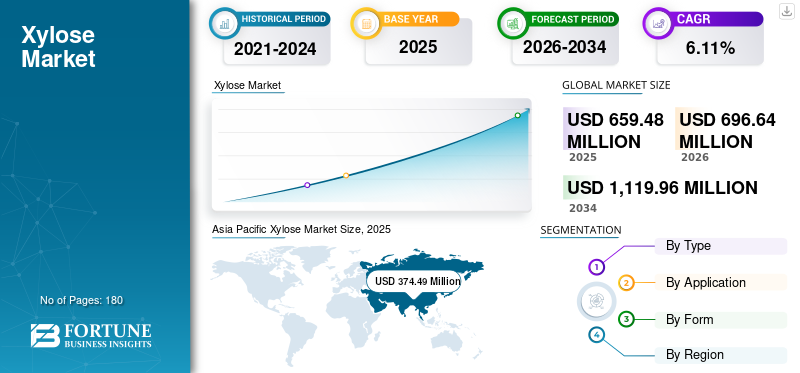
The global xylose market size was valued at USD 659.48 million in 2025. The market is projected to grow from USD 696.64 million in 2026 to USD 1,119.96 million by 2034, exhibiting a CAGR of 6.11% during the forecast period. Asia Pacific dominated the xylose market with a market share of 56.83% in 2025.
Xylose is a simple sugar found naturally in plants, especially in materials such as corn cobs, hardwood, and leftover crops. It is commonly used to produce xylitol, medicines, food additives, and other chemicals derived from natural sources. Xylose is also vital in biotechnology and fermentation, where it helps produce biofuels and special chemicals. More people are choosing plant-based ingredients, and new methods for turning plants into useful products are driving the market growth. Growing consumer preference for natural ingredients is increasing demand for plant-derived sweeteners such as xylose.
Companies such as Roquette Frères, Shandong Futaste Co., Ltd., Zhejiang Huakang Pharmaceutical Co., Ltd., and others are some of the key players operating in this market. Production innovation is one of the key strategies boosting product sales and supporting market growth.
Download Free sample to learn more about this report.
Xylose Market Key Takeaways
 Market Size & Forecast
- 2025 Market Size: USD 659.48 million
- 2026 Market Size: USD 696.64 million
- 2034 Forecast Market Size: USD 1,119.96 million
- CAGR: 6.11% from 2026–2034
 Market Share
- Asia Pacific dominated the xylose market with a 56.83% share in 2025.
- The D-Xylose segment accounted for the largest market share in 2025.
- The food & beverage segment held the leading application share in 2025.
 Key Regional Highlights
Asia Pacific
Asia Pacific generated USD 374.79 million in 2025 and remained the largest regional market, supported by strong food and pharmaceutical demand.
Europe
Europe reached USD 132.78 million in 2025, driven by growing adoption of sustainable and bio-based ingredients.
North America
North America accounted for USD 84.23 million in 2025, supported by biotechnology advancements and demand for natural sweeteners.
U.S.
The xylose market reached USD 73.27 million in 2025, driven by strong biotechnology research and increasing use of plant-based sweeteners.
Japan
The xylose market reached USD 42.05 million in 2025, supported by rising consumer demand for low-calorie and natural ingredients.
Read More

XYLOSE MARKET TRENDS
Advancements in Biorefinery Technologies and Sustainable Ingredients is a Key Market Trend
Several new trends are shaping the market as biotechnology advances, sustainable ingredients become more important, and demand for plant-based raw materials grows. A major trend is the increased use of biorefinery technologies that convert materials such as corn cobs, hardwood, and farm leftovers into valuable chemicals. Another important trend is the growing production of xylitol and other sugar alcohols from xylose, which helps meet the rising demand for low-calorie sweeteners in foods, drinks, and oral care products. Companies are also investing in microbial fermentation and enzyme-based methods to improve the conversion of xylose into biofuels, organic acids, and specialty chemicals.
MARKET DYNAMICS
MARKET DRIVERS
Rising Demand for Natural Sweeteners and Bio-Based Ingredients to Drive Market Growth
The demand for natural sweeteners and bio-based ingredients across various industries is the main driver of xylose market growth. Xylose is an important ingredient in the production of xylitol, a popular low-calorie sugar substitute used in sugar-free candy, chewing gum, drinks, and oral care products. As consumer concerns about diseases such as obesity and diabetes grow, food companies are turning to alternative sweeteners, boosting the demand for xylose. The growth of the food and beverage industry, along with rising interest in functional and reduced-sugar products, is also driving market expansion. Xylose is becoming more important in biotechnology and bio-refineries, where it is used in fermentation to make biofuels, organic acids, and specialty chemicals. Therefore, the market growth is supported by expanding applications in sweeteners, pharmaceuticals, and biotechnology industries.
MARKET RESTRAINTS
Complex Biomass Processing and High Production Costs Limiting Large-Scale Market Expansion
The market is negatively impacted by high production costs and the complicated process of extracting and processing biomass. Xylose usually comes from lignocellulosic biomass such as corn cobs, hardwood, and agricultural byproducts. Making xylose from these sources involves several industrial steps, such as hydrolysis, purification, and crystallization. These steps often require a lot of energy and advanced technology, making xylose more expensive to produce than regular sugar. These factors impact adoption and slow down the market growth.
MARKET OPPORTUNITIES
Expanding Bio-Based Chemical Production Create New Opportunities in Market
The xylose market is growing as more industries seek sustainable, bio-based chemicals and new biotechnology applications. As more industries turn to renewable materials, xylose from plant biomass is becoming a key ingredient for biofuels, organic acids, bioplastics, and specialty chemicals. New developments in biotechnology and fermentation are making it easier to turn xylose into valuable bio-based products, opening up more business opportunities. Emerging economies are also investing in biorefinery infrastructure and biomass utilization technologies to increase xylose production capacity.
Download Free sample to learn more about this report.
Segmentation Analysis
By Type
Extensive Use in Xylitol Production and Biotechnology Drives Dominance of D-Xylose Segment
By type, the market is segmented into D-Xylose and L-Xylose.
The D-Xylose segment led the global market in 2025. D-Xylose is widely used in industry as a key ingredient in the production of xylitol and other bio-based chemicals. It is mostly made from plant materials such as corn cobs and hardwood waste, making it easy to obtain and affordable for large-scale production. D-xylose is also used in food processing, medicine, and biotechnology, including diagnostic tests and fermentation.
L-Xylose segment is expected to grow at a CAGR of 5.28% during the forecast period. L-Xylose is increasingly used in specialty foods and as a functional ingredient. It is also used in some pharmaceutical and biotechnology products due to its unique chemical properties.
By Application
Rising Demand for Low-Calorie Sweeteners in Foods Driving Food & Beverages Segment Growth
By application, the market is segmented into food & beverage, pharmaceuticals, animal feed, cosmetics and personal care and others.
The food & beverage segment dominated with the largest xylose market share in 2025. Xylose is an important ingredient in the production of xylitol, which is often added to chewing gum, candy, baked goods, and drinks, offering added health benefits. The growing use of xylose in food products is driving demand for natural sugar alternatives. As people become more conscious about health issues and the risks of eating too much sugar, food companies are adding more natural sugar substitutes to their products. The growth of functional foods and consumer health consciousness also helps make food & beverages the primary application for xylose.
Pharmaceuticals segment accounted for the second largest market share in 2025 and is expected to register a CAGR of 5.97% during the forecast period. Xylose is widely used in drug formulations, diagnostic tests, and the manufacture of pharmaceutical intermediates. Xylose is often used in the D-xylose absorption test to help diagnose intestinal absorption problems. As the global pharmaceutical industry grows and research into bio-based ingredients increases, xylose is gaining traction in drug development and medical diagnostics.
To know how our report can help streamline your business, Speak to Analyst
By Form
Longer Shelf Life and Easier Industrial Handling Driving Dominance of Powdered Xylose Form
By form, the market is segmented into powder and liquid.
The powder form segment led the global market in 2025. Powdered xylose is the most popular type as it lasts longer, is easy to store, and can be used in many industrial settings. Food, pharmaceutical, and biotechnology companies often choose the powder form as it is easier to handle, use, and incorporate into various products. Powdered xylose can be measured accurately during production and mixes well with other dry or solid ingredients.
Liquid segment accounted for the second largest market share in 2025 and is expected to register a CAGR of 6.40% during the forecast period. Liquid xylose is well-suited for biotechnological fermentation and industrial chemical applications. The liquid form is easier to add to fermentation systems used to produce biofuels, organic acids, and specialty chemicals. It also reduces the need for additional dissolution steps during industrial processing, improving operational efficiency.
Xylose Market Regional Outlook
By geography, the market is categorized into Europe, North America, Asia Pacific, South America, and the Middle East & Africa.
Asia Pacific
Asia Pacific Xylose Market Size, 2025 (USD Million)
To get more information on the regional analysis of this market, Download Free sample
Asia Pacific dominated the market with a valuation of USD 374.79 million in 2025. The region leads the market as China produces it on a large scale, and there is strong demand from the region’s food and pharmaceutical industries. Japan and South Korea also contribute to the region’s demand, driven by their advanced food processing and oral care industries. More people are becoming health-conscious, opting for sugar substitutes, and the pharmaceutical industry is growing. These trends are helping the market expand. Investments in new biomass processing technologies are also making the Asia Pacific an evolving production center.
India Xylose Market
The Indian market in 2025 was valued around USD 22.57 million, accounting for roughly 3.42% of global market revenues.
China Xylose Market
China’s market in 2025 was valued at around USD 220.85 million, representing roughly 33.49% of the global market share. China leads the market as it can produce large quantities and has ample agricultural raw materials, such as corn cobs. China is a leading producer and exporter of xylose and xylitol, supplying these products to the food, pharmaceutical, and personal care industries worldwide. Chinese manufacturers benefit from low production costs, advanced processing facilities, and reliable supply chains, which enable them to produce at a larger scale. Rising demand in China for low-calorie sweeteners, functional foods, and oral care products is also driving market growth.
Japan Xylose Market
The Japanese market in 2025 reached a valuation of around USD 42.05 million, accounting for roughly 6.38% of global market revenues. Rising consumer health awareness is increasing demand for natural and low-calorie ingredients such as xylose.
North America
The market in North America reached a valuation of USD 84.23 million in 2025. Strong demand from the food, pharmaceutical, and biotechnology industries is fueling growth in the North American market. The U.S. leads the market owing to its advanced biotechnology and bio-refinery research, which focuses on turning lignocellulosic biomass into bio-based chemicals and sweeteners. The region also has ample agricultural biomass, such as corn residues, which helps ensure a steady, sustainable supply of raw materials. Ongoing investments in industrial biotechnology and bio-based chemical production are likely to drive further market growth in North America.
U.S. Xylose Market
In 2025, the U.S. market reached USD 73.27 million. The U.S. market is growing due to the strong biotechnology industry and rising interest in plant-based sweeteners and bio-based chemicals. Research centers and biotech companies are developing fermentation methods to convert xylose into biofuels, specialty chemicals, and valuable ingredients. More people are seeking natural, low-calorie sweeteners, boosting demand for xylose-based products like xylitol in foods, drinks, and oral care products. The U.S. also has rich agricultural resources that provide lignocellulosic biomass for production. Ongoing investment in sustainable biorefinery technology and industrial biotech research is expected to help the market grow in the future.
Europe
The European market reached a valuation of USD 132.78 million in 2025. The growth of this region is driven by strong regulations that support sustainable chemicals and bio-based ingredients. The region’s established food processing, pharmaceutical, and personal care industries create steady demand for xylose derivatives, such as xylitol. Countries such as Germany, France, and Finland are investing in biorefinery technologies that turn agricultural and forestry residues into valuable chemicals. More European consumers now prefer natural and low-calorie sweeteners, which encourages manufacturers to use xylose-based ingredients in food and oral care products. Government programs that promote circular-economy practices and the sustainable use of biomass also support the market growth across Europe.
Germany Xylose Market
The German market reached around USD 28.89 million in 2025, representing roughly 4.38% of global market revenues. Germany is a leading European market due to the high demand for sustainable ingredients and bio-based chemical production. The country has a strong biotechnology sector and modern industrial facilities for processing biomass and using fermentation technologies.
U.K. Xylose Market
The U.K. market reached approximately USD 19.28 million in 2025, equivalent to around 2.92% of global market sales. The U.K. market is expanding as more consumers seek natural sweeteners and ingredients with health benefits. As people become more aware of health issues and the risks of consuming too much sugar, they are increasingly choosing plant-based alternative sweeteners.
South America and Middle East & Africa
Over the forecast period, South America is expected to experience significant growth in this market. The South America market in 2025 recorded USD 43.21 million. The market in South America is slowly growing, due to the region’s large agricultural industry and rising interest in bio-based chemicals. Brazil and Argentina produce large amounts of agricultural waste, such as corn and sugarcane by-products, which can be used to extract xylose. Although still developing, the availability of raw materials and growing industrial applications are expected to support long-term market growth. Middle East & Africa region reached a valuation of USD 24.47 million in 2025. The market in the Middle East & Africa is still in its early stages, but it is slowly growing as more people want specialty food ingredients and functional sweeteners. The growing pharmaceutical and food processing industries, especially in countries such as the UAE and South Africa, are driving demand. As interest in sustainable ingredients increases, the regional market is expected to grow steadily. Growing demand for xylose is driven by its expanding use in sweeteners, pharmaceuticals, and bio-based chemical production.
UAE Xylose Market
UAE market is set to grow at a CAGR of 5.43% during the forecast period. The UAE market is slowly growing as more people in the region seek specialty food ingredients and functional sweeteners. The UAE is a key center for distributing food ingredients and specialty chemicals in the Middle East, helping import and share xylose and related products in the region.
COMPETITIVE LANDSCAPE
Key Industry Players
Growing Demand for Natural Sweeteners and Bio-Based Chemicals Intensifying Competition in Market
The xylose market is semi consolidated with most major manufacturers based in China and Europe, where there are plenty of agricultural byproducts, such as corn cobs and hardwood. Companies are trying to differentiate their products by improving production, efficiency, and boosting their ability to produce xylitol and other sugar alcohols on a large scale. Many producers also manage the entire supply chain of xylose, helping them control costs and maintain a steady supply. Companies are also investing in new biorefinery technologies and greener methods to convert biomass into useful products. This supports new uses in biofuels, medicine, and specialty chemicals.
LIST OF KEY XYLOSE COMPANIES PROFILED
- Roquette Frères (France)
- Shandong Futaste Co., Ltd. (China)
- Zhejiang Huakang Pharmaceutical Co., Ltd. (China)
- Gulshan Polyols Ltd. (India)
- Danisco A/S (Demark)
- zuChem Inc. (U.S.)
- NovaGreen Inc. (U.S.)
- Danish Bio Commodities A/S (U.S.)
- Jungbunzlauer Suisse AG (Switzerland)
- Shaanxi Sciphar Natural Products Co., Ltd. (China)
KEY INDUSTRY DEVELOPMENTS
- March 2022: Roquette Frères, a producer of plant-based ingredients, invested USD 27 million to boost liquid and powder polyol production at its site in Northern France. The investment made the equipment more efficient and raised safety standards. It also helped standardise some industrial operations, leading to better overall production performance.
REPORT COVERAGE
The global xylose market research provides an in-depth study of market size and forecast for all the market segments included in the report. The market forecast includes details on the market dynamics and trends expected to drive the market during the forecast period. It offers information on the technological advancements, new product launches, Porter’s Five Forces Analysis, key industry developments, and details on partnerships, mergers, and acquisitions. The industry also encompasses detailed competitive landscape with information on the market segmentation, market share and profiles of key operating players.
Request for Customization to gain extensive market insights.
Report Scope & Segmentation
| ATTRIBUTE | DETAILS |
| Study Period | 2021-2034 |
| Base Year | 2025 |
| Estimated Year | 2026 |
| Forecast Period | 2026-2034 |
| Historical Period | 2021-2024 |
| Growth Rate | CAGR of 6.11% from 2026-2034 |
| Unit | Value (USD Million) |
| Segmentation | By Type, By Application, By Form and Region |
| By Type |
|
| By Application |
|
| By Form |
|
| By Region |
|
Frequently Asked Questions
Fortune Business Insights says that the global market value stood at USD 659.48 million in 2025 and is projected to reach USD 1,119.96 million by 2034.
In 2025, the Asia Pacifics market value stood at USD 374.79 million.
The market is expected to exhibit a CAGR of 6.11% during the forecast period.
By application, food and beverages segment led the global market in 2025.
Rising demand for natural sweeteners and bio-based ingredients are the key factors driving the market.
Roquette Freres, Shandong Futaste Co., Ltd., and Zhejiang Huakang Pharmaceutical Co., Ltd. are a few of the players in the market.
Asia Pacific held the largest market share in 2025.
Advancements in biorefinery technologies and sustainable ingredients are the major market trend.



- 2021-2034
- 2025
- 2021-2024
- 180
-
(Offer valid till 15th Oct 2026)
Get 30-60 hrs Free Customization
Expand Regional and Country Coverage, Segments Analysis, Company Profiles, Competitive Benchmarking, and End-user Insights.

















Related Reports
-
US +1 833 909 2966 ( Toll Free )
-
Get In Touch With Us