3D Printed Jewelry Market Size, Share & Industry Analysis, By Type (Necklace, Ring, Bracelet, Earrings, and Others), By End-user (Men and Women), By Distribution Channel (Supermarket/Hypermarket, Specialty Store, Online, and Others), and Regional Forecast, 2026-2034
 Download Free Sample
(Offer valid till 15th Oct 2026)

KEY MARKET INSIGHTS
 Listen to Audio Version
The global 3D printed jewelry market size was valued at USD 870.00 million in 2025 and is projected to grow from USD 980.00 million in 2026 to USD 3,090.02 million by 2034, exhibiting a CAGR of 15.42% during the forecast period. North America dominated the 3D printed jewelry market with a market share of 50.21% in 2024.
Consumers increasingly demand unique and bespoke jewelry pieces. 3D printing technology enables the creation of intricate and tailored designs as per the consumer’s preferences, thereby boosting the growth of the 3D printed jewelry market. Gold, silver, brass, bronze, polyamide wax, and alumide are the commonly used materials in 3D printing. In this respect, material innovation positively influences the global market.
Key players, such as Imaginarium, Mirakin, OLA Jewelry, Diana Law Printed Accessories, and Boltenstern, emphasize innovation and the rapid introduction of new designs to stay aligned with evolving market trends. They also focus on offering user-friendly platforms for consumers to design and order personalized jewelry, blending 3D printing, which will fuel the global market growth during the forecast period.
For instance, according to the Government of India, per capita disposable income grew by ~8% in FY 2024 and by ~13% in FY 2023.
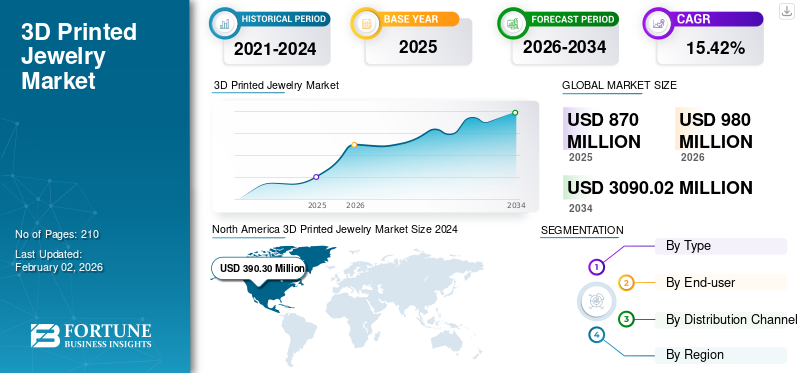
Download Free sample to learn more about this report.
3D Printed Jewelry Market Key Takeaways
 Global Market Size & Forecast
- 2025 Market Size: USD 870.00 million
- 2026 Market Size: USD 980.00 million
- 2034 Forecast Market Size: USD 3,090.02 million
- CAGR: 15.42% from 2026-2034
 Market Share
- North America dominated the 3D printed jewelry market with a 50.21% share in 2024.
- The women segment accounted for the largest market share.
- The earrings segment is projected to be the second fastest-growing segment.
 Key Regional Highlights
North America
North America dominated the global market, supported by strong consumer demand and advanced 3D printing adoption.
Asia Pacific
Asia Pacific is expected to emerge as the fastest-growing regional market, led by China, Japan, and India.
Europe
Europe remained the second-largest regional market for 3D printed jewelry.
U.S.
A mature e-commerce infrastructure is supporting online customization, virtual try-ons, and direct customer engagement.
Japan
Rising adoption of advanced manufacturing technologies is supporting growth in the 3D printed jewelry market.
Read More

Market Dynamics
Market Drivers
Growing Demand for Customized Jewelry Pieces to Boost Segment Growth
Modern consumers, particularly millennials and Gen Z, increasingly seek jewelry that reflects their personal style and identity. The desire for unique, bespoke pieces over mass-produced items and regular pieces is fueling robust demand for customization in the 3D printing jewelry segment. Moreover, innovations such as 3D printing and online customization platforms have made it easier and more cost-effective for both brands and consumers to design and produce bespoke jewelry pieces. These advancements are expected to drive the global 3D printed jewelry industry.
Market Restraints
High Costs of 3D Printed Jewelry to Restrict Market Growth
The high cost of 3D printing materials and related supplies could make up a significant portion of overall expenses. High equipment and material costs can make it challenging for businesses to scale operations or experiment with new designs. Furthermore, running a 3D printing jewelry business involves recurring expenses such as materials, packaging, shipping, marketing, utilities, and customer support. As a result, these cost factors could restrict the broader adoption of 3D printed jewelry, thereby hindering the global market expansion.
Market Opportunities
Fueling E-commerce Channels of Jewelry Brands to Expand Market Growth
E-commerce platforms empower jewelry brands and designers to reach a global customer base, overcoming geographical barriers. Online platforms allow customers to easily customize and personalize jewelry designs in real-time, leveraging 3D printing technology. This interactive experience is often unavailable in physical retail stores. By catering to the growing consumers’ demand for unique and trend-driven designs, e-commerce is playing a pivotal role in boosting the global 3D printed jewelry market growth.
3D Printed Jewelry Market Trends
Growing Demand for Sustainable Jewelry Products to Surge Market Growth
Many jewelry brands are adopting recycled metals and sustainable materials, which further lowers their carbon footprint. The ability to incorporate recycled precious metals into the production process enhances the sustainability profile of 3D-oriented jewelry products and differentiates them from traditional jewelry. Furthermore, the sustainable approach of 3D printing also enables jewelry designers to experiment with new forms and materials without raising their environmental footprint, thus attracting eco-conscious consumers and fostering the growth of the global 3D printed jewelry market in the near term.
Segmentation Analysis
By Type
Wide Usage of Rings for Occasional Purposes Drives Segment Growth
Based on type, the market is divided into necklace, ring, bracelet, earrings, and others.
The ring segment holds the major share of the market. Rings are deeply associated with major life events, such as engagement, weddings, anniversaries, and others. These emotional connections drive consistent, high-volume demand for customized rings. Additionally, rings are worn by all genders, expanding the potential customer base and boosting segment growth.
The earrings segment is projected to be the second fastest-growing segment in the market in the coming years. Earrings are often used as statement pieces and to complement other fashion accessories. Their versatility and ease of use make them a staple in everyday fashion. In addition, consumers are spending more on customized jewelry products, further surging segment growth.
By End-user
Increasing Disposable Income of Women Boosts Segment Growth
By end-user, the market is divided into men and women.
The women segment holds the largest share of the market. Jewelry has traditionally been associated with femininity, celebration, and self-expression. Women are drawn to jewelry for its ability to symbolize achievements and personal style. Moreover, increasing disposable income among women further contributes to the growth of the segment.
The men segment is also predicted to gain the fastest-growing share of the market. Men, particularly the younger generation, are becoming more fashion-conscious and influenced by social media trends. This has led to a surge in the demand for rings, bracelets, and necklaces, which are suitable for men, thus propelling segment growth.
By Distribution Channel
Growing Demand for Customized Jewelry Fostered Specialty Store Segment Growth
In terms of distribution channel, the global 3D printed jewelry market is segmented into supermarket/hypermarket, specialty store, online, and others.
The specialty store segment seized a dominant share of the market. Specialty stores employ staff with deep expertise in jewelry, enabling them to guide customers through the customization process and provide tailoring advice. This consultative approach is particularly valued for significant purchases, augmenting the growth of the segment.
The online segment is predicted to hold the fastest-growing share in the near term. Online platforms allow customers to design and order customized 3D orienting jewelry from anywhere, eliminating the need to visit physical stores. This convenience offers a flexible solution to busy consumers, thus propelling segment growth.
3D Printed Jewelry Market Regional Outlook
Based on region, the market is segmented into Europe, North America, Asia Pacific, South America, and the Middle East & Africa.
North America
North America 3D Printed Jewelry Market Size 2024 (USD Million)
To get more information on the regional analysis of this market, Download Free sample
North America dominated the market in 2024. The region benefits from a large, affluent customer base with a strong preference for luxury and unique jewelry products. This demographic is willing to pay a premium price for bespoke jewelry pieces. Furthermore, the region is also at the forefront of adopting advanced technologies for jewelry manufacturing, including 3D printing, further augmenting the regional growth.
The U.S. has a mature e-commerce infrastructure, supporting online customization, virtual try-ons, and direct engagement with customers. This has accelerated the adoption and sales of customized jewelry products within the country. Furthermore, leading brands invest heavily in marketing and product innovation, which also supports the growth of the 3D printing jewelry market in the near future.
Download Free sample to learn more about this report.
Europe
Europe is the second-largest region in the market. Countries such as the U.K, Germany, and France have a longstanding tradition of fine jewelry and artisanal craftsmanship, fostering the demand for personalized jewelry pieces. Major luxury jewelry brands are headquartered in the region, which further drives trends and innovation, contributing to sustained market growth during the projected period.
Asia Pacific
Led by China, Japan, and India, Asia Pacific is expected to emerge as the fastest-growing market in the near term. Economic growth and a burgeoning middle-class population in countries such as China, India, and Japan are increasing the number of customers who are able to afford personalized jewelry pieces. Furthermore, in many Asian countries, jewelry holds a deep cultural and social significance, particularly for weddings and festivals, driving the demand for 3D printed jewelry within the region.
South America and Middle East & Africa
South America and Middle East & Africa are expected to hold a considerable 3D printed jewelry market share. Rapid adoption of online retail channels and advanced manufacturing technologies is making customized jewelry more accessible in these regions. Additionally, urban residents in these regions are embracing global fashion trends, which also contribute to the overall growth of the market.
Competitive Landscape
Key Market Players
Key Players Incorporate Advanced Technologies to Surge Market Growth
Technological advancements in 3d printing technology have enabled manufacturers to produce intricate designs, complicated internal frameworks, and personalized designs that are challenging or unfeasible to accomplish with conventional manufacturing techniques. In recent years, key players have been increasingly adopting advanced digital workflows and advanced printing technologies to support mass customization, allowing customers to create bespoke jewelry pieces. This trend aligns with the growing demand for unique and one-of-a-kind jewelry, driving the growth of the market. Furthermore, emerging technologies include using artificial intelligence and machine learning are being used for design optimization and the creation of new materials and products. Therefore, these innovations are expanding the functionality and attraction of printed jewelry products, contributing to increased product consumption in the long run.
List of Key 3D Printed Jewelry Companies Profiled
- Imaginarium (India)
- Mirakin (U.K.)
- OLA Jewelry (Belgium)
- Boltenstern (Austria)
- 3D Systems, Inc. (India)
- RADIAN (U.S.)
- Materialise NV (Belgium)
- Stratasys (U.S.)
- JK3D (Austria)
- Platinum Guild International (Hong Kong)
Key Industry Developments
- June 2025: Nicky Hilton, an American fashion designer, launched a new personalized jewelry brand, ‘Theo Grace’.
- May 2025: Platinum Guild International (PGI) announced the launch of a 3D printed platinum jewelry collection, ‘Tùsaire Collection’, which included necklaces, bracelets, earrings, and rings.
- February 2025: JK3D launched a new collection of 3D printed earrings, ‘Coralea Series’, which comes in various sizes, including small, medium, and large.
- February 2025: MISHO, a luxury jewelry brand of India, launched a range of jewelry in Jaipur, covering earrings, necklaces, and others.
- September 2024: KAY Jewelers launched a new brand of jewelry for their next-generation consumers.
REPORT COVERAGE
The market research report provides a comprehensive analysis, focusing on key elements such as major companies, regional and market segments, competitive dynamics, types, end-users, and distribution channels. Additionally, it offers insights into market dynamics and highlights significant developments within the industry. Beyond these aspects, it also examines various factors contributing to market growth in recent years.
Request for Customization to gain extensive market insights.
Report Scope & Segmentation
|
ATTRIBUTE |
DETAILS |
|
Study Period |
2021-2034 |
|
Base Year |
2025 |
|
Estimated Year |
2026 |
|
Forecast Period |
2026-2034 |
|
Historical Period |
2021-2024 |
|
Growth Rate |
CAGR of 15.42% from 2026 to 2034 |
|
Unit |
Value (USD Million) |
|
Segmentation |
By Type
By End-user
By Distribution Channel
By Region
|
Frequently Asked Questions
Fortune Business Insights says that the global market size stood at USD 980 million in 2026 and is anticipated to record a valuation of USD 3,090.02 million by 2034.
Fortune Business Insights says that the global market value stood at USD 870 million in 2025.
The global market will exhibit a CAGR of 15.42% during the forecast period (2026-2034).
By type, the ring segment is dominating the market.
The growing demand for customized jewelry pieces is a key factor driving the global market growth.
Imaginarium, Mirakin, OLA Jewelry, and Boltenstern are some of the leading players in the market.
North America dominated the global market in 2024.



- 2021-2034
- 2025
- 2021-2024
- 210
-
(Offer valid till 15th Oct 2026)
Get 30-60 hrs Free Customization
Expand Regional and Country Coverage, Segments Analysis, Company Profiles, Competitive Benchmarking, and End-user Insights.


















Related Reports
-
US +1 833 909 2966 ( Toll Free )
-
Get In Touch With Us