 Download Free Sample



Get a Quote
Receive a tailored pricing based on your needs.
- Choose license type
- Multiple user options
- Custom scope & coverage
- Fast turnaround
"Designing Growth Strategies is in our DNA"
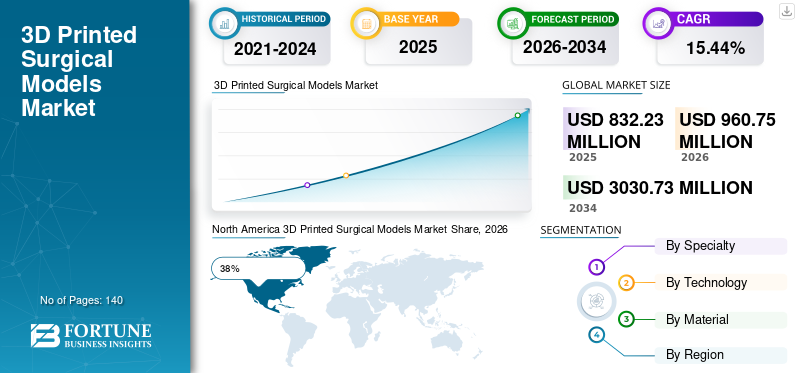
The 3D printed surgical models market size was valued at USD 832.23 Million in 2025. The market is projected to grow from USD 960.75 Million in 2026 to USD 3,030.73 Million by 2034, exhibiting a CAGR of 15.44% during the forecast period.

The 3D printed surgical models market is expanding as healthcare providers increasingly utilize patient-specific anatomical replicas to improve surgical planning, physician training, and procedural accuracy. These models are produced from CT, MRI, and other diagnostic imaging data, allowing surgeons to visualize complex anatomical structures before entering the operating room. The growing integration of additive manufacturing into hospital workflows, rising demand for personalized treatment approaches, and increased adoption of digital healthcare technologies continue to strengthen market penetration. The market is also benefiting from improvements in printing precision, material compatibility, and point-of-care manufacturing capabilities across advanced healthcare institutions.
The United States remains a leading contributor to the 3D printed surgical models market due to strong healthcare infrastructure, advanced surgical practices, and early adoption of medical 3D printing technologies. Academic medical centers, specialty hospitals, and research institutions increasingly use patient-specific models for orthopedic, cardiac, neurological, and reconstructive procedures. Growing investments in precision medicine and surgical simulation programs are accelerating market expansion. The presence of established additive manufacturing companies and favorable collaboration between healthcare providers and technology developers further supports market demand. Hospital-based 3D printing laboratories are becoming increasingly common across major healthcare networks.
Download Free sample to learn more about this report.
 Global Market Size & Forecast
 Market Share
 Key Regional Highlights
North America
North America held the largest regional share at 38% in 2025, supported by advanced healthcare infrastructure and additive manufacturing adoption.
Europe
Europe accounted for 28% of the global market, driven by growing adoption of personalized surgical planning technologies.
Asia-Pacific
Asia-Pacific represented 24% of the market, supported by expanding healthcare facilities and increasing use of 3D printing technologies.
U.S
The U.S. remains a major market, supported by advanced surgical facilities and strong adoption of 3D printing in healthcare.
Japan
Japan accounted for 22% of the Asia-Pacific market, supported by advanced medical technology and increasing demand for personalized surgical solutions.
Read More

One of the most influential trends in the 3D printed surgical models market is the shift toward in-house hospital manufacturing. Healthcare facilities are establishing dedicated 3D printing laboratories to reduce turnaround time and improve customization capabilities. This transition enables surgeons to access patient-specific anatomical models quickly while maintaining greater control over production quality and clinical integration.
Download Free sample to learn more about this report.
Another important trend involves the use of multi-material printing technologies capable of replicating soft tissues, vascular structures, and bone characteristics within a single model. Advanced materials are improving realism and enhancing surgical rehearsal capabilities. Artificial intelligence-assisted segmentation software is also streamlining model development workflows, reducing preparation time and improving anatomical accuracy. In addition, medical education institutions increasingly incorporate 3D printed surgical models into physician training programs, creating new opportunities for long-term market growth. These developments continue to position the 3D printed surgical models market as a critical component of modern surgical planning and healthcare innovation.
Rising Demand for Personalized Surgical Planning
The increasing need for personalized surgical interventions is a major growth driver for the 3D printed surgical models market. Surgeons frequently encounter complex anatomical variations that cannot be fully appreciated through conventional imaging alone. Three-dimensional printed models provide physical representations of patient anatomy, enabling enhanced visualization before procedures. This capability improves decision-making, surgical confidence, and communication among multidisciplinary teams.
Hospitals are increasingly adopting these models for cardiac surgery, neurosurgery, orthopedic reconstruction, and transplant procedures. Patient-specific models assist surgeons in determining optimal surgical approaches, reducing procedural uncertainties, and improving overall workflow efficiency. Healthcare providers also utilize these models to educate patients regarding treatment plans, creating greater transparency and informed consent. As precision medicine becomes a central healthcare strategy, demand for customized surgical planning solutions continues to strengthen, contributing significantly to the expansion of the 3D printed surgical models market.
High Implementation and Operational Costs
Despite strong adoption trends, the high cost associated with medical 3D printing remains a significant market restraint. Establishing a hospital-based printing laboratory requires investments in advanced printers, specialized software, trained personnel, and quality assurance systems. Small healthcare facilities often face budget limitations that restrict technology adoption.
The production process also involves extensive image segmentation, design verification, and post-processing activities that increase operational expenses. Regulatory compliance requirements further add complexity and cost to implementation. In many healthcare systems, reimbursement frameworks for patient-specific surgical models remain underdeveloped, creating uncertainty regarding return on investment. These financial challenges limit adoption among resource-constrained institutions and slow market penetration in emerging healthcare environments. As a result, cost considerations continue to represent a key obstacle within the 3D Printed Surgical Models Industry Analysis.
Expansion of Point-Of-Care Manufacturing
Point-of-care manufacturing presents substantial opportunities within the 3D printed surgical models market. Healthcare providers increasingly seek localized production capabilities that enable rapid creation of anatomical models directly within hospital environments. This approach reduces dependency on external suppliers and shortens production timelines.
The growing availability of compact and user-friendly medical-grade printers is encouraging healthcare facilities to establish internal additive manufacturing departments. Academic hospitals are leading this transformation by integrating imaging, engineering, and surgical planning functions under a unified workflow. Emerging economies are also investing in digital healthcare infrastructure, creating favorable conditions for technology adoption. As demand for personalized medicine expands globally, point-of-care manufacturing is expected to generate significant opportunities for equipment manufacturers, software developers, material suppliers, and healthcare service providers operating in the 3D printed surgical models market.
Regulatory Standardization and Quality Validation
Regulatory compliance remains one of the most important challenges affecting the 3D printed surgical models market. Surgical models used for clinical decision-making must meet strict standards regarding dimensional accuracy, material consistency, and production reliability. However, regulatory frameworks continue to evolve across different countries and healthcare systems.
Variations in imaging quality, segmentation procedures, printing methods, and post-processing techniques can influence model accuracy. Healthcare providers must implement rigorous validation processes to ensure clinical reliability. In addition, the absence of universally accepted standards creates operational complexity for manufacturers seeking global market expansion. Training requirements for medical personnel and engineers further contribute to implementation challenges. Addressing these issues will remain essential for sustaining long-term growth and strengthening confidence in the 3D Printed Surgical Models Industry Report.
Cardiac surgery represents a major segment within the 3D printed surgical models market due to the complexity of cardiovascular anatomy and the growing prevalence of congenital heart disorders. Surgeons use patient-specific heart models to visualize chambers, vessels, and structural abnormalities before complex interventions. These models support procedural planning, device selection, and communication among surgical teams.
Healthcare institutions increasingly rely on cardiac models for pediatric procedures where anatomical variations are highly individualized. The segment benefits from strong clinical demand for improved surgical precision and enhanced patient outcomes. As hospitals expand cardiovascular specialty programs, the cardiac surgery segment continues to strengthen its position within the 3D printed surgical models market forecast.
Neurosurgery remains a critical application area due to the intricate structure of the brain and surrounding vascular systems. Three-dimensional printed models assist surgeons in understanding tumor positioning, vascular pathways, and cranial abnormalities before surgery.
Medical centers increasingly use neurosurgical models for complex brain procedures and educational purposes. These anatomical replicas improve preoperative planning and facilitate interdisciplinary collaboration. Rising neurological disorder cases and growing emphasis on minimally invasive procedures continue to drive adoption within this specialty.
Orthopedic surgery accounts for the largest share of the 3D printed surgical models market. Bone structures are highly compatible with imaging and additive manufacturing technologies, making orthopedic applications particularly suitable for model production.
Surgeons utilize these models for fracture reconstruction, joint replacement planning, spinal surgery preparation, and tumor resection procedures. Customized anatomical models enable improved implant fitting and surgical accuracy. The segment continues to benefit from increasing musculoskeletal disorder prevalence and growing demand for personalized orthopedic interventions.
Reconstructive surgery applications are expanding as healthcare providers seek customized solutions for craniofacial reconstruction, trauma repair, and cosmetic procedures. Patient-specific models provide detailed anatomical references that support surgical planning and implant design.
These models improve procedural predictability and help surgeons evaluate multiple treatment approaches before intervention. Increased demand for reconstructive procedures and advancements in digital healthcare technologies support continued growth within this segment.
Transplant surgery represents a specialized but rapidly developing segment of the 3D printed surgical models market. Surgeons use anatomical models to assess donor-recipient compatibility and evaluate complex vascular structures before transplantation procedures.
Three-dimensional visualization improves surgical preparedness and supports multidisciplinary planning. As transplant programs expand globally and healthcare providers seek improved procedural outcomes, demand for patient-specific transplant models continues to increase.
To know how our report can help streamline your business, Speak to Analyst
Stereolithography remains one of the most widely adopted technologies in the 3D printed surgical models market due to its ability to produce highly detailed anatomical structures. SLA systems deliver excellent surface quality and dimensional accuracy, making them suitable for surgical planning applications.
Healthcare institutions frequently select SLA technology for cardiovascular, neurological, and craniofacial models requiring fine structural detail. Ongoing improvements in resin materials and printing efficiency continue to strengthen the technology's market position.
PolyJet technology is highly valued for its ability to produce multi-material and multi-color anatomical models. These capabilities enable realistic simulation of soft tissues, vascular systems, and bone structures within a single model.
Hospitals and medical education centers increasingly utilize PolyJet systems for advanced surgical rehearsal and physician training. The technology's ability to replicate tissue characteristics supports its growing adoption across specialized healthcare applications.
Fused Deposition Modeling has gained significant traction due to affordability and operational simplicity. Healthcare facilities often utilize FDM systems for educational models, procedural demonstrations, and preliminary surgical planning applications.
The technology offers cost advantages compared to more advanced printing methods, making it attractive for hospitals establishing in-house additive manufacturing capabilities. Continued improvements in material performance support ongoing expansion.
Additional technologies, including selective laser sintering and binder jetting, contribute to market diversification. These methods offer unique benefits for specialized medical applications requiring enhanced durability or specific material characteristics.
Growing research activities and technological innovation continue to expand the role of alternative printing technologies within the 3D printed surgical models market research report.
Photopolymer resins and medical-grade plastics dominate material usage due to their ability to reproduce intricate anatomical details with exceptional precision. These materials support transparent, flexible, and rigid model production for diverse surgical specialties.
Healthcare providers favor resin-based materials because they enable realistic anatomical visualization and support advanced surgical planning workflows. Continuous material innovation is expected to strengthen segment leadership.
Nylon-based materials provide durability and dimensional stability, making them suitable for repeated handling and educational applications. Medical institutions utilize these materials for training models and procedural simulations.
Improved mechanical performance and compatibility with advanced printing technologies continue to increase adoption across hospital environments and research facilities.
Composite materials are increasingly used for specialized surgical applications requiring enhanced structural characteristics. These materials enable the development of highly customized models that replicate complex anatomical conditions.
Research organizations and healthcare innovators continue exploring new material formulations to improve realism, durability, and clinical usability across the 3D Printed Surgical Models Industry.
North America 3D Printed Surgical Models Market Share, 2026 (%)
To get more information on the regional analysis of this market, Download Free sample
North America remains the largest regional market with approximately 38% market share. Strong healthcare infrastructure, high adoption of advanced surgical technologies, and substantial investment in medical innovation support regional leadership. Hospitals across the United States and Canada increasingly utilize patient-specific models for surgical planning and physician training.
Academic medical centers are major contributors to market development, frequently integrating additive manufacturing into clinical workflows. Growing acceptance of personalized medicine and point-of-care manufacturing further strengthens demand. The region also benefits from the presence of leading medical technology companies and established healthcare reimbursement frameworks supporting innovation.
Europe accounts for approximately 28% market share and continues to experience widespread adoption of surgical modeling technologies. Healthcare providers across the region increasingly utilize patient-specific anatomical models to improve treatment planning and procedural efficiency.
Government-supported healthcare systems, research initiatives, and university partnerships contribute significantly to market development. Growing emphasis on precision medicine and digital healthcare transformation supports long-term expansion. Advanced manufacturing capabilities and regulatory advancements continue strengthening regional competitiveness.
Germany represents approximately 29% of the European market. The country maintains a strong position due to advanced healthcare infrastructure, engineering expertise, and extensive research capabilities. Hospitals increasingly adopt additive manufacturing solutions to support orthopedic, cardiac, and neurological procedures.
Medical technology companies and academic institutions actively collaborate to advance surgical planning applications. The presence of highly specialized healthcare facilities contributes to sustained demand for customized anatomical models. Germany also benefits from a strong manufacturing ecosystem supporting innovation in medical printing technologies and materials.
The United Kingdom holds approximately 21% of the European market. Healthcare institutions increasingly integrate 3D printed models into surgical planning, medical education, and patient communication programs. Hospitals continue exploring point-of-care manufacturing strategies to improve procedural efficiency and reduce treatment delays.
Research universities and clinical innovation centers play important roles in advancing healthcare additive manufacturing adoption. Growing interest in personalized treatment solutions and digital healthcare initiatives supports continued market expansion throughout the country.
Asia-Pacific accounts for approximately 24% market share and represents one of the most dynamic regions within the 3D printed surgical models market. Rapid healthcare modernization, increasing surgical volumes, and expanding investments in medical technology support regional growth.
Countries throughout the region are establishing advanced healthcare facilities capable of integrating additive manufacturing into clinical practice. Rising awareness of personalized medicine and growing healthcare expenditures contribute to favorable market conditions. Medical tourism and infrastructure development further support regional expansion.
Japan represents approximately 22% of the Asia-Pacific market. The country benefits from advanced healthcare systems, technological expertise, and strong adoption of precision medicine approaches. Healthcare providers increasingly utilize patient-specific models for orthopedic reconstruction, cardiovascular procedures, and neurological interventions.
Academic hospitals and research institutions actively support innovation in medical additive manufacturing. The aging population and growing demand for complex surgical procedures continue to strengthen market opportunities across Japan.
China accounts for approximately 35% of the Asia-Pacific market. Rapid healthcare modernization, increasing hospital investments, and strong government support for advanced manufacturing technologies contribute significantly to market development.
Large healthcare networks are increasingly adopting 3D printing solutions for surgical planning and physician education. Domestic manufacturing capabilities and growing medical technology innovation continue accelerating adoption across urban healthcare centers.
The Rest of World region holds approximately 10% market share. Adoption is expanding across Latin America, the Middle East, and parts of Africa as healthcare systems modernize and invest in advanced treatment technologies.
Medical centers increasingly recognize the value of patient-specific surgical planning tools for improving outcomes and reducing procedural risks. International collaborations, healthcare investments, and growing awareness of additive manufacturing benefits support continued market development across emerging regions.
Investment activity within the 3D printed surgical models market continues to increase as healthcare providers prioritize precision medicine and digital surgical planning solutions. Venture capital firms, medical technology investors, and healthcare organizations are actively funding additive manufacturing initiatives aimed at improving patient outcomes and operational efficiency.
Opportunities are particularly strong in hospital-based manufacturing, advanced imaging integration, artificial intelligence-assisted model creation, and multi-material printing systems. Emerging economies present significant growth potential as healthcare infrastructure expands and surgical capabilities improve. Companies developing automated segmentation software, specialized biomaterials, and cloud-based workflow platforms are attracting substantial investor attention. Strategic partnerships between healthcare providers and technology companies continue creating new commercial opportunities across the global market.
Innovation remains a defining characteristic of the 3D printed surgical models market. Manufacturers are introducing advanced printers capable of producing highly realistic anatomical structures with improved speed and precision. New multi-material systems replicate tissue characteristics more accurately, enabling enhanced surgical simulation and physician training.
Software developers are also launching artificial intelligence-powered segmentation platforms that accelerate model generation from diagnostic imaging data. Cloud-connected workflow solutions allow healthcare teams to collaborate more effectively during surgical planning processes. Material innovation remains another key area of development, with companies introducing flexible, transparent, and biocompatible materials designed specifically for medical applications. These advancements continue expanding the clinical value and accessibility of patient-specific surgical models.
The 3D printed surgical models market report provides comprehensive analysis of market structure, competitive landscape, technological advancements, specialty-based demand, and regional performance. The report evaluates key growth factors influencing adoption across healthcare institutions, medical education facilities, and research organizations.
Request for Customization to gain extensive market insights.
Coverage includes detailed segmentation by specialty, technology, and material categories. The report also examines regulatory developments, investment trends, innovation strategies, and emerging opportunities affecting future market expansion. Regional assessments highlight demand patterns across North America, Europe, Asia-Pacific, and Rest of World markets. Competitive profiling of major industry participants provides insights into strategic initiatives, product development activities, and market positioning. The report serves as a valuable resource for investors, healthcare providers, technology developers, and stakeholders seeking actionable 3D printed surgical models market insights.
Fortune Business Insights says that the global market value stood at USD 832.23 million in 2025 and is projected to reach USD 3,030.73 million by 2034.
The market is expected to exhibit a CAGR of 15.44% during the forecast period of 2026-2034.
Orthopedic surgery was the leading specialty segment, accounting for the largest share due to the compatibility of bone structures with imaging and additive manufacturing technologies.
Key players include Stratasys Ltd., 3D Systems, Inc., Lazarus 3D, LLC, Osteo3D, Axial3D, and Onkos Surgical.
Major trends include the shift toward in-house hospital 3D printing and growing adoption of multi-material printing and AI-assisted segmentation. North America led the market with approximately 38% share.


(Offer valid till 31st Oct 2026)
Get 30-60 hrs Free Customization
Expand Regional and Country Coverage, Segments Analysis, Company Profiles, Competitive Benchmarking, and End-user Insights.













.webp)






Get In Touch With Us
US +1 833 909 2966 ( Toll Free )
Receive a tailored pricing based on your needs.
Discuss your questions with our industry experts.
Have questions? Get quick answers before you purchase.

