5G Network Slicing Market Size, Share & Industry Analysis, By Component, By Type (RAN Slicing, Edge Slicing, End-to-End Network Slicing), By Network Architecture, By Vertical, By Region, and Regional Forecast, 2026-2034
 Download Free Sample
5G Network Slicing Market Size & Overview
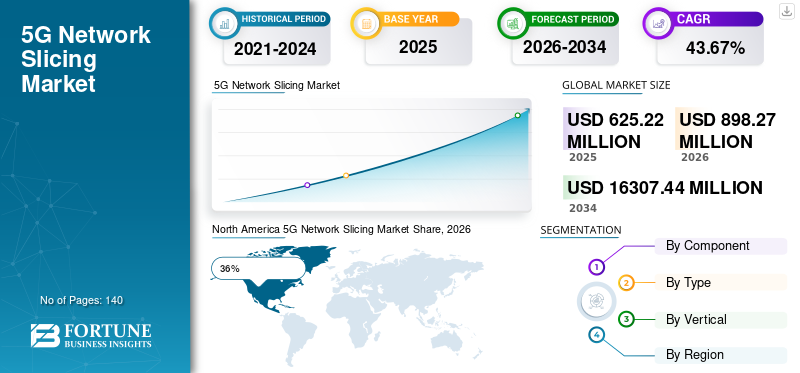
The 5G network slicing market size was valued at USD 625.22 Million in 2025. The market is projected to grow from USD 898.27 Million in 2026 to USD 16307.44 Million by 2034, exhibiting a CAGR of 43.67% during the forecast period.

The 5G network slicing market is becoming a critical segment within the global telecommunications ecosystem as enterprises demand customized connectivity solutions for industry-specific applications. Network slicing enables operators to create multiple virtual networks on a shared physical infrastructure, allowing dedicated performance, latency, security, and bandwidth configurations. The increasing adoption of Industry 4.0, autonomous systems, smart manufacturing, connected healthcare, and intelligent transportation is accelerating demand for advanced slicing capabilities. The 5G network slicing market report highlights growing investments in cloud-native cores, software-defined networking, and network function virtualization technologies that support flexible and scalable network architectures. As operators expand standalone 5G deployments, the 5G network slicing market analysis indicates stronger enterprise adoption across mission-critical environments.
The United States remains a leading contributor to the 5G network slicing market due to extensive standalone 5G deployments and enterprise digital transformation initiatives. Major telecom operators are expanding network slicing capabilities to support industrial automation, public safety communications, private enterprise networks, immersive media, and connected vehicle ecosystems. The country benefits from strong investments in cloud infrastructure, edge computing, and artificial intelligence-enabled network management platforms. The 5G Network Slicing Industry Report identifies increasing demand from manufacturing, healthcare, logistics, and defense sectors, where customized network performance is essential. Growing collaboration between telecom operators, cloud providers, and enterprise customers continues to strengthen the U.S. position in the global 5G network slicing market.
Download Free sample to learn more about this report.
5G Network Slicing Market Key Takeaways
 Global Market Size & Forecast
- 2025 Market Size: USD 625.22 Million
- 2026 Market Size: USD 898.27 Million
- 2034 Forecast Market Size: USD 16,307.44 Million
- CAGR: 43.67% from 2026-2034
 Market Share
- North America dominated with a revenue share of 36% in 2025.
- Solutions dominated by component with approximately 68% market share.
- RAN slicing dominated by type with approximately 42% market share.
 Key Regional Highlights
North America
North America held the largest regional share at 36% in 2025, supported by advanced 5G infrastructure and enterprise adoption.
Asia-Pacific
Asia-Pacific accounted for 30% of the global market, driven by rapid 5G deployment and digital transformation.
Europe
Europe represented 28% of the market, supported by investments in 5G networks and network virtualization.
U.S
The U.S. remains a major market, supported by strong 5G infrastructure investments and enterprise connectivity demand.
Japan
Japan accounted for 21% of the Asia-Pacific market, supported by advanced 5G deployment and industrial automation.
Read More

5G network slicing market Latest Trends
One of the most significant trends shaping the 5G network slicing market is the transition from pilot deployments to commercial-scale implementation. Telecommunications providers are increasingly launching dedicated slices for enterprises requiring guaranteed service levels, low latency, and enhanced reliability. Dynamic network slicing supported by artificial intelligence and automation platforms is becoming a preferred strategy for optimizing resource allocation across multiple industries.
Download Free sample to learn more about this report.
Another important trend in the 5G network slicing market research report is the integration of edge computing with network slicing frameworks. Enterprises are deploying edge-enabled slices to process critical data closer to end users, reducing latency and improving operational efficiency. Industries such as manufacturing, logistics, healthcare, and transportation are adopting customized slices for real-time analytics, predictive maintenance, autonomous operations, and mission-critical communications. The emergence of application-specific slicing models is creating new business opportunities for operators while strengthening overall market competitiveness.
5G network slicing market Dynamics
DRIVER
Rising Demand for Enterprise-Specific Connectivity Solutions
The primary growth driver in the 5G network slicing market is the increasing requirement for customized network performance across enterprise environments. Traditional network architectures often struggle to address varying service requirements across industries. Network slicing allows operators to allocate dedicated resources to different applications while maintaining service quality and operational efficiency. Manufacturing facilities require ultra-low latency connectivity for robotic systems, while healthcare institutions demand secure and reliable communication channels for remote diagnostics and patient monitoring.
The growing deployment of smart factories, connected infrastructure, autonomous vehicles, industrial IoT devices, and digital public services is expanding the addressable market for network slicing technologies. Enterprises are prioritizing solutions that provide guaranteed service-level agreements, improved cybersecurity, and operational flexibility. As a result, telecom providers are accelerating investments in standalone 5G networks, orchestration platforms, and software-defined architectures. The 5G network slicing market outlook indicates that enterprise demand will remain a major growth catalyst as organizations continue adopting digital transformation initiatives.
RESTRAINT
Complex Deployment and Integration Requirements
A significant restraint affecting the 5G network slicing market is the complexity associated with deployment and integration processes. Successful implementation requires advanced network infrastructure, cloud-native architecture, software-defined networking capabilities, and highly skilled technical expertise. Many telecom operators still operate hybrid environments that combine legacy systems with emerging 5G infrastructure, creating integration challenges.
Additionally, network slicing implementation often requires extensive coordination between infrastructure vendors, software providers, cloud service partners, and enterprise customers. Managing multiple slices while ensuring security, isolation, performance consistency, and regulatory compliance increases operational complexity. Small and medium-sized telecom providers may face limitations in terms of financial resources and technical capabilities required for large-scale deployments. These challenges can slow implementation timelines and create barriers for organizations seeking rapid adoption of advanced network slicing solutions.
OPPORTUNITY
Expansion of Industry 4.0 and Private 5g Ecosystems
The expansion of Industry 4.0 initiatives represents a substantial opportunity within the 5G network slicing market. Industrial organizations increasingly require dedicated communication networks capable of supporting automation, predictive analytics, machine learning applications, and connected devices. Network slicing provides the flexibility needed to deliver customized performance for different operational requirements within a single infrastructure environment.
Private 5G deployments are creating additional opportunities for telecom operators and technology vendors. Manufacturing plants, ports, mining facilities, energy sites, airports, and logistics hubs are adopting private network solutions supported by slicing capabilities. These deployments enable secure communications, improved asset monitoring, enhanced workforce safety, and operational efficiency improvements. The 5G network slicing market forecast suggests that expanding enterprise adoption across industrial sectors will create new revenue streams for service providers and infrastructure vendors.
CHALLENGE
Cybersecurity and Service Assurance Concerns
Cybersecurity remains one of the most significant challenges within the 5G network slicing market. Although network slicing provides logical separation between services, organizations remain concerned about potential vulnerabilities associated with multi-tenant environments and virtualized infrastructure. Ensuring secure communication across multiple slices requires advanced monitoring, threat detection, encryption, and policy management capabilities.
Maintaining service assurance across dynamically allocated network resources presents another challenge. Enterprises expect consistent performance, guaranteed uptime, and strict compliance with service-level agreements. Any disruption affecting critical applications can have substantial operational consequences. Telecom providers must continuously monitor slice performance while managing increasing network complexity. As the number of connected devices and enterprise applications continues to grow, maintaining reliability and security across diverse slicing environments will remain a major operational challenge for market participants.
5G network slicing market Segmentation
By Component
The solutions segment accounts for approximately 68% of the 5G network slicing market share due to growing demand for orchestration platforms, network management software, automation systems, analytics tools, and slice lifecycle management solutions. Telecom operators increasingly deploy integrated software environments that support end-to-end slicing capabilities across radio access networks, transport networks, and core infrastructure. The adoption of software-defined networking and network function virtualization technologies continues to strengthen this segment.
Advanced solutions enable operators to create, monitor, optimize, and monetize network slices efficiently. Enterprises are also investing in customized management platforms capable of supporting industry-specific connectivity requirements. The 5G network slicing market analysis highlights strong demand for AI-driven orchestration solutions that automate resource allocation and improve operational performance. As network complexity increases, software platforms are expected to remain a fundamental component of market development.
The services segment represents nearly 32% of the 5G network slicing market size, driven by increasing demand for consulting, deployment, integration, maintenance, and managed services. Many enterprises lack the internal expertise required to implement and operate sophisticated network slicing environments, creating opportunities for specialized service providers.
Telecom operators and technology vendors are expanding professional service portfolios to assist customers with infrastructure assessment, architecture design, deployment planning, and ongoing optimization. Managed service offerings are particularly attractive for organizations seeking to reduce operational complexity while maintaining high performance standards. The 5G Network Slicing Industry Analysis indicates that service-based business models will continue expanding as enterprises prioritize outsourcing strategies for advanced network operations.
By Type
RAN slicing holds approximately 42% of the 5G network slicing market due to its critical role in managing radio resources across multiple applications and users. This slicing approach enables operators to allocate dedicated wireless capacity to specific services while maintaining performance consistency. Industries requiring real-time connectivity, such as manufacturing, transportation, and public safety, increasingly rely on RAN slicing for mission-critical operations.
The adoption of standalone 5G networks is accelerating deployment of advanced radio access network slicing capabilities. Telecom providers are investing heavily in intelligent RAN architectures that support dynamic resource allocation and automated optimization. The 5G network slicing market Trends indicate continued demand for RAN slicing as operators seek differentiated service offerings and improved customer experiences.
Edge slicing accounts for around 25% of the market and is gaining momentum due to the rapid expansion of edge computing infrastructure. Organizations increasingly require localized processing capabilities to reduce latency and improve application responsiveness. Edge slicing enables dedicated connectivity and computing resources to be allocated closer to users and devices.
Applications such as augmented reality, autonomous vehicles, industrial automation, and remote healthcare benefit significantly from edge-enabled network slices. Telecom operators are deploying distributed edge nodes to support real-time processing requirements. The 5G network slicing market Insights indicate that edge slicing adoption will continue increasing as latency-sensitive applications become more prevalent across enterprise environments.
End-to-end network slicing represents approximately 33% of the market and provides comprehensive service customization across the entire network ecosystem. This approach integrates radio access, transport, core, and cloud infrastructure into a unified slicing framework. Enterprises increasingly prefer end-to-end solutions because they deliver consistent performance, security, and service assurance.
The growing need for enterprise-grade connectivity is driving investment in fully integrated slicing architectures. Operators are leveraging automation and orchestration technologies to simplify management and improve scalability. The 5G network slicing market opportunities are particularly strong within sectors requiring strict performance guarantees, including healthcare, defense, energy, and transportation.
To know how our report can help streamline your business, Speak to Analyst
By Vertical
Manufacturing represents approximately 28% of the 5G network slicing market. Smart factories require reliable connectivity for robotics, machine vision systems, predictive maintenance platforms, and industrial IoT deployments. Network slicing enables manufacturers to allocate dedicated resources to mission-critical applications while maintaining operational continuity.
Digital transformation initiatives across global manufacturing facilities are accelerating adoption of customized connectivity solutions. The 5G network slicing market report identifies strong demand from automotive, electronics, and heavy industrial sectors seeking advanced automation capabilities.
Healthcare accounts for nearly 18% of the market due to increasing adoption of connected medical devices, telemedicine platforms, remote diagnostics, and real-time patient monitoring systems. Network slicing provides secure and reliable connectivity that supports sensitive healthcare operations.
Hospitals and healthcare providers are investing in dedicated communication networks capable of handling large volumes of medical data while ensuring privacy and compliance requirements. The sector continues to benefit from advancements in remote healthcare delivery and digital medical infrastructure.
5G network slicing market Regional Outlook
North America 5G Network Slicing Market Share, 2026 (%)
To get more information on the regional analysis of this market, Download Free sample
North America
North America holds approximately 36% of the global 5G network slicing market share. The region benefits from advanced telecommunications infrastructure, extensive standalone 5G deployments, and strong enterprise adoption of digital technologies. Major operators continue investing in network automation, edge computing, and cloud-native core networks to support commercial slicing services.
Demand is particularly strong across manufacturing, healthcare, public safety, and transportation sectors. Enterprise customers increasingly seek customized connectivity solutions that support mission-critical applications and operational efficiency improvements. Strong collaboration among telecom operators, technology vendors, and cloud providers continues to accelerate market development across the region.
Europe
Europe accounts for approximately 28% of the global 5G network slicing market. The region is characterized by growing investments in smart manufacturing, industrial automation, digital infrastructure modernization, and enterprise connectivity solutions. Telecommunications providers are expanding standalone 5G networks to support customized services across multiple industries.
Government-led digital transformation programs and Industry 4.0 initiatives continue driving demand for advanced network architectures. The region also benefits from strong participation by leading telecommunications equipment vendors and technology innovators supporting commercial deployment activities.
Germany 5G network slicing market
Germany represents approximately 31% of the European 5G network slicing market. The country’s leadership in industrial manufacturing and automation creates strong demand for customized connectivity solutions. Automotive manufacturers, industrial equipment providers, and smart factory operators are implementing network slicing technologies to improve operational efficiency and support advanced production environments.
The German market benefits from extensive Industry 4.0 adoption and strong investment in private 5G networks. Telecom providers are collaborating with enterprise customers to develop specialized slicing solutions for manufacturing, logistics, and energy applications. Demand continues to increase as organizations prioritize automation, digitalization, and intelligent infrastructure development.
United Kingdom 5G network slicing market
The United Kingdom accounts for approximately 24% of the European 5G network slicing market. The country is experiencing growing adoption of network slicing technologies across financial services, healthcare, transportation, and media industries. Operators are expanding standalone 5G infrastructure while introducing enterprise-focused connectivity services.
Strong investment in smart city initiatives and digital infrastructure modernization is supporting market expansion. Enterprise organizations increasingly seek customized network capabilities that enhance security, performance, and service reliability. Collaboration between telecom operators and technology providers continues to accelerate commercial deployment activities throughout the country.
Asia-Pacific
Asia-Pacific holds approximately 30% of the global 5G network slicing market share. The region benefits from large-scale 5G infrastructure deployment, rapid industrialization, and extensive government support for digital transformation initiatives. Telecommunications providers across the region are implementing advanced network architectures to support enterprise and consumer applications.
Growing adoption of smart manufacturing, connected transportation systems, and intelligent urban infrastructure is creating significant demand for network slicing solutions. The region also benefits from strong participation by telecommunications equipment manufacturers and technology innovators focused on next-generation connectivity services.
Japan 5G network slicing market
Japan represents approximately 21% of the Asia-Pacific 5G network slicing market. The country’s advanced technology ecosystem and strong focus on industrial automation contribute significantly to market growth. Organizations across manufacturing, healthcare, transportation, and public safety sectors are adopting customized connectivity solutions supported by network slicing.
Telecommunications operators continue investing in standalone 5G infrastructure and edge computing capabilities. The increasing deployment of robotics, autonomous systems, and intelligent industrial applications is creating strong demand for reliable and low-latency communication networks throughout the Japanese market.
China 5G network slicing market
China accounts for approximately 42% of the Asia-Pacific 5G network slicing market. The country benefits from extensive 5G deployment programs, strong government support, and large-scale digital transformation initiatives. Telecom operators are actively implementing slicing technologies to support smart cities, industrial automation, connected transportation, and public sector modernization.
The presence of major telecommunications equipment manufacturers further strengthens market development. Enterprise demand continues increasing as organizations adopt advanced connectivity solutions capable of supporting large-scale digital ecosystems and intelligent infrastructure projects.
Rest of World
The Rest of World region accounts for approximately 6% of the global 5G network slicing market. Adoption is increasing across the Middle East, Africa, and Latin America as governments and telecom operators invest in modern telecommunications infrastructure. Growing interest in smart city development, industrial automation, and digital public services is supporting market expansion.
Telecommunications providers are gradually introducing standalone 5G capabilities and enterprise-focused connectivity solutions. Infrastructure modernization programs and increasing enterprise awareness of customized network services are expected to support future market opportunities across emerging economies.
List of Top 5G Network Slicing Companies
- AT&T, Inc.
- Telefonaktiebolaget LM Ericsson
- Nokia Corporation
- Huawei Technologies Co., Ltd.
- Cisco Systems, Inc.
- Deutsche Telekom AG
- Amdocs, Inc.
- Vodafone Group plc
- ZTE Corporation
Top Two Companies by market share
- Ericsson – 18%
- Nokia Corporation – 15%
Investment Analysis and Opportunities
Investment activity within the 5G network slicing market is increasing as telecom operators prioritize standalone 5G deployment and enterprise service expansion. Significant capital allocation is directed toward cloud-native cores, automation platforms, edge computing infrastructure, artificial intelligence integration, and network orchestration technologies. These investments support the creation of scalable and commercially viable slicing ecosystems.
The most attractive opportunities exist within industrial automation, smart manufacturing, transportation, healthcare, energy, and private network deployments. Investors are particularly focused on software-driven solutions that improve network efficiency and enable differentiated service offerings. Strategic partnerships among telecom operators, cloud providers, software vendors, and enterprise customers are creating additional opportunities for long-term market expansion. The 5G network slicing market forecast indicates sustained investment momentum as organizations seek advanced connectivity solutions capable of supporting digital transformation objectives.
New Product Development
Innovation remains a defining characteristic of the 5G network slicing market. Vendors are introducing advanced orchestration platforms capable of automating slice creation, lifecycle management, performance monitoring, and resource optimization. Artificial intelligence and machine learning technologies are increasingly integrated into network management systems to improve operational efficiency and service assurance.
Product development efforts also focus on edge-enabled slicing solutions, private 5G architectures, and industry-specific connectivity platforms. Telecom operators are launching commercial slicing services designed for manufacturing, healthcare, transportation, public safety, and immersive media applications. Enhanced security frameworks, real-time analytics capabilities, and application-aware network management features are becoming standard components of next-generation slicing solutions. These innovations continue strengthening the overall competitiveness of the market.
Five Recent Developments (2023-2025)
- AT&T expanded network automation initiatives and strengthened collaboration with Nokia to enhance cloud-based 5G core and slicing capabilities in 2025.
- Ericsson advanced commercial network slicing deployments through partnerships with global telecom operators supporting enterprise connectivity services in 2024 and 2025.
- Deutsche Telekom increased focus on mission-critical network slicing applications for emergency response and enterprise customers during 2024.
- Vodafone expanded commercial slicing deployments across European markets while enhancing standalone 5G infrastructure capabilities in 2024.
- Airtel and Ericsson launched commercial 5G network slicing services in India during 2025, supporting advanced enterprise connectivity applications.
Report Coverage
The 5G network slicing market research report provides a comprehensive assessment of industry developments, technological advancements, competitive dynamics, and deployment strategies across global markets. The report evaluates market trends, growth drivers, challenges, opportunities, and emerging business models influencing industry expansion.
Request for Customization to gain extensive market insights.
Coverage includes detailed segmentation analysis by component, slicing type, network architecture, application, vertical industry, and geography. The report further examines competitive positioning of major technology providers, telecom operators, and software vendors participating in the ecosystem. Market insights focus on enterprise adoption trends, infrastructure investments, regulatory developments, and innovation strategies shaping future market evolution. The scope also includes analysis of standalone 5G deployment, edge computing integration, private network adoption, and industry-specific connectivity requirements.
Frequently Asked Questions
Fortune Business Insights says that the global market value stood at USD 625.22 million in 2025 and is projected to reach USD 16,307.44 million by 2034.
The market is expected to exhibit a CAGR of 43.67% during the forecast period of 2026-2034.
RAN slicing was the leading type segment, accounting for approximately 42% of the market, supported by its role in managing radio resources and enabling dedicated wireless capacity.
Key players include AT&T, Inc., Telefonaktiebolaget LM Ericsson, Nokia Corporation, Huawei Technologies Co., Ltd., Cisco Systems, Inc., and Deutsche Telekom AG.
Major trends include the shift from pilot deployments to commercial-scale implementation and the integration of AI-driven automation and edge computing with network slicing. North America led the market with approximately 36% share.



- 2021-2034
- 2025
- 2021-2024
- 140
-

(Offer valid till 15th Oct 2026)
Get 30-60 hrs Free Customization
Expand Regional and Country Coverage, Segments Analysis, Company Profiles, Competitive Benchmarking, and End-user Insights.




















-
US +1 833 909 2966 ( Toll Free )
-
Get In Touch With Us