5G Radio Access Network Market Size, Share & Industry Analysis, By Component (Hardware, Software, Services), By Architecture Type, By Deployment, By End-use and Regional Forecast, 2026-2034
 Download Free Sample
5G Radio Access Network Market Overview
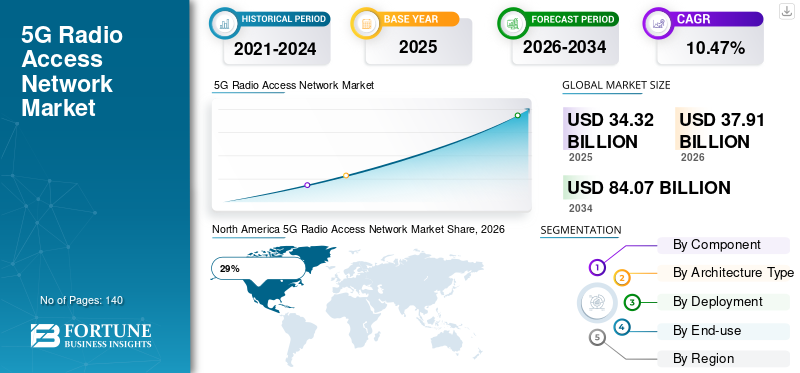
The 5G radio access network market size was valued at USD 34.32 billion in 2025. The market is projected to grow from USD 37.91 billion in 2026 to USD 84.07 billion by 2034, exhibiting a CAGR of 10.47% during the forecast period

The 5G radio access network market is a critical segment of the global telecommunications infrastructure ecosystem, supporting ultra-fast wireless connectivity, low-latency communications, and massive machine-type communications. The market is driven by increasing deployment of standalone 5G networks, Open RAN adoption, private 5G installations, and advanced Massive MIMO technologies. Telecom operators are investing heavily in network densification, spectrum optimization, and cloud-native architectures to improve service quality. The 5G radio access network market report highlights strong demand from industrial automation, smart city projects, connected vehicles, and enterprise digital transformation initiatives, making the market a key component of next-generation wireless infrastructure.
Download Free sample to learn more about this report.
USA 5G Radio Access Network Market
The United States remains one of the most advanced markets for 5G radio access network deployment. Nationwide rollout of mid-band and millimeter-wave spectrum has accelerated network modernization across urban and suburban regions. Telecommunications operators continue expanding standalone 5G architecture and Open RAN implementation to improve flexibility and reduce dependency on proprietary systems. Private 5G networks are increasingly deployed in manufacturing facilities, logistics hubs, healthcare institutions, and defense applications.
The USA market benefits from strong investments in cloud-native RAN platforms, AI-enabled network management, and edge computing integration. The country accounts for approximately 31% of the North American 5G radio access network market, supported by extensive infrastructure upgrades and high consumer demand for enhanced mobile broadband services.
5G Radio Access Network Market Key Takeaways
 Global Market Size & Forecast
- 2025 Market Size: USD 34.32 Billion
- 2026 Market Size: USD 37.91 Billion
- 2034 Forecast Market Size: USD 84.07 Billion
- CAGR: 10.47% from 2026-2034
 Market Share
- The market in Asia-Pacific dominated with a revenue share of 38% in 2025.
- Hardware dominated by component with a market share of approximately 57%.
- Public network deployments dominated by deployment with a market share of approximately 81%.
 Key Regional Highlights
Asia-Pacific
Asia-Pacific led the market with a 38% share, supported by expanding 5G infrastructure and large-scale network deployment.
North America
North America accounted for 29% of the market, driven by advanced telecommunications infrastructure and continued 5G network investments.
Europe
Europe held a 24% share, supported by ongoing network modernization and growing adoption of advanced wireless technologies.
U.S
The U.S. remains a key market, supported by strong investments in 5G infrastructure, network modernization, and advanced connectivity solutions.
Japan
Japan accounted for approximately 18% of the Asia-Pacific market, supported by advanced telecommunications infrastructure and continued 5G network expansion.
Read More

5G Radio Access Network Market Latest Trends
The 5G radio access network market trends indicate growing adoption of Open RAN and virtualized RAN technologies. Telecom operators are increasingly shifting toward disaggregated network architectures that allow interoperability among multiple vendors. This approach improves flexibility, reduces deployment complexity, and supports faster innovation cycles. Open RAN ecosystems are gaining traction across North America, Europe, and Asia-Pacific as governments and operators seek diversified supply chains.
Download Free sample to learn more about this report.
Another significant trend in the 5G radio access network market analysis is the integration of artificial intelligence and machine learning into network operations. AI-driven optimization improves spectrum utilization, traffic management, predictive maintenance, and energy efficiency. Edge computing integration is also becoming a key trend as operators support low-latency applications such as autonomous vehicles, industrial automation, immersive gaming, and smart manufacturing. Private 5G networks, 5G-Advanced deployments, and energy-efficient radio units continue to reshape the competitive landscape while creating new growth opportunities across enterprise and industrial sectors.
5G Radio Access Network Market Dynamics
DRIVER
Rapid Expansion of 5G Infrastructure Deployment
The primary driver of the 5G radio access network market growth is the increasing deployment of 5G infrastructure worldwide. Telecommunications operators continue upgrading legacy networks to accommodate higher data traffic volumes, enhanced mobile broadband requirements, and low-latency applications. Governments are supporting spectrum allocation and digital transformation initiatives, encouraging faster rollout of 5G services. Industries including manufacturing, transportation, healthcare, and utilities are adopting private 5G networks to improve operational efficiency. The growing demand for connected devices, smart factories, autonomous systems, and industrial IoT solutions further strengthens demand for advanced RAN equipment, software, and services across global markets.
RESTRAINT
High Capital Requirements for Network Modernization
One of the major restraints in the 5G radio access network market is the substantial investment required for infrastructure deployment and modernization. Establishing dense networks of small cells, base stations, antennas, and fiber backhaul connections requires significant financial commitments from operators. Rural and remote regions often present economic challenges due to lower subscriber density and extended deployment timelines.
In addition, integration of standalone 5G architecture, cloud-native infrastructure, and network virtualization introduces technical complexities. Operators must manage interoperability among multiple vendors while ensuring service continuity and cybersecurity compliance. Regulatory approvals, spectrum licensing costs, and ongoing maintenance expenses further increase deployment burdens. These factors can delay infrastructure expansion and impact the pace of network upgrades in certain markets.
OPPORTUNITY
Expansion of Private 5G and Enterprise Connectivity
A major opportunity in the 5G radio access network market outlook lies in private 5G network adoption. Enterprises increasingly require secure, low-latency, and high-capacity wireless connectivity for industrial automation, robotics, predictive maintenance, and mission-critical operations. Manufacturing facilities, ports, mining sites, airports, and logistics centers are deploying dedicated 5G networks to improve operational efficiency.
The emergence of Industry 4.0 initiatives is creating substantial opportunities for RAN vendors offering customized solutions. Edge computing, artificial intelligence, and cloud-based network management are enabling new business models and service offerings. As organizations prioritize digital transformation, demand for advanced RAN infrastructure is expected to increase across enterprise environments. The growing use of connected sensors, autonomous vehicles, and real-time analytics further expands the addressable market for 5G radio access network providers.
CHALLENGE
Cybersecurity and Network Complexity
The increasing complexity of modern wireless networks presents significant challenges for market participants. Virtualized and cloud-native RAN architectures introduce new security considerations that require continuous monitoring and protection. Open RAN ecosystems, while offering flexibility, can increase integration complexity among vendors.
Network operators must address cybersecurity threats, data privacy requirements, and regulatory compliance obligations. Managing large-scale deployments involving thousands of connected devices and distributed network elements requires advanced operational expertise. Skilled workforce shortages and evolving security risks continue to challenge operators and infrastructure vendors as they expand 5G coverage and introduce new services.
5G Radio Access Network Market Segmentation
By Component
Hardware remains the largest segment of the 5G radio access network market, accounting for approximately 57% market share. This segment includes radio units, antennas, baseband units, Massive MIMO systems, small cells, and related infrastructure components. Telecom operators continue investing in high-performance radio equipment to support increasing mobile data traffic and network capacity requirements.
The adoption of Massive MIMO technology and advanced beamforming solutions is strengthening demand for hardware products. Urban network densification programs and rural coverage expansion initiatives continue to support hardware deployment worldwide. Hardware remains a cornerstone of 5G network modernization and infrastructure development strategies.
Software represents approximately 24% market share within the 5G radio access network market. Cloud-native RAN software, virtualization platforms, orchestration systems, and network automation tools are becoming essential components of modern wireless infrastructure. Software-defined networking improves flexibility and enables dynamic resource allocation.
The increasing adoption of Open RAN architectures supports software-driven innovation. AI-powered network optimization, predictive maintenance, and automated performance management solutions continue gaining importance among telecommunications operators seeking operational efficiency and service quality improvements.
Services account for nearly 19% of the global market. This segment includes consulting, deployment, integration, maintenance, optimization, and managed services. As network architectures become more complex, operators increasingly rely on specialized service providers to ensure successful implementation and operation.
Demand for professional services continues rising due to Open RAN adoption, private 5G deployment, and cloud-native transformation initiatives. Managed services are particularly attractive for operators seeking to reduce operational complexity while maintaining network performance.
To know how our report can help streamline your business, Speak to Analyst
By Architecture Type
Traditional RAN solutions hold approximately 62% market share. Many operators continue utilizing traditional architectures due to established infrastructure investments and proven operational reliability. These solutions provide stable performance and broad compatibility across existing network environments.
Traditional RAN remains important in markets where large-scale infrastructure modernization is progressing gradually. Operators often combine traditional solutions with virtualization initiatives to balance performance, cost, and deployment flexibility.
Open RAN accounts for approximately 38% market share and represents one of the fastest-evolving segments in the industry. Open architectures allow interoperability among multiple vendors, reducing dependency on proprietary ecosystems. Governments and operators increasingly support Open RAN initiatives to promote competition and supply chain diversification.
The segment benefits from advancements in software-defined networking, cloud-native infrastructure, and virtualization technologies. Open RAN adoption is expected to expand across both developed and emerging telecommunications markets.
By Deployment
Public network deployments represent approximately 81% market share. Mobile operators continue expanding nationwide 5G coverage to support consumer broadband services, enterprise applications, and digital transformation initiatives. Public networks remain the primary source of demand for large-scale RAN infrastructure investments.
Growing smartphone penetration, video streaming consumption, and connected device adoption continue supporting public network expansion. Advanced spectrum utilization and network densification strategies are further strengthening this segment.
Private networks account for approximately 19% market share. Enterprises increasingly deploy dedicated 5G networks to support industrial automation, robotics, asset tracking, and mission-critical communications. Manufacturing, logistics, mining, and healthcare sectors are major adopters of private 5G infrastructure.
The demand for secure, low-latency connectivity continues driving private network deployments. Customized network configurations and edge computing integration further enhance enterprise adoption.
By End-use
Telecom operators dominate the market with approximately 73% share. These organizations are responsible for large-scale infrastructure deployment, spectrum utilization, and nationwide network expansion initiatives. Continuous investments in network modernization support segment growth.
Operators are focusing on standalone 5G deployment, Open RAN implementation, and AI-driven network optimization to enhance service quality and operational efficiency.
Enterprise and industrial users account for approximately 27% market share. Industries are deploying private 5G networks to support automation, digital transformation, and connected operations. Smart factories, ports, airports, and logistics facilities increasingly require advanced wireless connectivity.
Demand from Industry 4.0 applications and mission-critical communications continues strengthening the enterprise segment within the 5G radio access network market research report.
5G Radio Access Network Market Regional Outlook
North America
North America 5G Radio Access Network Market Share, 2026 (%)
To get more information on the regional analysis of this market, Download Free sample
North America accounts for 29% of the global 5G radio access network market share. The region benefits from advanced telecommunications infrastructure, extensive spectrum availability, and strong operator investments in network modernization. Deployment of standalone 5G architecture, Open RAN initiatives, and private wireless networks continues accelerating across multiple industries. The presence of leading technology providers and high adoption of digital services further support market expansion. Enterprises across manufacturing, healthcare, logistics, and transportation sectors increasingly rely on 5G connectivity to enable automation, edge computing, and real-time data processing applications.
Europe
Europe represents 24% of the global market share. The region continues investing in advanced telecommunications infrastructure while supporting Open RAN development and digital transformation initiatives. Governments encourage secure and resilient network deployment strategies to strengthen connectivity across urban and rural areas. Industrial automation, smart city projects, and enterprise digitalization programs contribute significantly to demand for advanced RAN technologies.
Germany 5G Radio Access Network Market
Germany is one of Europe's most important telecommunications markets and accounts for approximately 27% of the European 5G radio access network market. The country continues expanding standalone 5G coverage and industrial private network deployments. Manufacturing companies are implementing dedicated wireless infrastructure to support automation, robotics, predictive maintenance, and smart factory initiatives. Germany's strong industrial base creates significant demand for advanced wireless communication solutions.
The market benefits from extensive investments in digital infrastructure modernization and industrial transformation projects. Automotive manufacturers, logistics providers, and technology firms increasingly deploy advanced 5G solutions to improve productivity and operational efficiency. Open RAN adoption is gradually increasing as operators seek flexible network architectures and vendor diversification. Government-backed digital initiatives continue supporting nationwide connectivity improvements and enterprise deployment projects.
United Kingdom 5G Radio Access Network Market
The United Kingdom accounts for approximately 22% of the European market. Telecommunications operators continue investing in nationwide 5G infrastructure and standalone network deployment. Urban coverage expansion and enterprise connectivity initiatives remain key priorities. Advanced wireless services support smart city development, digital healthcare, transportation modernization, and industrial automation projects.
Private 5G deployments are gaining momentum across manufacturing facilities, logistics centers, and critical infrastructure environments. Open RAN initiatives receive substantial attention from both operators and policymakers seeking competitive and diversified telecommunications ecosystems. The UK's technology sector actively supports innovation in cloud-native networking, edge computing, and AI-driven network management. Continued infrastructure modernization strengthens the country's position within the European 5G Radio Access Network landscape.
Asia-Pacific
Asia-Pacific holds 38% of the global market share and remains the largest regional market. Extensive deployment of 5G infrastructure across major economies supports strong demand for RAN equipment, software, and services. Governments continue promoting digital transformation strategies, smart manufacturing initiatives, and advanced telecommunications development. Large-scale network rollouts, industrial modernization projects, and increasing mobile broadband consumption contribute to regional growth.
The region benefits from strong manufacturing capabilities, extensive telecommunications investment, and high smartphone adoption rates. Private 5G networks are increasingly deployed across industrial facilities, ports, airports, and logistics hubs. Emerging applications including autonomous transportation, smart cities, and industrial IoT continue expanding market opportunities. Advanced technologies such as Open RAN, AI-enabled network management, and cloud-native architectures are gaining widespread adoption across regional telecommunications ecosystems.
Japan 5G Radio Access Network Market
Japan accounts for approximately 18% of the Asia-Pacific market. The country focuses on advanced network modernization, industrial automation, and smart infrastructure development. Telecommunications operators continue expanding standalone 5G services while supporting enterprise connectivity solutions. Private wireless networks are increasingly deployed across manufacturing facilities and transportation systems.
The integration of artificial intelligence, edge computing, and advanced automation technologies strengthens demand for sophisticated RAN infrastructure. Japan remains a major center for telecommunications innovation and next-generation wireless technology development.
China 5G Radio Access Network Market
China represents approximately 46% of the Asia-Pacific market. The country maintains extensive 5G infrastructure deployment and large-scale network coverage across urban and rural regions. Industrial digitalization initiatives, smart city programs, and manufacturing modernization projects continue driving demand for advanced RAN solutions.
Domestic telecommunications equipment suppliers play a significant role in network expansion. The country's focus on 5G-Advanced technologies, industrial connectivity, and large-scale wireless infrastructure investments supports continued market development and technological advancement.
Rest of World
The Rest of World region accounts for 9% of the global market share. Countries across Latin America, the Middle East, and Africa continue expanding 5G infrastructure deployment to support digital transformation objectives. Governments and telecommunications operators are investing in modern wireless networks to improve connectivity and economic competitiveness. Enterprise applications, smart city initiatives, and industrial modernization projects contribute to growing demand for advanced RAN technologies. Improved spectrum availability and increasing digital service adoption continue creating opportunities for infrastructure vendors and service providers.
List of Top 5G Radio Access Network Companies
- Telefonaktiebolaget LM Ericsson
- Qualcomm Technologies, Inc.
- Nokia
- Rakuten Symphony Singapore Pte. Ltd
- Intel Corporation
- Samsung
- Verizon
- Cisco Systems, Inc.
- Huawei Technologies Co., Ltd.
- VMware, Inc.
Top Two Companies by Market Share
- Huawei Technologies Co., Ltd. – 31%
- Telefonaktiebolaget LM Ericsson – 29%
Investment Analysis and Opportunities
Investment activity in the 5G radio access network market remains focused on standalone 5G deployment, Open RAN ecosystems, edge computing integration, and private network infrastructure. Telecommunications operators are allocating capital toward network densification, spectrum utilization improvements, and cloud-native architecture implementation. Industrial sectors including manufacturing, logistics, energy, and transportation continue increasing investment in dedicated wireless connectivity solutions.
Significant opportunities exist in AI-driven network optimization, enterprise connectivity services, and advanced industrial applications. Vendors offering energy-efficient infrastructure, software-defined networking solutions, and Open RAN capabilities are well-positioned to benefit from long-term digital transformation initiatives.
New Product Development
Innovation remains a defining characteristic of the 5G radio access network market. Vendors are introducing advanced Massive MIMO radios, AI-powered network automation platforms, cloud-native RAN software, and energy-efficient infrastructure solutions. Open RAN-compliant products continue expanding interoperability across multi-vendor environments.
Recent product developments emphasize network intelligence, automation, and sustainability. Advanced beamforming technologies, intelligent radio units, edge computing integration, and virtualized network functions improve operational efficiency and service quality. These innovations support evolving enterprise and consumer connectivity requirements while enabling next-generation digital applications.
Five Recent Developments (2023-2025)
- Ericsson expanded AI-powered RAN automation capabilities and introduced new energy-efficient Massive MIMO radio solutions.
- Nokia secured multiple international 5G RAN modernization contracts and strengthened Open RAN interoperability programs.
- Samsung advanced virtualized RAN deployments and expanded enterprise-focused private 5G solutions.
- Huawei accelerated deployment of 5G-Advanced infrastructure and introduced enhanced AI-integrated wireless network technologies.
- Rakuten Symphony expanded Open RAN commercialization initiatives and launched additional cloud-native RAN management platforms.
Report Coverage
The 5G radio access network market report provides comprehensive analysis of market trends, dynamics, segmentation, regional outlook, competitive landscape, investment opportunities, and technological developments. The report evaluates hardware, software, and service segments while examining deployment models, architecture types, and end-use industries. It includes detailed assessment of major regional markets, emerging opportunities, industry challenges, and strategic initiatives undertaken by leading participants.
Request for Customization to gain extensive market insights.
The coverage also highlights Open RAN adoption, private 5G deployments, AI-driven network management, edge computing integration, and ongoing infrastructure modernization activities shaping the future of the global 5G Radio Access Network industry.
Frequently Asked Questions
Fortune Business Insights says that the global market value stood at USD 34.32 billion in 2025 and is projected to reach USD 84.07 billion by 2034.
The market is expected to exhibit a CAGR of 10.47% during the forecast period of 2026-2034.
Hardware led the component segment with approximately 57% market share, driven by demand for radio units, antennas, baseband units, Massive MIMO systems, and small cells.
Key players include Telefonaktiebolaget LM Ericsson, Qualcomm Technologies, Inc., Nokia, Rakuten Symphony Singapore Pte. Ltd., Intel Corporation, and Samsung.
Major trends include growing adoption of Open RAN and virtualized RAN and increasing integration of AI/ML and edge computing into network operations. Asia-Pacific led with approximately 38% market share.



- 2021-2034
- 2025
- 2021-2024
- 140
-

(Offer valid till 30th Sep 2026)
Get 30-60 hrs Free Customization
Expand Regional and Country Coverage, Segments Analysis, Company Profiles, Competitive Benchmarking, and End-user Insights.




















-
US +1 833 909 2966 ( Toll Free )
-
Get In Touch With Us