5G Security Market Size, Share & Industry Analysis, By Component (Solution, Services), By Deployment (Cloud, On-premise), By Architecture (5G NR Standalone, 5G NR Non-Standalone), By Network Security By End Use, and Regional Forecast, 2026-2034
 Download Free Sample
5G Security Market Overview
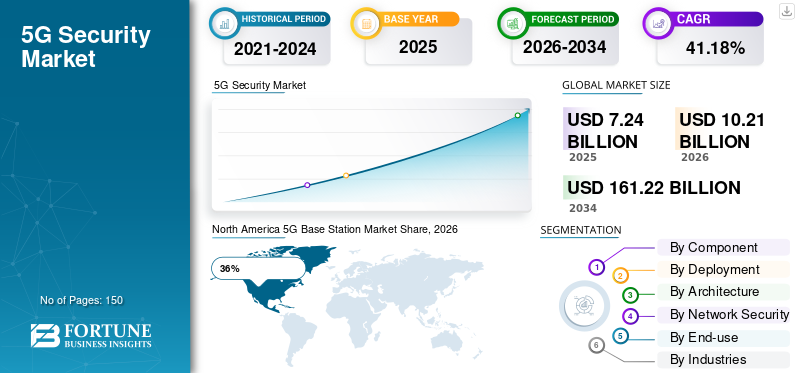
The 5G security market size was valued at USD 5.0 billion in 2025. The market is projected to grow from USD 7.20 billion in 2026 to USD 118.68 billion by 2034, exhibiting a CAGR of 41.93% during the forecast period.

The 5G security market is gaining strong momentum due to the rapid deployment of next-generation telecom infrastructure, increasing cyber threats, and the growing adoption of connected devices across enterprise environments. Telecom operators, cloud providers, and industrial organizations are investing heavily in advanced 5G security frameworks to protect ultra-fast networks, edge computing systems, and mission-critical communication channels. The 5G security market report highlights increasing demand for network slicing security, cloud-native protection platforms, threat intelligence systems, and zero-trust architectures. growth in smart cities, industrial IoT, autonomous transportation, and connected healthcare infrastructure is creating substantial demand for scalable and real-time 5G security solutions globally.
The USA 5G security market is expanding rapidly due to aggressive rollout of standalone 5G networks and increasing enterprise adoption of connected technologies. Telecom providers and cloud infrastructure companies are investing in secure network architectures to protect sensitive enterprise data, connected devices, and low-latency communication systems. The 5G Security Industry analysis indicates strong demand for AI-powered threat detection, secure access management, and cloud-native firewall solutions across defense, healthcare, manufacturing, and financial sectors. Increasing government focus on critical infrastructure protection and cybersecurity modernization is accelerating deployment of advanced 5G security technologies throughout the United States telecommunications ecosystem.
Download Free sample to learn more about this report.
5G Security Market Key Takeaways
 Global Market Size & Forecast
- 2025 Market Size: USD 5.0 Billion
- 2026 Market Size: USD 7.20 Billion
- 2034 forecast Market Size: USD 118.68 Billion
- CAGR: 41.93% from 2026-2034
 Market Share
- North America dominated with a 36% regional market share in 2025.
- Solutions held the largest component share at approximately 72%.
- Cloud-based deployment accounted for the largest share at approximately 61%.
 Key Regional Highlights
North America
North America held the largest regional share at 36%, supported by advanced 5G infrastructure and cybersecurity investments.
Asia-Pacific
Asia-Pacific accounted for 31% of the market, driven by rapid 5G deployment and digital transformation.
Europe
Europe represented 28% of the market, supported by increasing network security requirements.
U.S.
Demand is supported by strong 5G deployment and growing investments in network cybersecurity.
Japan
Japan accounted for 22% of the Asia-Pacific market, supported by advanced 5G infrastructure and security adoption.
Read More

5G Security Market Latest Trends
The 5G security market trends are increasingly shaped by the integration of artificial intelligence, machine learning, and automation into network protection platforms. Telecom operators are deploying AI-driven threat intelligence systems capable of detecting abnormal network behavior, malicious traffic patterns, and real-time security breaches across 5G infrastructure. The transition toward cloud-native telecom architectures is also driving demand for virtualized security platforms that provide flexible protection across distributed edge environments. The 5G security market research report highlights increasing adoption of zero-trust frameworks and identity-based authentication technologies to secure connected enterprise ecosystems.
Download Free sample to learn more about this report.
Another major trend influencing the 5G security market outlook is the rising deployment of secure network slicing technologies. Enterprises are utilizing dedicated network slices for industrial automation, healthcare communication, smart manufacturing, and autonomous transportation systems, requiring highly specialized security controls. Security vendors are also focusing on protecting edge computing nodes and IoT devices connected through high-speed 5G environments. Increasing investment in secure private 5G networks across industrial facilities and smart city projects continues to create strong 5G security market opportunities for technology providers and telecom infrastructure companies globally.
5G Security Market Dynamics
DRIVER
Rapid Deployment Of 5g Infrastructure and Connected Ecosystems
The large-scale expansion of 5G infrastructure across enterprise and telecom environments is one of the primary drivers accelerating 5G security market growth. Telecom operators and enterprises are deploying high-speed, low-latency communication networks supporting billions of connected devices, industrial IoT systems, and edge computing applications. As network complexity increases, organizations require advanced security solutions capable of protecting virtualized network functions, cloud-native architectures, and distributed edge infrastructure. The 5G security market analysis indicates that growing cyberattack sophistication and increasing data traffic volumes are forcing enterprises to prioritize next-generation network security investments.
The adoption of smart manufacturing, connected healthcare systems, autonomous transportation, and intelligent utility infrastructure is further increasing demand for scalable 5G protection platforms. Businesses are implementing AI-powered monitoring systems, secure access management, and advanced encryption technologies to safeguard mission-critical operations. Government agencies and telecom providers are also strengthening national cybersecurity frameworks to protect telecom infrastructure from espionage, malware, and network disruption threats. These factors continue to support strong long-term expansion of the global 5G Security Industry report landscape.
RESTRAINT
High Implementation Complexity and Infrastructure Costs
One of the major restraints affecting the 5G security market is the complexity associated with securing highly virtualized and distributed network environments. 5G ecosystems involve cloud-native architectures, edge computing nodes, software-defined networking, and millions of connected endpoints, creating significant operational and security management challenges. Enterprises often require substantial investment in cybersecurity infrastructure modernization, network segmentation, and advanced monitoring systems to support secure 5G deployment.
The 5G security market forecast is also impacted by the shortage of skilled cybersecurity professionals capable of managing next-generation telecom security environments. Many organizations struggle to integrate advanced 5G protection technologies with existing enterprise infrastructure and legacy communication systems. Continuous software updates, compliance management, and network configuration requirements can further increase operational complexity and maintenance costs. Smaller enterprises may delay adoption because of budget limitations and lack of technical expertise related to advanced 5G network protection technologies.
OPPORTUNITY
growth of Private 5g Networks and Industrial lot Adoption
The expansion of private 5G networks across industrial sectors presents substantial opportunities for the 5G security market. Manufacturing plants, logistics hubs, energy facilities, and smart campuses are increasingly deploying dedicated 5G infrastructure to support industrial automation, robotics, and real-time operational analytics. These environments require advanced network segmentation, endpoint security, and low-latency threat detection systems capable of protecting critical industrial operations. The 5G security market opportunities are expanding rapidly as enterprises seek secure communication frameworks for connected industrial ecosystems.
The increasing adoption of industrial IoT devices and edge computing infrastructure is also driving demand for advanced cybersecurity solutions tailored for ultra-fast networks. Vendors are developing AI-driven analytics platforms, automated incident response systems, and secure network slicing technologies to support complex enterprise environments. Smart city programs and autonomous transportation projects are further strengthening market opportunities by increasing deployment of connected infrastructure requiring continuous network protection and monitoring capabilities.
CHALLENGE
Rising Cyber Threats Targeting Telecom and Edge Infrastructure
The increasing sophistication of cyberattacks targeting telecom infrastructure remains a major challenge within the 5G security market. Distributed denial-of-service attacks, ransomware campaigns, signaling manipulation, and unauthorized network access attempts are becoming more advanced as telecom networks evolve toward highly virtualized environments. The enormous number of connected endpoints within 5G ecosystems significantly expands the attack surface for cybercriminals and state-sponsored threat actors.
Another challenge involves maintaining secure interoperability across multi-vendor telecom infrastructure and cloud-native network architectures. Telecom operators frequently integrate hardware, software, and virtualized services from multiple technology providers, creating potential vulnerabilities and compatibility issues. The 5G security market insights indicate that ensuring real-time threat detection, secure authentication, and data privacy across distributed environments requires continuous investment in advanced security infrastructure. Rapid technological evolution within telecom ecosystems also forces vendors to constantly update security protocols and monitoring systems to address emerging threats.
5G Security Market Segmentation
By Component
The Solutions segment accounts for approximately 72% of the global 5G security market share because enterprises and telecom operators require advanced technologies for protecting next-generation network infrastructure. This segment includes firewalls, threat intelligence platforms, intrusion detection systems, secure access management solutions, and network slicing security technologies. Telecom companies are investing heavily in AI-powered monitoring systems and automated threat detection platforms to manage increasingly complex network environments. The 5G security market research report highlights strong demand for cloud-native security solutions capable of protecting distributed edge computing ecosystems and virtualized telecom architectures.
The growing adoption of private 5G networks and industrial IoT infrastructure is further accelerating demand for integrated security platforms. Enterprises operating in manufacturing, healthcare, transportation, and energy sectors require highly scalable security solutions to protect sensitive operational data and connected devices. Vendors are continuously introducing AI-driven analytics, behavioral monitoring, and automated incident response capabilities to strengthen network resilience and operational security across advanced 5G ecosystems.
The Services segment represents nearly 28% of the global 5G security market share because enterprises increasingly require consulting, integration, managed security, and monitoring services to support secure 5G deployment. Telecom operators and large enterprises often depend on external cybersecurity specialists for risk assessment, infrastructure configuration, compliance management, and real-time threat monitoring operations. The increasing complexity of cloud-native and virtualized telecom environments is significantly strengthening demand for professional security services.
The 5G security market outlook for services remains strong because enterprises are seeking ongoing support for incident response, vulnerability assessment, and security policy management. Managed security providers are also offering AI-driven monitoring and predictive analytics solutions to improve operational resilience. As telecom infrastructure expands and connected ecosystems become more complex, organizations continue to increase investment in outsourced cybersecurity expertise and lifecycle security management services.
To know how our report can help streamline your business, Speak to Analyst
By Deployment
Cloud-Based deployment accounts for approximately 61% of the global 5G security market share because telecom operators and enterprises increasingly prefer scalable, flexible, and centrally managed security platforms. Cloud-native security solutions support rapid deployment, automated updates, and real-time analytics across distributed 5G environments. Enterprises deploying smart infrastructure, industrial IoT systems, and connected enterprise networks benefit from centralized visibility and remote security management capabilities.
The 5G security market analysis highlights increasing adoption of cloud-based threat intelligence platforms, AI-powered analytics systems, and automated network protection technologies. Integration of edge computing and virtualized network functions is further strengthening demand for cloud-managed security infrastructure. Organizations are also utilizing cloud-native frameworks to improve scalability and reduce operational complexity associated with protecting large connected ecosystems.
On-Premises deployment represents approximately 39% of the 5G security market share because industries handling sensitive data often require greater operational control and dedicated infrastructure protection. Defense organizations, financial institutions, industrial operators, and healthcare providers frequently deploy on-premises security architectures to maintain compliance, ensure data privacy, and reduce external network exposure. These environments typically require advanced encryption systems, secure authentication technologies, and isolated network management platforms.
The 5G Security Industry analysis indicates rising investment in dedicated cybersecurity infrastructure supporting private 5G networks and mission-critical enterprise operations. Organizations operating high-security environments are prioritizing customized protection frameworks and advanced threat monitoring systems. The need for regulatory compliance and operational continuity continues to support demand for on-premises security deployment models.
By Architecture
Standalone 5G architecture holds approximately 57% of the global 5G security market share because telecom operators are increasingly transitioning toward fully independent 5G core networks. Standalone architectures support advanced applications such as network slicing, ultra-low latency communication, and large-scale IoT connectivity, requiring sophisticated security frameworks. Telecom providers are implementing AI-driven monitoring systems and secure authentication protocols to protect standalone infrastructure from evolving cyber threats.
The 5G security market trends indicate increasing deployment of virtualized core networks and cloud-native architectures supporting standalone 5G environments. Security vendors are developing advanced encryption systems and zero-trust access frameworks specifically tailored for independent 5G infrastructure. Growing demand for industrial automation and smart infrastructure continues to strengthen this segment globally.
By Network Security
Network Slicing Security accounts for approximately 33% of the global 5G security market share because enterprises increasingly utilize dedicated network slices for critical industrial applications. Smart manufacturing, connected healthcare systems, autonomous transportation, and emergency communication networks require highly secure and isolated communication environments. Security solutions supporting network slicing provide real-time monitoring, policy enforcement, and traffic segmentation capabilities.
The 5G security market forecast highlights increasing enterprise demand for customized security controls supporting multi-tenant telecom environments. Telecom operators are investing in AI-driven traffic analysis and automated threat response systems to protect network slices from unauthorized access and cyberattacks. The rapid expansion of private enterprise networks and industrial IoT infrastructure continues to support growth in this segment.
By End-use
Telecom Operators account for nearly 41% of the global 5G security market share because they remain the primary deployers of large-scale 5G infrastructure globally. Telecom providers require advanced security frameworks to protect core networks, edge infrastructure, subscriber data, and high-speed communication services. Expansion of cloud-native telecom architectures and virtualization technologies is significantly increasing the need for automated network security management systems.
The 5G security market research report indicates that telecom operators are heavily investing in AI-driven threat detection, secure authentication systems, and network traffic analytics. Deployment of standalone 5G networks and edge computing infrastructure continues to create substantial demand for scalable and real-time telecom security solutions across global markets.
5G Security Market Regional Outlook
North America
North America 5G Base Station Market Share, 2026 (%)
To get more information on the regional analysis of this market, Download Free sample
North America holds approximately 36% of the global 5G security market share due to rapid standalone 5G deployment, advanced telecom infrastructure, and strong cybersecurity investment across enterprise sectors. Telecom operators, cloud providers, and government agencies are investing heavily in AI-driven network protection systems, secure edge computing infrastructure, and zero-trust security architectures. Expansion of industrial IoT ecosystems and connected enterprise environments is creating substantial demand for advanced 5G protection technologies.
The 5G security market report indicates rising adoption of secure private 5G networks across manufacturing, defense, healthcare, and transportation industries throughout North America. Regulatory focus on critical infrastructure protection and cyber resilience continues to support strong market expansion. Technology providers are also strengthening cloud-native telecom security platforms and automated threat intelligence systems to address increasing cyberattack sophistication.
Europe
Europe accounts for approximately 28% of the global 5G security market share because of strong telecom modernization programs and increasing investment in cybersecurity infrastructure. Enterprises across automotive, industrial manufacturing, financial services, and healthcare sectors are deploying advanced 5G security frameworks to support connected operations and industrial automation. Governments across the region are emphasizing telecom network resilience and data privacy protection, further accelerating market demand.
The 5G security industry report highlights increasing adoption of private enterprise 5G networks and secure edge computing infrastructure across Europe. Telecom operators are investing in network slicing security, AI-driven threat detection, and cloud-native firewall technologies to improve operational security. Rapid digital transformation and expansion of industrial IoT ecosystems continue to strengthen regional market opportunities.
Germany 5G security market
Germany represents approximately 32% of the European 5G security market share due to its strong industrial manufacturing base and rapid Industry 4.0 adoption. German enterprises are deploying secure private 5G networks to support connected factories, robotics, and industrial automation systems. Manufacturers are prioritizing secure edge infrastructure, AI-powered threat analytics, and advanced network segmentation technologies to protect mission-critical industrial operations.
The Germany 5G security market outlook is also strengthened by increasing investment in telecom infrastructure modernization and industrial cybersecurity innovation. Automotive manufacturers, logistics operators, and smart manufacturing facilities continue expanding adoption of secure 5G communication environments. Government support for digital infrastructure security and industrial modernization further contributes to market development.
United Kingdom 5G security market
The United Kingdom accounts for nearly 20% of the European 5G security market share supported by aggressive telecom infrastructure expansion and strong enterprise cybersecurity adoption. Telecom providers and enterprises are deploying advanced network protection systems to secure connected healthcare services, financial platforms, and industrial communication environments. Cloud-native security architectures and AI-driven monitoring platforms are becoming increasingly important within the country’s telecom ecosystem.
The 5G security market insights for the United Kingdom indicate rising investment in secure edge computing, private 5G infrastructure, and network slicing technologies. Financial institutions, healthcare organizations, and transportation operators are implementing advanced authentication and encryption systems to protect connected services. Continued growth in smart infrastructure and enterprise digitalization is supporting long-term market expansion.
Asia-Pacific
Asia-Pacific dominates the global 5G security market share with approximately 31% due to rapid telecom expansion, large-scale industrial digitization, and increasing deployment of smart infrastructure projects. Countries across the region are aggressively rolling out standalone 5G networks supporting connected manufacturing, autonomous transportation, and intelligent city ecosystems. Telecom providers and enterprises are investing heavily in AI-powered cybersecurity systems and cloud-native telecom protection platforms.
The 5G security market opportunities in Asia-Pacific are strengthened by strong government investment in digital infrastructure and industrial modernization initiatives. Expansion of industrial IoT networks, edge computing infrastructure, and connected healthcare systems continues to accelerate demand for advanced telecom security technologies. Regional technology providers are also developing innovative network slicing security and automated threat detection platforms.
Japan 5G security market
Japan accounts for approximately 22% of the Asia-Pacific 5G security market share because of its advanced telecom infrastructure and strong adoption of connected industrial technologies. Japanese enterprises are deploying secure 5G networks to support robotics, autonomous systems, and intelligent manufacturing environments. Telecom operators are investing in AI-driven cybersecurity systems and secure edge infrastructure to improve network reliability and operational security.
The Japan 5G security market analysis highlights growing investment in private enterprise 5G deployment and industrial automation security. Automotive manufacturers, electronics companies, and smart city projects continue to increase demand for advanced telecom protection platforms. Integration of edge analytics and predictive threat monitoring technologies is further strengthening market growth.
China 5G security market
China represents approximately 47% of the Asia-Pacific 5G security market share because of extensive telecom infrastructure deployment and rapid industrial digitalization initiatives. The country is aggressively expanding standalone 5G networks supporting smart manufacturing, connected logistics, and intelligent transportation systems. Enterprises are investing heavily in AI-powered threat analytics, secure edge computing, and network slicing protection technologies.
The China 5G security market forecast is supported by strong government investment in cybersecurity modernization and industrial connectivity infrastructure. Telecom providers and technology companies are developing advanced cloud-native security platforms tailored for large-scale enterprise and industrial applications. Continuous expansion of industrial IoT ecosystems and smart city initiatives continues to strengthen China’s leading position within the regional market.
Rest of World
The Rest of World region holds approximately 5% of the global 5G security market share because telecom infrastructure deployment and industrial digitalization are gradually expanding across Latin America, the Middle East, and Africa. Governments and telecom providers in these regions are investing in secure communication infrastructure, cloud-native security technologies, and enterprise connectivity modernization projects. Demand for secure telecom environments is increasing steadily across transportation, utilities, and financial sectors.
The 5G security market outlook for these regions remains positive due to increasing adoption of connected infrastructure and industrial automation technologies. International telecom vendors and cybersecurity providers are expanding partnerships and regional operations to support growing demand for scalable network protection solutions. Continued investment in smart city development and telecom modernization programs is expected to support future market expansion.
List of Top 5G Security Companies
- Telefonaktiebolaget LM Ericsson
- Palo Alto Networks
- Thales
- A10 Networks, Inc.
- Allot
- AT&T
- F5, Inc.
- Check Point Software Technologies Ltd.
- Fortinet, Inc.
- Spirent Communications
Top Two Companies by Market Share
- ERICSSON – 17%
- Palo Alto Networks – 14%
Investment Analysis and Opportunities
The 5G security market is witnessing substantial investment activity as telecom operators and enterprises accelerate deployment of secure next-generation communication infrastructure. Technology providers are investing heavily in AI-powered threat detection, cloud-native telecom security platforms, and edge infrastructure protection systems. Governments across multiple regions are also increasing cybersecurity funding to strengthen national telecom resilience and secure critical infrastructure from advanced cyber threats. Venture capital investment in telecom cybersecurity startups and AI-driven security analytics companies continues to rise significantly.
The 5G security market opportunities are particularly strong in industrial automation, private enterprise 5G networks, smart transportation systems, and connected healthcare infrastructure. Enterprises are seeking advanced network slicing security, automated incident response, and secure edge computing solutions to support mission-critical communication environments. Expansion of standalone 5G networks and industrial IoT ecosystems is expected to generate strong long-term investment opportunities for cybersecurity vendors, telecom operators, and cloud infrastructure providers globally.
New Product Development
Innovation within the 5G security market is increasingly focused on AI-driven cybersecurity automation, cloud-native telecom protection, and secure edge computing technologies. Vendors are introducing advanced threat intelligence platforms capable of monitoring real-time telecom traffic and detecting abnormal network behavior across highly virtualized 5G environments. Automated incident response systems and machine learning-based predictive analytics are also becoming critical product development areas.
The 5G security market trends indicate growing development of zero-trust access frameworks, secure network slicing platforms, and cloud-managed telecom firewalls. Security providers are integrating behavioral analytics, endpoint protection, and encrypted communication technologies into unified telecom security ecosystems. Companies are also developing lightweight security solutions optimized for industrial IoT devices and edge computing infrastructure. Continuous innovation in AI-powered monitoring, secure authentication, and automated risk management systems is strengthening competitive differentiation within the global market.
Five Recent Developments (2023-2025)
- ERICSSON expanded standalone 5G network security capabilities for telecom operators in 2024.
- Palo Alto Networks introduced AI-driven telecom threat detection solutions for cloud-native 5G environments during 2025.
- Fortinet, Inc. enhanced edge computing protection systems for industrial private 5G networks in 2023.
- Thales strengthened secure network slicing and identity authentication technologies for enterprise telecom environments in 2024.
- Check Point Software Technologies Ltd. launched advanced cloud-managed telecom firewall solutions optimized for 5G infrastructure in 2025.
Report Coverage of 5G Security Market
The 5G security market report provides comprehensive analysis of telecom cybersecurity infrastructure, cloud-native protection platforms, network slicing security, and AI-driven threat detection technologies across global markets. the report evaluates major market segments including solutions, services, deployment models, architecture types, network security applications, and industry adoption patterns. Detailed analysis of telecom modernization trends, private 5G deployment, industrial IoT integration, and edge computing expansion supports strategic market evaluation.
Request for Customization to gain extensive market insights.
The 5G security Industry analysis further examines competitive positioning, investment activity, regulatory developments, and product innovation strategies among leading cybersecurity and telecom providers. the report analyzes regional infrastructure deployment, enterprise cybersecurity adoption, and evolving threat landscapes affecting telecom ecosystems globally. Company profiling and strategic benchmarking provide insights into advanced network protection technologies, AI-driven security automation, and cloud-native telecom architectures. Comprehensive evaluation of operational challenges, technological developments, and long-term industry opportunities supports future 5G security market forecast planning and business decision-making.
Frequently Asked Questions
Fortune Business Insights says that the global market value stood at USD 5.0 billion in 2025 and is projected to reach USD 118.68 billion by 2034.
The market is expected to exhibit a CAGR of 41.93% during the forecast period of 2026-2034.
Solutions was the leading component segment, accounting for approximately 72% of the market, driven by demand for firewalls, threat intelligence, intrusion detection, and secure access technologies.
Key players include Ericsson, Palo Alto Networks, Thales, A10 Networks, Inc., Allot, and AT&T.
Major trends include increasing integration of AI, machine learning, and automation in network protection and growing adoption of cloud-native security, zero-trust frameworks, and secure network slicing. North America leads with approximately 36% market share.



- 2021-2024
- 2025
- 2021-2024
- 150
-

(Offer valid till 15th Sep 2026)
Get 30-60 hrs Free Customization
Expand Regional and Country Coverage, Segments Analysis, Company Profiles, Competitive Benchmarking, and End-user Insights.




















-
US +1 833 909 2966 ( Toll Free )
-
Get In Touch With Us