Acid Gas Removal Systems Market Size, Share & Industry Analysis, By Removal Process Type (Regenerative Acid Gas Removal Systems, Non-Regenerative Acid Gas Removal Systems, Membrane-Based Acid Gas Removal Systems, Adsorption-Based Acid Gas Removal Systems, & Cryogenic Acid Gas Removal Systems), By Acid-Gas Type (Hydrogen Sulfide (H₂S) Removal Systems, Carbon Dioxide (CO2) Removal Systems, Multi-Component Acid Gas Removal), By End-Use Industry (Upstream Oil & Gas, LNG Industry, Refining & Petrochemicals, Chemicals & Fertilizers, Renewable Energy & Biogas), and Regional Forecast, 2026-2034
 Download Free Sample
Acid Gas Removal Systems Market Size and Future Outlook
 Listen to Audio Version
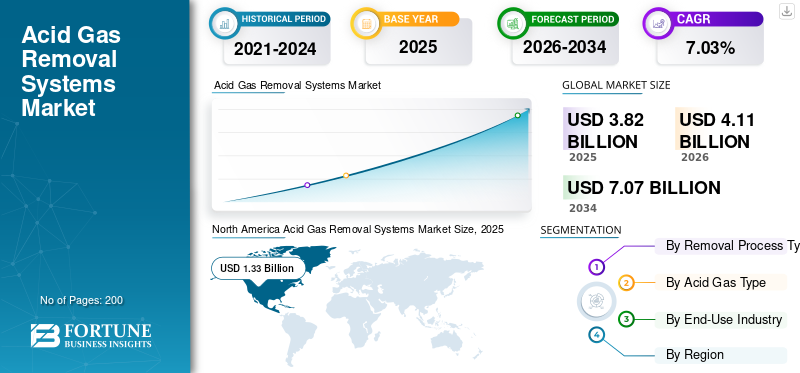
The global acid gas removal process systems market size was valued at USD 3.82 billion in 2025. The market is projected to grow from USD 4.11 billion in 2026 to USD 7.07 billion by 2034, with a CAGR of 7.03% over the forecast period. North America dominated the acid gas removal process systems market with a market share of 34.81% in 2025.
Acid gas removal system (AGRS) is a process unit or integrated treatment system designed to remove acidic gases, primarily hydrogen sulfide (H₂S) and carbon dioxide (CO₂), from natural gas, synthesis gas (syngas), refinery gas, biogas, and other industrial gas streams before they are transported, processed, or utilized.
The market is primarily driven by the increasing demand for natural gas processing, stringent environmental regulations, and the rising adoption of carbon capture technologies. As natural gas production expands globally, particularly from sour gas reservoirs containing high concentrations of hydrogen sulfide (H₂S) and carbon dioxide (CO₂), the need for efficient gas sweetening and purification systems continues to grow. Governments and regulatory agencies are imposing stricter emission standards to reduce sulfur compounds and greenhouse gas emissions, encouraging industries to invest in advanced acid gas removal solutions. Amine-based acid gas removal systems represent the dominant technology segment in the market due to their high efficiency in removing carbon dioxide and hydrogen sulfide from natural gas, refinery gas, syngas, and industrial process streams. Gas purification solutions are a key component of AGRS, enabling the removal of contaminants such as carbon dioxide, hydrogen sulfide, mercaptans, water vapor, and other impurities from natural gas, syngas, biogas, hydrogen, and industrial gas streams.
Industrial scrubbing systems are also a critical component of Acid Gas Removal Systems (AGRS), designed to remove harmful acid gases such as hydrogen sulfide (H₂S), carbon dioxide (CO₂), sulfur dioxide (SO₂), and other contaminants from industrial exhaust and process gas streams. These systems utilize liquid absorbents, chemical solvents, or packed-bed scrubbers to capture and neutralize acid gases before they are released into the atmosphere or sent for downstream processing.
- In April 2025, Honeywell's Acid Gas Removal business partnered with Argent LNG to develop an LNG export terminal in Louisiana, U.S. Honeywell will assess the application of its LNG pretreatment technologies, such as its Acid Gas Removal Unit (AGRU), to extract heavy hydrocarbons, mercury, water, sulfur compounds, and CO₂ from natural gas prior to liquefaction. Honeywell stated that its AGRU technology is a component of a comprehensive pretreatment solution created to improve the efficiency of LNG production and adhere to product specifications.
Honeywell, BASF SE, and SLB are considered major vendors in the market as they possess extensive technology portfolios, strong global project references, advanced gas treatment expertise, and a significant presence across the natural gas, LNG, refining, petrochemical, and carbon capture industries.
Download Free sample to learn more about this report.
ACID GAS REMOVAL SYSTEMS MARKET TRENDS
Rising Demand for Natural Gas Exploration and Production Activities Drive Market Forward
The increasing demand for natural gas as a cleaner alternative to coal and oil is driving investments in natural gas exploration and production activities worldwide, which in turn is boosting the demand for acid gas removal systems. A significant portion of newly discovered natural gas reserves are classified as sour gas, containing high concentrations of acid gases such as hydrogen sulfide and carbon dioxide. These contaminants must be removed before the gas can be transported, liquefied, or used in industrial and residential applications. As oil and gas companies expand exploration activities and develop unconventional gas resources, including shale gas and deepwater reserves, the need for efficient gas sweetening and purification technologies continues to increase.
- In June 2026, Oil India disclosed a substantial natural gas found in an Andaman Sea deepwater exploratory well. It is anticipated that the finding will aid in the country's offshore gas expansion. Gas processing infrastructure, such as acid gas removal units, will be necessary to eliminate pollutants and satisfy pipeline regulations as new offshore gas fields approach production.
MARKET DYNAMICS
MARKET DRIVERS
Download Free sample to learn more about this report.
Expansion of LNG Infrastructure to Drive Market Growth
The rapid expansion of global LNG infrastructure is expected to significantly drive the acid gas removal systems market growth. Before natural gas can be liquefied, impurities such as carbon dioxide (CO₂), hydrogen sulfide (H₂S), mercaptans, and other sulfur compounds must be removed to meet LNG quality specifications and prevent operational issues during the liquefaction process. Even small concentrations of acid gases can freeze at cryogenic temperatures, leading to equipment damage, pipeline blockages, reduced plant efficiency, and safety concerns. As a result, LNG developers increasingly rely on advanced acid gas removal technologies, including amine-based absorption systems, membrane separation technologies, and hybrid gas treatment solutions.
- In September 2021, PETRONAS chose BASF's OASE purple technology for the Acid Gas Removal Unit (AGRU) of its PFLNG Dua floating LNG plant in Malaysia, emphasizing the increasing incorporation of sophisticated acid gas treatment solutions in developing LNG infrastructure projects. This project represented a major achievement for BASF in offshore LNG applications, since it was the first floating LNG (FLNG) facility globally to employ BASF's OASE Gas Treatment technology. OASE purple process is a gas treatment method based on amines that was created to eliminate hydrogen sulfide (H₂S) and carbon dioxide (CO₂) from natural gas streams prior to liquefaction. The need for effective acid gas removal solutions is increasing as worldwide investments in LNG infrastructure, such as LNG export terminals, liquefaction plants, and floating LNG facilities, continue to climb.
MARKET RESTRAINTS
High Capital and Operating Costs to Restrain Market Growth
The high capital and operating costs associated with acid gas removal systems are expected to restrain market growth, particularly among small and medium-sized gas processing facilities. The installation of acid gas removal units requires substantial investments in absorption columns, regenerators, compressors, heat exchangers, sulfur recovery units, and associated infrastructure. In addition to the initial capital expenditure, operators incur significant ongoing costs related to solvent procurement, energy consumption, maintenance, and system monitoring. Conventional amine-based technologies, which are widely used for removing hydrogen sulfide (H₂S) and carbon dioxide (CO₂), require energy-intensive solvent regeneration processes that contribute to high operating expenses.
MARKET OPPORTUNITIES
Growing Investments in Carbon Capture, Utilization, and Storage (CCUS) to Drive Market Growth
The growing investments in Carbon Capture, Utilization, and Storage (CCUS) projects worldwide are expected to significantly drive the growth of the AGRS market. Governments, energy companies, and industrial operators are increasingly investing in CCUS technologies to reduce carbon emissions and achieve net-zero climate targets. Acid gas removal systems play a critical role in these projects by separating and capturing carbon dioxide (CO₂) from natural gas, syngas, hydrogen production streams, and industrial emissions before the gas is transported, utilized, or stored. Technologies such as amine-based absorption, physical solvents, and membrane separation are widely used to achieve high CO₂ capture efficiency.
In June 2024, a joint venture created by SLB and Aker Carbon Capture, called SLB Capturi, is committed to speeding up the global deployment of industrial carbon capture technology. For industrial sites, power generation, waste-to-energy, and cement, the business offers carbon capture solutions. This development is opening up new chances for acid gas removal systems and related gas treatment technologies because carbon capture projects need effective CO2 separation technologies.
MARKET CHALLENGES
Volatility in Oil and Gas Industry Investments May Hamper Market Growth
The volatility in oil and gas industry investments is expected to hamper the growth of the market, as demand for these systems is closely tied to capital spending on natural gas processing, LNG, refining, and petrochemical projects. Fluctuations in crude oil and natural gas prices often create uncertainty among energy companies, leading to delays, cancellations, or reductions in investments for new exploration, production, and gas processing facilities. During periods of low energy prices, operators typically prioritize cost optimization and defer large-scale infrastructure projects, which can reduce the deployment of acid gas removal systems.
Segmentation Analysis
By Removal Process Type
Regenerative Acid Gas Removal Systems are Gaining Traction as they Remove Co₂ and H₂S While Reducing Solvent Consumption Continuously
Based on removal process type, the market is classified into regenerative acid gas removal systems, non-regenerative acid gas removal systems, membrane-based acid gas removal systems, adsorption-based acid gas removal systems, and cryogenic acid gas removal systems.
Regenerative acid gas removal systems dominates the market and accounted for 37.23% in 2025 as their demand is increasing due to its ability to offer cost-effective, energy-efficient, and sustainable solutions for removing acid gases such as H₂S and CO₂ from natural gas, syngas, refinery gas, and industrial emissions. Unlike non-regenerative systems, regenerative technologies use solvents that can be continuously regenerated and reused, significantly reducing chemical consumption and operating costs over the system's lifetime. These systems are widely employed in natural gas processing, LNG facilities, refineries, petrochemical plants, hydrogen production, and carbon capture projects where continuous, large-volume gas treatment is required.
- In May 2025, BASF entered into a contract with Carbon Cap Applications Technology Co. (CCAT) to implement OASE blue technology at the Taiwan Power Company's Taichung Power Plant. The initiative illustrates the growing use of regenerative gas treatment systems in carbon capture applications in the power industry, with future goals of maybe increasing CO2 capture to 1 million tons per year.
The membrane-based acid gas removal systems segment is estimated to project the fastest-growth with a CAGR of 7.99% during the forecast period. Its growth is attributed to the system’s lower energy consumption, compact design, operational flexibility, and reduced maintenance requirements compared to conventional solvent-based technologies. Membrane systems selectively separate carbon dioxide (CO₂) and hydrogen sulfide (H₂S) from natural gas and industrial gas streams without the need for chemical solvents, making them an attractive solution for gas processing facilities seeking to improve efficiency and reduce operating costs.
By Acid Gas Type
Hydrogen sulfide (H₂S) Removal Systems Lead due to the Critical Need of Eliminating Toxic and Highly Corrosive H₂S
By acid gas type, the market is categorized into hydrogen sulfide (H2S) removal systems, carbon dioxide (C02) removal systems, and multi-component acid gas removal.
The hydrogen sulfide (H2S) removal systems segment dominated the market in 2025, accounting for 67.88% of acid gas removal systems market share. The segment’s dominance is led by the critical need to eliminate this highly toxic, corrosive, and environmentally hazardous gas from natural gas, refinery gas, syngas, and petrochemical processing streams. H₂S can cause severe corrosion in pipelines, processing equipment, and storage facilities, leading to increased maintenance costs and operational risks.
- In June 2026, Merichem Technologies finished a field test of its ECOTREAT technology in New Mexico, achieving a hydrogen sulfide removal efficiency of around 99% from gas streams with up to 20,000 ppm. Compared to traditional treatment methods, the system employs a regenerable catalytic process that does away with the generation of solid garbage and lowers operating expenses. Due to the increase in sour gas production, this advancement emphasizes the industry's increasing concentration on effective H₂S removal methods.
The carbon dioxide (C02) removal systems are projected to grow at a CAGR of 7.75% during the estimated timeframe. The segment’s growth is supported by widespread presence of CO₂ in natural gas, syngas, biogas, LNG feed gas, and industrial emissions streams, as well as the growing focus on carbon emission reduction and gas quality improvement. CO₂ must be removed from natural gas before transportation and liquefaction because it can reduce heating value, cause pipeline specification issues, and freeze during LNG production, leading to operational inefficiencies and equipment damage.
By End-Use Industry
To know how our report can help streamline your business, Speak to Analyst
Increasing Development of Sour Gas Reserves Drive Upstream oil & gas as the Leading End-use Industry
By end-use industry, the market is categorized into upstream oil and gas, LNG industry, Refining and petrochemicals, chemicals and fertilizers, renewable energy and biogas, and others.
The upstream oil and gas segment captured the largest market share, accounting for 35.85% in 2025. The upstream oil & gas segment dominates the market due to the increasing exploration and production of sour gas reserves containing high concentrations of hydrogen sulfide (H₂S) and carbon dioxide (CO₂). Before natural gas can be transported, processed, or sold, these acid gases must be removed to meet pipeline specifications, ensure operational safety, prevent equipment corrosion, and comply with environmental regulations.
- In March 2025, Northwind Midstream's Titan Treating Complex located in the Delaware Basin, received an addition of substantial sour gas treatment capacity and acid gas injection infrastructure. The expansion is intended to process natural gas streams with high amounts of hydrogen sulfide (H₂S) and carbon dioxide (CO₂) coming from production operations upstream. The company stated that the investment was primarily motivated by the Permian Basin's increasing sour gas output.
Renewable energy and biogas is the fastest-growing segment, projected to depict a CAGR of 9.11 over the forecast period. The segment’s growth is linked to the increasing biogas upgrading projects and the need to remove CO₂ and H₂S to produce high-purity biomethane for renewable energy applications.
ACID GAS REMOVAL SYSTEMS MARKET REGIONAL OUTLOOK
By geography, the market is categorized into Europe, North America, Asia Pacific, Latin America, and the Middle East & Africa.
Asia Pacific
North America Acid Gas Removal Systems Market Size, 2025 (USD Billion)
To get more information on the regional analysis of this market, Download Free sample
Asia Pacific’s acid gas removal systems market size was valued at USD 1.03 billion in 2025 and is expected to reach USD 1.12 billion by 2026. The market is experiencing significant growth due to rapid industrialization, increasing natural gas consumption, expanding LNG infrastructure, and rising investments in refining and petrochemical facilities across China, India, Japan, South Korea, and Australia. The region is witnessing substantial development of natural gas processing plants and LNG import/export terminals, which require the removal of acid gases such as carbon dioxide (CO₂) and hydrogen sulfide (H₂S) to meet gas quality standards.
CHINA ACID GAS REMOVAL SYSTEMS MARKET
In 2025, China’s market reached USD 0.35 billion primarily due to the country's extensive coal gasification, coal-to-chemicals, and hydrogen production industries, which generate significant volumes of synthesis gas (syngas) containing carbon dioxide (CO₂) and sulfur compounds that require treatment before downstream processing. Unlike many other regions where demand is largely driven by natural gas processing and LNG infrastructure, China's growth is strongly supported by its large-scale industrial decarbonization initiatives and investments in advanced manufacturing sectors.
- In March 2026, the Qilu-Shengli CCUS project, one of China's largest carbon capture initiatives, became one of Sinopec's expanding carbon capture, utilization, and storage (CCUS) operations. For enhanced oil recovery (EOR), the initiative captures and transfers CO2, raising the need for sophisticated CO2 removal and gas treatment technologies. The market is expanding as a result of the growth of CCUS infrastructure, given how crucial acid gas removal systems are for separating CO2 from industrial gas
INDIA ACID GAS REMOVAL SYSTEMS MARKET
In 2025, India captured USD 0.22 billion in 2025, accounting for roughly 21.20% of the global market. India's market is growing due to the country's increasing investments in fertilizer production, refinery expansion, compressed biogas (CBG) projects, and hydrogen development initiatives. India is one of the world's largest producers of ammonia and urea, where acid gas removal systems are extensively used to remove CO₂ and sulfur compounds from synthesis gas during fertilizer manufacturing. Additionally, government programs such as SATAT (Sustainable Alternative towards Affordable Transportation) are accelerating the development of compressed biogas plants, creating demand for gas upgrading systems that remove CO₂ and H₂S to produce pipeline-grade biomethane.
North America
North America is the dominating region in the global market with valuations accounting for USD 1.24 billion in 2024 and USD 1.32 billion in 2025. The region’s market expansion is fueled by its vast shale gas output, sour gas processing operations, and substantial carbon capture and storage (CCS) expenditures. Canada and the U.S. have vast unconventional natural gas resources, particularly in the Delaware Basin, Marcellus Shale, Permian Basin, and Montney formations, where natural gas streams frequently have significant amounts of hydrogen sulfide and carbon dioxide that need treatment prior to commercialization and transportation. Furthermore, the U.S. Gulf Coast is witnessing growing investment in LNG export terminals, which need sophisticated acid gas removal techniques to fulfill LNG feed gas specifications.
U.S. ACID GAS REMOVAL SYSTEMS MARKET
The U.S. market captured USD 1.11 billion in 2025 due to the country's increasing production of shale gas and sour gas resources, expanding LNG export infrastructure, and rising investments in CCUS projects. It is one of the world's largest natural gas producers, with major producing regions such as the Permian Basin, Delaware Basin, Eagle Ford, and Haynesville Shale generating gas streams that often contain significant concentrations of CO₂ and H₂S, requiring treatment before transportation and commercialization.
Europe
In 2025, Europe gained USD 0.42 billion and is expected to reach USD 0.44 billion in 2026 majorly due to the region's aggressive industrial decarbonization plans, carbon capture implementation, and projects for developing low-carbon hydrogen. Moreover, the region’s market growth also receives strong support from stringent climate policies under the European Green Deal, the Fit for 55 package, and national net-zero pledges, in contrast to North America, which is driven by shale gas production, or Asia Pacific, which is fueled by LNG and industrial expansion. In order to record and remove CO2 from hydrogen-generating plants, waste-to-energy facilities, chemical production operations, and industrial processes, industries throughout the region are employing acid gas removal technologies more frequently.
U.K. ACID GAS REMOVAL SYSTEMS MARKET
The U.K. accounted for around USD 0.06 billion in 2025, representing roughly 13.66% of the global market. It is growing due to the country's strong focus on developing a low-carbon industrial economy, particularly through large-scale hydrogen production, industrial cluster decarbonization, and offshore carbon storage projects. It is investing heavily in initiatives such as the HyNet North West and East Coast Cluster, which aim to capture millions of tons of CO₂ from industrial facilities and hydrogen production plants.
GERMANY ACID GAS REMOVAL SYSTEMS MARKET
Germany achieved USD 0.08 billion in 2025, accounting for roughly 19.46% of the global market due to the country's strong presence in the chemical, ammonia, and industrial manufacturing sectors, which require extensive gas purification processes to remove carbon dioxide (CO₂) and sulfur-containing compounds from synthesis gas and industrial gas streams. As Germany advances its industrial transformation strategy, companies are increasingly investing in low-carbon production technologies, particularly in the chemicals and manufacturing industries, where acid gas removal systems are essential for feedstock purification and process efficiency.
Latin America & Middle East Africa
Latin America and the Middle East & Africa (MEA) stood at USD 0.16 billion and USD 0.88 billion, respectively, in 2025. Latin America’s market is growing due to increasing investments in offshore oil and gas developments, associated gas processing, and refinery modernization projects across Brazil, Argentina, and Mexico.
The Middle East & Africa’s AGRS market is growing due to the region's abundant sour gas reserves and large-scale gas processing projects aimed at maximizing hydrocarbon recovery and meeting rising domestic and export energy demand. Saudi Arabia, the UAE, Qatar, and Kuwait are increasingly developing gas fields with high concentrations of hydrogen sulfide (H₂S) and carbon dioxide (CO₂), which require advanced acid gas removal technologies before the gas can be utilized or exported.
GCC ACID GAS REMOVAL SYSTEMS MARKET
The GCC market in 2025 stood at around USD 0.61 billion, representing roughly 69.40% of the global market. Because of the region's increasing emphasis on gas monetization, petrochemical feedstock optimization, and sulfur management projects, the GCC Acid Gas Removal Systems (AGRS) market is expanding. To maximize the worth of hydrocarbon resources and aid in economic diversification plans, GCC countries are making significant investments in integrated gas processing and petrochemical facilities.
COMPETITIVE LANDSCAPE
Key Industry Players
Acid Gas Removal Systems Vendors are Developing Advanced CO₂ and H₂S Treatment Technologies to Gain Market Share
Key players are working to create highly effective gas treatment technology, grow carbon capture capacity, and satisfy the rising need for projects involving sour gas processing, hydrogen, and liquefied natural gas (LNG). Honeywell, BASF, SLB, Air Liquide, and Linde are investing in advanced solvent-based, membrane-based, and hybrid acid gas removal systems that lower energy consumption and operating costs while increasing CO2 and H2S removal effectiveness.
- In February 2024, Fluor's proprietary Econamine FG Plus carbon capture technology was chosen by Chevron New Energies for its Eastridge Cogeneration plant in California. It is anticipated that the technology will lower CO2 emissions by about 95%. Econamine is primarily a carbon capture project, but it is built on advanced acid gas absorption ideas and is frequently used to remove CO2 from industrial gas streams.
LIST OF KEY ACID GAS REMOVAL SYSTEMS COMPANIES PROFILED
- Honeywell UOP (U.S.)
- Shell Global Solutions (Netherlands)
- BASF SE (Germany)
- Dow Inc. (U.S.)
- SLB (Schlumberger Limited) (U.S.)
- Fluor Corporation (U.S.)
- John Wood Group plc (U.K.)
- Worley Limited (Australia)
- Linde plc (U.K.)
- Air Liquide S.A. (France)
- Elessent Clean Technologies (formerly DuPont Clean Technologies) (U.S.)
- Mitsubishi Heavy Industries, Ltd. (Japan)
- Prosernat (Technip Energies) (France)
- ExxonMobil Technology & Engineering Company (U.S.)
- Aker Solutions ASA (Norway)
KEY INDUSTRY DEVELOPMENTS
- June 2025: Johnson Matthey, GIDARA Energy, Samsung E&A, and Honeywell formed a strategic partnership to create an all-in-one method for creating sustainable aviation fuel (SAF) from biomass and municipal solid trash. GIDARA's gasification technology converts garbage into syngas (synthesis gas), which includes impurities such as carbon dioxide (CO₂), hydrogen sulfide (H₂S), and other sulfur chemicals, as part of the process. These pollutants must be eliminated using advanced acid gas removal systems before the syngas can be transformed into SAF via downstream synthesis operations in order to preserve catalysts, increase conversion efficiency, and ensure fuel quality. Thus, the increasing use of SAF and waste-to-fuel production plants is opening up new avenues for technologies that eliminate acid gases, emphasizing their crucial position in the developing value chain for sustainable fuels.
- October 2025: The acquisition of Sulphurnet, a Netherlands-based provider of sulfur processing and advanced filtration technologies, by Elessent Clean Technologies is one of the market's most recent major developments. Solutions from Sulphurnet are designed to eliminate impurities from sulfur feed streams, boosting the effectiveness and reliability of sulfur recovery in gas processing and sulfur treatment operations.
- May 2025: The expansion of the Advanced KM CDR Process by Mitsubishi Heavy Industries, which is an amine-based gas treatment technology designed for efficient CO₂ removal from industrial gas streams. In 2025, MHI launched a new CO₂ capture pilot plant at Kansai Electric Power's Himeji No. 2 Power Station in Japan in order to further advance next-generation carbon capture technologies. The plant is being used to show off sophisticated CO2 separation methods, improve capture efficiency, and lower operational expenses.
- December 2024: Worley Limited is strengthening its presence in the Acid Gas Removal Systems market by participating in ADNOC Gas' Bab Gas Cap project in Abu Dhabi. The company is designing acid gas enrichment, sulfur recovery, acid gas removal, and CO₂ capture facilities in accordance with the FEED contract to handle the rise in sour gas processing capacity. In addition to these advancements, Worley's partnership with Dow Global Technologies for UCARSOL solvent technologies further strengthens its capability to provide sophisticated acid gas treatment and sulfur recovery solutions for gas processing projects around the world.
- June 2020: The Acid Gas Recycling Project (NAGRP) at the Mina Al-Ahmadi Refinery was completed by the Kuwait National Petroleum Company (KNPC). The objective of the project was to improve gas utilization and substantially lower emissions while recycling condensate and acidic gas that were generated by Kuwait Oil Company's western oilfields. The facility processes hydrogen sulfide (H₂S) into elemental sulfur for sale abroad and reduces sulfur dioxide emissions in line with environmental laws.
REPORT COVERAGE
The global acid gas removal systems market analysis provides an in-depth study of the market size & forecast across all segments. It contains details on the market dynamics and trends expected to drive the market in the forecast period. Moreover, the report offers information on technological advancements, new product launches, key industry developments, and partnerships, mergers & acquisitions. The market research report also includes a detailed competitive landscape, providing market share and profiles of key players.
Request for Customization to gain extensive market insights.
Report Scope & Segmentation
| ATTRIBUTE | DETAILS |
| Study Period | 2021-2034 |
| Base Year | 2025 |
| Estimated Year | 2026 |
| Forecast Period | 2026-2034 |
| Historical Period | 2021-2024 |
| Growth Rate | CAGR of 7.03% from 2026-2034 |
| Unit | Value (USD Billion) |
| Segmentation | By Removal Process Type, Acid Gas Type, End-Use Industry, and Region |
| By Removal Process Type |
|
| By Acid Gas Type |
|
| By End-Use Industry |
|
| By Geography |
|
Frequently Asked Questions
Fortune Business Insights says that the global market value stood at USD 3.82 billion in 2025 and is projected to reach USD 7.07 billion by 2034.
The market is expected to exhibit a CAGR of 7.03% during the forecast period.
The upstream oil and gas segment led the market by end-use industry.
Expansion of LNG infrastructure is a key factor driving market growth.
Honeywell UOP, BASF SE, and Dow Inc. are among the top players in the market.
North America dominates the market in terms of market share.
Growing investments in Carbon Capture, Utilization, and Storage (CCUS) is one of the key factors driving product adoption.



- 2021-2034
- 2025
- 2021-2024
- 200
Get 30-60 hrs Free Customization
Expand Regional and Country Coverage, Segments Analysis, Company Profiles, Competitive Benchmarking, and End-user Insights.















Related Reports
-
US +1 833 909 2966 ( Toll Free )
-
Get In Touch With Us