AI-Based Prior Authorization Automation Market Size, Share & Industry Analysis, By Component (Software/Platform and Services), By Deployment (Cloud-Based, On-Premise, and Hybrid), By Technology (NLP/Generative AI, Machine Learning, and Rules/Workflow Automation), By Application (Eligibility & Benefit Verification, Clinical Criteria Matching, and Prior Authorization Request Submission), By Workflow (Prospective, Retrospective, Medication, and Procedure/Imaging Authorization), By End User (Healthcare Providers, Healthcare Payers, and RCM Vendors & BPOs), and Regional Forecast, 2026-2034
 Download Free Sample
AI-Based Prior Authorization Automation Market Size and Future Outloo
 Listen to Audio Version
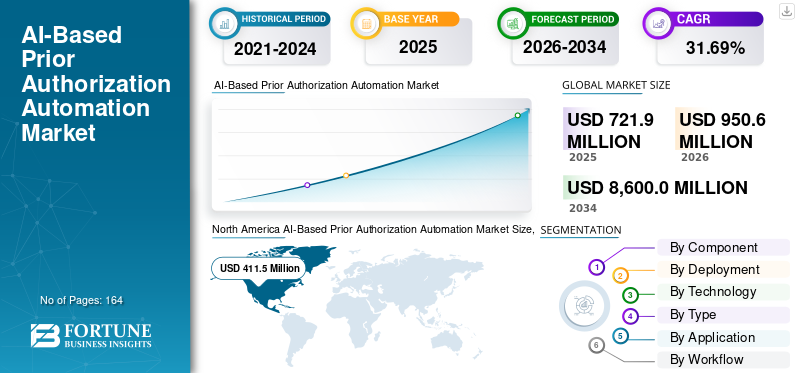
The global AI-based prior authorization automation market size was valued at USD 721.9 million in 2025. The market is projected to grow from USD 950.6 million in 2026 to USD 8,600.0 million by 2034, exhibiting a CAGR of 31.69% during the forecast period. North America dominated the AI-based prior authorization automation market with a market share of 57.00% in 2025.
The global market includes software platforms and services used to streamline authorization workflows across healthcare providers, payers, pharmacies, PBMs, and RCM organizations. The market is growing due to rising administrative burden, increasing authorization volumes, pressure to reduce care delays, and expanding adoption of AI, NLP, generative AI, predictive analytics, OCR, and workflow automation.
Key market players in the global market include Cohere Health, Waystar, Infinx Healthcare, and Availity, LLC, among others. These companies are focusing on advanced product offering along with strategic initiatives to strengthen their market presence.
Download Free sample to learn more about this report.
AI-Based Prior Authorization Automation Market KEY TAKEAWAYS
 Global Market Size & Forecast
- 2025 Market Size: USD 721.9 million
- 2026 Market Size: USD 950.6 million
- 2034 Forecast Market Size: USD 8,600.0 million
- CAGR: 31.69% from 2026–2034
 Market Share
- North America dominated the market with a 57.00% share in 2025.
- The services segment is anticipated to grow at a CAGR of 24.53% during the forecast period.
- The hybrid segment is growing at a CAGR of 27.97% during the forecast period.
 Key Regional Highlights
Asia Pacific
The Asia Pacific market is expected to reach USD 189.1 million by 2026, supported by large patient populations and growing healthcare IT adoption across major countries.
North America
North America dominated the market with USD 411.5 million in 2025, supported by high prior authorization volumes, established healthcare networks, and strong healthcare IT adoption.
Europe
Europe is projected to grow at a CAGR of 32.48% during the forecast period, supported by healthcare digitalization, interoperable EHR adoption, and efforts to streamline insurer pre-approval processes.
U.S.
The U.S. dominated the North American market and is analytically estimated at around USD 498.8 million in 2026, driven by increasing demand to reduce administrative burdens across healthcare providers and insurers.
Japan
The Japanese market is estimated at around USD 28.2 million in 2026, accounting for roughly 3.0% of global revenues.
Read More

AI-BASED PRIOR AUTHORIZATION AUTOMATION MARKET TRENDS
Shift from Basic Workflow Automation to Agentic AI is a Noticeable Market Trend
The market is progressively transitioning from rule-based tools that merely generate alerts or direct tasks to agentic AI platforms that can autonomously handle multiple prior authorization stages. These systems are capable of accessing clinical records, pulling pertinent evidence, aligning with payer standards, preparing submissions, tracking case progress, and elevating intricate requests for human evaluation. This change assists providers and payers in minimizing manual efforts, enhancing response times, and handling growing authorization volumes without significantly raising personnel. With enhanced interoperability, agentic AI is anticipated to emerge as a fundamental component within comprehensive utilization-management processes. These factors are supporting the overall global AI-based prior authorization automation market growth during the forecast period.
- In July 2025, ZeOmega announced a statewide initiative with the Massachusetts Health Data Consortium to automate prior authorization and clinical-data exchange using FHIR-based technology, supporting faster approvals and reduced administrative paperwork.
MARKET DYNAMICS
MARKET DRIVERS
Download Free sample to learn more about this report.
High Administrative Burden Associated with Prior Authorization is Propelling Market Growth
Prior authorization requires staff to verify payer rules, collect clinical documents, complete portal submissions, and repeatedly track request status. These manual activities increase administrative costs, consume clinical staff time, and create treatment and reimbursement delays. Consequently, healthcare organizations are adopting AI-based platforms to automate requirement identification, documentation review, submission, and payer follow-up. All these factors cumulatively drive the overall market growth.
- In October 2025, athenahealth introduced AI-native athenaOne capabilities, including AI agents designed to improve the speed and quality of prior authorizations while reducing manual administrative work across physician practices.
|
Rank |
Market Driver |
Expected Impact on Market Growth |
Estimated Gross Market Growth Contribution (USD Million) |
Impact: 2026-2028 |
Impact: 2029-2031 |
Impact: 2032-2034 |
|
1 |
Rising administrative burden and need to reduce prior authorization turnaround time |
High |
2,500.00 |
High |
High |
High |
|
2 |
Regulatory push toward electronic and interoperable prior authorization |
High |
2,100.00 |
High |
High |
Medium |
|
3 |
Increasing authorization volumes for specialty drugs, imaging, procedures, and high-cost care |
High |
1,700.00 |
Medium |
High |
High |
|
4 |
Rapid advancement of NLP, generative AI, predictive analytics, and document AI |
Medium–High |
1,400.00 |
Medium |
High |
High |
|
5 |
Growing pressure to reduce denials, revenue leakage, and treatment delays |
Medium |
1,000.00 |
Medium |
High |
High |
|
6 |
Others |
Low |
600 |
Low |
Low |
Low |
|
|
Total Gross Growth Contribution |
|
9,300.00 |
|
|
|
MARKET RESTRAINTS
High Implementation and Integration Costs to Hamper Market Growth
AI powered prior authorization platforms must connect with EHRs, payer APIs, RCM systems, clinical databases, and legacy authorization portals. Building customized interfaces, adopting FHIR standards, redesigning workflows, training employees, and maintaining changing payer rules increase deployment costs. These expenses can delay adoption, particularly among smaller hospitals, specialty clinics, and physician practices with limited IT budgets.
- In January 2024, CMS finalized requirements for impacted payers to implement and maintain FHIR-based prior authorization APIs, highlighting the substantial technical integration and system-upgrade work required across payer and provider infrastructure.
|
Rank |
Market Restraint |
Expected Impact on Market Growth |
Estimated Reduction in Market Size (USD Million) |
Impact: 2026-2028 |
Impact: 2029-2031 |
Impact: 2032-2034 |
|
1 |
Fragmented payer rules, clinical policies, and authorization workflows |
High |
-650 |
High |
High |
Medium |
|
2 |
High implementation, integration, and workflow-transformation costs |
Medium–High |
-450 |
High |
Medium |
Medium |
|
3 |
Data privacy, cybersecurity, AI accuracy, and regulatory concerns |
Medium |
-350.6 |
Medium |
Medium |
High |
|
4 |
Others |
Low |
-200 |
Low |
Low |
Low |
|
|
Total Market Reduction |
|
-1,650.60 |
|
|
|
MARKET OPPORTUNITIES
End-to-End Authorization Orchestration to Offer Market Growth Opportunities
Healthcare organizations increasingly need a comprehensive platform that oversees the entire prior authorization process rather than using separate tools for specific tasks. End-to-end orchestration integrates benefit verification, requirement identification, clinical document gathering, request submission, status tracking, decision management, and appeals. This presents a chance for vendors to minimize workflow fragmentation, enhance transparency, and facilitate increased authorization volumes via a unified integrated platform. All these factors would drive the market growth in the coming years.
- In March 2025, Infinx acquired Glidian to strengthen its prior authorization capabilities, combining AI-powered technology, payer integrations, workflow automation, and specialist services across comprehensive authorization workflows.
MARKET CHALLENGES
Limited Interoperability and Inconsistent Data Quality Pose a Prominent Challenge to Market Growth
Automation of prior authorization using AI relies on precise exchange of clinical data among EHRs, payer platforms, RCM systems, and authorization portals. Nevertheless, inadequate records, disorganized attachments, mismatched coding, and incompatible interfaces can hinder automated tools from recognizing the appropriate payer criteria or required documentation. This enhances exception management, diminishes touchless approvals, and compels providers to maintain manual review teams, constraining the efficiency benefits from AI implementation. All the factors cumulatively affect the market growth.
- In July 2025, ASTP/ONC finalized new FHIR-based certification criteria under the HTI-4 Final Rule to standardize electronic prior authorization exchange, indicating that interoperability between provider and payer systems remains a significant implementation challenge.
Segmentation Analysis
By Component
Software/Platform Segment Dominated Due to Growing Adoption of End-to-End Authorization Automation
In terms of component, the market is bifurcated into software/platform and services.
The software/platform segment accounted for the largest global AI-based prior authorization automation market share in 2025. This growth is driven by the increasing adoption of integrated solutions by healthcare organizations to automate eligibility checks, clinical data extraction, payer-rule matching, request submission, and status tracking. These platforms generate recurring subscription and transaction-based revenue and can process higher authorization volumes without a proportional increase in administrative staff. Moreover, continuous advances in NLP, generative AI, predictive analytics, and workflow orchestration strengthened the demand for scalable prior authorization software across providers and payers.
- In August 2025, ZeOmega launched Smart Auth Optimizer, a machine learning-powered prior authorization platform designed to accelerate approvals, reduce utilization-management costs, and integrate with payer and provider workflows.
The services segment is anticipated to rise with a CAGR of 24.53% over the forecast period.
To know how our report can help streamline your business, Speak to Analyst
By Deployment
Cloud-Based Segment Led the Market Due to Faster Deployment and Scalable Authorization Processing
On the basis of deployment, the market is divided into on-premise, cloud-based, and hybrid.
The cloud-based segment dominated the global market share in 2025. Healthcare organizations required scalable platforms that could connect with multiple EHRs, payer systems, and authorization portals without extensive local infrastructure. Cloud-based deployment enables faster implementation, centralized payer-rule updates, remote access, and flexible processing of changing authorization volumes. Moreover, subscription-based pricing and easier integration with AI models, APIs, and automation tools supported adoption among providers, payers, pharmacies, and RCM vendors. Furthermore, the segment is set to hold a share of 68.3% in 2026.
- In April 2025, UiPath partnered with Google Cloud to launch a generative AI-powered medical record summarization agent designed to reduce prior authorization turnaround time by up to 50%.
The hybrid segment is growing at a CAGR of 27.97% over the forecast period.
By Technology
NLP/Generative AI Segment Dominated Due to Its Ability to Interpret Complex Clinical Documentation
Based on technology, the market is classified into NLP/generative AI, machine learning & predictive analytics, rules/workflow automation, OCR/document AI, and others.
The NLP/generative AI segment dominated the global market in 2025. This growth is due to the prior authorization workflow’s involvement in large volumes of unstructured physician notes, medical records, and payer policies. These technologies can summarize clinical evidence, interpret medical terminology, match documentation with coverage criteria, and draft authorization requests or medical-necessity narratives. Additionally, their ability to automate knowledge-intensive tasks beyond basic rule-based processing supported strong adoption among healthcare payers and providers. Furthermore, the segment is set to hold a share of 40.4% in 2026.
- In October 2025, Cohere Health announced the integration of its prior authorization capabilities with Microsoft Dragon Copilot to automate care requests using ambient clinical intelligence at the point of care.
The machine learning & predictive analytics segment is anticipated to rise with a CAGR of 31.10% over the forecast period.
By Type
Seamless Connectivity with Existing Healthcare Workflows Supported Integrated Segment’s Leadership
In terms of type, the market is divided into standalone and integrated.
The integrated segment captured the highest share of the global market in 2025. This can be attributed to the fact that healthcare organizations prefer prior authorization solutions embedded within EHRs, payer platforms, RCM systems, and clinical decision-support workflows. Integrated platforms reduce duplicate data entry, automatically retrieve patient and clinical information, and allow staff to submit and track requests without switching between multiple portals. Moreover, seamless connectivity supports faster processing, better data accuracy, and wider enterprise-level adoption across providers and payers. Furthermore, the segment is set to hold 50.5% share in 2026.
- In August 2025, Availity and Onyx launched an integrated FHIR-based platform to help health plans manage interoperability and prior authorization requirements through a unified compliance solution.
The standalone segment is anticipated to rise with a CAGR of 26.12% over the forecast period.
By Application
Prior Authorization Request Submission Segment Dominated Due to High Transaction Volumes and Manual Workload
On the basis of application, the market is divided into eligibility & benefit verification, clinical criteria matching, prior authorization request submission, document extraction & medical record review, status tracking & payer communication, denial prediction & appeals support, and others.
The prior authorization request submission segment captured the highest share of the global market in 2025. Nearly every authorization case requires patient data, clinical evidence, payer forms, and supporting documents to be compiled and transmitted. AI-based platforms automate data entry, validate submission completeness, attach required records, and route requests through payer portals or APIs. The high frequency of this activity and its direct impact on approval turnaround times supported the segment’s leading market share. Furthermore, the segment is set to hold a share of 20.0% in 2026.
- In February 2025, Waystar introduced Auth Accelerate within its Authorization Manager platform to automate authorization workflows and enable real time approvals without requiring clinical documentation for eligible requests.
The clinical criteria matching segment is anticipated to rise with a CAGR of 32.51% over the forecast period.
By Workflow
Prospective Prior Authorization Segment Led the Market Due to the Need for Approval Before Care Delivery
In terms of workflow, the market is categorized into prospective prior authorization, retrospective authorization review, medication prior authorization, procedure/imaging prior authorization, referral & specialty care authorization, and others.
In 2025, the prospective prior authorization segment led the market as the majority of payers demand approval for coverage prior to the administration of medications, procedures, imaging, or specialty care. AI-driven solutions assist providers in recognizing authorization needs promptly, gathering clinical evidence, submitting requests, and addressing documentation deficiencies prior to the planned treatment. This minimizes appointment cancellations, delays in treatment, and claim denials due to authorization issues, facilitating widespread adoption throughout provider and payer processes. Furthermore, the segment is set to hold 32.9% share in 2026.
- In February 2025, Surescripts unveiled its Prior Authorization Automation technology to complete medication authorization requirements within the prescribing workflow and accelerate patient access before treatment initiation.
The referral & specialty care authorization segment is anticipated to rise with a CAGR of 33.09% over the forecast period.
By End User
Healthcare Providers Segment Dominated Due to High Administrative and Revenue-Cycle Burden
In terms of end user, the market is segmented into healthcare providers, healthcare payers, RCM vendors & BPOs, pharmacies/PBMs, and others.
In 2025, the healthcare providers segment held the leading position in the global market. The segment’s dominance can be attributed to the fact that these facilities manage large volumes of authorization requests before delivering medications, imaging, procedures, and specialty care. Providers directly bear the workload of collecting records, completing payer-specific submissions, tracking decisions, and resolving authorization-related denials. Therefore, they increasingly adopt AI-based platforms to reduce staff burden, avoid treatment delays, and protect reimbursement. Furthermore, the segment is set to hold 40.9% share in 2026.
- In August 2025, Allegheny Health Network and Highmark Health announced a collaboration with Abridge to deploy AI-enabled real-time prior authorization within clinician workflows across an integrated payer-provider ecosystem.
In addition, healthcare payers are projected to witness a growth rate of 33.16% during the forecast period.
AI-Based Prior Authorization Automation Market Regional Outlook
By region, the market is divided into North America, Latin America, Asia Pacific, Europe, and the Middle East & Africa.
North America
North America AI-Based Prior Authorization Automation Market Size, 2025 (USD Million)
To get more information on the regional analysis of this market, Download Free sample
The North America market reached USD 319.3 million in 2024 and led the global market. In 2025, the region continued to hold its leading position, with USD 411.5 million. The regional growth is primarily driven by the high volume and administrative cost of prior authorization across hospitals, physician practices, health plans, pharmacies, and PBMs. Strong EHR penetration, established payer-provider networks, high specialty-drug utilization, and the presence of major vendors further support regional dominance.
U.S. AI-Based Prior Authorization Automation Market
The U.S. dominated the North American market and can be analytically approximated at around USD 498.8 million for 2026, accounting for roughly 52.5% of the global market.
Europe
Europe’s market size is anticipated to grow at a CAGR of 32.48% during the forecast period. The region’s growth is supported by the continued digitalization of healthcare systems, increasing adoption of interoperable EHR infrastructure, and pressure to streamline insurer pre-approval and medical-necessity review processes.
U.K. AI-Based Prior Authorization Automation Market
The U.K. market size in 2026 is estimated at around USD 35.6 million, representing roughly 3.7% of global revenues.
Germany AI-Based Prior Authorization Automation Market
The Germany market size is projected to reach approximately USD 38.4 million by 2026, equivalent to around 4.0% of global sales.
Asia Pacific
The Asia Pacific market is expected to reach a valuation of USD 189.1 million by 2026. Asia Pacific is expected to record strong growth due to large patient populations and growing healthcare IT adoption in China, India, Japan, South Korea, Australia, and Southeast Asia.
Japan AI-Based Prior Authorization Automation Market
The Japan market in 2026 is estimated at around USD 28.2 million, accounting for roughly 3.0% of global revenues.
China AI-Based Prior Authorization Automation Market
China’s market is projected to reach revenues of around USD 59.9 million by 2026, representing roughly 6.3% of global sales.
India AI-Based Prior Authorization Automation Market
The Indian market size in 2026 is estimated at around USD 24.9 million, accounting for roughly 2.6% of global revenues.
Latin America and Middle East & Africa
The Middle East & Africa and Latin America regions are likely to witness a moderate growth over the forecast period. The market in Latin America is projected to attain a valuation of USD 39.1 million by 2026. The regional growth is supported by digital transformation of fragmented healthcare systems, increasing private insurance penetration, and the need to reduce manual coordination between providers and insurers.
In the Middle East & Africa region, the GCC market is projected to reach approximately USD 9.0 million by 2026, representing about 0.9% of worldwide revenues. The regional market expansion is supported by government-led healthcare modernization, growing private hospital and insurance networks, and rising investment in AI, cloud platforms, and electronic medical records.
COMPETITIVE LANDSCAPE
Key Industry Players
Focus on Integrated AI Platforms, Payer Connectivity, and Clinical Automation by Key Players to Strengthen Market Position
The global AI-based prior authorization automation market is moderately fragmented, with companies such as Cohere Health, Waystar, Infinx Healthcare, and Availity, LLC accounting for a significant market share. These players are focusing on end-to-end authorization platforms, payer integrations, clinical criteria matching, AI-based document review, real-time submissions, and status tracking to strengthen their competitive positions.
- In May 2025, Cohere Health raised USD 90 million to expand its AI-powered clinical decision-making platform and extend its presence across prior authorization and related health-plan workflows.
Additional key entities include Rhyme, MCG Health, ZeOmega, and Surescripts. These companies are strengthening market presence through partnerships and interoperable authorization networks.
LIST OF KEY AI-BASED PRIOR AUTHORIZATION AUTOMATION COMPANIES PROFILED
- Cohere Health (U.S.)
- Waystar (U.S.)
- Infinx Healthcare (U.S.)
- Availity, LLC. (U.S.)
- Rhyme (U.S.)
- MCG Health (U.S.)
- ZeOmega (U.S.)
- Surescripts (U.S.)
- Experian Information Solutions, Inc. (U.S.)
- Anterior, Inc. (U.S.)
KEY INDUSTRY DEVELOPMENTS
- May 2026: Cohere Health joined and endorsed the CMS Electronic Prior Authorization Acceleration initiative under the Health Tech Ecosystem program. The participation is intended to support electronic clinical-data exchange, faster authorization decisions, and improved payer-provider collaboration.
- March 2026: Telligen’s MCG-supported Blue-Ribbon Prior Authorization Program received the 2025 Richard L. Doyle Award. The program expanded provider participation by 500% and increased automated authorization volumes by 180%, demonstrating the scalability of evidence-based authorization automation.
- October 2025: Surescripts expanded its Prior Authorization Automation technology to more than 76,000 prescribers and over 70 medications. The expansion strengthened automated clinical-information retrieval and rapid medication authorization within prescribing workflows.
- September 2025: Smile Digital Health partnered with MCG Health to advance FHIR-based prior authorization modernization. The companies’ combined interoperability infrastructure with evidence-based clinical guidance to support faster and more transparent payer-provider authorization decisions.
- March 2025: Cohere Health launched Cohere Align, a personalized prior authorization solution designed to move beyond traditional gold-carding programs. The platform uses provider performance and clinical intelligence to reduce unnecessary authorization requirements and accelerate access to appropriate care.
REPORT COVERAGE
The global AI-based prior authorization automation market analysis encompasses an extensive examination of the market size and projections for all market segments featured in the report. It provides information on the market dynamics and trends that are anticipated to propel the market during the forecast period. It offers insights into crucial elements, such as innovations in products, the regulatory landscape, and the introduction of new products. Furthermore, it outlines collaborations, mergers & acquisitions, along with significant advancements in the industry within the market. The global market forecast report additionally offers a comprehensive competitive landscape with details on market share and profiles of major active participants.
Request for Customization to gain extensive market insights.
Report Scope & Segmentation
| ATTRIBUTE | DETAILS |
| Study Period | 2021-2034 |
| Base Year | 2025 |
| Estimated Year | 2026 |
| Forecast Period | 2026-2034 |
| Historical Period | 2021-2024 |
| Growth Rate | CAGR of 31.69% from 2026-2034 |
| Unit | Value (USD Million) |
| Segmentation | By Component, Deployment, Technology, Type, Application, Workflow, End User, and Region |
| By Component |
|
| By Deployment |
|
| By Technology |
|
| By Type |
|
| By Application |
|
| By Workflow |
|
| By End User |
|
| By Region |
|
Frequently Asked Questions
According to Fortune Business Insights, the global market value stood at USD 721.9 million in 2025 and is projected to reach USD 8,600.0 million by 2034.
In 2025, North America’s market value stood at USD 411.5 million.
The market is expected to exhibit a CAGR of 31.69% during the forecast period.
By component, the software/platform segment is expected to lead the market.
High administrative burden, prior authorization, increasing care delays, and provider dissatisfaction are primarily driving market expansion.
Cohere Health, Waystar, Infinx Healthcare, and Availity, LLC. are some of the prominent players in the global market.
North America dominated the market in 2025.



- 2021-2034
- 2025
- 2021-2024
- 164
Get 30-60 hrs Free Customization
Expand Regional and Country Coverage, Segments Analysis, Company Profiles, Competitive Benchmarking, and End-user Insights.













.webp)






Related Reports
-
US +1 833 909 2966 ( Toll Free )
-
Get In Touch With Us