 Download Free Sample



Get a Quote
Receive a tailored pricing based on your needs.
- Choose license type
- Multiple user options
- Custom scope & coverage
- Fast turnaround
"Designing Growth Strategies is in our DNA"
 Listen to Audio Version
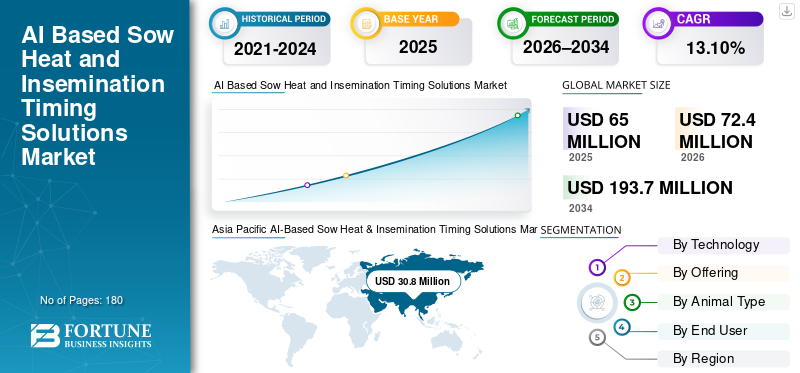
The global AI-based sow heat & insemination timing solutions market size was valued at USD 65.0 million in 2025. The market is projected to grow from USD 72.4 million in 2026 to USD 193.7 million by 2034, exhibiting a CAGR of 13.10% during the forecast period. Asia Pacific dominated the AI-based sow heat & insemination timing solutions market with a market share of 47.38% in 2025.
AI-based sow heat (estrus) and insemination timing solutions are precision-livestock tools that use Artificial Intelligence (AI) and Machine Learning (ML) to detect when a sow is coming into/standing in heat and recommend the best time window to inseminate for semen and ovulation to align. The market is witnessing significant growth owing to the rapid integration of AI/ML models into these products and the increasing demand for pork production across the globe.
Moreover, key players in the industry, such as Big Dutchman, Guangzhou Yingzi Technology Co., Ltd., and Conception Ro-Main Inc. are emphasizing on the launch of new products and collaborations to gain a competitive edge in this market.
Download Free sample to learn more about this report.
 Global Market Size & Forecast
 Market Share
 Key Regional Highlights
Asia Pacific
Asia Pacific market reached USD 30.8 million in 2025
North America
Regional growth is driven by enhanced workflow integration, record systems, and increasing software subscription adoption.
Europe
The market is projected to grow at a CAGR of 11.62% during the forecast period.
U.S.
U.S. market is estimated to reach USD 13.3 million by 2026.
Japan
Japan market is estimated to reach USD 1.3 million by 2026.
Read More

Shift toward Multi-Signal Systems and Hybrid Modules is a Prominent Market Trend
In recent years, the market is witnessing a strong shift from single-signal heat detection toward multi-signal fusion. Estrus expression varies by parity, housing, health, and environment. Hence, combining signals improve reliability and reduce false alerts. The integrated hybrid approach shortens deployment time, lowers workflow friction, and lets farms act immediately from the same platform. It also fits multi-site integrators who want standardized KPIs and centralized oversight across farms. These factors are supporting the global AI-based sow heat & insemination timing solutions market growth.
Download Free sample to learn more about this report.
Labor Shortage and Inconsistent Manual Heat Detection to Drive Product Adoption
Labor shortage is a key market driver as most sow farms still rely on skilled stockpersons to visually detect heat and decide insemination timing and performance varies widely by person, shift, and barn workload. When staffing is tight, farms reduce observation frequency, which increases missed heats, late breeding, and repeat services, directly raising non-productive days and disrupting pig flow. AI-based monitoring addresses this by enabling continuous automated heat alerts and more consistent decision-making, even when experienced labor is unavailable. It also standardizes breeding SOPs across large sites, improving compliance and reducing alert-to-action delays. As a result, integrated producers are increasingly willing to invest as the solution converts labor constraints into a measurable productivity. All these factors cumulatively drive the market growth.
Significant Upfront Investment to Limit Market Growth
Significant upfront investment restrains the market up to a certain extent as most deployments are hardware dependent and often need integration into existing sow-management/ESF workflows. Farms typically also incur installation, commissioning, and staff training costs before benefits show up in KPIs such as conception rate or non-productive days. The restraint is the strongest for small/medium farms and for regions where credit is costly as they must prioritize essential capex over new digital layers. Even integrated producers tend to bundle AI adoption into larger modernization cycles, which slows the addressable annual spend. As a result, vendors often need financing/partner ecosystems to overcome capex friction, but adoption is still concentrated among well-capitalized operators. These factors are likely to limit the market growth to a certain extent.
System-integrated Modules with ESF/Sow Management Ecosystems to Offer Market Growth Opportunities
System-integrated modules which are embedded in ESF/sow-management ecosystems are a strong market opportunity. Farms want one connected workflow where heat detection automatically drives actionable steps instead of running separate tools. Integration reduces friction by cutting IT/API work, avoiding duplicate hardware, and simplifying staff training, scaling adoption faster beyond pilots. Additionally, it also improves outcomes given that alerts are linked to farm execution, reducing missed heats, repeat breeders, and non-productive days. All these factors are likely to drive the market growth in the coming years.
Connectivity Constraints Pose a Significant Challenge to Market Growth
Connectivity constraints are a major market challenge as AI heat/estrus detection depends on continuous data flow from sensors/cameras to an edge device or cloud. When barn internet is weak or unstable which is common in rural areas, farms can see delayed alerts, missed optimal insemination windows, and gaps in historical data needed for model calibration. Poor connectivity also increases false alarms and alert fatigue as partial data streams can trigger incomplete pattern detection. This reduces user confidence and slows rollouts beyond pilot barns, especially for multi-site integrated producers that need standardized, real-time monitoring. All these factors cumulatively affect the market growth.
Rising Demand for System-Integrated Modules to Propel Segmental Growth
Based on technology, the market is divided into camera/ computer vision, sensor-based (wearables), system-integrated modules, and hybrid.
The system-integrated modules segment is anticipated to capture the largest global AI-based sow heat & insemination timing solutions market share. Key factors supporting this include frequent installations, easy deployments, and others. Owing to this, operating players are also focusing on the launch of new products in the market.
The hybrid segment is anticipated to rise with a CAGR of 16.68% over the forecast period.
To know how our report can help streamline your business, Speak to Analyst
High Capital Expenditure to Push Hardware Segment Growth
On the basis of offering, the market is divided into hardware, software, and services.
In 2025, the hardware segment dominated the global market. This is attributed to high capital investment, increasing number of installations especially by small farms, and other factors. Furthermore, the segment is set to hold a share of 51.1% in 2026.
The software segment is projected to witness a CAGR of 16.19% over the forecast period.
Sows Segment Led the Market owing to High Monitored Base
Based on animal type, the market is divided into gilts and sows.
In 2025, the sows segment led with the largest market share. This can be attributed to the fact that most AI heat-detection and insemination-timing deployments are designed around the core breeding herd. In addition, sows represent a larger monitored base on commercial farms and remain in the system across multiple parities. Furthermore, the segment is set to hold a share of 81.1% in 2026.
The gilts segment is anticipated to rise with a CAGR of 16.21% over the forecast period.
Integrated Pork Producers Segment Led the Market Owing to Adoption of Multi-site Sow Systems
On the basis of end user, the market is segmented into commercial sow farms, integrated pork producers, nucleus/multiplier breeding farms, and contract sow units.
In 2025, the integrated pork producers segment secured the dominating share in the global market. These producers run large, multi-site sow systems where small improvements in conception and farrowing rates translate into material, measurable ROI. Labor shortages further accelerate adoption, as automation reduces dependence on scarce skilled staff while improving compliance and documentation. Furthermore, the segment is set to hold a share of 39.1% in 2026.
In addition, the contract sow units segment is projected to grow at a CAGR of 13.49% during the forecast period.
By geography, the market is segmented into North America, Europe, Asia Pacific, Latin America, and the Middle East & Africa.
Asia Pacific AI-Based Sow Heat & Insemination Timing Solutions Market Size, 2025 (USD Million)
To get more information on the regional analysis of this market, Download Free sample
Asia Pacific dominated the global market with a value of USD 27.4 million in 2024 and USD 30.8 million in 2025. In the region, the penetration of AI technologies differs significantly by countries, making modular and hybrid deployments (multi-signal) essential for expanding beyond initial adopters.
In 2026, the Japan market is estimated to reach around USD 1.3 million, accounting for roughly 1.8% of global revenues.
The China market is projected to reach a revenue of around USD 26.2 million in 2026, representing roughly 36.2% of global sales. China is the world’s largest pork producer, with production concentrated in regions such as the Yangtze River and Huang-Huai-Hai Plain.
The India market is estimated to hit a valuation of around USD 1.4 million in 2026, accounting for roughly 1.9% of global revenues.
North America’s regional growth is propelled by enhanced workflow and data integration such as record systems and task execution, leading to software subscriptions and services taking up a larger share of expenditures.
The U.S. market captured the leading share of the North American market and can be analytically approximated at around USD 13.3 million in 2026, accounting for roughly 18.4% of the global market.
Europe market is expected to grow at a CAGR of 11.62% during the study period. The European market growth is driven by established system-integrated automation frameworks (feeding/workflow components) and quick validation through EuroTier-focused commercial introductions.
The U.K. market is estimated to reach a value of around USD 1.9 million in 2026, representing roughly 2.6% of global revenues.
The Germany market size is projected to reach approximately USD 1.0 million in 2026, equivalent to around 1.4% of global sales.
The Latin America and Middle East and Africa regions captured a smaller share of the market in 2025. These regions are anticipated to witness moderate growth over the study period. Latin America’s market is boosted by an export-led production model and rapid professionalization of farms. The Latin America market size is set to reach a valuation of USD 4.4 million in 2026.
Further, the Middle East & Africa market growth is anticipated to be driven by improvements in connectivity, technological modernization, and benefits associated with the integration of AI-based tools. The GCC market is estimated to touch a value of around USD 0.7 million in 2026, accounting for roughly 1.0% of global revenues.
Leading Companies Focus on Product Innovation and Strategic Collaborations to Strengthen Market Share
The global AI-based sow heat & insemination timing solutions market shows a consolidated competitive landscape. As the market is very niche, there are only a few entities that influence the growth trajectory of the overall market. The prominent players include Big Dutchman, Guangzhou Yingzi Technology Co., Ltd., and Conception Ro-Main Inc. These companies are focusing on new product launches and partnerships to maintain their market presence.
Other key players in the market include Fancom BV, Agrisys A/S, and others. Their strategies typically focus on partnerships to expand market presence.
Request for Customization to gain extensive market insights.
| ATTRIBUTE | DETAILS |
| Study Period | 2021-2034 |
| Base Year | 2025 |
| Estimated Year | 2026 |
| Forecast Period | 2026-2034 |
| Historical Period | 2021-2024 |
| Growth Rate | CAGR of 13.10% from 2026-2034 |
| Unit | Value (USD Million) |
| Segmentation | By Technology, Offering, Animal Type, End User, and Region |
| By Technology |
|
| By Offering |
|
| By Animal Type |
|
| By End User |
|
| By Region |
|
According to Fortune Business Insights, the global market value stood at USD 65.0 million in 2025 and is projected to reach USD 193.7 million by 2034.
In 2025, the market value stood at USD 30.8 million.
The market is expected to exhibit a CAGR of 13.10% during the forecast period of 2026-2034.
By technology, the system-integrated modules segment is expected to lead the market.
Labor shortage and inconsistent manual heat detection are primarily driving the market expansion.
Big Dutchman, Guangzhou Yingzi Technology Co., Ltd., and Conception Ro-Main Inc. are some of the major players in the global market.
Asia Pacific dominated the market in 2025.

Get 30-60 hrs Free Customization
Expand Regional and Country Coverage, Segments Analysis, Company Profiles, Competitive Benchmarking, and End-user Insights.













.webp)






Get In Touch With Us
US +1 833 909 2966 ( Toll Free )
Receive a tailored pricing based on your needs.
Discuss your questions with our industry experts.
Have questions? Get quick answers before you purchase.

