AI Data Readiness Platforms Market Size, Share & Industry Analysis, By Data Readiness Function (Data Integration and Ingestion, Data Quality and Cleansing, Data Cataloging and Metadata Management, Data Governance and Privacy, Data Transformation and Preparation, and Data Labeling and Annotation), By Deployment, By Enterprise Type (Large Enterprises and Small and Medium Enterprises (SMEs)), By End-user (BFSI, IT and Telecommunications, Healthcare and Life Sciences, Retail and E-commerce, Manufacturing, Government and Public Sector, and Others), and Regional Forecast, 2026-2034
 Download Free Sample
AI DATA READINESS PLATFORMS MARKET SIZE AND FUTURE OUTLOOK
 Listen to Audio Version
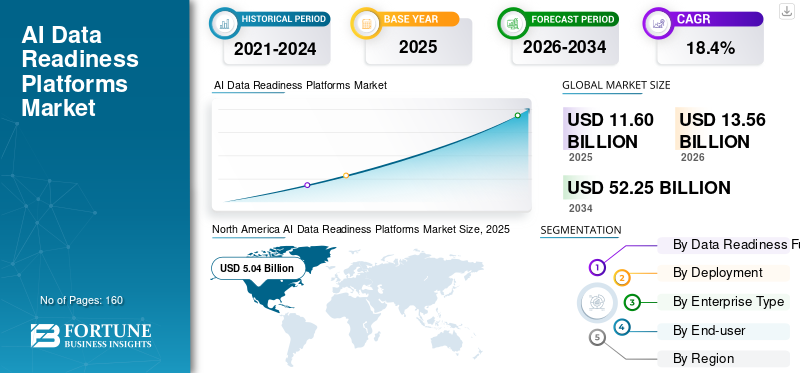
The AI data readiness platforms market size was valued at USD 11.60 billion in 2025 and is projected to grow from USD 13.56 billion in 2026 to USD 52.25 billion by 2034, exhibiting a CAGR of 18.4% during the forecast period. North America dominated the AI data readiness platforms market share of 43.44% in 2025.
AI data readiness platforms refer to software solutions that enable enterprises to prepare, organize, govern, and enhance data for effective use in artificial intelligence and machine learning applications. The market encompasses platforms supporting data integration and ingestion, data quality and cleansing, cataloging and metadata management, data governance and privacy, data transformation and preparation, and labeling and annotation. These solutions are deployed through cloud-based and on-premises environments and are adopted by large enterprises as well as small and medium-sized enterprises. Market growth is assessed across BFSI, IT and telecommunications, healthcare, retail, manufacturing, government, energy and utilities, and other end-user industries globally.
Salesforce, Inc., Microsoft Corporation, IBM Corporation, and Oracle Corporation are the top players in the global market.
Download Free sample to learn more about this report.
AI data readiness platforms market KEY TAKEAWAYS
 Global Market Size & Forecast
- 2025 Market Size: USD 11.60 Billion
- 2026 Market Size: USD 13.56 Billion
- 2034 Forecast Market Size: USD 52.25 Billion
- CAGR: 18.4% from 2026-2034
 Market Share
- North America dominated the market with a revenue share of 43.44% in 2025.
- Data integration and ingestion segment held the largest market share of 30.5% in 2025.
- BFSI segment held the largest market share of 22.5% in 2025.
 Key Regional Highlights
North America
North America dominated the market with revenue of USD 5.04 billion in 2025.
Europe
Europe holds a significant market share, supported by strong demand for data governance, privacy, and AI-ready data infrastructure.
Asia Pacific
Asia Pacific is expected to record the highest CAGR during the forecast period, driven by increasing AI investments and cloud adoption.
U.S.
The market was valued at around USD 4.45 billion in 2025, accounting for roughly 38.4% of global revenues.
Japan
The market was valued at around USD 0.44 billion in 2025, accounting for roughly 3.8% of global revenues.
Read More

AI data readiness platforms market TRENDS
Growing Shift toward Unified and Governed AI-Ready Data Foundations is a Key Market Trend
Enterprises are increasingly consolidating fragmented data sources through an intelligent data platform that combines a data readiness platform, knowledge graph platform, and data orchestration platform within a unified architecture. These platforms support automated data classification, metadata enrichment, lineage tracking, and preparation of structured, unstructured, and multimodal data for enterprise AI applications. The growing convergence of cloud-based AI platforms and on-premises AI platforms is also encouraging organizations to modernize their data infrastructure while maintaining security, scalability, and regulatory control. This trend is enabling organizations to generate more reliable AI outcomes and support increasingly complex advanced AI workloads.
- According to industry experts, through 2026, organizations will abandon 60% of AI projects that are unsupported by AI-ready data. This highlights the growing need for platforms that improve data quality, governance, accessibility, and contextual readiness before AI deployment.
MARKET DYNAMICS
MARKET DRIVERS
Download Free sample to learn more about this report.
Rapid Expansion of Enterprise AI Adoption Propels Market Growth
Rapid AI adoption across industries is increasing demand for high-quality data that can support production-scale AI initiatives, diverse AI use cases, and enterprise-wide automation. Organizations require reliable data integration, cleansing, transformation, and cataloging capabilities to improve AI model training and reduce failures across AI projects. The expansion of generative AI is further strengthening demand for platforms that can prepare trusted, contextual, and governed information for model development and deployment. As enterprises increase investment in AI development, data readiness capabilities are becoming essential to improve performance, reduce operational risk, and unlock the full potential of AI. This is expected to boost the AI data readiness platforms market growth in the coming years.
- According to industry experts’ 2025 Global Survey, 88% of respondents reported regular AI use in at least one business function, compared with 78% a year earlier. However, only around one-third stated that their organizations had begun scaling AI programs, strengthening demand for production-ready data foundations.
|
Rank |
Market Drivers |
Overall Impact Rank |
CAGR Contribution (2026-2034) |
Impact 2026-2028 |
Impact 2029-2031 |
Impact 2032-2034 |
|
1 |
Rapid expansion of enterprise AI, generative AI, and machine learning adoption is increasing the need for accurate, integrated, and AI-ready data. |
High |
+5.1% |
High |
High |
High |
|
2 |
Growing migration toward cloud-native data platforms, lakehouses, and unified data architectures is accelerating platform deployment. |
High |
+4.3% |
High |
High |
Medium |
|
3 |
Increasing regulatory, privacy, lineage, and responsible AI requirements are strengthening demand for governed and auditable enterprise data. |
High |
+3.8% |
Medium |
High |
High |
|
4 |
Rising volumes of unstructured, multimodal, and distributed enterprise data are increasing demand for preparation, cataloging, and metadata capabilities. |
High |
+3.5% |
Medium |
High |
High |
|
5 |
Growing demand for real-time data integration, automated data quality, and continuous data observability is supporting platform adoption. |
Medium |
+3.2% |
Medium |
High |
High |
|
6 |
Others (agentic AI adoption, synthetic data usage, SME digitalization, data products, and industry-specific AI initiatives) |
Medium |
+2.7% |
Low |
Medium |
High |
|
Total Positive Growth Contribution |
+22.6% |
MARKET RESTRAINTS
Complex Data Integration and Legacy-System Challenges to Restrain Market Growth
The market faces challenges, as enterprise data is frequently distributed across legacy applications, isolated databases, cloud environments, and on-premises AI platforms, making integration and standardization difficult. Organizations must establish a comprehensive data governance framework covering privacy, ownership, access permissions, lineage, quality, residency, and regulatory compliance before sensitive data can be used in AI applications. Weak governance, inconsistent formats, and incomplete data can undermine AI model training, delay AI projects, and produce unreliable or biased AI outcomes. High migration costs, limited technical expertise, and difficulties integrating a data orchestration platform with existing data infrastructure may therefore slow the adoption of comprehensive data readiness solutions.
- According to MuleSoft’s 2025 Connectivity Benchmark Report, organizations use an average of 897 applications, while 45% manage 1,000 or more. Only 2% of IT leaders reported integrating more than half of their applications, highlighting persistent enterprise data fragmentation.
|
Rank |
Market Restraints |
Overall Impact Rank |
Negative CAGR Contribution (2026-2034) |
Impact 2026-2028 |
Impact 2029-2031 |
Impact 2032-2034 |
|
1 |
Complex integration with fragmented legacy systems, isolated databases, and inconsistent enterprise data formats |
High |
-1.4% |
High |
High |
Medium |
|
2 |
Data privacy, cybersecurity, sovereignty, and cross-border data-transfer concerns affecting enterprise AI deployments |
High |
-1.1% |
High |
High |
Medium |
|
3 |
High implementation, customization, migration, and governance costs, combined with shortages of skilled data professionals |
Medium |
-0.9% |
High |
Medium |
Low |
|
4 |
Others (uncertain return on investment, vendor lock-in, fragmented standards, organizational resistance, and weak data ownership) |
Low |
-0.8% |
Medium |
Medium |
Low |
|
Total Negative Growth Impact |
-4.2% |
MARKET OPPORTUNITIES
Unlocking Unstructured Enterprise Data for Generative and Agentic AI to Create New Growth Opportunities
A significant market opportunity lies in helping enterprises convert documents, images, audio, video, operational records, and other multimodal data into information suitable for generative AI and other advanced AI applications. Modern platforms can combine automated extraction, semantic enrichment, automated data classification, and knowledge graph capabilities to improve the accessibility and contextual relevance of previously underutilized information. An integrated data management environment can also connect these assets with structured data sources, enabling more accurate search, reasoning, analytics, and agent-based workflows. Vendors that provide scalable preparation and orchestration capabilities can help organizations expand AI use cases, strengthen AI outcomes, and accelerate the commercial value of enterprise data.
- According to IBM, approximately 80% of enterprise data is unstructured, while less than 1% is directly suitable for AI consumption. This substantial utilization gap creates strong opportunities for platforms that prepare and govern unstructured data for enterprise AI.
SEGMENTATION ANALYSIS
By Data Readiness Function
Data Integration and Ingestion Led the Market Due to Growing Need for Unified AI-Ready Data
Based on data readiness function, the market is divided into data integration and ingestion, data quality and cleansing, data cataloging and metadata management, data governance and privacy, data transformation and preparation, and data labeling and annotation.
In 2025, the data integration and ingestion segment held the largest market share of 30.5%, as enterprises must collect, connect, and consolidate information from databases, applications, data lakes, and hybrid environments before deploying AI. Its broad use across structured and unstructured data, batch and real-time pipelines, and multiple business systems creates a wider spending base than other readiness functions.
The data governance and privacy segment is expected to record the highest CAGR of 21.0% over the forecast period, as production AI increases requirements for lineage, access control, regulatory compliance, ownership, and auditable data usage. Concerns regarding privacy violations, unauthorized access, biased outputs, and unreliable decisions are making governance a core element of enterprise AI architecture.
By Deployment
Cloud Deployment Dominated the Market, Owing to Scalability, Flexibility, and Faster Implementation
Based on deployment, the market is segmented into cloud and on-premises.
In 2025, the cloud segment led the market, as it offers scalable processing, faster implementation, managed updates, and easier integration with cloud-based data platforms, applications, and AI services. Subscription and consumption-based pricing also allow enterprises to expand data preparation workloads without making substantial upfront investments in infrastructure. The cloud segment is expected to record the highest CAGR of 20.2% over the forecast period, as organizations increasingly migrate data estates and AI workloads to flexible, distributed, and managed environments.
The on-premises segment is expected to grow at a CAGR of 14.2% over the forecast period, as it requires higher capital expenditure, dedicated technical resources, longer implementation cycles, and continuous infrastructure maintenance, despite remaining important for highly regulated organizations.
By Enterprise Type
Large Enterprises Led the Market Due to Complex Data Environments and Higher AI Investments
Based on enterprise type, the market is bifurcated into large enterprises and small and medium enterprises (SMEs).
In 2025, large enterprises dominated the market, as they manage extensive and fragmented data estates, operate numerous business systems, and possess larger budgets for enterprise-wide AI and data management programs. Their complex regulatory, security, integration, governance, and scalability requirements also generate higher spending per organization on comprehensive AI data readiness platforms.
Small and medium enterprises (SMEs) are projected to record the highest CAGR of 20.8% over the forecast period, as cloud-native platforms, automated preparation tools, packaged connectors, managed services, and flexible pricing reduce adoption barriers. Their lower current penetration creates significant expansion potential as smaller businesses increase AI use for productivity, customer engagement, forecasting, and operational decision-making.
By End-user
To know how our report can help streamline your business, Speak to Analyst
BFSI Dominated the Market Owing to Large Data Volumes and Strict Governance Requirements
Based on end-user, the market is divided into BFSI, IT and telecommunications, healthcare and life sciences, retail and e-commerce, manufacturing, government and public sector, energy and utilities, and others.
In 2025, the BFSI segment led the market with a 22.5% share, as financial institutions depend on large volumes of customer, transaction, payment, risk, fraud, compliance, and historical data for AI-enabled operations. Strict requirements for accuracy, privacy, explainability, security, and regulatory reporting further support sustained investment in integration, quality, cataloging, and governance capabilities.
The government and public sector is expected to record the highest CAGR of 21.4% over the forecast period, as public institutions expand AI across service delivery, administration, policymaking, taxation, healthcare, security, and citizen engagement. Modernization of fragmented legacy systems, development of interoperable public data infrastructure, and adoption of responsible AI frameworks are accelerating demand from a comparatively underpenetrated base.
AI data readiness platforms market Regional Outlook
By geography, the market is categorized into North America, South America, Asia Pacific, Europe, and the Middle East & Africa.
North America
North America AI Data Readiness Platforms Market Size, 2025 (USD Billion)
To get more information on the regional analysis of this market, Download Free sample
North America dominates the AI data readiness platforms market share due to its concentration of cloud, data management, and AI platform providers, combined with high enterprise technology spending. Organizations across BFSI, healthcare, retail, telecommunications, and government have already invested heavily in data modernization. Strong cloud infrastructure, regulatory practices, large data volumes, and early adoption of generative AI further support sustained demand for AI data readiness platforms.
U.S. AI Data Readiness Platforms Market
The U.S. market was valued at around USD 4.45 billion in 2025, accounting for roughly 38.4% of sales.
To know how our report can help streamline your business, Speak to Analyst
Asia Pacific
Asia Pacific is expected to record the highest CAGR over the forecast period due to enterprise digitalization, cloud expansion, and growing AI investment across China, India, Japan, South Korea, and ASEAN. Governments are promoting AI strategies, data infrastructure, and digital public services. A large base of developing enterprises, expanding manufacturing activity, and increasing SME adoption create substantial opportunities for market growth.
Japan AI Data Readiness Platforms Market
The Japanese market was valued at around USD 0.44 billion in 2025, accounting for roughly 3.8% of global revenues.
China AI Data Readiness Platforms Market
China’s market is projected to be one of the largest globally, with 2025 revenues valued at USD 0.90 billion, roughly 7.8% of global sales.
India AI Data Readiness Platforms Market
The Indian market was valued at USD 0.37 billion in 2025, accounting for roughly 3.2% of global revenues.
Europe
Europe holds a significant market share, as enterprises face strong requirements for data governance, privacy, transparency, lineage, and regulatory compliance. The region also has a base of banks, manufacturers, healthcare organizations, and public institutions investing in AI. Extensive cloud adoption, industrial digitalization, common data initiatives, and compliance with European data and AI regulations sustain demand for comprehensive data readiness platforms.
U.K. AI Data Readiness Platforms Market
The U.K. market was valued at approximately USD 0.60 billion in 2025, accounting for roughly 5.2% of global revenues.
Germany AI Data Readiness Platforms Market
Germany’s market reached USD 0.66 billion in 2025, equivalent to around 5.7% of global sales.
Middle East & Africa
The Middle East & Africa market is expected to record the second-highest CAGR over the forecast period due to accelerating cloud infrastructure investment, national AI strategies, and digital-government programs, particularly across GCC countries. Enterprises are modernizing fragmented data environments and expanding sovereign data capabilities. Growth from a relatively underpenetrated base, combined with investments in banking, telecommunications, energy, healthcare, and public services, supports strong regional platform adoption.
GCC AI Data Readiness Platforms Market
The GCC market reached USD 0.23 billion in 2025, accounting for roughly 2.0% of global revenues.
South America
The market in South America is expected to grow at an average rate over the forecast period, as AI adoption and cloud modernization are expanding. Still, enterprise investment remains concentrated in Brazil and economies. Limited digital infrastructure, skills shortages, budget constraints, and uneven data maturity restrict faster adoption. Increasing demand from BFSI, telecommunications, retail, government, and manufacturing supports steady growth in integration, quality, governance, and preparation platforms.
Brazil AI Data Readiness Platforms Market
The Brazilian market was valued at USD 0.24 billion in 2025, accounting for roughly 2.1% of global revenues.
COMPETITIVE LANDSCAPE
Key Industry Players
Top Companies Launch New Solutions to Strengthen Their Market Positioning
Key players in the AI data readiness platforms market are strengthening their positions by expanding integrated data readiness portfolios, improving data quality, governance, integration, and metadata management capabilities, and addressing the growing demand for trusted, secure, and AI-ready data. They are focusing on innovations in data ingestion, cleansing, transformation, cataloging, lineage, privacy, labeling, and observability. Product enhancements, strategic partnerships, acquisitions, and continuous platform development enable vendors to strengthen their competitive presence and support the evolving data requirements of artificial intelligence and machine learning initiatives worldwide.
LIST OF KEY AI DATA READINESS PLATFORM COMPANIES PROFILED
- Salesforce, Inc. (U.S.)
- Microsoft Corporation (U.S.)
- IBM Corporation (U.S.)
- Oracle Corporation (U.S.)
- SAP SE (Germany)
- Amazon Web Services, Inc. (U.S.)
- Google LLC (U.S.)
- Databricks, Inc. (U.S.)
- Snowflake Inc. (U.S.)
- QlikTech International AB (U.S.)
KEY INDUSTRY DEVELOPMENTS
- June 2026: Snowflake enhanced Horizon Catalog with centralized governance, semantic context, data quality, lineage, and AI security capabilities. The update helps enterprises deliver trusted and governed data for AI applications and agents.
- November 2025: Salesforce completed its acquisition of Informatica to strengthen its enterprise data management portfolio. The acquisition added data integration, quality, cataloging, governance, privacy, metadata, and master data management capabilities.
- October 2025: Oracle announced the general availability of Oracle AI Data Platform. The platform supports governed data integration, semantic enrichment, vector indexing, and preparation of structured and unstructured enterprise data for AI workloads.
- September 2025: Microsoft introduced new Microsoft Purview capabilities integrated with Microsoft Fabric. The enhancements improve data discovery, classification, quality management, governance, and secure use of enterprise data across analytics and AI environments.
- June 2025: Databricks introduced major enhancements to Unity Catalog. The updates expanded data discovery, business semantics, governance, interoperability, and data quality management across enterprise data and artificial intelligence environments.
- May 2025: IBM enhanced watsonx.data by combining data lakehouse and data fabric capabilities. The platform enables enterprises to integrate, discover, govern, and activate structured and unstructured data for analytics and AI workloads.
- February 2025: SAP launched SAP Business Data Cloud in collaboration with Databricks. The solution unifies SAP and third-party data while preserving business context and providing trusted data for analytics and artificial intelligence applications.
REPORT COVERAGE
The AI data readiness platforms market report provides a comprehensive assessment of market size, forecasts, and key segments. It evaluates market dynamics, emerging trends, technological advancements, and the growing adoption of data integration, data quality, metadata management, data governance, data transformation, and labeling solutions to support artificial intelligence and machine learning initiatives. The report highlights major developments, including product launches, partnerships, mergers, acquisitions, and strategic initiatives undertaken by leading market participants. It also presents the competitive landscape, market share analysis, and detailed profiles of prominent companies operating in the global market.
Request for Customization to gain extensive market insights.
REPORT SCOPE & SEGMENTATION
| ATTRIBUTE | DETAILS |
| Study Period | 2021-2034 |
| Base Year | 2025 |
| Estimated Year | 2026 |
| Forecast Period | 2026-2034 |
| Historical Period | 2021-2024 |
| Growth Rate | CAGR of 18.4% from 2026 to 2034 |
| Unit | Value (USD Billion) |
| Segmentation | By Data Readiness Function, By Deployment, By Enterprise Type, By End-user, and By Region |
| By Data Readiness Function |
|
| By Deployment |
|
| By Enterprise Type |
|
| By End-user |
|
| By Region |
|
Frequently Asked Questions
Fortune Business Insights says that the global market value stood at USD 11.60 billion in 2025 and is projected to reach USD 52.25 billion by 2034.
In 2025, the North America market value stood at USD 5.04 billion.
The market is expected to grow at a CAGR of 18.4% over the forecast period.
By end-user, the BFSI industry led the market.
Rapid expansion of enterprise AI adoption is driving market growth.
Salesforce, Inc., Microsoft Corporation, IBM Corporation, and Oracle Corporation are among the top players in the market.
North America held the largest market share in 2025.
Product adoption is expected to benefit from automated data preparation, unified governance, seamless ecosystem integration, faster AI deployment, and improved operational efficiency.



- 2021-2034
- 2025
- 2021-2024
- 160
Get 30-60 hrs Free Customization
Expand Regional and Country Coverage, Segments Analysis, Company Profiles, Competitive Benchmarking, and End-user Insights.




















Related Reports
-
US +1 833 909 2966 ( Toll Free )
-
Get In Touch With Us