 Download Free Sample



Get a Quote
Receive a tailored pricing based on your needs.
- Choose license type
- Multiple user options
- Custom scope & coverage
- Fast turnaround
"Smart Strategies, Giving Speed to your Growth Trajectory"
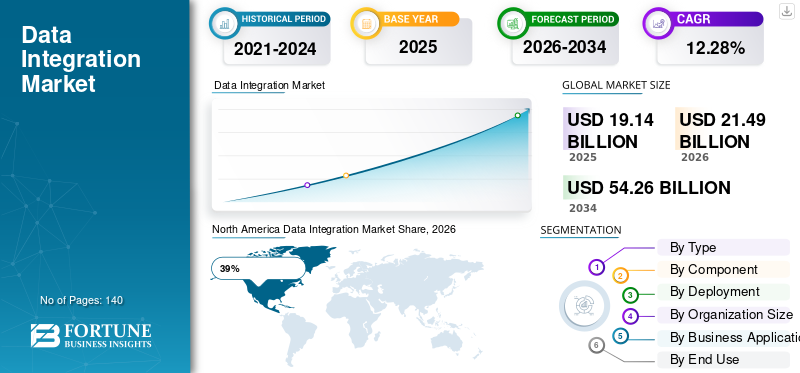
The global data integration market size was valued at USD 19.14 billion in 2025 and is projected to grow from USD 21.49 billion in 2026 to USD 54.26 billion by 2034, exhibiting a CAGR of 12.28% during the forecast period.

The data integration market is expanding rapidly due to increasing enterprise demand for unified data management, real-time analytics, and cloud-based business intelligence solutions. Organizations across banking, healthcare, retail, manufacturing, and telecommunications sectors are investing heavily in data integration platforms to consolidate structured and unstructured data from multiple business environments. The data integration market report highlights rising adoption of AI-powered integration tools, automated workflow management systems, and hybrid cloud architectures. Growing digital transformation initiatives and increasing enterprise reliance on predictive analytics continue supporting data integration market growth. Businesses are prioritizing centralized data ecosystems to improve operational visibility, decision-making efficiency, and cross-functional collaboration across enterprise environments.
The United States data integration market is witnessing strong growth due to increasing adoption of cloud computing, enterprise analytics platforms, and artificial intelligence technologies across industries. Large enterprises and government organizations are deploying advanced data integration systems to manage complex business operations and improve digital infrastructure efficiency. The data integration market analysis indicates rising investment in API management, data virtualization, and enterprise automation solutions throughout the country. Financial institutions, healthcare providers, and retail companies are increasingly integrating real-time data synchronization technologies to improve customer engagement and operational performance. Growing enterprise focus on cybersecurity and compliance management is also strengthening the data integration market outlook in the United States.
Download Free sample to learn more about this report.
 Global Market Size & Forecast
 Market Share
 Key Regional Highlights
Asia-Pacific
Dominated with a 34% market share, driven by rapid digital transformation.
North America
Held a 31% market share, supported by strong enterprise technology adoption.
Europe
Accounted for 27% of the market, fueled by growing demand for integrated data systems.
U.S.
Market growth is supported by widespread cloud adoption and enterprise digital transformation.
Japan
Accounted for 26% of the Asia-Pacific market, reflecting increasing demand for advanced data integration solutions.
Read More

The data integration market trends reveal increasing adoption of cloud-native integration platforms and artificial intelligence-enabled automation technologies. Enterprises are rapidly transitioning from traditional on-premise systems toward scalable cloud integration environments capable of supporting real-time data processing and cross-platform connectivity. Businesses are increasingly utilizing AI-driven integration tools for automated data mapping, anomaly detection, and workflow optimization. The data integration market research report highlights rising demand for low-code and no-code integration platforms that simplify deployment and reduce operational complexity for enterprises.
Another important trend shaping the Data Integration Industry Report is the expansion of hybrid and multi-cloud data integration strategies. Organizations are integrating data across private clouds, public clouds, edge computing environments, and legacy systems to improve operational flexibility and digital transformation capabilities. Real-time analytics and streaming data integration are becoming critical priorities for businesses seeking faster decision-making and customer insights. The data integration market insights also indicate growing demand for API-led integration frameworks and data governance platforms capable of improving compliance management, security visibility, and enterprise-wide data accessibility across complex IT ecosystems.
Download Free sample to learn more about this report.
Rising Enterprise Demand for Unified and Real-Time Data Management
The increasing need for centralized and real-time data accessibility is the primary driver of the data integration market growth. Enterprises across industries are generating massive volumes of structured and unstructured data through digital platforms, cloud applications, IoT devices, and enterprise software systems. Businesses are implementing advanced data integration solutions to consolidate information from multiple environments and improve operational efficiency. The data integration market report highlights that organizations increasingly rely on integrated data ecosystems to support business intelligence, predictive analytics, and customer experience optimization initiatives.
The rapid expansion of cloud computing and remote business operations has further strengthened demand for scalable integration infrastructure. Enterprises require seamless connectivity between customer relationship management systems, enterprise resource planning platforms, supply chain software, and analytics tools to improve business visibility. The data integration market analysis indicates that organizations are prioritizing automated data synchronization and workflow management technologies to reduce manual processing and improve productivity. Rising adoption of AI-powered analytics and digital transformation strategies continues accelerating enterprise investment in intelligent integration platforms and real-time data processing capabilities.
Complex Integration Processes and High Implementation Costs
Complexity associated with integrating legacy systems and modern cloud environments remains a major restraint for the data integration market. Many enterprises operate outdated infrastructure that lacks compatibility with advanced integration platforms, creating operational challenges during deployment and migration processes. The Data Integration Industry Analysis indicates that integration projects often require extensive customization, technical expertise, and infrastructure upgrades, increasing implementation timelines and operational expenses.
Small and medium enterprises frequently face budget limitations and limited technical resources, restricting adoption of advanced integration technologies. Data quality inconsistencies and fragmented business systems also complicate integration initiatives and reduce operational efficiency. Businesses must invest heavily in cybersecurity, compliance management, and employee training to support successful integration deployment. The data integration market outlook highlights that ongoing maintenance requirements and evolving enterprise IT architectures may continue increasing operational complexity for organizations implementing enterprise-wide integration systems across hybrid cloud and multi-platform environments.
Expansion of Ai-Driven Automation and Cloud Integration Services
Rapid advancements in artificial intelligence and cloud computing technologies are creating substantial opportunities for the data integration market. Enterprises are increasingly adopting AI-powered integration platforms capable of automating data workflows, improving system interoperability, and enhancing operational efficiency. The data integration market opportunities are expanding as businesses seek intelligent solutions capable of managing large-scale data environments and supporting real-time analytics initiatives.
Cloud integration services are witnessing strong demand due to increasing enterprise migration toward software-as-a-service applications and distributed digital infrastructure. Businesses are implementing API-based integration frameworks and data virtualization technologies to improve connectivity between cloud and on-premise systems. The data integration market forecast indicates rising opportunities for providers offering low-code automation platforms, predictive data management tools, and hybrid cloud integration solutions. Expansion of IoT ecosystems, edge computing, and machine learning applications is further strengthening demand for advanced enterprise integration infrastructure across multiple industries.
Data Security Risks and Regulatory Compliance Complexities
Data security and compliance management remain significant challenges for the data integration market. Enterprises handling sensitive customer information and business-critical data face increasing cybersecurity risks related to unauthorized access, data breaches, and integration vulnerabilities. The data integration market research report highlights that organizations must comply with complex regional regulations governing data privacy, storage, and transfer practices across industries including banking, healthcare, and telecommunications.
Hybrid cloud environments and cross-border data movement further increase compliance complexity and operational risk exposure. Businesses must implement advanced encryption systems, identity management frameworks, and governance policies to maintain data security and regulatory alignment. The data integration market insights indicate that rapid growth in connected devices and digital applications is expanding the attack surface for enterprise systems. Organizations continue investing heavily in secure integration architecture, compliance monitoring tools, and risk management solutions to protect sensitive business information and maintain operational continuity across evolving digital ecosystems.
Cloud data integration accounts for nearly 42% of the data integration market share due to increasing enterprise migration toward cloud computing infrastructure and software-as-a-service applications. Businesses are implementing cloud integration platforms to improve scalability, real-time connectivity, and centralized data accessibility across distributed digital environments. The data integration market analysis highlights rising adoption of cloud-native integration tools capable of supporting multi-cloud and hybrid cloud business operations.
Organizations across banking, healthcare, retail, and manufacturing sectors are prioritizing cloud integration strategies to improve operational flexibility and reduce infrastructure complexity. AI-powered automation and API-driven connectivity frameworks are strengthening the performance of cloud integration platforms. The data integration market report also indicates increasing use of cloud-based analytics and machine learning applications requiring seamless data synchronization between enterprise systems. Businesses continue investing in secure cloud integration architecture to improve workflow automation and enterprise-wide digital transformation efficiency.
On-premise data integration holds approximately 31% of the data integration market size due to continued reliance on legacy infrastructure and strict data control requirements among large enterprises. Government organizations, financial institutions, and healthcare providers frequently deploy on-premise integration systems to maintain direct oversight over sensitive business information and regulatory compliance processes. The data integration market research report reveals that organizations handling confidential customer data continue prioritizing secure on-premise integration environments.
Enterprises utilizing traditional IT infrastructure are integrating advanced automation and analytics capabilities within on-premise systems to improve operational efficiency. Businesses are also adopting hybrid integration models combining local infrastructure with cloud connectivity solutions to support digital modernization initiatives. The data integration market outlook highlights increasing investment in secure data management architecture, enterprise middleware platforms, and system interoperability technologies designed to improve operational continuity across legacy business ecosystems.
Hybrid data integration represents nearly 27% of the data integration market share due to growing enterprise preference for flexible IT infrastructure combining cloud and on-premise environments. Organizations are increasingly deploying hybrid integration solutions to manage data across distributed systems while maintaining security, scalability, and operational agility. The data integration market trends indicate strong demand for hybrid connectivity frameworks supporting seamless communication between cloud applications, enterprise databases, and legacy business systems.
Businesses adopting hybrid integration models benefit from improved disaster recovery, workload optimization, and operational flexibility across complex IT environments. AI-enabled orchestration and real-time synchronization technologies are improving hybrid system performance and reducing integration complexity. The data integration market insights also reveal increasing enterprise investment in centralized monitoring tools and automated workflow management platforms to improve visibility and governance across hybrid digital ecosystems. Expansion of remote operations and multi-cloud adoption continues strengthening demand for hybrid integration solutions globally.
To know how our report can help streamline your business, Speak to Analyst
Software solutions dominate the data integration market with approximately 63% market share due to rising enterprise demand for automation platforms, API management tools, and data governance technologies. Businesses are increasingly implementing advanced integration software capable of supporting analytics, machine learning, and cloud-based workflow management systems. The data integration market report highlights growing adoption of low-code integration tools and intelligent data orchestration platforms across enterprise environments.
Service providers are also witnessing increasing demand for consulting, deployment, and managed integration services as businesses modernize digital infrastructure. Organizations require technical support and integration expertise to optimize enterprise data environments and improve operational efficiency. The data integration market analysis indicates that software vendors are continuously enhancing AI capabilities, security frameworks, and automation functionalities within integration platforms to improve scalability and enterprise performance.
Cloud deployment accounts for nearly 69% of the data integration market share due to increasing enterprise transition toward cloud-native infrastructure and software-as-a-service platforms. Businesses prefer cloud deployment models because of scalability, cost efficiency, and simplified integration management capabilities. The data integration market research report highlights strong demand for cloud-based integration systems capable of supporting remote work environments and distributed digital operations.
Organizations are increasingly adopting cloud deployment to improve real-time analytics accessibility and enterprise collaboration efficiency. Integration vendors are expanding support for hybrid cloud orchestration, automated scaling, and cross-platform synchronization within cloud environments. The data integration market outlook also indicates rising investment in containerized integration architecture and serverless computing technologies designed to improve operational flexibility and reduce infrastructure complexity for enterprises.
Large enterprises represent approximately 66% of the data integration market due to extensive digital infrastructure and complex data management requirements. Multinational corporations generate massive data volumes across customer engagement platforms, enterprise applications, and operational systems, increasing demand for advanced integration technologies. The data integration market Industry Analysis reveals that large enterprises prioritize centralized governance, predictive analytics, and AI-driven workflow automation to improve operational efficiency.
Small and medium enterprises are also increasing adoption of cloud integration solutions due to affordability and simplified deployment models. Businesses are implementing scalable integration platforms to improve digital competitiveness and operational agility. The data integration market opportunities continue expanding as SMEs invest in customer analytics, cloud business applications, and real-time reporting systems requiring integrated data environments.
Marketing and sales applications account for nearly 34% of the data integration market share due to rising enterprise focus on customer analytics and personalized engagement strategies. Businesses integrate customer relationship management systems, digital marketing platforms, and sales automation tools to improve customer targeting and revenue optimization capabilities. The data integration market trends indicate increasing use of AI-powered analytics and customer data platforms to improve campaign performance and lead conversion rates.
Sales teams rely heavily on integrated data systems for real-time reporting, predictive forecasting, and customer behavior analysis. Enterprises are increasingly utilizing centralized customer data environments to improve cross-channel marketing efficiency and customer retention strategies. The data integration market insights reveal growing demand for automated workflow management and omnichannel data synchronization technologies across sales and marketing operations.
Banking and financial services account for approximately 29% of the data integration market due to rising digital banking adoption and increasing need for secure real-time data management. Financial institutions rely heavily on integrated analytics platforms and transaction processing systems to improve operational efficiency and fraud detection capabilities. The data integration market forecast highlights increasing investment in API-driven financial integration systems and AI-powered compliance management tools.
Healthcare, retail, manufacturing, and telecommunications sectors are also major adopters of integration technologies due to increasing digital transformation initiatives and data-driven business operations. Enterprises across industries are implementing centralized data management strategies to improve operational visibility and customer experience optimization. The data integration market growth continues to strengthen as businesses prioritize automation, predictive analytics, and cloud-based digital infrastructure modernization.
North America Data Integration Market Share, 2025 (%)
To get more information on the regional analysis of this market, Download Free sample
North America dominates the data integration market with nearly 31% market share due to advanced digital infrastructure, high cloud adoption rates, and strong enterprise investment in analytics technologies. Businesses across the United States and Canada are increasingly implementing AI-powered integration platforms, hybrid cloud systems, and enterprise automation solutions to improve operational efficiency and customer engagement capabilities. The data integration market report highlights strong demand for real-time analytics and centralized data management systems across banking, healthcare, retail, and telecommunications industries.
Technology providers and cloud service companies in North America are investing heavily in automation, cybersecurity, and API-based connectivity solutions to strengthen enterprise integration performance. The region also benefits from strong adoption of machine learning and predictive analytics applications requiring scalable data integration infrastructure. The data integration market insights indicate that increasing enterprise focus on digital transformation and business intelligence modernization will continue supporting regional market expansion across multiple industries.
Europe accounts for approximately 27% of the data integration market share due to rising digital transformation initiatives and increasing enterprise focus on secure data management infrastructure. Organizations across financial services, manufacturing, healthcare, and government sectors are implementing advanced integration platforms to improve operational visibility and regulatory compliance. The data integration market analysis indicates that European businesses prioritize privacy-focused integration systems and cloud governance frameworks aligned with regional data protection standards.
Cloud computing expansion and increasing enterprise analytics adoption continue driving integration technology demand across Europe. Businesses are investing heavily in API management platforms, hybrid cloud connectivity, and AI-powered workflow automation systems. The data integration market outlook also highlights growing adoption of data virtualization technologies and enterprise intelligence platforms designed to improve operational agility and cross-border collaboration efficiency throughout the region.
Germany represents nearly 32% of Europe’s data integration market due to strong industrial digitalization and advanced enterprise technology adoption. Businesses across automotive, manufacturing, banking, and logistics sectors are increasingly deploying data integration solutions to improve operational automation and analytics performance. The data integration market research report indicates rising demand for AI-enabled integration platforms and cloud connectivity solutions within German enterprises.
Manufacturing companies are heavily investing in industrial IoT integration and real-time operational analytics to strengthen smart factory capabilities. Enterprises are also prioritizing cybersecurity-focused integration systems and automated compliance management tools to align with strict data governance regulations. The data integration market trends reveal increasing deployment of hybrid cloud architecture and enterprise-wide analytics systems across Germany’s industrial and financial sectors. Expansion of digital infrastructure modernization initiatives continues supporting strong integration technology adoption across the country.
The United Kingdom accounts for approximately 24% of Europe’s data integration market due to increasing enterprise cloud adoption and rising investment in analytics-driven business operations. Organizations across financial services, retail, healthcare, and telecommunications sectors are utilizing integration platforms to improve customer engagement, operational visibility, and digital transformation efficiency. The data integration market Industry Analysis highlights growing adoption of AI-powered automation systems and API-based integration frameworks throughout the country.
Businesses in the United Kingdom are increasingly focusing on hybrid cloud integration and centralized governance systems to improve regulatory compliance and business continuity. Data-driven marketing strategies and predictive analytics applications are strengthening demand for scalable integration infrastructure. The data integration market forecast also indicates rising investment in low-code integration tools and intelligent workflow automation platforms designed to improve operational agility across enterprise environments.
Asia-Pacific holds nearly 28% share in the data integration market due to rapid enterprise digitalization, expanding cloud infrastructure, and increasing adoption of analytics technologies. Countries including China, India, Japan, and South Korea are witnessing strong investment in AI-powered integration platforms, cloud computing systems, and enterprise automation solutions. The data integration market research report highlights growing demand for scalable integration infrastructure capable of supporting digital banking, e-commerce, and smart manufacturing operations across the region.
Enterprises in Asia-Pacific are increasingly implementing centralized data management systems to improve operational efficiency and customer engagement capabilities. Telecommunications providers, financial institutions, and retail companies are investing heavily in API-driven integration frameworks and real-time analytics platforms. The data integration market opportunities continue expanding due to increasing adoption of IoT ecosystems, edge computing environments, and predictive analytics technologies across emerging digital economies.
Japan accounts for nearly 26% of the Asia-Pacific data integration market due to advanced enterprise technology adoption and strong investment in automation infrastructure. Businesses across manufacturing, healthcare, banking, and telecommunications sectors are increasingly deploying integration platforms to improve operational visibility and AI-driven analytics performance. The data integration market insights indicate growing demand for hybrid cloud integration systems and intelligent workflow automation technologies throughout the country.
Japanese enterprises prioritize high-performance data management infrastructure and real-time analytics capabilities to support digital transformation initiatives. Smart manufacturing and robotics integration are further strengthening demand for scalable enterprise integration platforms. The data integration market analysis also highlights increasing adoption of cloud-native analytics environments and API-based business applications designed to improve cross-functional collaboration and operational efficiency across industries.
China represents approximately 41% of the Asia-Pacific data integration market due to rapid digital economy expansion and increasing enterprise investment in cloud infrastructure and AI technologies. Businesses across e-commerce, banking, manufacturing, and telecommunications sectors are heavily utilizing data integration solutions to improve analytics capabilities and customer engagement strategies. The data integration market growth in China is supported by rising adoption of cloud computing, big data platforms, and intelligent automation technologies.
Technology companies and cloud service providers are investing heavily in scalable integration architecture and enterprise analytics platforms to support digital transformation initiatives. Businesses are increasingly integrating real-time analytics systems and predictive data management tools to improve operational efficiency and competitive positioning. The data integration market outlook indicates continued expansion in cloud-native integration services and AI-powered enterprise workflow automation across China’s rapidly evolving digital ecosystem.
The Rest of World region accounts for nearly 6% of the data integration market share due to increasing digital infrastructure development and rising cloud technology adoption across Latin America, the Middle East, and Africa. Enterprises within these regions are implementing integration platforms to improve business intelligence, customer analytics, and operational automation capabilities. The data integration market report highlights growing investment in cloud connectivity and enterprise data management systems across emerging economies.
Telecommunications providers, financial institutions, and government organizations are increasingly adopting scalable integration infrastructure to support digital modernization initiatives. Businesses are prioritizing cost-efficient cloud integration platforms and API-based automation tools to improve operational agility and data accessibility. The data integration market forecast also indicates expanding opportunities for integration service providers offering localized cloud infrastructure and cybersecurity-focused enterprise solutions across developing digital markets.
The data integration market is attracting substantial investment due to increasing enterprise demand for cloud analytics, AI-powered automation, and centralized data management infrastructure. Investors are focusing heavily on integration platforms supporting hybrid cloud environments, real-time analytics, and API-driven enterprise connectivity. The data integration market opportunities are particularly strong within artificial intelligence, predictive analytics, and intelligent workflow automation technologies.
Technology providers and cloud service companies are expanding investments in scalable integration architecture, cybersecurity frameworks, and low-code automation tools designed to improve enterprise digital transformation efficiency. Emerging economies present strong growth potential due to rapid cloud adoption and increasing enterprise modernization initiatives. The data integration market insights reveal rising investment in machine learning integration, edge computing connectivity, and data governance platforms. Businesses across banking, healthcare, manufacturing, and retail sectors continue prioritizing integrated analytics ecosystems to improve operational agility and customer engagement capabilities.
Innovation within the data integration market is focused on artificial intelligence, automation, and hybrid cloud orchestration technologies. Vendors are launching AI-powered integration platforms capable of automating data mapping, workflow management, and predictive analytics operations across distributed enterprise environments. The data integration market trends indicate increasing development of low-code and no-code integration tools designed to simplify deployment and improve operational scalability for enterprises.
Technology companies are also introducing advanced API management platforms, real-time synchronization tools, and cloud-native analytics solutions to improve interoperability between enterprise systems. Intelligent data governance and cybersecurity functionalities are becoming core features within modern integration platforms. The data integration market research report highlights growing adoption of machine learning-enabled anomaly detection and automated compliance management systems. Businesses are increasingly investing in scalable integration ecosystems capable of supporting digital transformation, cloud modernization, and enterprise-wide automation initiatives across complex IT infrastructures.
The data integration market report provides comprehensive analysis of integration technologies, cloud computing trends, competitive landscape developments, and enterprise digital transformation strategies across global industries. The report covers segmentation by type, component, deployment, organization size, business application, end use, and regional outlook while evaluating enterprise adoption of AI-powered integration systems and real-time analytics infrastructure. The data integration market analysis also examines hybrid cloud connectivity, API management technologies, and intelligent workflow automation trends shaping industry expansion.
Request for Customization to gain extensive market insights.
The study includes detailed assessment of cybersecurity frameworks, governance platforms, predictive analytics integration, and cloud-native architecture developments influencing enterprise data ecosystems. The data integration market research report further analyzes investment activity, strategic partnerships, product innovation initiatives, and regional digital infrastructure modernization trends. Competitive profiling of leading technology vendors and evaluation of integration platform scalability, automation capabilities, and compliance management functionalities are also included within the report scope.
Fortune Business Insights says that the global market value stood at USD 19.14 billion in 2025 and is projected to reach USD 54.26 billion by 2034.
The market is expected to exhibit a CAGR of 12.28% during the forecast period of 2026-2034.
Cloud data integration was the leading type segment, accounting for nearly 42% of the market, driven by increasing enterprise migration toward cloud infrastructure and SaaS applications.
Key players include Informatica Inc., IBM, Microsoft, SAP, Oracle, and Talend.
Major trends include rising adoption of cloud-native integration platforms and AI-enabled automation, along with growing demand for low-code/no-code and hybrid/multi-cloud integration. North America accounted for nearly 31% of the market in 2025.


(Offer valid till 15th Oct 2026)
Get 30-60 hrs Free Customization
Expand Regional and Country Coverage, Segments Analysis, Company Profiles, Competitive Benchmarking, and End-user Insights.




















Get In Touch With Us
US +1 833 909 2966 ( Toll Free )
Receive a tailored pricing based on your needs.
Discuss your questions with our industry experts.
Have questions? Get quick answers before you purchase.

