AI-Enabled Mission Planning Systems Market Size, Share & Industry Analysis, By Offering (Software, Hardware, and Services), By Planning Function (Route & Trajectory Planning, Threat Assessment, and Mission Replanning), By Operational Domain (Air, Land, Naval, Space, and Multi-Domain), By AI Technology (Machine Learning, Optimization, Generative AI, and Agentic AI), By Planning Level (Strategic, Operational, and Tactical), By Application (Air Tasking, Strike Planning, and ISR Collection), By End User (Air Forces, Armies, Navies, and Joint Defense Commands), and Regional Forecast, 2026-2034
 Download Free Sample
AI-Enabled Mission Planning Systems Market Size and Future Outlook
 Listen to Audio Version
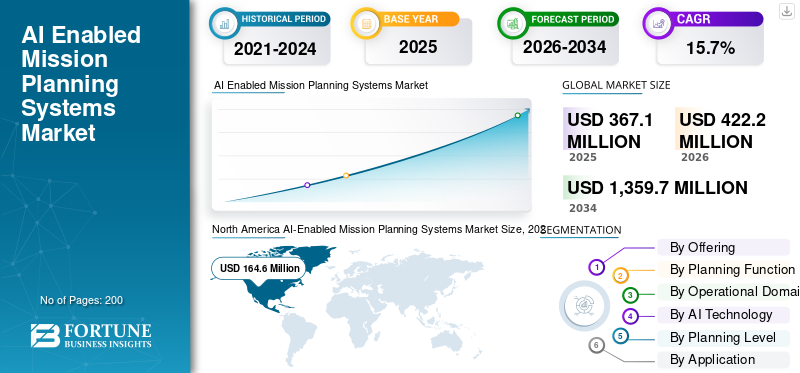
The AI-enabled mission planning systems market size was valued at USD 367.1 million in 2025. The market is projected to grow from USD 422.2 million in 2026 to USD 1,359.7 million by 2034, exhibiting a CAGR of 15.7% during the forecast period. North America dominated the AI enabled mission planning systems market with a market share of 44.84% in 2025.
AI-enabled mission planning systems combine AI, predictive analytics, geospatial data, and command and control tools to support route planning, threat assessment, asset allocation, and dynamic replanning. Market growth is driven by rising investments in AI, expanding multi-domain operations, autonomous platforms, and demand for faster decisions that improve mission success and enhance operational efficiency.
Key market players include Northrop Grumman, Lockheed Martin, RTX, BAE Systems, and Palantir Technologies. These companies are driving growth through AI-driven planning, mission-critical decision support, and the integration of AI across advanced defense systems.
Download Free sample to learn more about this report.
AI Enabled Mission Planning Systems Market Key Takeaways
 Global Market Size & Forecast
- 2025 Market Size: USD 367.1 million
- 2026 Market Size: USD 422.2 million
- 2034 Forecast Market Size: USD 1,359.7 million
- CAGR: 15.7% from 2026-2034
 Market Share
- North America dominated with a market share of 44.84% in 2025.
- The dynamic mission replanning segment is expected to show the fastest growth at a CAGR of 17.2%.
- The space segment is expected to show the fastest growth at a CAGR of 17.4% during the forecast period.
 Key Regional Highlights
North America
North America holds the largest market share and is anticipated to grow at a CAGR of 14.2% during the forecast period.
Europe
Europe is anticipated to grow at a CAGR of 16.7% during the forecast period.
Asia Pacific
Asia Pacific is anticipated to grow at the highest CAGR of 17.6% over the forecast period.
U.S.
The U.S. market stood at around USD 152.2 million in 2025 and is expected to grow at a CAGR of 13.7% during the forecast period.
Japan
The market in Japan is supported by modernization efforts for command networks, autonomous platforms, and joint operational capabilities.
Read More

AI-Enabled Mission Planning Systems Market Trends
Integration of AI into Command and Control and Multi-Domain Operations is a Key Market Trend
Defense organizations are moving from standalone mission planning tools to AI-driven platforms integrated with command and control networks. Such systems integrate predictive analytics and operational data to generate courses of action, enabling dynamic preplanning and synchronizing air, land, maritime, cyber, and space assets. Moreover, focus has shifted toward Collaborative Combat Aircraft (CCA) and intelligent drone swarms, requiring mission planners to coordinate fleets of unmanned assets collaboratively without continuous human input.
MARKET DYNAMICS
MARKET DRIVERS
Download Free sample to learn more about this report.
Rising Investments in AI and Joint Warfighting Capabilities Drive Market Growth
Governments are investing heavily in artificial intelligence, tactical networks, autonomous systems, and next-generation defense systems to improve decision speed in challenged environments. These investments in AI are creating direct demand for mission-critical planning software that can prioritize threats, allocate assets, and improve mission success across multi-domain operations.
In March 2024, the U.S. Department of Defense requested USD 1.8 billion for artificial intelligence and USD 1.4 billion for Combined Joint All-Domain Command and Control under its FY2025 budget.
MARKET RESTRAINTS
Shortage of Skilled AI Personnel Restrains Large-Scale System Deployment
Personnel who can build, validate, integrate, and operate complex models in classified defense environments are the key to the success of AI solutions. AI engineer, data specialist, and technically trained military operator shortages can delay implementation schedules, increase reliance on contractors, and slow the transition of cutting-edge prototypes into fielded systems.
MARKET OPPORTUNITIES
Coalition-Wide AI Planning Platforms Create a Major Market Opportunity
Growing demand for interoperable planning across allied forces provides a strong opportunity for companies offering secure, scalable, and data-driven mission-planning platforms. Adoption by NATO and other multinational commands can expand the market beyond individual military services, particularly across North America, Europe, and Asia Pacific, where joint exercises and shared operational architectures are becoming more important.
MARKET CHALLENGES
Ensuring Reliable, Explainable, and Secure AI Remains a Critical Market Challenge
Mission-planning recommendations directly impact targeting, force allocation, and operational risk. Therefore, reliability and precision are critical. Vendors need to demonstrate that the outputs from AI are traceable, have resilience to adversarial operations, and are supported by high-quality data. Moreover, testing and certification requirements can thus increase development costs and slow the introduction of AI into mission-critical defense systems, challenging market growth.
Impact of Ongoing Conflicts and Increasing Geopolitical Tensions
Ongoing Wars and Rising Geopolitical Tensions Accelerate Market Growth
Demand for AI-enabled mission planning systems is driven by the Russia-Ukraine war, instability in the Middle East, and growing strategic competition across the Indo-Pacific. Today’s conflicts demand faster threat assessment, constant route modification, rapid target prioritization, and coordinated command and control of dispersed forces.
These tensions are also changing the focus of procurement from experimental projects to operational deployment. Compressed acquisition schedules, restrictions on classified data, cyber threats, and interoperability requirements can increase integration costs and delay large-scale adoption. The geopolitical environment is still a strong driver of the market as militaries are increasingly looking for mission-critical defense systems that can adapt plans as battlefield conditions evolve.
In March 2025, NATO finalized the acquisition of the AI-enabled Maven Smart System NATO for Allied Command Operations. The system supports intelligence fusion, targeting, battlespace awareness, operational planning, and accelerated decision-making across the Alliance.
Segmentation Analysis
By Offering
Software Segment Dominated Market as It Supports Faster Capability Deployment
By offering, the market is categorized into software (core mission planning and course-of-action generation, route, trajectory, and survivability optimization, target, sensor, weapon, and resource allocation, dynamic mission replanning and execution support, mission rehearsal and digital-twin software, mission data management and post-mission learning), hardware (mission-planning workstations, servers and high-performance computing systems, edge and embedded mission computers, and data storage and networking hardware), and services (system integration and customization, installation and deployment, training and mission engineering, verification, validation, and ai assurance, and maintenance, upgrades, and technical support).
The software segment held the largest global AI-enabled mission planning systems market share in 2025, as the main value of AI-enabled mission planning lies in data processing, course-of-action generation, predictive analytics, and continuous software updates. Software can be integrated across several platforms and command and control environments, supporting faster capability deployment and periodic upgrade revenue. Within software, Mission Data Management and Post-Mission Learning held the largest share.
The services segment is expected to grow at the second-highest CAGR of 15.6% over the forecast period.
To know how our report can help streamline your business, Speak to Analyst
By Planning Function
Mission and Course-of-Action Generation Segment Dominated Market Due to Its Central Role in Converting Operational Data into Executable Plans
On the basis of planning function, the market is classified into mission and course-of-action generation, route and trajectory planning, threat and survivability assessment, target-sensor-weapon allocation, ISR collection and sensor tasking, force, asset, and resource scheduling, logistics and mobility planning, dynamic mission replanning, and mission rehearsal and validation.
The mission and course-of-action generation segment held the largest global market share in 2025, as it serves as the mind of AI-enabled mission planning, turning commander intent, intelligence input, force availability, and operational constraints into multiple executable options. Mission and course-of-action generation enables the ability to rapidly compare alternatives, as it is very important for mission-critical operations conducted on compressed decision timelines and in a challenging environment.
The dynamic mission replanning segment is expected to show the fastest growth, registering a CAGR of 17.2% over the forecast period.
By Operational Domain
Air Segment Dominated Market Due to Mature Digital Mission-Planning Infrastructure
By operational domain, the market is classified into air, land, naval, space, and joint and multi-domain.
The air segment held the largest global market share in 2025. Air missions require detailed coordination of routes, weapons, threats, airspace, and supporting assets, creating sustained demand for AI solutions across fighters, bombers, transport aircraft, helicopters, and unmanned systems. Air forces have also adopted software-led planning earlier than most land, naval, and space organizations.
The space segment is expected to show the fastest growth, registering a CAGR of 17.4% over the forecast period.
By AI Technology
Machine Learning and Predictive Analytics Dominated Market Due to Proven Deployment Across Prediction and Decision-Support Workflows
On the basis of AI technology, the market is classified into machine learning and predictive analytics, mathematical optimization and prescriptive analytics, knowledge-based and expert systems, generative AI and natural-language processing, reinforcement learning, multi-agent and agentic AI, and hybrid AI.
Machine learning and predictive analytics held the largest market share in 2025, as these technologies can be deployed using existing operational and intelligence datasets to identify patterns, predict threats, rank options, and support resource allocation. They are also more mature than reinforcement learning and agentic AI for use within sensitive defense systems.
The generative AI and natural-language processing segment is expected to show the fastest growth, registering a CAGR of 19.4% over the forecast period.
By Planning Level
Tactical Planning Segment Dominated Market Due to Need for Rapid Battlefield Decisions
On the basis of planning level, the market is classified into strategic planning, operational planning, and tactical planning.
The tactical planning segment held the largest global market share in 2025, as military forces require frequent updates to routes, targets, asset assignments, and threat responses as battlefield conditions change. This high planning frequency creates stronger recurring demand for AI-driven decision support than planning processes conducted mainly at strategic headquarters.
The operational planning segment is expected to show the second fastest growth, registering a CAGR of 16.1% over the forecast period.
By Application
ISR Collection Planning Dominated Market Due to Growing Need for Timely Sensor Allocation
By application, the market is further divided into air mission/air tasking, strike & precision engagement, ISR collection planning, targeting & effects planning, air & missile defense planning, electronic warfare mission planning, cyber mission planning, logistics & mobility planning, aerial refueling & transport, maritime/ASW planning, mine countermeasure planning, ground maneuver & fires, space mission planning, special operations planning, personnel recovery/SAR, and others.
The ISR collection planning segment held the largest global market share in 2025 due to current missions depending on the timely positioning and tasking of airborne, land, maritime, and space-based sensors. AI-enabled planning allows commanders to prioritize intelligence requirements, retask assets, and align surveillance coverage with changing operational objectives.
The cyber mission planning segment is expected to show the fastest growth, registering a CAGR of 17.4% over the forecast period.
By End User
Air Forces Dominated Market Due to Large Platform Fleets and Established Planning Ecosystems
Based on end user, the market is segmented into air forces, armies, navies and marine forces, space forces and space commands, joint defense commands, intelligence and national-security agencies, and border, coast guard, and homeland-security agencies.
The air forces segment dominated the market in 2025, driven by its leadership, which reflects the scale of military aviation fleets and the complexity of coordinating flight routes, weapons, mission data, electronic threats, airspace restrictions, and supporting assets. Continuous platform modernization also creates recurring requirements for software updates, integration, training, and lifecycle support.
The space forces and space commands segment is expected to show the fastest growth, registering a CAGR of 16.9% over the forecast period.
AI-Enabled Mission Planning Systems Market Regional Outlook
By geography, the market is categorized into North America, Europe, Asia Pacific, Middle East & Africa, and Latin America.
North America
North America AI-Enabled Mission Planning Systems Market Size, 2025 (USD Million)
To get more information on the regional analysis of this market, Download Free sample
North America Dominates Market Due to Strong Defense AI Investment and an Advanced Technology Base
North America holds the largest market share and is anticipated to grow at a CAGR of 14.2% during the forecast period, led primarily by the U.S. The region benefits from large investments in AI, extensive command and control modernization, a large advanced-platform installed base, and an established competitive landscape comprising defense primes and specialized software companies. Continued experimentation and rapid procurement are accelerating the integration of AI into multi-domain operations.
For instance, in May 2025, the U.S. Office of Naval Research awarded Pacific Defense Strategies a USD 9.10 million contract to develop an AI- and machine-learning-enabled electronic-warfare mission-planning, orchestration, and management capability under the iCMOSS program.
U.S. AI-Enabled Mission Planning Systems Market
Based on the strong contribution of North America to the market and the dominance of the U.S. within the region, the U.S. market stood at around USD 152.2 million in 2025 and is expected to grow at a CAGR of 13.7% during the forecast period.
Europe
The market in Europe is anticipated to grow at a CAGR of 16.7% during the forecast period, supported by NATO modernization, rising defense expenditure, and stronger demand for interoperable planning across allied forces. The region is increasingly integrating AI solutions with command and control, intelligence fusion, targeting, and multi-domain operations, driving the market growth in the region.
U.K. AI-Enabled Mission Planning Systems Market
The market in the U.K. reached approximately USD 18.8 million in 2025, equivalent to around 20.75% of Europe revenues.
Asia Pacific
Asia Pacific is anticipated to grow at the highest CAGR of 17.6% over the forecast period. Market growth is driven by China, India, Japan, South Korea, and Australia's modernization efforts for command networks, autonomous platforms, and joint operational capabilities. Regional demand is increasingly focused on air and maritime planning, long-range operations, contested logistics, and mission critical decision support across the Indo-Pacific.
China AI-Enabled Mission Planning Systems Market
The Chinese market stood at around USD 29.8 million in 2025, representing roughly 38.95% of Asia Pacific sales.
India AI-Enabled Mission Planning Systems Market
The Indian market in 2025 stood at around USD 12.4 million and is expected to grow at a CAGR of 19.0% during the forecast period.
Middle East & Africa
The Middle East & Africa region holds a comparatively smaller market share. Still, it is expected to grow at a 15.9% CAGR during the forecast period, with demand concentrated in Israel, Saudi Arabia, the UAE, Türkiye, and selected African defense forces.
Israel AI-Enabled Mission Planning Systems Market
The Israel market stood at around USD 7.6 million in 2025, representing roughly 33.45% of Middle East & Africa sales.
Latin America
The market in Latin America reached around USD 12.8 million in 2025 and is expected to grow at a CAGR of 15.3% during the forecast period. Adoption remains relatively early-stage and is primarily linked to border security, Amazon surveillance, search and rescue, counter-narcotics operations, logistics, and joint-force planning.
Brazil AI-Enabled Mission Planning Systems Market
The Brazil market stood at around USD 5.5 million in 2025, representing roughly 43.10% of Latin America sales.
COMPETITIVE LANDSCAPE
Key Industry Players
Leading Defense Contractors Strengthen the Competitive Landscape Through AI-Driven Mission Planning
The competitive landscape is led by Lockheed Martin, Northrop Grumman, RTX, BAE Systems, Palantir Technologies, L3Harris Technologies, and Leidos. These companies combine established command and control portfolios, platform-integration expertise, secure data architectures, and long-standing government relationships. Their advantage lies in connecting mission-planning applications with sensors, weapons, intelligence feeds, and operational networks rather than offering isolated AI solutions. Northrop Grumman’s battle-management portfolio, for example, supports AI-enabled target classification, sensor–weapon pairing, and autonomous resource allocation. At the same time, RTX’s ASTARTE software generates courses of action for complex airspace and joint-fire operations.
Competition is increasingly shifting toward modular software, open architectures, tactical-edge processing, and human-machine collaboration. Lockheed Martin and Palantir are strengthening their positions through multi-domain planning, collaborative decision support, and integration of AI into mission-critical defense systems. Smaller specialists, including Anduril and Systematic, are also challenging traditional primes with faster software development and autonomy-led solutions.
LIST OF KEY AI-ENABLED MISSION PLANNING SYSTEM COMPANIES PROFILED
- Lockheed Martin Corporation (U.S.)
- Northrop Grumman Corporation (U.S.)
- RTX Corporation (U.S.)
- BAE Systems plc. (U.K.)
- L3Harris Technologies, Inc. (U.S.)
- Palantir Technologies Inc. (U.S.)
- Leidos Holdings, Inc. (U.S.)
- Anduril Industries, Inc. (U.S.)
- General Dynamics Mission Systems, Inc. (U.S.)
- Thales S.A. (France)
- Leonardo S.p.A. (Italy)
- Saab AB (Sweden)
- Systematic A/S (Denmark)
- Indra Sistemas, S.A. (Spain)
- Rheinmetall AG (Germany)
- Elbit Systems Ltd. (Israel)
- Israel Aerospace Industries Ltd. (Israel)
- Rafael Advanced Defense Systems Ltd. (Israel)
- ASELSAN A.Ş. (Türkiye)
- Hanwha Systems Co., Ltd. (South Korea)
KEY INDUSTRY DEVELOPMENTS
- May 2026: Anduril Industries received a U.S. Army contract to develop a Battle Manager prototype for missile defense operations in the Western Pacific. The Lattice-based system will dynamically assign sensors, evaluate engagement options, and continuously update operational plans.
- May 2026: The U.S. Air Force, U.S. Space Force, Air Force Research Laboratory, and six industry software teams conducted the Multi-Decision Advantage Sprint for Human-Machine Teaming.
- April 2026: Systematic introduced a dedicated targeting application within SitaWare Headquarters 6.22. The application integrates target nomination, engagement assignment, target-list management, and dynamic targeting workflows within the operational planning environment.
- March 2026: BAE Systems and Scale AI entered a strategic agreement to integrate agentic AI, generative AI, and advanced data-engineering capabilities into defense missions and operational platforms.
- November 2025: The U.S. Air Force completed Capstone 2025 at Nellis Air Force Base, testing AI-enabled course-of-action generation, target-effector matching, and dynamic mission replanning.
- June 2025: The U.S. Air Force’s Shadow Operations Center-Nellis evaluated the Maven Smart System, ISR planning automation, dynamic mission-replanning, and refueling-planning tools during Experiment 3.
- May 2025: RTX’s Raytheon demonstrated the ASTARTE system during Project Convergence Capstone 5. The AI-enabled software integrated with multiple command-and-control systems, predicted airspace usage, and generated recommendations for airspace deconfliction and joint-fire mission planning.
- March 2025: S. Special Operations Command awarded Anduril Industries a three-year USD 86.00 million contract to develop and deploy mission-autonomy software across multi-domain uncrewed systems using the Lattice for Mission Autonomy platform.
- March 2025: BAE Systems’ Bohemia Interactive Simulations and the U.S. Army Futures Command announced that the Synthetic Training Environment Mission Planning Toolkit had achieved initial operating capability.
- August 2024: The U.S. Air Force awarded Palantir Technologies a USD 8.00 million contract for AI Mission Control software and integration services supporting the 7th Air Force and 607th Air Operations Command in South Korea.
REPORT COVERAGE
The global AI-enabled mission planning systems market analysis provides an in-depth study of market size, market segmentation, company profiling & forecast by all the market segments included in the report. It includes details on the market dynamics and trends that are expected to drive the market during the forecast period. It offers information on the technological advancements, new product launches, key market experts’ developments, and details on strategic partnerships, mergers & acquisitions. The market research report also encompasses a detailed competitive landscape with information on the market share and profiles of key players.
Request for Customization to gain extensive market insights.
Report Scope & Segmentation
| ATTRIBUTE | DETAILS |
| Study Period | 2021-2034 |
| Base Year | 2025 |
| Estimated Year | 2026 |
| Forecast Period | 2026-2034 |
| Historical Period | 2021-2024 |
| Growth Rate | CAGR of 15.7% from 2026 to 2034 |
| Unit | Value (USD Million) |
|
Segmentation |
By Offering
|
|
By Planning Function
|
|
|
By Operational Domain
|
|
|
By AI Technology
|
|
|
By Planning Level
|
|
|
By Application
|
|
|
By End User
|
|
|
By Region
|
Frequently Asked Questions
Fortune Business Insights says that the global market value stood at USD 367.1 million in 2025 and is projected to reach USD 1,359.7 million by 2034.
In 2025, the North America market value stood at USD 164.6 million.
The market is expected to exhibit a CAGR of 15.7% during the forecast period.
By operational domain, the air segment led the market.
Rising investments in AI and joint warfighting capabilities drive market growth.
Key players in the market include Lockheed Martin Corporation, Northrop Grumman Corporation, RTX Corporation, BAE Systems plc, and Palantir Technologies Inc.
North America dominated the market.



- 2021-2034
- 2025
- 2021-2024
- 200
Get 30-60 hrs Free Customization
Expand Regional and Country Coverage, Segments Analysis, Company Profiles, Competitive Benchmarking, and End-user Insights.




















Related Reports
-
US +1 833 909 2966 ( Toll Free )
-
Get In Touch With Us