AI-Enhanced Knowledge Management Market Size, Share & Industry Analysis, By Component (Software and Services), By Deployment (Cloud-based, On-premises, and Hybrid), By Enterprise Type (Large Enterprises and SMEs), By Application (Enterprise Knowledge Management, Customer Support & Self-Service, Document & Content Management, IT Service Management Knowledge Bases, Employee Onboarding & Training, and Others), By Industry (BFSI, Healthcare & Life Sciences, IT & Telecommunications, Retail & E-commerce, Manufacturing, Government & Public Sector, and Education), and Regional Forecast, 2026-2034
 Download Free Sample
AI-Enhanced Knowledge Management Market Size and Future Outlook
 Listen to Audio Version
The global AI-enhanced knowledge management market size was valued at USD 8.75 billion in 2025. The market is projected to grow from USD 11.71 billion in 2026 to USD 193.62 billion by 2034, exhibiting a CAGR of 42.0% during the forecast period. North America dominated the AI enhanced knowledge management market with a market share of 41.6% in 2025.
The market comprises software platforms, AI-powered tools, and ecosystem-level solutions that enable real-time knowledge retrieval, contextual search, and intelligent decision support across enterprises, customer service operations, and employee workflows. These solutions are built around AI models, semantic search engines, knowledge graphs, and workflow automation platforms that together deliver accurate, context-aware insights for use cases such as enterprise knowledge management, customer support automation, employee onboarding, IT service management, and business intelligence. By enabling seamless access to organizational knowledge across departments, these systems support applications in BFSI, healthcare, IT & telecom, retail, and manufacturing, where operational efficiency and knowledge accuracy are critical.
The market is gaining strong momentum as enterprises accelerate digital transformation, cloud adoption, and AI-driven automation, where traditional document repositories and static knowledge bases are insufficient for modern business demands. Growing deployment of AI assistants, intelligent search, and workflow automation in customer support and enterprise operations is driving adoption. Increasing demand for real-time, actionable insights, generative AI content, and multi-platform accessibility is also accelerating AI-KM integration across cloud, SaaS, and hybrid enterprise environments, making ai powered knowledge management a strategic tool rather than a support function.
Key players such as Microsoft, Salesforce, Zendesk, and Zoho are driving AI-KM adoption across enterprises and industries. Microsoft is expanding AI capabilities through Viva Topics and Copilot, embedding generative AI across productivity suites and enterprise workflows. Salesforce enhances knowledge delivery through Einstein Search and AI-driven Service Cloud, enabling intelligent customer support and contextual insights. Zendesk focuses on AI-assisted help centers and knowledge bases for efficient customer service automation, while Zoho strengthens integrated knowledge and workflow solutions across CRM and enterprise applications. Together, these companies are accelerating the commercialization and adoption of AI-enhanced knowledge systems across multiple sectors and enterprise sizes.
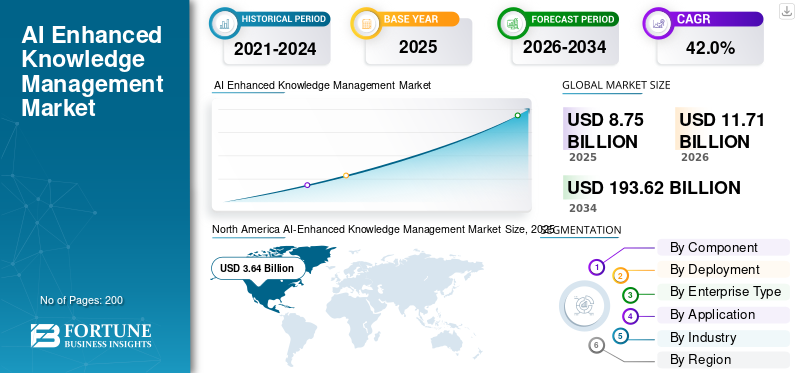
Download Free sample to learn more about this report.
AI-ENHANCED KNOWLEDGE MANAGEMENT MARKET KEY TAKEAWAYS
 Global Market Size & Forecast
- 2025 Market Size: USD 8.75 billion
- 2026 Market Size: USD 11.71 billion
- 2034 Forecast Market Size: USD 193.62 billion
- CAGR: 42.0% from 2026–2034
 Market Share
- North America dominated the market with a 41.6% share in 2025.
- The BFSI segment held the largest market share 23.5% in 2025.
- The Cloud-based deployment segment held the largest market share 59.4% in 2025.
 Key Regional Highlights
North America
North America reached USD 3.64 billion in 2025, driven by strong enterprise AI adoption, continuous technology innovation, cloud infrastructure, and high digital transformation spending.
Europe
Europe reached USD 1.80 billion in 2025, growing at a 39.0% CAGR, supported by AI-driven digital transformation, GDPR-driven data management, and widespread cloud adoption.
Asia Pacific
Asia Pacific reached USD 2.71 billion in 2025 and is expected to record the highest CAGR, driven by coordinated public policy, AI investments, and accelerating enterprise digital transformation.
U.S.
The market reached USD 3.07 billion in 2025, accounting for approximately 35.1% of global sales, supported by advanced enterprise AI adoption and strong technology-sector innovation.
Japan
The market reached USD 0.27 billion in 2025, accounting for approximately 3.1% of global revenues.
Read More

IMPACT OF GENERATIVE AI
Integration of Generative AI Unlocks Advanced Use Cases in Knowledge Management
Generative AI is reshaping the AI-KM market by enabling use cases that go far beyond traditional search or keyword matching, turning passive knowledge repositories into active, context-aware intelligence layers that drive productivity and data driven decision-making. For example, enterprises are now using AI to automatically generate summaries from vast document stores, create conversational question-answering interfaces on internal knowledge bases, and personalize knowledge delivery based on user role or past interactions. By implementing such initiatives these enterprises are effectively reducing search time and improving accuracy.
- A Business Insider report highlights how companies such as Ancestry have leveraged large language models to automate the extraction, transcription, and even narration of unstructured historical records. Further, it is dramatically accelerating content creation and making deep datasets more accessible and actionable.
This trend is mirrored in corporate deployments where generative AI is integrated into enterprise productivity tools and enterprise knowledge platforms. Further, enabling real-time insights, automated content generation, and intelligent assistants that enhance workflows across departments, fundamentally transforming how organizations capture, retrieve, and use knowledge.
AI-Enhanced Knowledge Management Market Trends
Embedding Knowledge into Daily Workflows Drives Contextual Access and Productivity as a Current Market Trend
In the AI-KM market, a major strategic trend is embedding knowledge directly into daily workflows so that employees access intelligence at the point of work rather than searching separate systems. Modern collaboration tools such as Microsoft Teams and Slack are evolving into dynamic knowledge repositories. It is where conversations, video call transcripts, action items, and content from connected systems such as CRM and project tools all become part of the enterprise’s living memory rather than isolated silos.
A notable industry implementation in smart factories shows UWB RTLS being used for production line monitoring and smart logistics optimization. It is where tagged assets move across workstations and managers receive real-time alerts on delays or inefficiencies, significantly improving throughput and reducing idle time.
- Research from Digital Workplace Group highlights that integrating KM into platforms employees already use reduces friction and naturally encourages knowledge sharing without disrupting workflow habits.
- A recent TechTarget article describes how Teams and Slack are transforming from simple communication tools into platforms. Such platforms continuously capture context and organizational memory, such as meeting outcomes, chat threads, and decision logs, effectively turning everyday work interactions into reusable corporate knowledge.
Initiatives by major vendors reflect this trend, as Salesforce has announced Slack innovations that bring CRM data agents and knowledge into a unified work operating system so teams can work with critical information without switching tools. This shift means that knowledge is no longer a separate repository to query but is delivered contextually within the workflow itself. Further, enhancing productivity, reducing duplication of effort, and making organizational knowledge part of routine work execution rather than an external task.
MARKET DYNAMICS
MARKET DRIVERS
Download Free sample to learn more about this report.
Explosion of Generative AI and Large Language Models (LLMs) Adoption Accelerates AI-KM Deployment
The explosion of generative AI and Large Language Models (LLMs) adoption is a core driver of the AI-enhanced knowledge management market growth. This is as advances in generative models have transformed how enterprises generate, retrieve, and curate organizational knowledge, moving far beyond static search or manual tagging.
- A recent Presenc AI enterprise adoption analysis shows that over 160,000 organizations have deployed more than 400,000 AI agents such as Microsoft Copilot Studio and Salesforce Agentforce. Further, illustrating how generative AI is rapidly becoming embedded in real work environments rather than remaining in pilot stages. These AI agents are used for automated knowledge retrieval, task execution, and workflow assistance, which directly strengthens the underlying value of knowledge management systems.
- Meanwhile, news from major IT firms confirms that Microsoft’s 365 Copilot rollout now supports millions of enterprise users and tens of millions of seats. Further, indicating that generative AI adoption at scale is happening in flagship productivity platforms where enterprise knowledge is created and used every day.
These developments signal a structural shift in enterprise IT strategy from traditional keyword‑based search toward intelligent conversational interfaces, context‑aware summarization, and Retrieval‑Augmented Generation (RAG) architectures. These are essential for delivering timely, relevant insights from vast corporate knowledge stores and for driving real productivity gains across departments.
|
Rank |
Market Drivers |
Overall Impact Rank |
CAGR Contribution (2026-2034) |
Impact 2026-2028 |
Impact 2029-2031 |
Impact 2032-2034 |
|
1 |
Explosion of Generative AI and Large Language Model Adoption Accelerates AI-KM Deployment |
High |
+25.0% |
High |
High |
High |
|
2 |
Growing Digital Transformation and Cloud Adoption Across Enterprises |
High |
+14.3% |
High |
High |
Medium |
|
3 |
Rising Demand for Intelligent Customer Support and Employee Productivity Solutions |
Medium-High |
+10.0% |
Medium |
High |
High |
|
4 |
Integration of AI-KM with Analytics and Decision Support Systems |
Medium |
+5.4% |
Medium |
Medium |
High |
|
5 |
Expansion of Industry-Specific and Compliance-Centric Knowledge Platforms |
Medium |
+2.5% |
Medium |
Medium |
Medium |
|
6 |
Others (multi-lingual AI adoption, hybrid work enablement, workflow automation, etc.) |
Low |
+0.5% |
Low |
Low |
Medium |
|
|
Total Positive Growth Contribution |
|
+57.7% |
|
|
|
MARKET RESTRAINTS
Data Privacy, Security, and Compliance Concerns Limit Cloud AI-KM Adoption
Data privacy, security, and compliance have become major restraints on AI‑enhanced knowledge management adoption as enterprises must protect highly sensitive corporate, customer, and regulatory information while complying with increasingly strict global legal frameworks.
- A recent Kiteworks global report found that 53% of organizations identify data privacy as the top obstacle to broader AI agent deployment. Further, highlighting that concerns over how AI tools access and use internal data significantly slow down adoption in enterprise environments.
Regulations such as the EU’s GDPR and the U.S. HIPAA framework impose heavy compliance requirements and potential fines, making cloud‑based knowledge systems riskier to implement without strong governance controls. Real-world cloud security challenges compound these concerns, as industry research shows increasing frequency of cloud security incidents and rising cybersecurity risks as workloads shift to distributed environments. However, it is leading many firms to hesitate before moving critical knowledge assets to cloud platforms.
As a breach of sensitive data can expose firms to regulatory penalties, reputational damage, or costly recovery efforts, organizations with global operations often delay or limit AI‑KM initiatives until they can demonstrate robust data protection and compliance architectures.
|
Rank |
Market Restraint |
Overall Impact Rank |
Negative CAGR Contribution (2026-2034) |
Impact 2026-2028 |
Impact 2029-2031 |
Impact 2032-2034 |
|
1 |
Data Privacy, Security, and Compliance Concerns Limit Cloud AI-KM Adoption |
High |
-7.7% |
High |
High |
Medium |
|
2 |
High Implementation Cost and Integration Complexity |
Medium-High |
-4.0% |
High |
Medium |
Medium |
|
3 |
Limited Skilled Workforce for AI and Knowledge Management Deployment |
Medium |
-2.7% |
Medium |
Medium |
Low |
|
4 |
Others (Resistance to change, vendor lock-in, ROI uncertainty, etc.) |
Low |
-1.3% |
Low |
Low |
Low |
|
|
Total Market Reduction |
|
-15.7 |
|
|
|
MARKET OPPORTUNITIES
Industry-Specific Compliance-Centric AI-KM Solutions Unlock Growth in BFSI, Healthcare, and Life Sciences
Industry-specific compliance-centric AI-KM is a significant opportunity as regulated sectors such as BFSI, healthcare, and life sciences face strict regulatory scrutiny that traditional knowledge systems cannot fully address. Frameworks such as GDPR, HIPAA, HITECH, and FDA 21 CFR Part 11 require auditable documentation, strict access controls, and ongoing compliance readiness. AI-KM solutions tailored to these verticals embed features such as continuous audit trails, automated evidence capture, and role-based access controls, reducing operational burdens.
BFSI institutions must align AI systems with financial governance requirements, while healthcare and life sciences manage protected health information and clinical trial data. Audit-ready, traceable, and pre-aligned AI-KM modules accelerate adoption, reduce risk, and unlock broader market access in regulated industries.
By developing AI-KM modules that are audit-ready, traceable, and pre-aligned with industry compliance frameworks, vendors can accelerate enterprise adoption in these high-value segments. It can further reduce risk for regulated customers and unlock broader market access by demonstrating readiness for strict governance environments.
Segmentation Analysis
By Industry
BFSI Segment Dominated Due to High Knowledge Intensity, Regulatory Pressure, and Large-Scale Data Management Needs
Based on industry, the market is segmented into BFSI, healthcare & life sciences, IT & telecommunications, retail & e-commerce, manufacturing, government & public Sector, education, energy & utilities, and others.
The BFSI segment held the majority share of the market in 2025. The segment dominated with a share of 23.5% as the sector is highly knowledge-intensive and heavily regulated, requiring robust systems to manage risk, compliance, and customer data. Banks, insurance companies, and financial institutions generate vast volumes of operational, transactional, and regulatory knowledge that must be accurately captured, structured, and accessible for decision-making and audit purposes. The critical need for real-time insights, regulatory compliance, and secure knowledge workflows drives BFSI organizations to adopt AI-KM platforms at scale, making them the largest industry segment in the market.
The healthcare & life sciences segment is expected to witness the highest CAGR of 46.1% during the forecast period.
To know how our report can help streamline your business, Speak to Analyst
By Component
Software Segment Held the Largest Share Due to Its Role as the Core Infrastructure Powering AI-Enabled Knowledge Operations
Based on the component, the market is segmented into software and services.
The software segment held the majority share of the market in 2025. The segment dominates the market as it forms the core infrastructure for all knowledge operations, enabling enterprises to centralize, structure, and analyze large volumes of data. Advanced software platforms incorporate AI capabilities, generative models, and knowledge graphs that allow real-time, context-aware insights and decision support across departments. This makes software the primary driver of value, as it directly powers intelligent knowledge retrieval, automated recommendations, and enterprise-wide workflow integration.
The services segment is expected to witness the second-highest CAGR of 38.9% during the forecast period.
By Deployment
Cloud-Based Deployment Led the Market Owing to Scalability, Real-Time Updates, and Global Accessibility
Based on the deployment, the market is categorized into cloud-based, on-premises, and hybrid.
The cloud-based segment held the majority share of 59.4% in the market. Such dominance is due to its ability to allow enterprises to scale rapidly without heavy upfront infrastructure investments while providing real-time updates, AI model integration, and accessibility across distributed teams. Cloud platforms enable seamless collaboration, centralized data storage, and continuous delivery of new features, including generative AI and advanced analytics, which on-premises systems cannot match as efficiently. Additionally, the flexibility of cloud solutions supports global operations and multi-regional knowledge access, making it the preferred choice for organizations seeking agility, cost efficiency, and enterprise-wide adoption.
The hybrid segment is expected to witness the second-highest CAGR of 38.1% during the forecast period.
By Enterprise Type
Large Enterprises Segment Dominated the Market Due to Complex Knowledge Needs and Regulatory Compliance Requirements
Based on enterprise type, the market is categorized into large enterprises and Small & Medium Enterprises (SMEs).
The large enterprises segment held the majority share of the market in 2025. The segment dominated the market as enterprises have complex, multi-departmental knowledge needs and generate massive volumes of data that require centralized, AI-driven management. These organizations have the financial resources to invest in sophisticated AI-KM platforms that integrate generative AI, analytics, and workflow automation across global operations. Furthermore, large enterprises often face regulatory, compliance, and operational pressures that make structured knowledge management essential, ensuring that critical information is accessible, secure, and auditable across multiple business units and geographies.
The Small & Medium Enterprises (SMEs) segment is expected to witness the highest CAGR of 45.5% during the forecast period.
By Application
Enterprise Knowledge Management Segment Led as it is the Foundational Backbone for All Knowledge Workflows
Based on application, the market is categorized into enterprise knowledge management, customer support and self-service, document and content management, IT service management knowledge bases, employee onboarding and training, business intelligence and decision supports, and others.
Enterprise knowledge management held the majority share of 28.7% in the application segment in 2025. The segment dominates as it forms the core foundation for all knowledge operations across the organization. It enables centralized storage, structuring, and retrieval of organizational knowledge, which is critical for decision-making, regulatory compliance, and operational efficiency. Large-scale integration with AI capabilities, knowledge graphs, and analytics allows enterprises to deliver context-aware insights and automate knowledge workflows, supporting multiple departments, business units, and global operations. This foundational role makes EKM the largest application segment, as all other AI-KM functions, such as customer support, onboarding, or IT service management, depend on a robust enterprise knowledge backbone.
The customer support and self-service segment is expected to witness the highest CAGR of 45.9% during the forecast period.
AI-Enhanced Knowledge Management Market Regional Outlook
By region, the market is categorized into North America, South America, Europe, the Middle East & Africa, and Asia Pacific.
North America
North America AI-Enhanced Knowledge Management Market Size, 2025 (USD Billion)
To get more information on the regional analysis of this market, Download Free sample
North America holds the majority in the AI-enhanced knowledge management market share as it is both the innovation epicenter and early adoption leader for enterprise AI technologies. Enterprises in the region have rapidly integrated advanced generative and agentic AI into core knowledge workflows, supported by continuous product innovation from major local tech firms.
- In May 2026, Salesforce announced its Summer ’26 Release with new AI, data, and automation innovations designed to help humans and AI agents work together across enterprise systems, accelerating real-world KM adoption.
- Additionally, Microsoft’s general availability of Copilot Cowork expands agent-based automation across organizational data and workflows, strengthening AI KM capabilities deeply embedded into productivity tools.
This combination of strong corporate R&D, continuous product launches, cloud infrastructure, and high enterprise digital transformation spending creates a fertile environment for market growth, giving North America a leading position globally.
The North America region held the largest market share at USD 3.64 billion in 2025.
U.S. AI-Enhanced Knowledge Management Market
Given North America’s strong contribution and the U.S. dominance in the region, the U.S. market achieved USD 3.07 billion in 2025, accounting for roughly 35.1% of sales.
Europe
Europe is projected to grow at a CAGR of 39.0% over the coming years and accounted for USD 1.80 billion in 2025. This growth is attributed to increasing investments by enterprises across the region in AI-driven digital transformation to optimize operations, compliance, and knowledge workflows. Strong regulatory environments, such as GDPR, are pushing organizations to adopt structured and AI-enabled knowledge systems to manage data securely and efficiently. Additionally, widespread cloud adoption, a mature IT infrastructure, and growing collaboration between technology vendors and European enterprises enable faster deployment of advanced AI-KM solutions. The combination of regulatory drivers, technological maturity, and enterprise readiness positions Europe for steady and meaningful growth.
U.K. AI-Enhanced Knowledge Management Market
The U.K. market in 2025 was valued at around USD 0.31 billion, representing roughly 3.5% of global revenues.
Germany AI-Enhanced Knowledge Management Market
Germany’s market reached approximately USD 0.23 billion in 2025, equivalent to around 2.6% of global sales.
Asia Pacific
Asia Pacific is expected to grow at the highest CAGR and was valued at USD 2.71 billion in 2025, as the region is rapidly transitioning from experimentation to enterprise-scale AI adoption. It is driven by coordinated public policy, strong investment, and accelerating digital transformation across industries.
- According to IDC, AI and generative AI investment in the region is projected to reach about USD 175 billion by 2028, growing at an annual rate of over 30 percent. It fuels demand for AI-ready knowledge systems that can support automation, intelligent decision support, and contextual insights across sectors from banking to healthcare and telecom.
Governments and major technology players are actively investing in cloud and AI infrastructure while private sector digitalization accelerates, leading to unified AI ecosystems and increasing enterprise readiness for scalable AI deployments. High enthusiasm for AI tools among businesses and consumers, especially in markets such as India where advanced AI usage and digital maturity are surging, also contributes to this dynamic growth environment. These factors combine to create a fertile landscape for AI-enhanced KM adoption, with strong GDP contributions expected from AI innovation and broad integration into organizational workflows.
Japan AI-Enhanced Knowledge Management Market
The Japan market in 2025 was valued at around USD 0.27 billion, accounting for roughly 3.1% of global revenues.
China AI-Enhanced Knowledge Management Market
China’s market is projected to be one of the largest worldwide, with 2025 hitting around USD 0.99 billion, representing roughly 11.3% of global sales.
India AI-Enhanced Knowledge Management Market
The India market in 2025 was at USD 0.69 billion, accounting for roughly 7.9% of global market share.
South America and Middle East & Africa
The Middle East & Africa region is expected to grow with the third-highest CAGR in the market as the region is witnessing rapid adoption of enterprise AI solutions among large organizations and government initiatives, particularly in sectors such as banking, energy, and healthcare. Several multinational corporations and local enterprises are actively deploying AI-KM systems to centralize knowledge and improve decision-making, while regional partnerships and technology collaborations are accelerating AI maturity. The combination of increasing cloud adoption, infrastructure investments, and strategic digitalization programs enables organizations to implement scalable AI-KM platforms more effectively, driving robust growth across the region.
South America is expected to grow with a slow and steady CAGR in the market due to gradual digital transformation and limited cloud infrastructure in some regions. Adoption is mainly driven by large enterprises in BFSI, healthcare, and retail, while SMEs face cost and technical barriers. Despite growing interest, slower IT modernization and regional economic constraints keep the growth steady rather than rapid.
GCC AI-Enhanced Knowledge Management Market
The GCC market reached around USD 0.17 billion in 2025, representing roughly 1.9% of global revenues.
COMPETITIVE LANDSCAPE
Key Industry Players
Key Industry Players Driving Innovation in Market through Semantic Search Tools, Conversational Assistants, and Knowledge Platforms
Key players in the AI‑Enhanced Knowledge Management market, including Microsoft, Salesforce, Zendesk, and Zoho, are advancing enterprise intelligence through AI‑powered knowledge platforms, conversational assistants, and semantic search tools. They focus on enabling real-time insights, automated content generation, and decision support across business functions such as customer support, employee training, and document management. Vendors are expanding capabilities in knowledge graph architectures, RAG models, and AI governance while partnering with cloud and enterprise ecosystem providers to enhance scalability, security, and industry-specific compliance. Leading companies are targeting adoption across sectors including BFSI, healthcare, IT & telecom, and retail, offering solutions that increase efficiency, reduce manual work, and deliver actionable knowledge at scale.
LIST OF KEY AI-ENHANCED KNOWLEDGE MANAGEMENT COMPANIES PROFILED
- Microsoft (U.S.)
- Salesforce, Inc. (U.S.)
- Atlassian (U.S.)
- Zendesk, Inc. (U.S.)
- Bloomfire (U.S.)
- Document360 (U.K.)
- Guru Technologies (U.S.)
- Zoho Corporation Pvt. Ltd. (India)
- Helpjuice (U.S.)
- Notion (U.S.)
- Glean Technologies, Inc. (U.S.)
- USU Knowledge Management (Germany)
- io (U.S.)
KEY INDUSTRY DEVELOPMENTS
- July 2026: CLPS Incorporation announced the launch of Project Athena, an enterprise AI initiative focused on knowledge assetization, enhancing operational efficiency and service quality while safeguarding intellectual assets. The solution aims to improve business workflows by leveraging AI to structure and manage core enterprise knowledge more effectively.
- May 2026: Teradata announced the launch of its new Autonomous Knowledge Platform, a flagship system that unifies AI, analytics, and enterprise data to support always‑on AI agents across cloud, hybrid, and on‑premises deployments. The platform is designed to help organizations turn data into actionable knowledge, enabling enterprise intelligence and governance at scale.
- May 2026: ServiceNow announced major enhancements to its AI Control Tower, adding expanded integrations, governance tools and a new Action Fabric that lets AI agents execute tasks across enterprise systems under a single platform. The updates also include partnerships with Microsoft and NVIDIA, aiming to make AI workflows more secure and scalable. These developments are part of the ServiceNow Knowledge 2026 announcements focused on enterprise AI automation.
- April 2026: Microsoft published new features for Copilot Studio in April 2026, adding enhanced agent governance, intelligent workflows, and connected app experiences. These updates enable enterprises to build and manage AI agents that automate knowledge tasks across systems while maintaining visibility and control.
- April 2026: Onix, in partnership with Google Cloud, introduced Wingspan 2.0, an agentic AI platform aimed at accelerating enterprise digital modernization. The platform is designed to reduce manual work and support scalable AI execution across business-wide processes, marking a key development in AI adoption for knowledge workflow.
- February 2026: Anthropic announced extensions to Claude Cowork, a platform that lets users build artificial intelligence agents capable of understanding enterprise context and integrating with tools such as Slack and Gmail. This expansion reinforces the trend of embedding AI into daily knowledge workflows, allowing teams to reduce context switching and improve work continuity.
REPORT COVERAGE
The AI-enhanced knowledge management industry report provides a comprehensive analysis of the industry, focusing on key market players and the overall competitive landscape. It offers valuable insights into current market trends, technological advancements, and significant industry developments. The report further examines key growth drivers, restraints, opportunities, and challenges influencing market expansion.
Request for Customization to gain extensive market insights.
Report Scope & Segmentation
| ATTRIBUTE | DETAILS |
| Study Period | 2021-2034 |
| Base Year | 2025 |
| Estimated Year | 2026 |
| Forecast Period | 2026-2034 |
| Historical Period | 2021-2024 |
| Growth Rate | CAGR of 42.0% from 2026-2034 |
| Unit | Value (USD Billion) |
| Segmentation | By Component, Deployment, Enterprise Type, Application, Industry, and Region |
| By Component |
|
| By Deployment |
|
| By Enterprise Type |
|
| By Application |
|
| By Industry |
|
| By Region |
|
Frequently Asked Questions
According to Fortune Business Insights, the global market value stood at USD 8.75 billion in 2025. and is projected to reach USD 193.62 billion by 2034.
In 2025, the market value stood at USD 3.64 billion.
The market is expected to grow at a CAGR of 42.0% over the forecast period.
By industry, the BFSI segment is expected to lead the market.
The explosion of generative AI and large language model adoption accelerates the AI-KM deployment.
Microsoft, Salesforce, Zendesk, and Zoho are the major players in the global market.
North America dominated the market in 2025.



- 2021-2034
- 2025
- 2021-2024
- 200
Get 30-60 hrs Free Customization
Expand Regional and Country Coverage, Segments Analysis, Company Profiles, Competitive Benchmarking, and End-user Insights.




















Related Reports
-
US +1 833 909 2966 ( Toll Free )
-
Get In Touch With Us