AI in Aviation Market Size, Share, Industry Analysis, By Application (Flight Operations, Maintenance, Air Traffic Management, and Others), By Offering (Software, Hardware, and Service), By Technology (Machine Learning, Computer Vision, Data Analytics, and Others) By End User (Airlines, Airports, OEMs, and MRO), and Regional Forecast, 2026-2034
 Download Free Sample
KEY MARKET INSIGHTS
 Listen to Audio Version
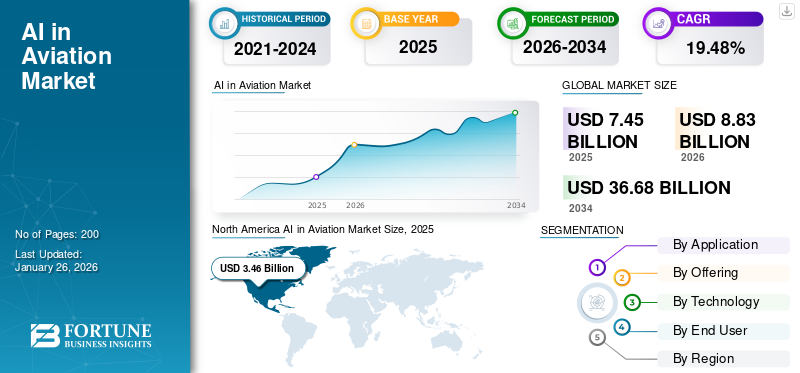
The global AI in aviation market size was valued at USD 7.45 billion in 2025 and is projected to grow from USD 8.83 billion in 2026 to USD 36.68 billion by 2034, exhibiting a CAGR of 19.48%. North America dominated the AI in aviation market with a market share of 46.50% in 2025.
Artificial intelligence is transforming the aviation industry by streamlining operations, enhancing safety, and improving passenger experiences. AI technologies are now integral to various aspects of aviation, including passenger check-ins, security screening, baggage handling, dynamic ticket pricing, flight path optimization, and predictive maintenance. Machine learning algorithms analyze vast datasets from aircraft sensors and operational systems to predict maintenance needs, optimize fuel usage, and personalize customer service through chatbots and recommendation engines. These innovations help airlines and airports operate more efficiently and deliver a smoother travel experience.
Key players driving AI in aerospace adoption include major technology companies and aerospace manufacturers. Notable names are Intel, NVIDIA, IBM, Microsoft, Amazon, Airbus, Boeing, General Electric, Thales, and Lockheed Martin. Specialized aviation tech firms such as SynpaseMX, Jeppesen, Skywise, and TAV Technologies are also making significant contributions, developing solutions for flight delay prediction, AI-driven maintenance, and personalized passenger services
Download Free sample to learn more about this report.
AI in Aviation Market Key Takeaways
 Global Market Size & Forecast
- 2025 Market Size: USD 7.45 billion
- 2026 Market Size: USD 8.83 billion
- 2034 Forecast Market Size: USD 36.68 billion
- CAGR: 19.48% from 2026–2034
 Market Share
- North America dominated the AI in aviation market with a 46.50% share in 2025.
- The flight operations segment is expected to account for the largest market share of 37.28% in 2026.
- The software segment is projected to dominate with a 44.25% market share in 2026.
 Key Regional Highlights
North America
North America generated USD 3.46 billion in 2025 and is projected to reach USD 4.13 billion by 2026.
Europe
Europe accounted for USD 1.66 billion in 2025 and is expected to grow to USD 1.97 billion in 2026.
Asia Pacific
Asia Pacific reached USD 1.26 billion in 2025 and is projected to expand to USD 1.49 billion by 2026.
U.S.
U.S. Market projected to reach USD 2.56 billion by 2026.
Japan
Japan Market projected to reach USD 0.37 billion by 2026.
Read More

Market Dynamic
Market Drivers
Operational Efficiency and Automation Optimizes Air Traffic Management and Flight Routes to Bolster Market Growth
Operational efficiency and automation are rapidly transforming the aviation industry, with AI-driven optimization of air traffic management and flight routes emerging as key growth catalysts. Traditional flight planning methods, which rely heavily on historical data and fixed routes, often fail to account for real-time variables such as dynamic weather patterns, airspace congestion, and aircraft performance. In contrast, advanced AI and machine learning platforms such as DeepSeek continuously analyze vast streams of real-time data, including weather forecasts, fuel consumption, and live air traffic conditions, and dynamically adjust flight paths. This enables airlines to minimize fuel usage, reduce operational costs, and enhance on-time performance, all while improving passenger safety and satisfaction.
In April 2025, Alaska Airlines' adoption of an AI route optimizer resulted in saving 480,000 gallons of jet fuel in just six months. Furthermore, AI-driven air traffic management systems can predict and resolve potential congestion and conflicts, allocating flight slots more efficiently and minimizing delays. These advancements streamline airline operations and position AI as an essential tool for sustainable growth and competitive advantage in the global AI in aviation market.
Download Free sample to learn more about this report.
Market Restraints
Data Security and Privacy Concerns Ought to Restrict Market Expansion
Data security and privacy concerns represent significant barriers to the expansion of AI in aviation market. As AI systems become deeply integrated into aviation operations, handling everything from passenger data to flight management, these platforms process vast amounts of sensitive information, making them attractive targets for cybercriminals.
AI in aviation introduces new risks such as data poisoning, adversarial attacks, and prototype theft, where attackers manipulate AI models or steal intellectual property, potentially compromising safety and competitive advantage. The “black box” nature of many AI algorithms further complicates the detection and mitigation of such threats, while regulatory compliance and the ethical handling of personal data add layers of complexity. These mounting concerns drive up security costs, slow AI adoption, and may deter stakeholders from fully embracing AI solutions, ultimately restricting the pace and scale of AI in aviation market growth.
Market Opportunities
Growing Adoption of Autonomous Aircraft and AI-Driven Flight Management Systems Offers Major Growth Opportunity
The growing adoption of autonomous aircraft and AI-driven flight management systems is creating a transformative growth opportunity in the global market. Autonomous aircraft, defined as unmanned or fully automated planes with minimal pilot intervention, are rapidly gaining traction due to their ability to reduce human error, lower operational costs, and enhance overall safety.
Simultaneously, the integration of AI into Flight Management Systems (FMS) is revolutionizing how airlines approach navigation, route optimization, and operational decision-making using real-time data. Modern FMS solutions leverage AI and real-time data analytics to automate flight planning, monitor aircraft performance, and enable predictive maintenance, resulting in enhanced safety, fuel efficiency, and cost savings. As global air traffic continues to rise and regulatory standards become more stringent, airlines are increasingly investing in advanced FMS technologies to meet demands for precision, reliability, and sustainability. The trend is further amplified by collaborations between aviation and technology leaders, which are accelerating innovation and expanding the capabilities of autonomous and AI-driven flight systems.
Market Challenges
Cost-Effectiveness and ROI Issues with Smaller Players are Major Growth Challenges
Cost-effectiveness and Return On Investment (ROI) are major challenges for smaller players in the global market. Implementing AI-driven solutions requires significant upfront investments in infrastructure, software, data collection, and skilled personnel. While large airlines and airport operators may have the capital and resources to absorb these costs, smaller airlines and regional airports often struggle to justify such expenditures, especially when immediate financial returns are uncertain. The high initial outlay, combined with ongoing expenses for system maintenance, updates, and staff training, can deter smaller players from adopting AI technologies at the same pace as industry giants.
Moreover, the complexity of integrating AI into legacy aviation systems adds another layer of cost and risk. Many smaller operators lack the in-house technical expertise needed to manage sophisticated AI deployments, leading to increased reliance on external vendors or consultants, which further drives up costs. The shortage of skilled labor in AI and data analytics compounds the issue, as recruiting or training qualified staff can be both time-consuming and expensive. This skills gap hampers effective implementation and affects the ability to extract actionable insights from AI-driven systems, limiting the potential ROI.
AI in Aviation Market Trends
Proliferation of Generative AI and Advanced Analytics is the Latest Trend in the Market
Generative AI-powered models are now integral to flight operations optimization, dynamically modeling countless flight scenarios to create the most efficient routes, reduce fuel consumption, and minimize delays. These AI-driven systems can adapt flight plans in real-time to changing weather or airspace conditions, boosting both operational productivity and passenger satisfaction.
Beyond flight operations, generative AI is revolutionizing predictive maintenance by analyzing sensor data to forecast component failures before they occur, thereby reducing unexpected downtimes and extending the lifespan of aircraft parts. Airports are deploying AI in aviation for security screening, crowd management, and terminal layout optimization, while manufacturers use it for design simulation and supply chain efficiency. Advanced analytics, powered by AI, further enable real-time personalized recommendations for passengers, dynamic pricing, and predictive disruption management, fundamentally transforming customer engagement and loyalty.
SEGMENTATION ANALYSIS
By Application
Flight Operations Dominated Market Owing to Need for Increased Efficiency, Reliability, and Cost Reduction
The market is classified, by application, into flight operations, maintenance, air traffic management, and others.
Among the applications, the flight operations segment is expected to dominate the global market with share of 37.28% in 2026 and is expected to be the fastest-growing segment for the 2026-2034 period. The adoption of AI in flight operations is driven by the need for increased efficiency, cost reduction, and enhanced safety. Airlines are utilizing AI-powered tools for predictive maintenance, which minimizes unplanned downtime and reduces maintenance costs. AI also enables real-time monitoring of aircraft health, optimizing fuel usage, and improving flight scheduling.
The air traffic management segment is anticipated to show significant growth during the study period. AI-powered systems enhance the ability of air traffic control to manage multiple flights simultaneously, predict traffic patterns, and prevent potential conflicts.
By Offering
AI-Driven Software Platforms Fuels AI Adoption In Aviation Software
The market is segmented, based on offering, into software, hardware, and service.
The software segment is projected to dominant segment with market share of 44.25% in 2026. AI-driven software platforms provide airlines and airports with advanced analytics, automation, and decision-support capabilities. These solutions enable predictive maintenance, passenger personalization, disruption management, and enhanced cybersecurity.
Among the offerings, the hardware segment witnesses significant growth in the global AI in aviation market during the forecast period. The proliferation of IoT devices, such as smart sensors and connected aircraft components, generates real-time data that feeds AI algorithms for operational optimization. Airports and airlines are investing in AI-enabled hardware for automated baggage handling, biometric security, and self-service kiosks, which enhance efficiency and passenger experience.
To know how our report can help streamline your business, Speak to Analyst
By Technology
Advancements in Aviation Enabling Predictive Analytics to Drive Machine Learning Segment Growth
By technology, the segment is categorized into machine learning, computer vision, data analytics, and others.
Among the technologies, the machine learning segment is estimated to dominate the global market with share of 38.55% in 2026. Machine Learning (ML) is at the core of AI advancements in aviation, enabling predictive analytics, anomaly detection, and process optimization. ML algorithms analyze historical and real-time data to forecast maintenance needs, optimize flight paths, and personalize passenger services. Airlines and airports leverage ML to reduce operational costs, enhance safety, and deliver superior customer experiences, driving widespread adoption across the industry.
The data analytics segment is anticipated to show moderate growth during the study period. AI-powered analytics tools process and analyze vast amounts of data to uncover patterns, trends, and actionable insights. This enables more informed decision-making, better resource allocation, and improved performance monitoring.
By End User
Airports Segment Dominated Market Owing to Its Ability to Manage Crowds and Optimize Energy
By end user, the market is categorized into airlines, airports, OEMs, and MRO.
Among the end users, the airports segment is expected to dominate the market with share of 42.56% in 2026. AI-driven solutions automate check-in, baggage handling, and security screening, reducing wait times and enhancing the overall traveler experience. Smart airport initiatives leverage AI for crowd management, facility maintenance, and energy optimization.
The airlines segment is projected to grow significantly during the forecast period. The adoption of AI is primarily driven by the need to boost operational efficiency, reduce costs, and enhance the passenger experience. AI enables airlines to automate routine processes, optimize fleet management, and provide personalized customer service through chatbots and recommendation engines.
AI in Aviation Market Regional Outlook
Geographically, the market is segmented into North America, Europe, Asia Pacific, and the Rest of the World.
North America
North America AI in Aviation Market Size, 2025 (USD Billion)
To get more information on the regional analysis of this market, Download Free sample
The market in North America reached USD 3.46 billion in 2025, representing 46.50% of total market revenue, and is projected to reach USD 4.13 billion in 2026. The region remains at the forefront of AI adoption in aviation, driven by a robust technology ecosystem and strong collaboration between airlines, airports, and tech companies. The region is witnessing the rapid deployment of AI-powered solutions for predictive maintenance, passenger experience, and air traffic management. Major U.S. airlines and airports are increasingly partnering with AI startups and established tech giants to pilot smart check-in systems, biometric boarding, and automated baggage handling.
The U.S. market is a global leader in AI-driven aviation innovation, with a strong emphasis on both passenger experience and operational excellence. U.S. airlines are early adopters of AI-powered chatbots, predictive maintenance, and personalized marketing, while airports are investing in biometric security and smart facility management. The U.S. market is projected to reach USD 2.56 billion by 2026.
Europe
Europe contributed approximately USD 1.66 billion to the global market in 2025, accounting for 22.28% share, and is expected to reach USD 1.97 billion in 2026. Europe is advancing in the integration of AI in aviation, supported by strong regulatory frameworks and cross-border cooperation. The European Union’s focus on digital transformation and sustainability is accelerating AI investments, especially in air traffic management and eco-friendly flight operations. European airlines are leveraging AI for route optimization and emissions reduction, aligning with the region’s ambitious climate goals. The UK market is projected to reach USD 0.62 billion by 2026, and the Germany market is projected to reach USD 0.48 billion by 2026.
Asia Pacific
In 2025, the Asia Pacific market stood at USD 1.26 billion, representing 16.91% of global demand, and is projected to grow to USD 1.49 billion in 2026. Asia Pacific is experiencing the fastest growth in AI adoption within the aviation sector, fueled by rapid air traffic expansion and large-scale infrastructure investments. Countries such as China, Japan, and Singapore are leading with smart airport initiatives, integrating AI for seamless passenger journeys and efficient airport operations. Airlines in the region are embracing AI for dynamic pricing, customer service chatbots, and predictive analytics to manage high passenger volumes. Recent news includes collaborations between Asian airlines and tech firms to develop AI-powered maintenance platforms and the launch of fully automated, AI-driven terminals in major cities. The Japan market is projected to reach USD 0.37 billion by 2026, the China market is projected to reach USD 0.49 billion by 2026, and the India market is projected to reach USD 0.27 billion by 2026.
Rest of the World
In regions such as the Middle East, Latin America, and Africa, Middle East & Africa maintained a strong presence in the global market, reaching USD 1.07 billion in 2025, accounting for 14.32% share, and is expected to reach USD 1.23 billion in 2026. AI adoption in aviation is gaining momentum as governments and private sector players invest in modernizing airport infrastructure. The Middle East, in particular, is making headlines with its vision for smart airports and AI-based security systems, aiming to position itself as a global aviation hub. Latin American airlines are piloting AI-based tools for operational efficiency and improved customer engagement, while African airports are exploring AI for better resource management and passenger flow optimization.
Competitive Landscape
Key Industry Players
Key Players are Focused on Several Strategies to Maintain a Competitive Edge, Including Investing in Research And Development
Leading players in the market are strategically focused on maintaining a competitive edge through several initiatives. The key players in the market include Thales Group, Honeywell International Inc., Siemens AG, Airbus, and others. Many aviation companies are partnering with AI technology providers, startups, and academic institutions to co-develop advanced solutions. For instance, airlines are teaming up with tech firms to implement AI-driven predictive maintenance and passenger service chatbots. Airports are collaborating with biometric and security technology companies to deploy AI-based facial recognition and smart surveillance systems.
LIST OF KEY AI IN AVIATION MARKET PLAYERS
- Intel (U.S.)
- IBM (U.S.)
- Airbus (Netherlands)
- Thales Group (France)
- Lockheed Martin Corporation (U.S.)
- General Electric Company (U.S.)
- Boeing (U.S.)
- Garmin (U.S.)
- Northrop Grumman (U.S.)
- Honeywell International Inc (U.S.)
KEY INDUSTRY DEVELOPMENTS
- August 2026 : Archer Aviation Inc. announced a technical breakthrough for its ZEE AI Foundation Model, demonstrating real-time prediction of airport surface aircraft trajectories. The strategic objective was to improve safety by giving controllers and crews earlier predictive context. Capabilities involved ADS-B data, conditional flow matching, vision transformers, trajectory prediction, and AI-driven aviation safety.
- May 2026 : Airbus SE announced a partnership with Mistral AI to expand trusted artificial intelligence across commercial aircraft, helicopters, defense, and space activities. The strategic objective was to embed secure AI across design and operations. Capabilities involved on-premises models, trusted-cloud deployment, AI simulations, technical-document automation, and onboard edge AI for aviation.
- May 2026 : Coforge Limited launched its Aeronova.AI framework to help airlines transition from legacy PNR-based operations to Offer, Order, Settlement and Delivery processes. The strategic objective was to modernize airline retailing while protecting operational continuity. Capabilities involved reusable assets, AI-assisted automation, execution playbooks, governance controls, and AI-enabled airline operations.
- February 2026 : Amadeus IT Group S.A. acquired SkyLink to add AI-driven conversational automation to its travel technology portfolio. The strategic objective was to accelerate automated booking and servicing for travelers and employees. Capabilities involved conversational AI, multilayer orchestration, chat-platform integration, API connectivity, and AI-enabled airline booking automation across aviation.
- March 2025 : The Federal Aviation Administration awarded a USD 80,000 contract for “Azure OpenAI CDO,” utilizing OpenAI’s models via Microsoft Azure for an aviation application.
- February 2025 : flyExclusive Inc., a publicly listed company offering luxury jet charter services, signed a conclusive agreement to purchase the aviation division of Jet. AI Inc., a pioneering firm in private aviation and artificial intelligence.
- February 2025 : GE Aerospace has begun to implement a new, AI-enhanced tool to boost inspection precision and uniformity for vital components of narrowbody aircraft engines, aiding in the quicker return of engines to service in response to ongoing air travel demand. Skilled technicians utilize the AI-enhanced Blade Inspection Tool to capture images of turbine blades that generate a significant portion of the engine’s thrust. The AI subsequently assists technicians in choosing which images to examine, offering greater consistency to identify problems earlier while reducing inspection durations by fifty percent.
- May 2023 : Jet Aviation declared that it entered into a partnership agreement with Donecle, a supplier of drone and Artificial Intelligence (AI) technology for the aviation sector. This agreement is part of Jet Aviation’s ongoing commitment to innovation and to enhancing its MRO services.
REPORT COVERAGE
The report outlines competitive dynamics by assessing business segments, product offerings, target market earnings, geographical reach, and significant strategic initiatives by leading manufacturers. It provides a detailed insight into the market segments. Besides this, it offers insights into the global market trends, Porter’s five forces analysis, supply chain trends, factors increasing demand for AI in aviation, company profile, and highlights key industry developments. In addition to the aforementioned factors, it encompasses several factors that have contributed to the growth of the developed market over recent years.
Request for Customization to gain extensive market insights.
Report Scope & Segmentation
|
ATTRIBUTE |
DETAILS |
|
Study Period |
2021-2034 |
|
Base Year |
2025 |
|
Estimated Year |
2026 |
|
Forecast Period |
2026-2034 |
|
Historical Period |
2021-2024 |
|
Growth Rate |
CAGR of 19.48% from 2026 to 2034 |
|
Unit |
Value (USD Million) |
|
Segmentation
|
By Application
|
|
By Offering
|
|
|
By Technology
|
|
|
By End User
|
|
|
By Region
|
Frequently Asked Questions
As per the Fortune Business Insights study, the market size was valued at USD 8.83 billion in 2026 and is anticipated to record a valuation of USD 36.68 billion by 2034.
The market is likely to grow at a CAGR of 19.48% during the forecast period.
The top players in the industry are Thales Group, Honeywell International Inc., Siemens AG, Airbus, and others.
North America dominated the market in 2025.
Operational efficiency and automation optimize air traffic management and flight routes are expected to bolster market growth.
Data security and privacy concerns ought to restrict market expansion.



- 2021-2034
- 2025
- 2021-2024
- 200
Get 30-60 hrs Free Customization
Expand Regional and Country Coverage, Segments Analysis, Company Profiles, Competitive Benchmarking, and End-user Insights.




















Related Reports
-
US +1 833 909 2966 ( Toll Free )
-
Get In Touch With Us