Synthetic Leather Market Size, Share & Industry Analysis, By Type (Polyurethane (PU) Based, Polyvinyl Chloride (PVC) Based, Bio-Based, and Others), By End-use (Footwear, Furnishing, Automotive, Apparel & Fashion, and Others), and Regional Forecast, 2026-2034
 Download Free Sample
Synthetic Leather Market Overview
 Listen to Audio Version
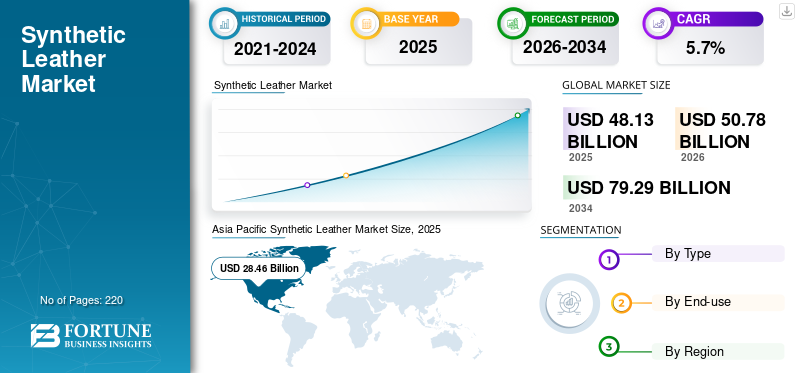
The global synthetic leather market size was USD 48.13 billion in 2025 and is projected to grow from USD 50.78 billion in 2026 to USD 79.29 billion by 2034 at a CAGR of 5.7% during the forecast period. Asia Pacific dominated the synthetic leather market with a market share of 59.13% in 2025.
Synthetic leather or artificial leather is an engineered material designed to replicate the appearance, texture, and functional performance of natural leather while offering greater consistency, design flexibility, and cost efficiency. It is typically manufactured by coating or laminating a textile substrate, such as polyester, cotton, nylon, or non-woven fabric, with polymer systems including Polyurethane (PU), Polyvinyl Chloride (PVC), bio-based materials, or other specialty coatings. Synthetic leather is widely used in footwear, furnishing, automotive interiors, apparel, fashion accessories, and other coated-fabric applications. Its adoption is driven by durability, lower maintenance, customizable finishes, vegan positioning, and suitability for large-scale industrial production.
NAN YA Plastics Industrial Co., Ltd., Sf, Mayur Uniquoters Limited, KURARAY Co., Ltd., and Zhejiang Hexin Holdings Co., Ltd. are the key players operating in the market.
Download Free sample to learn more about this report.
SYNTHETIC LEATHER MARKET KEY TAKEAWAYS
 Global Market Size & Forecast
- 2025 Market Size: USD 48.13 billion
- 2026 Market Size: USD 50.78 billion
- 2034 Forecast Market Size: USD 79.29 billion
- CAGR: 5.7% from 2026-2034
 Market Share
- Asia Pacific dominated the synthetic leather market with a 59.13% share in 2025.
- The bio-based segment is projected to grow at a 14.5% CAGR.
- The automotive segment is projected to grow at a 6.2% CAGR.
 Key Regional Highlights
North America
North America recorded strong demand for synthetic leather across automotive interiors, furnishings, healthcare seating, and marine upholstery applications.
Asia Pacific
Asia Pacific remained the leading market, supported by its large footwear, apparel, bags, furniture, and automotive manufacturing base.
Europe
Europe continued to witness demand for premium, compliant, and sustainable leather alternatives across automotive, footwear, fashion, and furnishing applications.
U.S.
The market was valued at USD 5.75 billion in 2025, accounting for roughly 11.9% of global sales.
Japan
The market reached USD 1.98 billion in 2025, equivalent to around 4.1% of global sales.
Read More

SYNTHETIC LEATHER MARKET TRENDS
Customization and Design-Led Differentiation Products to be a Significant Market Trend
A major trend in the industry is the growing focus on customization and design-led differentiation. Manufacturers are increasingly offering varied textures, embossing patterns, grain structures, colors, gloss levels, perforations, and tactile finishes to meet specific requirements across footwear, automotive interiors, furnishing, bags, apparel, and luxury-inspired accessories. Buyers are no longer looking only for a leather-like substitute, they want materials that support brand identity, seasonal design refreshes, and premium visual appeal. This trend is pushing suppliers to invest in surface innovation, finishing technologies, and application-specific product development.
MARKET DYNAMICS
MARKET DRIVERS
Download Free sample to learn more about this report.
Synthetic Leather Gains Momentum as Brands Seek Scalable and Versatile Alternatives, Driving Market Growth
Synthetic leather is gaining traction across footwear, furnishing, automotive interiors, apparel, fashion accessories, and specialty coated-fabric applications due to its affordability, functionality, and scalability. Compared with natural leather, it offers consistent thickness, texture, color, finish, and performance, making it suitable for both mass-market and premium products. Footwear remains a key demand driver, supported by flexibility, lightweight structure, design freedom, and cost efficiency. Furnishing and automotive applications are also growing due to demand for durable, easy-to-clean, and visually appealing surfaces. Overall, synthetic leather’s ability to combine aesthetics, customization, lower maintenance, and industrial-scale production capacities supports its continued adoption globally. Thus, in turn, benefitting and driving synthetic leather market growth.
MARKET RESTRAINTS
Environmental Scrutiny Challenges Conventional PU and PVC Synthetic Leather Market Growth
The industry faces growing restraint from environmental, regulatory, and reputational concerns linked to petroleum-based PVC and solvent-based PU materials. Although positioned as an animal-free alternative, many conventional grades rely on fossil-based polymers, plasticizers, solvents, pigments, stabilizers, and additives, raising concerns around emissions, toxicity, worker safety, and disposal. PVC faces scrutiny due to plasticizer use, while solvent-based PU may create volatile emission risks. Recycling is also difficult as synthetic leather is typically a multi-layer composite. Rising criticism of greenwashing further pressures suppliers to prove safer chemistry, traceability, lower environmental impact, and credible sustainability performance.
MARKET OPPORTUNITIES
Next-Generation PU, Bio-Based Materials, and Premium Microfiber Open a New Growth Frontier
The strongest opportunity in the industry lies in next-generation materials that combine sustainability, performance, and premium aesthetics. Water-based PU, solvent-free PU, microfiber synthetic leather, sustainable alternatives, silicone-based materials, recycled-content grades, and specialty coated fabrics are gaining relevance as brands reduce reliance on conventional PVC and solvent-heavy systems. These materials offer improved softness, durability, flexibility, low odor, breathability, and leather-like appearance. Bio-based inputs such as mycelium, cactus, apple waste, and pineapple fibers create differentiation opportunities, while premiumization through advanced textures, low-VOC formulations, antimicrobial surfaces, and automotive-approved grades supports higher-value market positioning.
MARKET CHALLENGES
Recycling Complex Multi-Layer Materials Constraints Market Growth
A major challenge for the industry is the difficulty of recycling multi-layer composite structures. Most synthetic leather products combine textile substrates, polymer coatings, pigments, adhesives, surface finishes, and functional additives, making material separation technically complex and commercially unattractive. Once converted into shoes, bags, furniture, or automotive interiors, recycling becomes even more difficult due to mixed materials and contamination. This creates pressure on suppliers to develop mono-material structures, recyclable coatings, take-back models, and better end-of-life solutions while still maintaining durability, softness, appearance, and cost efficiency.
SEGMENTATION ANALYSIS
By Type
Polyurethane (PU) Based Segment Leads Owing to Comfort, Performance, and Premium Appeal
Based on type, the market segments include polyurethane (PU) based, polyvinyl chloride (PVC) based, bio-based, and others.
The polyurethane (PU) based segment is anticipated to hold the dominant synthetic leather market share during the forecast period. Demand for PU-based synthetic leather is driven by its superior balance of aesthetics, flexibility, comfort, and performance compared with traditional PVC-based materials. PU offers a softer hand feel, lighter weight, better breathability, and closer resemblance to natural leather, making it attractive for footwear, automotive interiors, fashion accessories, apparel, and premium furnishing. Growing adoption of water-based PU and microfiber PU further supports demand, as brands seek improved durability, lower odor, better surface finish, and more premium product positioning.
The bio-based segment is anticipated to rise with a CAGR of 14.5% over the forecast period. Rising demand for bio-based synthetic leather is driven by rising sustainability expectations among brands, regulators, and consumers. Fashion, footwear, automotive, and interior brands are increasingly exploring plant-based and renewable-origin materials to reduce dependence on fossil-based polymers and strengthen animal-free positioning. Inputs such as cactus, mycelium, apple waste, pineapple fiber, and other bio-derived materials provide differentiation opportunities for premium products. Although still emerging, the segment benefits from strong brand interest in lower-impact materials, ESG alignment, and credible sustainability storytelling.
By End-use
To know how our report can help streamline your business, Speak to Analyst
Design Flexibility and Cost Efficiency Powers Demand in Footwear Segment
Based on end-use, the market is segmented into footwear, furnishing, automotive, apparel & fashion, and others.
The footwear segment is anticipated to hold the dominant market share during the forecast period. Growing demand for synthetic leather in footwear is driven by the need for cost-effective, flexible, lightweight, and design-versatile materials across casual shoes, sports shoes, sandals, formal footwear, school shoes, and safety footwear. Synthetic leather allows footwear manufacturers to achieve consistent quality, multiple colors, embossing options, and leather-like appearance at scale. Its lower maintenance, durability, and ability to support fast-changing fashion trends make it attractive for both mass-market and mid-premium footwear brands.
The automotive segment is anticipated to rise with a CAGR of 6.2% over the forecast period. Demand for synthetic leather in automotive applications is driven by the growing need for durable, premium-looking, easy-to-clean, and customizable interior materials. OEMs and aftermarket suppliers use synthetic leather in seats, door trims, dashboards, steering covers, armrests, and headrests to enhance cabin aesthetics and comfort. The material supports consistent grain, color, texture, low odor, abrasion resistance, and design flexibility, making it suitable for both mass-market vehicles and premium interior upgrades.
SYNTHETIC LEATHER MARKET REGIONAL OUTLOOK
By region, the market is segmented into North America, Europe, Asia Pacific, Latin America, and the Middle East & Africa.
Asia Pacific
Asia Pacific Synthetic Leather Market Size, 2025 (USD Billion)
To get more information on the regional analysis of this market, Download Free sample
Demand for synthetic leather in Asia Pacific is primarily driven by the region’s large footwear, apparel, bags, furniture, and automotive manufacturing base. China, India, Vietnam, Indonesia, South Korea, Taiwan, and Japan support both domestic consumption and export-oriented production. Synthetic leather is preferred as it offers cost efficiency, consistent quality, design flexibility, easy processing, and suitability for high-volume manufacturing. The material is widely used in footwear, fashion accessories, upholstery, and vehicle interiors, while rising income levels, urban retail growth, and expanding middle-class consumption further strengthen regional market demand.
Japan Synthetic Leather Market
Japan’s market reached USD 1.98 billion in 2025, equivalent to around 4.1% of global sales.
China Synthetic Leather Market
China’s market is projected to be one of the largest globally, with 2025 revenues valued at USD 13.39 billion, representing roughly 27.8% of global sales.
India Synthetic Leather Market
The market reached USD 4.82 billion in 2025, equivalent to around 10.0% of global sales.
North America
Demand for synthetic leather in North America is driven by its strong adoption across automotive interiors, furnishing, healthcare seating, marine upholstery, RVs, footwear, and lifestyle products. Buyers in the region value materials that provide durability, cleanability, low maintenance, consistent appearance, and premium aesthetics. Automotive and contract furnishing applications are particularly important, as OEMs, furniture producers, and institutional buyers require high-performance surfaces with abrasion resistance, low odor, stain resistance, and long service life. The region’s preference for practical, easy-care, and design-flexible materials continues to support synthetic leather consumption.
U.S. Synthetic Leather Market
The U.S. market was valued at USD 5.75 billion in 2025, accounting for roughly 11.9% of global sales.
Europe
Demand for synthetic leather in Europe is driven by the need for premium, compliant, and increasingly sustainable leather alternatives across automotive, footwear, fashion, furnishing, and interior applications. European buyers place strong emphasis on aesthetics, tactile quality, regulatory compliance, low emissions, and responsible material sourcing. Automotive and fashion brands are particularly influential, as they seek materials that offer leather-like appearance, design flexibility, animal-free positioning, and improved environmental credentials. This has supported interest in PU-based, microfiber, bio-based, and low-VOC synthetic leather products over conventional commodity grades.
U.K. Synthetic Leather Market
The market reached USD 1.22 billion in 2025, equivalent to around 2.5% of global sales.
Germany Synthetic Leather Market
Germany’s market reached USD 1.89 billion in 2025, equivalent to around 3.9% of global sales.
Latin America
Demand for synthetic leather in Latin America is driven by affordability and practical performance across footwear, furniture, automotive aftermarket, bags, apparel accessories, and consumer goods. Brazil and Mexico support consumption through local footwear production, furniture demand, vehicle interior applications, and retail-oriented lifestyle products. Synthetic leather is attractive as it provides a leather-like appearance at accessible price points, while offering durability, water resistance, easy maintenance, and design variety. The region’s value-conscious consumer base and growing urban retail channels continue to support its use across mass-market and mid-tier applications.
Brazil Synthetic Leather Market
Brazil’s market reached USD 1.34 billion in 2025, equivalent to around 2.8% of global sales.
Middle East & Africa
Demand for synthetic leather in the Middle East & Africa is driven by its use in footwear, furnishing, hospitality interiors, automotive aftermarket, commercial seating, and institutional applications. In GCC markets, premium interiors, hotels, malls, offices, marine seating, and vehicle customization support demand for visually appealing and easy-to-clean materials. In African markets, affordability, durability, and availability are key drivers across footwear, upholstery, bags, and public-use seating. Synthetic leather’s water resistance, low maintenance, design flexibility, and suitability for hot and high-use environments make it a practical material choice across the region.
South Africa Synthetic Leather Market
The market reached USD 0.45 billion in 2025, equivalent to around 0.9% of global sales.
COMPETITIVE LANDSCAPE
Key Industry Players
Key Players to Focus on Scale, Specialization, and Sustainability to Expand Market Share
The global synthetic leather market is moderately fragmented, with competitive landscape split between large Asian integrated producers, Japanese premium microfiber specialists, and regional coated-fabric manufacturers. Asia remains the key production hub, supported by strong footwear, automotive, furnishing, and fashion supply chains, while Europe and North America focus more on premium, compliant, and specialty grades. Competitive differentiation is increasingly based on PU quality, microfiber technology, surface finishing, sustainability positioning, low-emission formulations, and application-specific performance.
LIST OF KEY SYNTHETIC LEATHER COMPANIES PROFILED IN REPORT
- KURARAY CO., LTD. (Japan)
- Teijin Cordley Limited (Japan)
- NAN YA Plastics Industrial Co., Ltd. (Taiwan)
- FILWEL Co., Ltd. (Japan)
- San Fang Chemical Industrial Co., Ltd. (Taiwan)
- Mayur Uniquoters Limited (India)
- Zhejiang Hexin Holdings Co., Ltd. (China)
- HUAFENG GROUP (China)
- Responsive Industries (India)
- Rextile Leather Pvt. Ltd (India)
KEY INDUSTRY DEVELOPMENTS
- August 2023: Teijin Cordley Limited and WR Supply Inc. launched a collaborative initiative to recycle release paper, a material commonly discarded during artificial leather production. The project aims to reduce industrial waste, improve resource efficiency, and promote a circular manufacturing model by reusing materials that would otherwise be disposed of, helping lower the overall environmental footprint of production.
- October 2022: Kuraray’s environmentally friendly CLARINO man-made leather made from recycled plastic bottles was adopted for Lenovo’s ThinkPad X1 Fold Series, supporting the company’s expansion into sustainable materials for premium consumer electronics applications.
REPORT COVERAGE
The global synthetic leather market report provides a detailed analysis of the market. It focuses on key aspects such as profiles of leading companies, product types, and leading end-uses of the product. Besides this, it offers insights into the analysis of key market trends and highlights key industry developments. In addition to the aforementioned factors, it encompasses several factors that have contributed to the growth of the market over recent years.
Request for Customization to gain extensive market insights.
Report Scope & Segmentation
| ATTRIBUTE | DETAILS |
| Study Period | 2021-2034 |
| Historical Period | 2021-2024 |
| Base Year | 2025 |
| Estimated Year | 2026 |
| Forecast Period | 2026-2034 |
| Unit | Volume (Million Meter Square) and Value (USD Billion) |
| Growth Rate | CAGR of 5.7% during 2026-2034 |
| Segmentation | By Type, By End-use, and By Region |
| By Type |
|
| By End-use |
|
| By Region |
|
Frequently Asked Questions
Fortune Business Insights says that the global market size was valued at USD 48.13 billion in 2025 and is projected to record a valuation of USD 79.29 billion by 2034.
In 2025, Asia Pacific’s market stood at USD 28.46 billion.
Registering a CAGR of 5.7%, the market will exhibit steady growth during the forecast period of 2026-2034.
The footwear segment is expected to lead in the market.
Synthetic leather gains momentum as brands seek scalable and versatile alternatives, driving market growth.
NAN YA Plastics Industrial Co., Ltd., San Fang Chemical Industrial Co., Ltd., Mayur Uniquoters Limited, KURARAY Co., Ltd., and Zhejiang Hexin Holdings Co., Ltd. are the major players operating in the market.
Asia Pacific held the highest share in the market.
Growing need for cost-effective, customizable, and scalable leather alternatives to drive wider adoption of synthetic leather.



- 2021-2034
- 2025
- 2021-2024
- 220
Get 30-60 hrs Free Customization
Expand Regional and Country Coverage, Segments Analysis, Company Profiles, Competitive Benchmarking, and End-user Insights.


















-
US +1 833 909 2966 ( Toll Free )
-
Get In Touch With Us