Insect Repellent Market Size, Share & Industry Analysis, By Product (Topical Liquid Repellents [Sprays & Aerosols, Lotions, Creams, and Others], Electric Vaporizers, Mosquito Coils, and Others), By Ingredient Type (Synthetic and Natural), By Insect Type (Mosquito Repellents and Multi-Insect Repellents & Others), By End-User (Households, Hospitality Settings, Healthcare Settings, Schools & Day Care Centers, and Others), By Distribution Channel (Supermarkets & Hypermarkets, Pharmacies & Drug Stores, Convenience Stores, Online Channels, and Others), and Regional Forecast, 2026-2034
 Download Free Sample
(Offer valid till 30th Sep 2026)

Insect Repellent Market Overview
 Listen to Audio Version
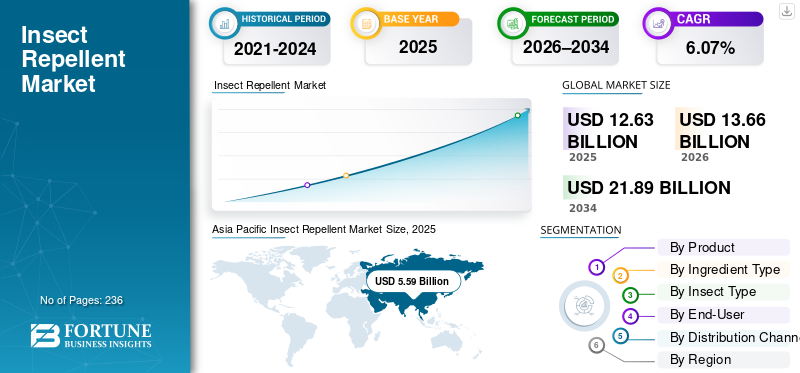
The global insect repellent market size was valued at USD 12.63 billion in 2025 and is projected to grow from USD 13.66 billion in 2026 to USD 21.89 billion by 2034, exhibiting a CAGR of 6.07% during the forecast period. Asia Pacific dominated the insect repellent market with a market share of 44.26% in 2025.
Insect repellents effectively prevent itchy bites and allergic reactions from insects and protect users against diseases such as malaria, dengue, Lyme disease, and others. Consumers prefer premium products of safer formulations, improved efficacy, and ease of use for their indoor and outdoor insect protection needs. Consistent manufacturers’ efforts to develop innovative formulation-based repellents that enable users to avoid insect-borne diseases effectively are positively contributing to industry growth. For instance, in April 2025, Godrej, an Indian consumer goods brand, launched Kala HIT Mosquito spray equipped with Thunderbolt technology for Indian household and commercial end users.
Key companies in the global market include Reckitt Benckiser Group plc., S.C. Johnson & Son, Inc., Spectrum Brands Holdings, Inc., Godrej Consumer Products Ltd, and The 3M Company.
Download Free sample to learn more about this report.
Insect Repellent Market Key Takeaways.
 Market Size & Forecast
- 2025 Market Size: USD 12.63 billion
- 2026 Market Size: USD 13.66 billion
- 2034 Forecast Market Size: USD 21.89 billion
- CAGR: 6.07% from 2026–2034
 Market Share
- Asia Pacific dominated the insect repellent market with a 44.26% share in 2025.
- The topical liquid repellents segment accounted for a 36.59% share in 2025.
- The synthetic segment held a 69.47% market share in 2025.
 Key Regional Highlights
North America
North America held a 20.51% market share in 2025 and is expected to reach USD 2.79 billion in 2026.
Europe
Europe accounted for USD 1.93 billion in 2025, representing 15.29% of the global market.
Asia Pacific
Asia Pacific reached USD 5.59 billion in 2025 and is projected to grow at a 6.78% CAGR through 2034.
U.S.
The market reached USD 1.97 billion in 2025, supported by strong demand for premium and AI-assisted repellent solutions.
Japan
The market reached USD 0.57 billion in 2025, driven by continued innovation in household vaporizer products.
Read More

Insect Repellent Market Trends
Increasing Preference for Repellents for Protection against Multiple Insects to Augment Market Growth
The increasing consumer preference for repellents that protect against multiple insects, including mosquitoes, flies, ticks, and others, is augmenting the global insect repellent industry. In addition, the growing consumer exposure to outdoor recreational activities, including hiking, camping, gardening, and others, is creating new market growth prospects for multipurpose insect repellent products.
Download Free sample to learn more about this report.
Market Dynamics
Market Drivers
Rising Prevalence of Vector-Borne Diseases to Drive Insect Repellents Demand
The rising prevalence of vector-borne diseases, including malaria, zika, dengue, and others, and the growing awareness of the availability of tropical repellents, enabling users to avoid insect bites and the spread of diseases, are driving the global market growth. According to the World Health Organization (WHO), in 2024, around 282 million patients suffered from malaria, with roughly 9 million more cases every year. In addition, consistent healthcare providers and government promotion of the use of mosquito coils and vaporizers to prevent vector-borne diseases are favoring product sales across many countries.
Market Restraints
Health Concerns Due to Chemical-Based Repellents to Restrain Market Growth
Chemical-based repellents can cause skin irritation, toxicity, and allergic reactions. Increasing incidences of inhaling toxicity and allergy concerns due to the usage of such products are hampering the demand for such products. In addition, the growing use of alternative products, including protective nets, mosquito-killing rackets, and essential oils, enabling users to maintain their immediate environment insect-free, is restraining market growth.
Market Opportunities
Growing Demand for Plant-based Repellents to Create Newer Market Growth Opportunities
The growing number of eco-conscious consumers preferring repellents made with natural, plant-based formulations to avoid potential health risks associated with chemical-based products is creating new market growth opportunities. In addition, the increasing number of consumers seeking products derived from eco-friendly botanical sources, including citronella, eucalyptus, neem, lemongrass, and lavender, is creating new industry growth prospects.
Market Challenges
Significant Competition from Local Industry Manufacturers to Challenge Key Players' Business Expansion
Significant competition from local industry manufacturers, who offer products at competitive prices, is posing challenges to the key players in their international business expansion activities. In addition, greater accessibility to counterfeit products, leading to allergy and irritation issues, is lowering consumers’ confidence in buying such products, hindering global market expansion.
Segmentation Analysis
By Product
Topical Liquid Repellents Segment Dominated due to Ease of Use
By product, the market is segmented into topical liquid repellents, electric vaporizers, mosquito coils, and others. The topical liquid repellents segment accounted for the leading global market share of 36.59% in 2025. The segment’s leading share is attributed to the topical repellents’ immediate effectiveness, ease of use, and suitability for indoor and outdoor environments compared to counterpart products. In addition, advancements in the development of repellents equipped with patented formulations and natural & botanical extracts are positively contributing to the segment’s growth.
Topical liquid repellents are further sub-segmented into sprays & aerosols, lotions, creams, and others. The sprays & aerosols are slated to hold a leading share within the topical liquid repellents segment during the forecast period (2026-2034). Significant demand for travel-friendly sprays and aerosols during hiking and other outdoor recreational activities is driving considerable revenue growth in the segment.
To know how our report can help streamline your business, Speak to Analyst
The electric vaporizers segment is projected to grow at the fastest rate of 7.18% from 2026 to 2034. The rising demand for consistent electric vaporizers that do not require manual intervention in modern living spaces is accelerating the segment’s growth.
By Ingredient Type
Greater Efficacy and Broad-Spectrum Effectiveness Led to the Dominance of the Synthetic Segment
By ingredient type, the market is bifurcated into synthetic and natural. The synthetic segment exhibited a leading global market share of 69.47% in 2025. The segment’s leading share is attributed to the proven efficacy, longer protection duration, and broad-spectrum effectiveness of synthetically produced repellents against mosquitoes and other biting insects. In addition, increasing demand for affordable, synthetic formulation-based products, including coils, topical sprays, and others, is favoring the segment’s growth.
The natural segment is projected to grow at the fastest rate of 6.90% from 2026 to 2034. Natural formulation-based products are usually sold at premium prices over conventional products. The rising demand for premium formulation-based products made from natural ingredients & botanical extracts is driving the segment’s growth.
By Insect Type
Greater Prevalence of Mosquito-Borne Diseases Boosted the Mosquito Repellents Segment Growth
Based on insect type, the market is bifurcated into mosquito repellents and multi-insect repellents & others. The mosquito repellents segment exhibited a leading global market share of 74.74% in 2025. The segment’s leading share is attributed to the greater prevalence of mosquito-borne diseases and widespread perception of mosquitoes as a primary insect affecting human health worldwide. In addition, the growing awareness of the availability of mosquito repellents in multiple formats, including coils, sprays, and others, is accelerating the segment’s growth.
The multi-insect repellents & others segment is projected to grow at the fastest rate of 6.77%, from 2026 to 2034. The growing need for comprehensive protection against multiple insects, such as flies, ticks, mites, fleas, and others, is primarily driving the segment’s growth. In addition, the rising demand for multi-insect solutions that enable commercial consumers to avoid the risks of vector-borne diseases is favoring the sale of such products.
By End-User
High Demand for Repellents to Maintain Living Spaces Insect-free Led Dominance of the Household Segment
Based on end-user, the market is segmented into households, hospitality settings, healthcare settings, schools & daycare centers, and others. The households segment exhibited a leading global market share of 70.54% in 2025. The segment’s leading share is due to significant demand for repellents among households seeking to maintain a mosquito-free living environment worldwide. In addition, the growing residential infrastructure and the increasing demand for premium products among households are driving the segment’s growth.
The hospitality settings segment is growing at a CAGR of 8.07% from 2026 to 2034. The expanding hotel industry and consistent hospitality firms’ investments in expanding their hotel chain networks are driving demand for repellents in these settings across many countries.
By Distribution Channel
Wide Product Assortment and Greater Brand Visibility Encouraged Supermarkets & Hypermarkets Expansion
Based on distribution channel, the market is segmented into supermarkets & hypermarkets, pharmacies & drug stores, convenience stores, online channels, and others. The supermarkets & hypermarkets segment exhibited a leading global insect repellent market share of 31.55% in 2025. The segment’s leading share is attributed to the availability of a wide product assortment and greater brand visibility under one roof, which drives significant product sales in supermarkets. The expanding hypermarket infrastructure and its consistent provision of products at discounted prices encourage bulk purchases of such different product types, thereby skyrocketing the segment’s growth.
The online channels segment is growing at a CAGR of 8.81% from 2026 to 2034. The increasing e-commerce penetration and the growing consumer access to niche, premium, and natural insect repellent formulations are driving product sales through online channels.
Insect Repellent Market Regional Outlook
By region, the market is categorized into North America, Europe, Asia Pacific, South America, and the Middle East & Africa.
Asia Pacific
Asia Pacific Insect Repellent Market Size, 2025 (USD Billion)
To get more information on the regional analysis of this market, Download Free sample
The Asia Pacific region’s market is projected to grow at the fastest rate of 6.78% from 2026 to 2034. The region held a leading global market share of 44.22% and a market size of USD 5.59 billion in 2025. The high prevalence of mosquito-borne diseases and the significant adoption of daily protection products, including coils, vaporizers, and topical repellents, are generating considerable product revenues across the region. In addition, the expanding urbanization rate and increasing demand for innovative formulation-based products among hospitality & other commercial end-users are creating new insect repellent market growth opportunities across the region.
Japan Insect Repellent Market
The Japanese market in 2025 reached around USD 0.57 billion, accounting for roughly 4.54% of global product revenues. The manufacturers’ consistent efforts to launch innovative products are driving the vaporizer product replacement rate in households, which is driving market growth.
China Insect Repellent Market
China’s market is projected to be one of the largest worldwide, with revenues estimated at around USD 1.73 billion in 2025, representing roughly 13.67% of global product sales.
India Insect Repellent Market
The Indian market in 2025 reached around USD 1.47 billion, accounting for roughly 11.62% of global market revenues.
North America
The North America region held the second-largest global market share of 20.51% in 2025 and is expected to maintain its leading position during the forecast period (2026-2034). The North America market size is estimated to reach USD 2.79 billion by 2026. Greater product awareness and high consumer preference for premium formulation-based products are driving significant product revenue across the region. Rising demand for DEET-free, plant-based sprays and aerosols among high-income households is accelerating the region’s market growth.
U.S. Insect Repellent Market
The U.S. market size reached USD 1.97 billion in 2025. The U.S. market accounted for around 15.61% of the global market sales in 2025. The expansion of hospitality infrastructure and the high preference for AI-assisted insect vaporizers & control systems are favoring market growth across the U.S.
Europe
The European region is expected to maintain its third-leading global market position during the forecast period (2026-2034). The European market size reached USD 1.93 billion in 2025, accounting for approximately 15.29% of the global product sales. Rising seasonal demand for mosquito repellent solutions and increasing demand for travel-friendly sprays & aerosols are driving growth in the European market. In addition, rising awareness of West Nile virus and other vector-borne diseases is uplifting product sales across Europe.
U.K. Insect Repellent Market
The U.K. market in 2025 reached around USD 0.28 billion, representing approximately 2.20% of global product revenues.
Germany Insect Repellent Market
Germany’s market reached approximately USD 0.41 billion in 2025, equivalent to around 3.21% of global product sales.
South America and Middle East & Africa
The markets in South America and the Middle East & Africa are expected to grow at a moderate rate from 2026 to 2034. The South America market in 2025 reached a valuation of USD 1.19 billion. The growing awareness of the availability of insect repellents in multiple formats and formulations is driving market growth across the region. The expansion of hospitality infrastructure and the preference for premium products are positively contributing to market development across the Middle East and Africa. In the Middle East & African market, South Africa reached a market value of USD 0.095 billion in 2025.
UAE Insect Repellent Market
The UAE market is projected to reach approximately USD 0.19 billion by 2025, accounting for roughly 1.51% of the global market revenues.
Competitive Landscape
Key Industry Players
Consistent Focus on Portfolio Expansion to Help Key Players Maintain their Product Reach
The key players operating in the global market are Reckitt Benckiser Group plc., S.C. Johnson & Son, Inc., Spectrum Brands Holdings, Inc., Godrej Consumer Products Ltd, and The 3M Company. These players broaden their product portfolios into different formats to build their business presence worldwide. In addition, they partner with international retailers to increase their product reach globally.
LIST OF KEY INSECT REPELLENT COMPANIES PROFILED
- Reckitt Benckiser Group plc. (U.K.)
- C. Johnson & Son, Inc. (U.S.)
- Godrej Consumer Products Limited (India)
- Spectrum Brands Holdings, Inc. (U.S.)
- Dabur India Limited (India)
- Henkel AG & Co. KGaA (Germany)
- Bayer AG (Germany)
- BASF SE (Germany)
- The 3M Company (U.S.)
- Sumitomo Chemical Co., Ltd. (Japan)
KEY INDUSTRY DEVELOPMENTS
- January 2026: BASF Agricultural Solutions acquired AgBiTech, a biological insect control company, to develop insect control products based on naturally occurring viruses for corn, cotton, soybeans, and specialty crops.
- February 2025: SC Johnson Sons launched a high-speed manufacturing line of spatial mosquito repellents at its Nairobi, Kenya, plant. The line is efficient in producing mosquito repellents, catering to the insect management needs of the African households during the peak malaria season.
- June 2025: Aantex Pest Control acquired Bugs Be Gone Pest Control to strategically enhance its business presence across Contra Costa County and surrounding areas in the U.S., serving both residential and commercial clients.
- June 2025: Mimikai, a California-based start-up, launched its first line of DEET-free insect and tick repellents made of natural ingredients for effective bite protection. The product containing the design formulation consists of a wild tomato plant to develop natural ingredients that repel insects.
- March 2025: Goodeill Holdings, Inc. acquired EcoGuard Pest Control, a Chicago-based pest control brand catering to homeowners and business consumers. This acquisition enabled Goodeill Holdings, Inc. to broaden its portfolio of insect killers and strengthen its presence as a pest control
- July 2024: Godrej Consumer Products Ltd. (GCPL) developed Renofluthrin, a patented molecule that enhances the efficacy of the liquid vaporizer formulations for mosquito control.
- August 2023: CenterOak Partners LLC, a private equity firm, and its portfolio company, Palmetto Exterminators, acquired PestNow to form Entomo Brands, a brand offering multiple insect management-related services in the Southeast and Mid-Atlantic regions of the U.S.
REPORT COVERAGE
Request for Customization to gain extensive market insights.
Report Scope & Segmentation
|
ATTRIBUTE |
DETAILS |
|
Study Period |
2021-2034 |
|
Base Year |
2025 |
|
Estimated Year |
2026 |
|
Forecast Period |
2026-2034 |
|
Historical Period |
2021-2024 |
|
Growth Rate |
CAGR of 6.07% from 2026 to 2034 |
|
Unit |
Value (USD Billion) |
|
Segmentation |
By Product, Ingredient Type, Insect Type, End-User, Distribution Channel, and Region |
|
By Product |
· Topical Liquid Repellents o Sprays & Aerosols o Lotions o Creams o Others · Electric Vaporizers · Mosquito Coils · Others |
|
By Ingredient Type |
· Synthetic · Natural |
|
By Insect Type |
· Mosquito Repellents · Multi-Insect Repellents & Others |
|
By End-User |
· Households · Hospitality Settings · Healthcare Settings · Schools & Daycare Centers · Others |
|
By Distribution Channel |
· Supermarkets & Hypermarkets · Pharmacies & Drug Stores · Convenience Stores · Online Channels · Others |
|
By Geography |
· North America (By Product, Ingredient Type, Insect Type, End-User, Distribution Channel, and Country) o U.S. (By Product) o Canada (By Product) o Mexico (By Product) · Europe (By Product, Ingredient Type, Insect Type, End-User, Distribution Channel, and Country) o Germany (By Product) o France (By Product) o Italy (By Product) o Spain (By Product) o U.K. (By Product) o Russia (By Product) o Rest of Europe (By Product) · Asia Pacific (By Product, Ingredient Type, Insect Type, End-User, Distribution Channel, and Country) o China (By Product) o India (By Product) o Japan (By Product) o Australia (By Product) o Rest of Asia Pacific (By Product) · South America (By Product, Ingredient Type, Insect Type, End-User, Distribution Channel, and Country) o Brazil (By Product) o Argentina (By Product) o Rest of South America (By Product) · Middle East & Africa (By Product, Ingredient Type, Insect Type, End-User, Distribution Channel, and Country) o South Africa (By Product) o UAE (By Product) o Rest of the Middle East & Africa (By Product) |
Frequently Asked Questions
Fortune Business Insights says that the global market value stood at USD 12.63 billion in 2025 and is projected to reach USD 21.89 billion by 2034.
In 2025, the market value stood at USD 5.59 billion.
At a CAGR of 6.07%, the global insect repellent market is forecasted to grow from 2026 to 2034.
By product, the topical liquid repellents segment held the leading global market share.
The rising prevalence of vector-borne diseases is the key factor driving market growth.
Reckitt Benckiser Group plc., S.C. Johnson & Son, Inc., Spectrum Brands Holdings, Inc., Godrej Consumer Products Ltd, and The 3M Company are the top players in the market.
Asia Pacific dominated the market in 2025.
The growing demand for plant-based repellents is expected to create new market growth opportunities.



- 2021-2034
- 2025
- 2021-2024
- 236
-
(Offer valid till 30th Sep 2026)
Get 30-60 hrs Free Customization
Expand Regional and Country Coverage, Segments Analysis, Company Profiles, Competitive Benchmarking, and End-user Insights.



















Related Reports
-
US +1 833 909 2966 ( Toll Free )
-
Get In Touch With Us