Mosquito Repellent Market Size, Share & Industry Analysis, By Product Type (Coil, Spray, Cream and Oil, Vaporizers, and Others), By Raw Material (Plant-based Repellents and Chemically Derived Repellents), By Distribution Channel (Retail Stores, Supermarkets, Online, and Others), and Regional Forecast, 2026-2034
 Download Free Sample
(Offer valid till 30th Sep 2026)

KEY MARKET INSIGHTS
 Listen to Audio Version
The global mosquito repellent market size was valued at USD 7.49 billion in 2025. The market is projected to grow from USD 7.88 billion in 2026 to USD 12.54 billion by 2034, exhibiting a CAGR of 5.99% during the forecast period. Asia Pacific dominated the mosquito repellent market with a market share of 35.42% in 2024.
Based on our analysis, the global market exhibited an average growth of 3.69% in 2020 as compared to 2019.
Earth's global temperature has continued to rise over the past few years and is expected to rise in the near future due to increasing concentrations of greenhouse gases in the atmosphere. Hot temperatures provide perfect conditions for mosquito breeding and increased activity. It also guarantees humid climate in certain areas, which helps with population growth. The effects of increasing global warming will therefore directly affect the growth of mosquito population, leading to the proliferation of products designed to repel mosquitoes. This would, in turn, increase the overall demand for mosquito repellent. Moreover, rapid urbanization and industrialization in India, China, Brazil, Argentina, the UAE, and others is leading to the construction of buildings and apartments, which amplifies the demand for mosquito repellent products, thus fostering market growth.
The closure of shops and mega stores, uncertainties in the supply of raw materials and lack of workers significantly impacted market revenue during the COVID-19 pandemic. However, online sales channels witnessed a boom in mosquito repellent demand during 2020 compared to offline distribution channels.
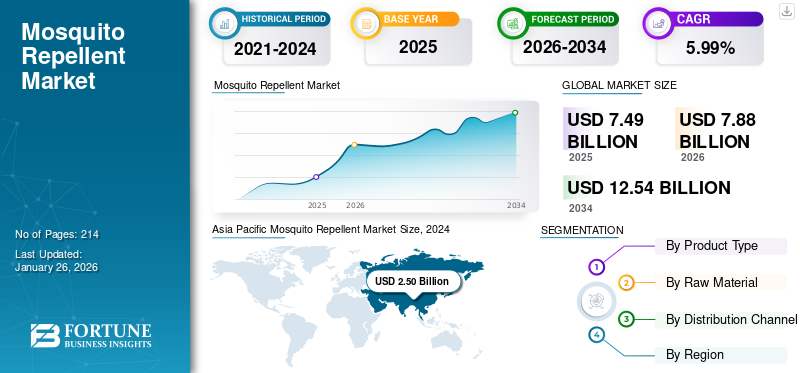
Download Free sample to learn more about this report.
Mosquito Repellent Market Key Takeaways
 Market Size & Forecast
- 2025 Market Size: USD 7.49 billion
- 2026 Market Size: USD 7.88 billion
- 2034 Forecast Market Size: USD 12.54 billion
- CAGR: 5.99% from 2026–2034
 Market Share
- Asia Pacific dominated the mosquito repellent market with a 35.42% share.
- The coil segment accounted for a 28.68% market share in 2026.
- The supermarkets segment held the dominant distribution channel share.
 Key Regional Highlights
Asia Pacific
generated USD 2.65 billion in 2025, accounting for 35.42% of the global market, and is projected to reach USD 2.82 billion in 2026.
Europe
reached USD 2.15 billion in 2025 with a 28.71% market share and is projected to grow to USD 2.24 billion in 2026.
North America
accounted for USD 1.77 billion in 2025, representing 23.64% of the global market, and is expected to reach USD 1.85 billion in 2026.
U.S
Strong R&D investments and rising consumer demand continue to support market growth.
Japan
Growing consumer awareness and demand for household insect protection products are driving market expansion.
Read More

Mosquito Repellent Market Trends
Shifting Consumer Preference of Branded Home Care Products to Impact Consumption Trends
Consumer tastes are constantly altering as patterns of demand for products keep changing. The competitive scenario of the home care industry has transformed considerably due to major shift in consumer lifestyles toward brands and luxury consumer goods. Recent trends have altered the behavior of consumer buying, placing more emphasis on quality products. This factor has created great potential for different brand owners to create different types of new products.
People are likely to live in a different way of life these days, with consumption patterns varying from time to time. Higher-income consumers and younger generations are turning to online shopping for non-essential & essential items as it saves time and offers a wide variety of products. Therefore, this is expected to drive the global mosquito repellent market growth.
Download Free sample to learn more about this report.
Mosquito Repellent Market Growth Factors
Growing Awareness Regarding Insect Repellents to Favor Market Expansion
The rise of insect-borne diseases, such as malaria and dengue fever, has made it necessary for consumers to use insect repellents. Mosquito-borne diseases include dengue, malaria, yellow fever, West Nile, Zika, chikungunya, and lymphatic filariasis. The insect kills more people than any other creature in the world. Dengue and malaria cases and deaths are unacceptably high and are rising in semi-urban and rural places. For instance, as per a report published by the World Health Organization (WHO), in 2021, approximately 14 million new cases of malaria occurred in 2020, with the highest number of cases and deaths in the new WHO Malaria Report since 2012. West Nile virus (WNV) is another most common mosquito-borne disease in the continental U.S. On average, there are 2,400 cases every year. The latest largest WNV breakout occurred in 2021 in Arizona state U.S., sickening 1,715 people, including 125 deaths. This calls for people's attention and generates awareness for mosquito-related diseases, supplementing market growth.
Unsuitable Environmental Conditions to Augment Mosquito Repellent Demand
Temperature is the most important abiotic factor affecting insect growth. Climate change directly impacts insect population dynamics by altering incidence, reproduction, and mortality rates. Weather can also affect insect populations indirectly by altering the population, distribution, and physiology of host trees, with increasing temperatures exponentially raising insect metabolic rates. Therefore, inadequate environmental conditions, such as heavy rains and global warming, also led to mosquito problems, mounting the demand for mosquito repellents.
RESTRAINING FACTORS
Allergic Reaction due to Mosquito Sprays and Coils to Hamper Sales
Products, such as sprays, vaporizers, and others, used to repel mosquitoes can be associated with health problems, including skin reactions such as rashes, swelling, itching, and eye irritation, and others. They can be harmful as they contain certain chemicals that can have adverse effects on skin over time. This reduces the demand for insect repellent products, thus hindering market growth.
Mosquito Repellent Market Segmentation Analysis
By Product Type Analysis
Effective Actions of Coils to Trigger Demand for Coil Product Type
Based on product type, the market is segmented into coil, spray, cream and oil, vaporizers, and others. The coil segment is projected to grow at a significant rate in the near future. Mosquito coils provide immediate actions to the surrounding and are also widely available in all places. This, in turn, surges the demand for coils contributing to the segment growth.
The coil segment accounted for a market share of 28.68% in 2026 and is expected to grow continuously during the forecast period.
To know how our report can help streamline your business, Speak to Analyst
By Raw Material Analysis
Chemically Derived Repellents to Dominate Owing to their Efficiency
Based on raw material, the market is segmented into plant-based repellents and chemically derived repellents. The chemically derived repellents segment generated the largest share in the market as they are the most effective alternatives when dealing with mosquitoes. Chemically derived repellent products provide immediate solutions and are made of highly concentrated chemicals. These chemicals are very powerful at repelling and exterminating invading mosquitoes and other insects.
On the other hand, plant-based repellents are projected to grow fastest over the projected years. As these products are safer, toxin-free, and made with naturally derived essential oils from plants, they are preferred by consumers. A shift in consumer preference toward organic and herbal products is amplifying demand for plant-based mosquito repellents.
By Distribution Channel Analysis
Supermarkets Segment to Dominate the Market Due to Availability of a Wide Variety of Products
On the basis of distribution channel, the market is segmented into retail stores, supermarkets, online, and others. The supermarkets segment held a significant market share in 2024. They offer a wide variety of specialty products, and consumers are free to validate the authenticity of their products. Also, major retailers involved in the home care business are expanding into large retail outlets such as mega stores and hypermarkets to meet the growing demand for home care products.
Meanwhile, the online retail segment is expected to grow fastest during the forecast period. Increasing internet penetration in different regions has helped consumers to gain knowledge about the usage and application of different products, which, in turn, fosters the demand for the products through online channels.
REGIONAL INSIGHTS
In terms of region, the market is segregated into Asia Pacific, Europe, North America, Latin America, and the Middle East & Africa.
Asia Pacific Mosquito Repellent Market Size, 2025 (USD Billion)
To get more information on the regional analysis of this market, Download Free sample
Asia Pacific
In 2025, Asia Pacific represented USD 2.65 billion, accounting for 35.42% of the worldwide market, and is projected to grow to USD 2.82 billion in 2026. Launch of new product variants, increased consumer awareness regarding the benefits of using insect repellent products, and consumer acceptance of these products are factors driving the regional market growth. In addition, the growing awareness of the value of insect repellents among slum residents will have a significant impact on business expansion. This results in an increase in mosquito repellent demand from the Asia Pacific market.
To know how our report can help streamline your business, Speak to Analyst
North America
The North America market accounted for USD 1.77 billion in 2025, representing 23.64% of the global industry, and is expected to reach USD 1.85 billion in 2026. The North America and Europe markets have witnessed several improvements in the production volume of mosquito repellent products, owing to increasing research & development, both by the governments and the established players to cater to the rising demand from consumers. Due to increasing overall demand, the market is expected to accelerate throughout the forecast period.
Europe
Europe recorded a market size of USD 2.15 billion in 2025, capturing 28.71% of the global market share, and is projected to reach USD 2.24 billion in 2026. The development of the market in Europe is anticipated to be assisted by the production of branded products and premium household products, including home care products along with increasing urban population in these countries.
South America
South America contributed approximately USD 0.62 billion to the global market in 2025, accounting for 8.28% share, and is expected to reach USD 0.65 billion in 2026. South America is expected to experience strong growth during the forecast period due to increase in insect borne diseases followed by continuous weather changes, which is accelerating the product demand in the region. Moreover, the growing construction of supermarkets and hypermarkets is also attracting consumers to buy insect repellent products of different types and flavors, thereby fostering market growth.
Middle East & Africa
Middle East & Africa contributed 3.94% to the global market in 2025, with a valuation of USD 0.3 billion, and is projected to reach USD 0.31 billion in 2026. The focus of governments and other international organizations on eliminating vector-borne diseases in this area, especially in African countries, has increased the demand for this product. For instance, in August, according to a report published by the World Health Organization (WHO), the heath department of Africa agreed to introduce a strong plan to reduce insect-borne diseases in Africa.
Key Industry Players
Innovative Launches to Create Lucrative Opportunities for the Market Players
The companies are increasingly focusing on product development and acquisition to capture a competitive share in the market. In addition, rising industrialization and construction activities increase the demand for mosquito repulsive products in various regions. At present, the growing temperature and occurrence of global warming in every region provided suitable conditions for the mosquitoes to breed, thus increasing their population over the years. This, in turn, amplifies the demand for mosquito repellent, thereby contributing to market growth.
LIST OF TOP MOSQUITO REPELLENT COMPANIES:
- 3M (U.S.)
- Coghlan’s Ltd. (Canada)
- Dabur (India)
- Godrej Consumer Products Ltd. (India)
- Homs LLC (U.S.)
- New Avon LLC. (U.S.)
- PIC Corporation (U.S.)
- Reckitt Benckiser Group Plc (U.K.)
- S.C. Johnson & Son, Inc. (U.S.)
- Spectrum Brands Holdings Inc. (U.S.)
KEY INDUSTRY DEVELOPMENTS:
- February 2023: Godrej Consumer Products Ltd (GCPL) launched two new products in the mosquito-repellent segment, including a low-cost liquid mosquito-repellent device and a no-gas instant mosquito–kill spray. These product innovations bring down costs by up to 50% in India, making them accessible to everyone.
- June 2022: Kao Corporation, a Japanese chemical and cosmetics company, launched a new mosquito repellent product, Bioré GUARD Mos Block Serum, which makes use of Kao's unique, revolutionary technology in Thailand.
- June 2022: AkzoNobel launched a powerful mosquito-repellent coating that helps combat invasive carriers of dengue fever – the mosquito. The product is a colorless matt varnish and is named Well-being Protection Anti-Mosquito. It contains an active ingredient called permethrin which is specifically designed to combat the Aedes aegypti mosquito.
- September 2021: Godrej Consumer Products Ltd., an Indian packaged consumer goods company, launched a paper-based mosquito repellent, “Goodknight Jumbo Fast Card,” priced at Rs.15 for 10 cards. This new launch aims to drive penetration and access in urban and rural markets.
- August 2020 - Bodyguard launched a natural insect repellent cream that is 100% plant-based and DEET-free. Aloe vera and neem are added to the lotion to provide hydration along with protecting against mosquitoes.
REPORT COVERAGE
The research report analyzes the market in detail and highlights important aspects such as well-known companies, product types, and distribution channels. Additionally, the report provides insight into market trends and highlights key industry developments. In addition to the aforementioned aspects, the report includes several factors contributing to the growth of the market.
Request for Customization to gain extensive market insights.
Report Scope & Segmentation
|
ATTRIBUTE |
DETAILS |
|
Study Period |
2021-2034 |
|
Base Year |
2025 |
|
Estimated Year |
2026 |
|
Forecast Period |
2026-2034 |
|
Historical Period |
2021-2024 |
|
Growth Rate |
CAGR of 5.99% from 2026 to 2034 |
|
Unit |
Value (USD Billion) |
|
Segmentation |
By Product Type
By Raw Material
By Distribution Channel
By Region
|
Frequently Asked Questions
According to Fortune Business Insights, the global mosquito repellent market size was valued at USD 7.49 billion in 2025 and is projected to grow from USD 7.88 billion in 2026 to USD 12.54 billion by 2034.
Ascending at a CAGR of 5.99%, the global market will exhibit steady growth over the forecast period (2026-2034).
The market is driven by rising global temperatures, increased awareness of vector-borne diseases like malaria and dengue, and urbanization in emerging economies such as India, Brazil, and China. Climate change and global warming are also expanding mosquito breeding zones, further increasing demand for repellent products.
Asia Pacific held the largest market share in 2025, accounting for USD 2.50 billion, driven by high mosquito prevalence, population density, and increasing awareness of mosquito-borne diseases among slum and rural communities.
The market is segmented into coils, sprays, creams and oils, vaporizers, and others. Among these, coils are in high demand due to their immediate effectiveness and affordability, holding a 28.74% market share in 2025.
Chemically derived repellents dominate the market due to their high efficacy. However, plant-based repellents are growing rapidly as consumers shift toward organic, DEET-free, and toxin-free solutions.
Key trends include the rise of natural and herbal repellents, increased online shopping, and shifting consumer preference toward branded and premium home care products. There also a surge in demand for eco-friendly and child-safe repellents.
Key restraints include skin allergies, eye irritation, and other health issues caused by chemical-based repellents like sprays and coils. This has led to growing scrutiny over product safety and encouraged demand for natural alternatives.



- 2021-2034
- 2025
- 2021-2024
- 214
-
(Offer valid till 30th Sep 2026)
Get 30-60 hrs Free Customization
Expand Regional and Country Coverage, Segments Analysis, Company Profiles, Competitive Benchmarking, and End-user Insights.












Related Reports
-
US +1 833 909 2966 ( Toll Free )
-
Get In Touch With Us