AI in Insurance Market Size, Share & Industry Analysis, By Application (Claims Processing, Customer Service, Underwriting, Fraud Detection and Others), By Deployment (Cloud and On Premise), By Enterprise Type (Large Enterprise and SMEs), By Technology (Machine Learning, Natural Language Processing (NLP), Computer Vision and Others), and Regional Forecast, 2026-2034
 Download Free Sample
KEY MARKET INSIGHTS
 Listen to Audio Version
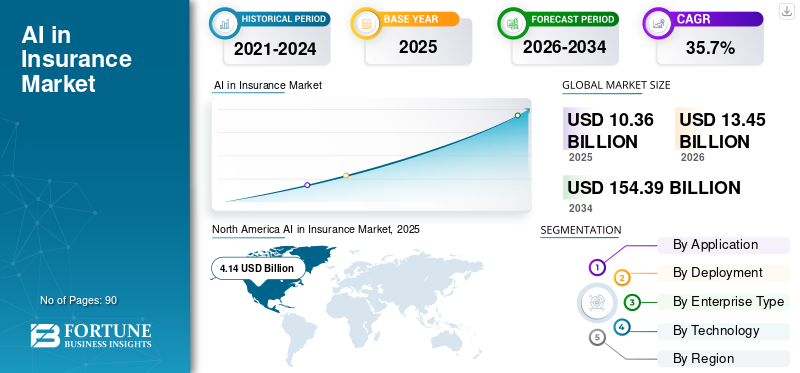
- The global AI in the insurance market was valued at USD 10.36 billion in 2025 and is projected to grow from USD 13.45 billion in 2026 to USD 154.39 billion by 2034, reflecting strong long-term adoption across the insurance value chain.
- The market is expected to expand at a CAGR of 35.7% during 2026–2034, indicating accelerating investments by insurers in AI-driven analytics, automation, and decision-making systems.
- AI deployment is increasing across core insurance functions such as claims processing, underwriting, fraud detection, and customer service, enabling insurers to automate workflows and improve operational efficiency.
- North America currently leads the AI in the insurance market, accounting for approximately 39.96% of global market share in 2025, supported by strong adoption of advanced analytics and digital insurance technologies.
The global AI in Insurance market size was valued at USD 10.36 billion in 2025. The market is projected to grow from USD 13.45 billion in 2026 to USD 154.39 billion by 2034, exhibiting a CAGR of 35.7% during the forecast period. North America dominated the global AI in Insurance market with a market share of 39.96% in 2025.
The AI in the insurance market is emerging as a critical transformation layer within the global insurance industry. Artificial intelligence technologies are reshaping underwriting practices, claims management, customer engagement, and fraud detection processes. Insurance providers increasingly rely on advanced analytics, machine learning models, and automation tools to improve operational efficiency and enhance risk assessment capabilities. As insurers face rising data complexity and competitive pressures, AI adoption is becoming a strategic necessity rather than a discretionary technology investment.
The AI in the insurance market size continues to expand as insurers modernize legacy systems and transition toward digital operating models. Traditional insurance operations involve extensive manual processes, fragmented data systems, and time-intensive decision workflows. Artificial intelligence technologies enable insurers to automate routine tasks, analyze large datasets, and improve decision accuracy across multiple business functions. These capabilities contribute directly to AI in the insurance market growth by reducing operational costs and improving service responsiveness.
Claims processing and fraud detection represent two of the most immediate applications driving AI adoption within insurance companies. Machine learning algorithms analyze historical claims data, behavioral patterns, and transaction records to identify anomalies and potential fraud cases. This capability significantly improves detection accuracy while reducing investigative costs. Similarly, AI-powered claims automation tools enable faster processing and improved customer satisfaction.
Customer service transformation is another major contributor to AI in the insurance market trends. Insurers increasingly deploy conversational AI platforms, virtual assistants, and predictive analytics to improve customer engagement. These technologies support real-time policy information access, automated claims updates, and personalized product recommendations.
Artificial intelligence (AI) application in insurance refers to the use of advanced algorithms, machine learning, and data-driven systems to automate, optimize, and enhance core insurance processes. It helps life insurers improve underwriting accuracy, streamline claims handling, detect fraud, and personalize products based on customer behavior. By analyzing large datasets quickly, AI supports faster decision-making and better risk assessment. Overall, it strengthens operational efficiency while improving customer experience across the insurance value chain.
The market is being driven by the growing need to automate claims processing. Insurers are under pressure to handle rising claim volumes quickly and accurately, and AI helps reduce manual effort, minimize errors, and shorten settlement time. By using tools that can analyze documents, images, and customer data in real time, companies can improve efficiency and lower operational costs. This rising focus on faster and more reliable claims management is pushing insurers to adopt AI solutions at a rapid pace.
Major companies in the market, including Lemonade, Inc., Tractable, ZestyAI, FurtherAI, Inc., and Afinity, are pursuing strategies such as building AI native platforms to automate underwriting, pricing, and claims while expanding into new product lines and geographies.
Download Free sample to learn more about this report.
AI in Insurance Market Key Takeaways
 Market Size & Forecast
- 2025 Market Size: USD 10.36 billion
- 2026 Market Size: USD 13.45 billion
- 2034 Forecast Market Size: USD 154.39 billion
- CAGR: 35.7% from 2026-2034
 Market Share
- North America dominated the AI in Insurance market with a 39.96% share in 2025.
- The claims processing segment secured the largest market share in 2025.
- The cloud segment recorded the largest market share in 2025 and is projected to grow at a CAGR of 36.9%.
 Key Regional Highlights
North America
North America accounted for USD 4.14 billion in 2025, driven by early adoption of AI technologies across the insurance sector.
Europe
Europe reached USD 2.58 billion in 2025, supported by increasing investments in digital insurance transformation.
Asia Pacific
Asia Pacific recorded USD 2.80 billion in 2025 and emerged as the fastest-growing region with a CAGR of 42.2%.
U.S.
The market was valued at USD 3.23 billion in 2025, supported by strong adoption of AI-driven claims and underwriting solutions.
Japan
Insurance companies are increasingly adopting AI-driven analytics to enhance underwriting, claims automation, and risk monitoring systems.
Read More

MARKET DYNAMICS
Market Drivers
Growing Adoption of Generative AI Across Insurance Workflows to Drive the Market Growth
Growing use of generative AI across insurance workflows is becoming a major catalyst for AI in insurance market growth as it transforms how information is created, processed, and delivered. Generative models can draft policy documents, summarize claims files, and create customer-friendly explanations in seconds, which sharply reduces the manual workload. GenAI automatically generates policy wording, proposals, endorsements, and internal reports. For instance,
- A life insurer uses GenAI to draft customised policy proposals based on a customer’s age, income, and risk profile. This saves time for underwriters and allows faster policy issuance.
- In motor insurance, GenAI analyses repair invoices, accident descriptions, and photos, then produces a structured claim summary for the adjuster. This reduces claim handling time and improves consistency.
This momentum is expected to accelerate overall investment and strengthen the long-term growth of Gen-AI's outlook for the market.
The AI in the insurance market is expanding as insurers confront rising operational complexity, growing data volumes, and increasing pressure to improve risk management capabilities. Artificial intelligence technologies enable insurers to analyze large datasets efficiently and automate previously manual decision processes, making AI adoption a critical driver of operational modernization.
One of the most influential drivers is the growing need for improved underwriting accuracy. Insurers rely heavily on predictive analytics and machine learning models to assess risk more precisely. These technologies analyze behavioral, transactional, and historical claims data to produce more accurate risk profiles. Improved underwriting precision reduces loss ratios and strengthens profitability.
Claims processing automation represents another major driver of AI in the insurance market growth. Traditional claims management involves extensive documentation review and manual verification procedures. Artificial intelligence systems can automate claim validation, analyze supporting documents, and detect inconsistencies in real time. This capability accelerates claim resolution and reduces administrative costs.
Fraud detection is also a significant growth catalyst. Insurance fraud results in substantial financial losses globally. Machine learning models are increasingly deployed to identify suspicious claim patterns, detect anomalies, and flag potential fraud cases early in the claims lifecycle.
Market Restraints
Regulatory and Compliance Concerns to Restrict the Market Growth
Regulatory uncertainty around data privacy, automated decision-making, and customer protection is slowing the wider adoption of AI in the insurance sector. Insurers must comply with strict rules related to data usage, model transparency, fairness, consent management, and auditability, which increases the complexity and cost of deploying AI systems.
- For instance, AI-based underwriting models require clear explanations of how decisions are made to avoid potential bias or discrimination. Many insurers delay scaling as they fear non-compliance penalties if the model outputs are not fully explainable. Similar challenges appear in claims automation, where AI decisions must be traceable for regulatory reviews.
As insurance regulators introduce new guidelines on AI governance, data sharing, and algorithmic accountability, insurers take a cautious approach to adoption. This cautious pace limits the speed at which AI solutions can be deployed, directly affecting overall market growth.
Despite strong adoption momentum, several structural challenges constrain the pace of expansion of AI in the insurance market. One major restraint involves integration complexity associated with legacy information technology infrastructure. Many insurance companies operate on outdated core systems that were not designed to support advanced analytics or artificial intelligence platforms. Integrating AI solutions with these legacy systems often requires significant investment in system modernization.
Data quality limitations represent another barrier to effective AI deployment. Artificial intelligence models rely heavily on large volumes of structured and reliable data to produce accurate predictions. However, insurance data is frequently fragmented across multiple internal systems, third-party sources, and historical archives. Inconsistent data quality can reduce the accuracy of AI-driven risk assessments and decision models.
Regulatory compliance also introduces operational challenges. Insurance markets are highly regulated, and decision-making transparency is a critical requirement in underwriting and claims management. Artificial intelligence algorithms, particularly complex machine learning models, can function as opaque systems that are difficult to interpret. Regulators increasingly require insurers to demonstrate algorithmic transparency and explainability.
Market Opportunities
Rapid Digitalization in Emerging Markets Creates Major Opportunity
Rising smartphone penetration, wider internet access, and government-backed digital initiatives are pushing insurers to modernize their platforms. Many companies are moving from paper-based processes to fully digital journeys, which creates significant demand for AI-driven tools in underwriting, pricing, and customer interaction.
Insurers in regions such as Southeast Asia, India, Africa, and South America are adopting cloud-based systems that support faster deployment of AI capabilities. Digital distribution models supported by AI recommendation engines are helping insurers reach first-time buyers in previously underserved areas. As digital payments and customer verification systems become more common, insurers are integrating AI to improve fraud control and operational efficiency.
The combination of young digital-first populations and rising insurance awareness further strengthens this opportunity. This shift positions emerging markets as major contributors to the expansion of AI in insurance.
The AI in the insurance market presents several strategic opportunities for insurers seeking to improve operational efficiency and expand digital service capabilities. One of the most significant opportunities lies in advanced risk modeling. Artificial intelligence technologies enable insurers to incorporate alternative data sources such as telematics, satellite imagery, and behavioral analytics into underwriting models. These data-driven insights improve risk prediction accuracy and support more dynamic pricing strategies.
Personalized insurance products represent another emerging opportunity. AI-driven analytics platforms allow insurers to analyze customer behavior patterns and develop customized policy offerings tailored to individual risk profiles. This capability supports more flexible insurance products and improves customer retention.
Automation of back-office operations also offers significant potential for cost reduction. Artificial intelligence tools can streamline document processing, policy administration, and regulatory reporting activities. By automating repetitive administrative tasks, insurers can reallocate human resources toward higher-value analytical roles.
Another opportunity lies in the development of real-time claims assessment platforms. Artificial intelligence systems integrated with mobile applications can evaluate damage reports instantly, enabling rapid claims decisions and faster payouts. This capability significantly improves customer satisfaction.
AI in Insurance Market Trends
Partnerships Between Insurers and Insurtech Companies are a Significant Market Trend
Partnerships between insurers and insurtech companies have become a major trend as traditional carriers look to accelerate their AI capabilities and modernize their operating models. By collaborating with tech-driven startups, insurers gain access to advanced tools such as predictive analytics, AI underwriting engines, automated FNOL systems, and fraud-detection platforms that would traditionally take years to build internally. These partnerships help insurers enhance customer experience through faster onboarding, personalized policy recommendations, real-time risk insights, and seamless claims processing. For instance,
- In July 2025, MetLife partnered with AI-insurtech Sprout.ai to accelerate and automate the claims process across its global markets, including the U.S., Asia, and Latin America. This expanded collaboration follows an AI-powered platform demonstrating measurable improvements in claims turnaround times, accuracy, and customer satisfaction.
Several technological and operational trends are shaping the future trajectory of AI in the insurance market. One of the most significant AI trends in the insurance market is the increasing use of predictive analytics across underwriting and pricing operations. Insurers are leveraging machine learning models to analyze customer behavior, environmental factors, and real-time data streams to refine risk assessment models.
Another major trend involves the integration of conversational artificial intelligence within customer service operations. Virtual assistants and AI-powered chat platforms allow insurers to automate routine policy inquiries, claims status updates, and customer support interactions. These technologies improve service responsiveness while reducing operational costs associated with call center operations.
The adoption of computer vision technologies in claims processing is also gaining momentum. Insurance companies are deploying image recognition algorithms to analyze photographs of vehicle damage, property loss, and accident scenes. These tools can estimate repair costs, assess claim validity, and accelerate claims settlement processes.
Cloud-based AI infrastructure is becoming increasingly important as insurers seek scalable analytics capabilities. Cloud computing platforms enable insurers to process large datasets and deploy machine learning models more efficiently. This trend is expanding access to advanced analytics tools across the insurance ecosystem.
Download Free sample to learn more about this report.
SEGMENTATION ANALYSIS
By Application
Rise in Digital Claims Across Different Industries Accelerated the Segment Growth
Based on application, the market is divided into Claims Processing, Customer Service, Underwriting, Fraud Detection, and Others (Product Development).
Claims Processing
Claims processing secured the largest AI in Insurance market share in 2025 as insurers used AI to automate claim intake, document review, fraud checks, and settlement workflows, which reduced turnaround time and operational cost. The rise in digital claims across auto, health, and property created strong demand for intelligent systems. Further, growing customer expectations for faster payouts also pushed insurers to modernize their claims platforms. Together, these shifts make claims processing the most widely implemented AI application in the industry.
Claims processing represents one of the most mature application segments within AI in the insurance market. Insurance claims management historically involves complex workflows, manual document verification, and time-consuming assessments. Artificial intelligence technologies are increasingly deployed to automate these processes, improving efficiency and reducing operational costs. AI-powered claims platforms analyze policy documents, accident reports, photographs, and repair estimates using machine learning and computer vision technologies. These systems can rapidly validate claims data and flag inconsistencies that may require further investigation. Automation significantly reduces claims cycle times while improving processing accuracy.
Another advantage of artificial intelligence in claims management is the ability to prioritize claims based on severity and urgency. AI systems can identify high-value or complex claims that require human review while automatically approving straightforward cases. This approach allows insurers to allocate resources more effectively.
Customer Service
Customer service is another major application segment shaping the AI in the insurance market. Insurance companies increasingly deploy conversational artificial intelligence technologies such as chatbots, virtual assistants, and automated service platforms to improve customer engagement and service efficiency.
AI-driven customer service platforms enable insurers to respond to routine customer inquiries instantly. These systems provide policy information, premium payment details, coverage explanations, and claims status updates through automated communication channels. This reduces dependence on traditional call center operations.
Natural language processing technologies play a central role in enabling conversational AI systems to interpret customer requests accurately. These systems analyze text and voice inputs to understand user intent and deliver relevant responses. Over time, machine learning algorithms refine these interactions based on historical customer data.
AI-powered customer service platforms also enable personalized engagement. Insurers can analyze customer behavior patterns and offer tailored product recommendations or policy adjustments based on individual needs.
Operational efficiency benefits are also significant. Automated customer support systems operate continuously without human intervention, reducing staffing requirements and service response times. This allows insurers to scale customer service capabilities while controlling operational costs.
Underwriting
The underwriting segment is anticipated to grow at the highest CAGR of 41.6% during the forecast period due to the increasing use of AI-driven risk models that analyze large and complex datasets to improve accuracy and speed. Insurers are accelerating investments in automated decision engines to deliver instant quotes and expand digital distribution.
Underwriting represents one of the most strategically significant applications of AI in the insurance market. Accurate risk assessment is fundamental to insurance profitability, and artificial intelligence technologies provide insurers with powerful tools for improving underwriting precision.
Machine learning models analyze large datasets, including historical claims records, demographic information, behavioral patterns, and environmental factors. These insights enable insurers to produce more accurate risk profiles for policyholders. Enhanced risk prediction reduces underwriting errors and improves overall portfolio performance.
Artificial intelligence also enables dynamic underwriting models capable of adapting to real-time data. For example, telematics devices installed in vehicles can provide driving behavior data that insurers analyze using AI algorithms. These insights support usage-based insurance pricing models that reflect individual risk characteristics.
Another advantage of AI-enabled underwriting is improved operational efficiency. Automated underwriting systems can process applications quickly, reducing approval times and enabling insurers to issue policies more rapidly.
Fraud Detection
Fraud detection is one of the most critical applications driving the expansion of AI in the insurance market. Insurance fraud represents a major financial burden for insurers, increasing claim costs and affecting premium pricing across the industry. Artificial intelligence technologies enable insurers to analyze complex datasets and identify suspicious patterns that may indicate fraudulent activity. Machine learning algorithms evaluate historical claims data, policyholder behavior patterns, and transaction records to detect anomalies.
AI-based fraud detection systems can identify unusual claim submissions, suspicious billing patterns, and inconsistencies in supporting documentation. These systems continuously learn from new data, improving their ability to identify emerging fraud schemes. Another advantage of AI-powered fraud detection is early identification of fraudulent activity. By analyzing claims data in real time, insurers can flag suspicious cases before payments are issued. This proactive approach reduces financial losses and strengthens fraud prevention strategies.
Advanced analytics platforms also allow insurers to monitor networks of relationships between claimants, service providers, and intermediaries. Identifying these connections helps detect organized fraud operations that may involve multiple participants.
Because fraud prevention directly affects insurer profitability, investment in artificial intelligence solutions within this segment continues to increase. Fraud detection, therefore, represents a major contributor to overall AI in the insurance market.
By Deployment
Strong Adoption of Cloud-based Platforms by Insurance Companies to Boost the Market Growth
Based on deployment, the market is divided into cloud and on-premise.
Cloud
Cloud segment recorded a largest market share in 2025 and anticipated to grow at the highest CAGR of 36.9% during the forecast period as insurers are rapidly shifting to scalable cloud platforms that support high volume data processing, advanced analytics, and faster deployment of AI models.
Cloud deployment models represent the fastest-expanding infrastructure segment within AI in the insurance market. Insurance companies increasingly rely on cloud-based platforms to deploy artificial intelligence applications due to their scalability, flexibility, and lower infrastructure costs. Cloud environments allow insurers to process large datasets, deploy machine learning models, and integrate analytics tools without maintaining extensive on-premise computing infrastructure.
A key advantage of cloud-based AI platforms is the ability to scale computing resources according to operational requirements. Insurance analytics workloads can fluctuate significantly depending on claim volumes, underwriting activities, or fraud investigation needs. Cloud platforms provide dynamic resource allocation, enabling insurers to handle these fluctuations efficiently.
Cloud-based AI solutions also accelerate deployment timelines. Insurance companies can integrate analytics capabilities more rapidly compared with traditional on-premise systems that require extensive infrastructure installation and configuration. This flexibility is particularly valuable for insurers pursuing digital transformation strategies.
Another factor supporting cloud adoption is the growing availability of specialized artificial intelligence services offered by major cloud providers. These services include pre-trained machine learning models, natural language processing tools, and data analytics platforms designed specifically for enterprise use.
Cloud-based infrastructure helps insurance companies cut capital costs, streamline operations, and improve integration across underwriting, claims, and customer service systems. The rise of cloud native AI tools is also enabling real-time insights, automated risk assessment, and faster product launches. For instance,
- In August 2025, Wipro partnered with Google Cloud to deploy around 200 AI “agents” across industries, including insurance, leveraging Google Cloud’s scalable infrastructure to automate complex workflows.
On-Premise
On-premise deployment remains an important segment of the AI in the insurance market, particularly among large insurance organizations with strict regulatory compliance requirements and legacy infrastructure investments. Many insurers maintain internal data centers where artificial intelligence applications are deployed within controlled computing environments.
One of the primary reasons insurers choose on-premise deployment is data security. Insurance companies manage highly sensitive information, including financial records, personal identification data, and health-related information. Maintaining internal control over this data infrastructure allows organizations to enforce strict security protocols and regulatory compliance standards.
Another factor supporting on-premise deployment is system integration with legacy insurance platforms. Many insurers operate complex policy management systems developed over decades. Deploying AI solutions directly within existing infrastructure can simplify integration and reduce operational disruption. On-premise systems also allow insurers to maintain full control over data governance, model development, and system customization. This flexibility can be valuable for companies developing proprietary analytics capabilities tailored to specific business processes.
By Enterprise Type
High Customer Volumes and Complex Product Portfolios to Boost the Large Enterprises Segment Growth
Based on enterprise type, the market is divided into SMEs and large enterprises.
Large Enterprise
Large enterprises have taken the largest share in 2025 as they have the financial resources, technical talent, and established digital ecosystems required to implement advanced AI solutions at scale. Their high customer volumes and complex product portfolios created strong demand for automated underwriting, intelligent claims handling, and predictive analytics. Different global insurers also accelerated cloud migration and partnered with technology providers to modernize core systems. These factors allowed large enterprises to adopt AI faster than smaller players and maintain a dominant position in the overall market.
Large insurance enterprises represent the dominant adopters of AI in the insurance market. These organizations possess the financial resources, data infrastructure, and technical expertise necessary to deploy advanced artificial intelligence solutions across multiple operational functions.
Major insurers operate extensive customer bases and manage large volumes of claims, policy records, and risk data. Artificial intelligence technologies enable these organizations to analyze complex datasets more efficiently and identify patterns that improve underwriting accuracy and fraud detection capabilities.
Large enterprises often implement AI across multiple departments simultaneously, including underwriting, claims management, marketing, and customer service. This broad deployment allows insurers to achieve substantial operational efficiencies while improving decision-making capabilities across the organization.
SMEs
Small and medium-sized enterprises (SMEs) represent an emerging but increasingly important segment within the AI in the insurance market. Historically, smaller insurance companies faced challenges adopting artificial intelligence technologies due to high infrastructure costs and limited technical resources.
However, the availability of cloud-based AI platforms has significantly reduced these barriers. SMEs can now access advanced analytics tools, machine learning models, and automation platforms through subscription-based services without building extensive internal infrastructure.
These solutions allow smaller insurers to improve operational efficiency and compete more effectively with larger industry participants. For example, AI-driven underwriting tools enable SMEs to analyze risk data more accurately, while automated customer service platforms improve service responsiveness. SMEs also benefit from specialized software solutions developed specifically for insurance workflows. Technology vendors increasingly offer packaged AI platforms tailored to policy administration, claims management, and fraud detection tasks.
The SMEs segment is anticipated to grow at the highest CAGR of 38.0% during the forecast period due to the rising availability of affordable cloud-based AI tools that reduce the need for large upfront investment. Smaller insurers and intermediaries are increasingly adopting automated chatbots and AI-assisted risk scoring to improve efficiency and compete with larger players.
By Technology
Higher Dependencies of Insurers on Machine Learning Models Lead to the Segment’s Dominance
Based on technology, the market is analyzed into Machine Learning, Natural Language Processing (NLP), Computer Vision, and Others.
Machine Learning
Machine learning captured the largest market share in 2025. Insurers rely heavily on ML models for risk scoring, fraud detection, pricing optimization, and claims automation. These models can process large datasets, learn from historical patterns, and deliver more accurate outcomes than traditional rule-based systems. Its widespread use across the underwriting, customer analytics, and portfolio management sectors further strengthened its dominance. For instance,
- SAS has deployed its Viya 4 AI platform with leading insurers, enabling continuous-learning ML models. These models reportedly reduced fraud investigation time dramatically from months to seconds.
Machine learning represents the foundational technology driving innovation in AI in the insurance market. These algorithms analyze historical datasets to identify patterns, generate predictive insights, and automate complex decision processes.
In underwriting, machine learning models evaluate risk factors by analyzing large datasets that include demographic information, historical claims data, and behavioral patterns. This capability improves risk assessment accuracy and allows insurers to develop more precise pricing strategies. Machine learning is also widely used in fraud detection systems. Algorithms analyze transaction patterns and claim histories to identify anomalies that may indicate fraudulent behavior. Continuous model training enables these systems to adapt to evolving fraud schemes.
Natural Language Processing (NLP)
Natural Language Processing (NLP) is anticipated to grow at the highest CAGR of 39.4% during the forecast period, owing to the rising use of text and voice-based automation across insurance workflows. Insurers are adopting NLP to extract information from claims documents, interpret customer queries, generate policy summaries, and enhance service quality.
Natural language processing technologies enable computers to interpret and analyze human language in written and spoken form. Within the AI in the insurance market, NLP technologies play a central role in customer service automation and document processing. Conversational AI platforms rely on NLP algorithms to interpret customer inquiries and deliver automated responses. These systems power virtual assistants and chatbots used by insurers to handle routine policyholder interactions.
NLP also supports automated document analysis. Insurance claims often involve large volumes of textual information, including medical reports, legal documentation, and policy agreements. NLP systems can extract relevant information from these documents and streamline claims assessment processes.
Computer Vision
Computer vision technologies enable artificial intelligence systems to analyze visual data such as photographs and video recordings. In the AI in the insurance market, computer vision is particularly valuable in claims assessment and damage analysis.
For example, policyholders can submit photographs of vehicle accidents or property damage through mobile applications. Computer vision algorithms analyze these images to estimate repair costs and evaluate claim validity. This process significantly accelerates claims assessment and reduces the need for manual inspections.
Computer vision is also used in property risk assessment, allowing insurers to evaluate building conditions using satellite imagery or drone-based inspections. As digital claims submission becomes more common, computer vision technologies are expected to play an increasingly important role in AI in the insurance market expansion.
To know how our report can help streamline your business, Speak to Analyst
Regional Insights
By geography, the market is categorized into Europe, North America, Asia Pacific, South America, and the Middle East & Africa.
North America AI in Insurance Market Analysis
The North America region held a dominant share in 2025, valued at USD 4.14 billion. This growth is primarily driven by strong digital adoption among insurers, high investment in AI-based underwriting and claims systems, and the presence of major technology providers that supply advanced analytics and cloud solutions. Large insurers in the region are rapidly modernizing legacy platforms and integrating AI to improve operational efficiency and customer experience.
North America represents the most advanced region in AI in the insurance market, supported by strong technology infrastructure, high digital adoption, and early investment by major insurance carriers. Insurers increasingly deploy artificial intelligence for underwriting, claims automation, and fraud detection. Collaboration between insurance companies and financial technology firms accelerates innovation. These factors collectively support sustained AI in the insurance market growth across the region.
North America AI in Insurance Market, 2025 (USD Billion)
To get more information on the regional analysis of this market, Download Free sample
- The U.S. market benefited from high consumer demand for quick claims settlement and personalized insurance products that encouraged the service adoption. Additionally, ongoing investments by insurers in cloud infrastructure and generative AI tools also played a major role in U.S. market growth.
United States AI in the insurance market
The United States leads the AI in the insurance market due to strong adoption among large insurance carriers and a mature financial technology ecosystem. Insurers are investing heavily in predictive analytics, automation platforms, and cloud-based artificial intelligence infrastructure. Advanced data availability and strong venture capital investment further support innovation. These developments significantly contribute to expanding AI in the insurance market within the country. In 2025, the U.S. market is estimated to reach USD 3.23 billion.
Europe AI in the insurance market Analysis
The market in Europe is estimated to reach USD 2.58 billion in 2025 and secure a strong position. Insurers in the region are investing heavily in AI to improve underwriting, enhance risk assessment, and streamline claims processes. Strong regulatory support for data-driven innovation is also helping accelerate the deployment of AI solutions. In addition, high customer expectations for faster and more personalized insurance services are pushing companies to scale AI across their operations. For instance,
- In May 2025, the European Insurance and Occupational Pensions Authority (EIOPA) launched a survey aimed at assessing how insurers across the EU are adopting generative-AI systems, their governance frameworks, and future plans.
Europe represents a steadily expanding region within AI in the insurance market, supported by digital transformation initiatives across the financial services sector. Insurance providers increasingly deploy artificial intelligence technologies to improve operational efficiency and regulatory compliance. Strong collaboration between insurers and technology startups contributes to innovation. These developments continue to strengthen AI in the insurance market share across European insurance institutions.
The region combines mature markets such as the U.K. with high-growth opportunities in the insurance sector. Backed by these factors, countries including the U.K. recorded a valuation of USD 0.56 billion, Germany registered USD 0.55 billion, and France recorded USD 0.3 billion in 2025.
Germany AI in the insurance market
Germany plays a significant role in the European AI in the insurance market due to its large insurance sector and strong technology research capabilities. Insurance companies increasingly implement artificial intelligence solutions to improve underwriting accuracy and automate claims processing. Regulatory frameworks supporting financial technology innovation also encourage adoption. These developments support consistent AI in the insurance market growth within Germany.
United Kingdom AI in the insurance market
The United Kingdom represents a major hub for financial technology innovation in the insurance market. Insurance providers collaborate with technology startups and analytics firms to deploy advanced artificial intelligence solutions. These systems enhance fraud detection, risk modeling, and customer engagement platforms. The strong digital finance ecosystem continues to support the expansion of AI in the insurance market across the country.
Asia-Pacific AI in insurance market Analysis
After Europe, the Asia Pacific region recorded the highest growth rate of 42.2% and reached a valuation of USD 2.80 billion in 2025. In the region, India and China both registered a share of USD 0.58 billion and USD 0.71 billion, respectively, in 2025. The region’s growth is supported by a growing number of insurers in India and China that are aggressively deploying AI to expand into underpenetrated markets. In addition, supportive government initiatives around digital ecosystems and data infrastructure are encouraging investment in AI-driven insurance solutions, supporting the Asia Pacific market growth.
Asia-Pacific represents the fastest-expanding region in AI in the insurance market due to rapid digital transformation across financial services. Insurance companies increasingly invest in automation platforms and analytics technologies to improve operational efficiency. Growing smartphone adoption and expanding digital ecosystems generate valuable customer data. These factors contribute significantly to accelerating AI in the insurance market growth throughout the region.
Japan AI in the insurance market
Japan maintains a technologically advanced insurance sector that actively adopts artificial intelligence technologies. Insurance companies utilize AI-driven analytics to improve underwriting models, claims automation, and risk monitoring systems. The country’s strong technology infrastructure supports innovation in machine learning and data analytics. These developments contribute steadily to AI in the insurance market size expansion within Japan.
China AI in the insurance market
China represents one of the largest growth markets for AI in the insurance market due to its rapidly expanding digital financial ecosystem. Insurance companies increasingly leverage artificial intelligence technologies for fraud detection, claims automation, and customer engagement platforms. Strong government support for artificial intelligence research also accelerates innovation. These factors collectively strengthen AI in the insurance market growth within China.
South America and the Middle East & Africa
Over the forecast period, South America and the Middle East & Africa regions would witness a moderate growth in this market. The South America market in 2025 recorded USD 0.33 billion as its valuation. This regional market growth is driven by the rapid digitalization of financial services and the growing penetration of mobile-based insurance channels.
- In the Middle East & Africa, GCC attained a value of USD 0.16 billion in 2025. This market growth is supported by ambitious national digital transformation programs and strong investment in AI across financial services.
Latin America is gradually expanding its presence in AI in the insurance market as insurers modernize their digital infrastructure and adopt advanced analytics tools. Artificial intelligence technologies are increasingly used to improve fraud detection and claims processing efficiency. Growing smartphone usage and digital financial services adoption also support innovation. These developments contribute to the steady growth of AI in the insurance market across the region.
The Middle East and Africa region represents an emerging AI in the insurance market, supported by growing investment in financial technology infrastructure. Insurance companies are gradually adopting artificial intelligence platforms to improve risk assessment and operational efficiency. Although adoption remains uneven across countries, digital transformation initiatives are expected to drive gradual AI in the insurance market expansion.
AI in Insurance Industry Competitive Landscape
Product Innovation and Generative AI Integration by Insurers to Propel the Market Growth
Key players in the AI in insurance market are prioritizing product innovation and generative AI integration to differentiate their offerings and deepen customer engagement. Insurtechs and incumbents alike are embedding AI into core workflows such as policy issuance, underwriting, and claims triage to deliver instant decisions and personalized coverage. Companies including Lemonade, Tractable, ZestyAI, and Afiniti are combining advanced analytics with conversational AI to offer tailored recommendations, proactive risk alerts, and faster settlements, which improve customer satisfaction and retention.
The competitive landscape of AI in the insurance market is defined by a combination of established technology vendors, global insurance companies, specialized analytics providers, and financial technology startups. Competition centers on data analytics capabilities, artificial intelligence model accuracy, integration with insurance core systems, and the ability to deliver scalable automation platforms.
Large technology companies play a central role in shaping AI in the insurance market ecosystem. These firms provide cloud computing infrastructure, machine learning platforms, and enterprise analytics tools that insurers use to deploy artificial intelligence solutions. Their platforms enable insurers to process large datasets, develop predictive models, and automate operational workflows.
Insurance technology vendors also represent a critical competitive segment. These companies develop specialized artificial intelligence software tailored specifically to insurance operations such as underwriting automation, fraud detection systems, and digital claims management platforms. Their industry-specific expertise allows them to deliver solutions that integrate directly with policy management systems and existing insurance workflows.
Financial technology startups are increasingly influencing innovation within AI in the insurance market. Many startups focus on niche applications such as predictive risk analytics, conversational AI customer service platforms, and advanced fraud detection algorithms. These companies often collaborate with established insurers through technology partnerships or pilot projects.
LIST OF KEY COMPANIES PROFILED:
- Lemonade, Inc. (U.S.)
- Tractable (U.K.)
- ZestyAI (U.S.)
- FurtherAI, Inc. (U.S.)
- Afiniti (Bermuda)
- Metromile, Inc. (U.S.)
- Counterforce Health (U.S.)
- STS Software (U.S.)
- Root, Inc. (U.S.)
- Next Insurance (U.S.)
- Hippo Holdings Inc (U.S.)
- ZhongAn Online P&C Insurance Co Ltd (China)
- CCC Intelligent Solutions (U.S.)
- Fairmatic (U.S.)
- OneConnect Financial Technology (China)
KEY INDUSTRY DEVELOPMENTS:
- In November 2025, Chubb debuted a new AI-powered optimization engine within Chubb Studio, its global technology platform for embedded insurance distribution partnerships, at the Singapore Fintech Festival. The new capability uses proprietary AI to analyze data and deliver personalized insurance offerings at the point of sale.
- In June 2025, Dai‑ichi Life Group partnered with Capgemini to set up a global capability centre in Hyderabad. The partnership will focus on AI, data analytics, and cybersecurity as part of its digital transformation strategy.
- In March 2025, DXC Technology announced new offerings with ServiceNow, the AI platform for business transformation, to modernize the insurance industry. As an Elite partner, DXC is combining its industry-leading solutions and ServiceNow's AI capabilities and workflows to introduce DXC Assure BPM powered by ServiceNow.
- In January 2025, Generali launched a research collaboration with the Laboratory for Information and Decision Systems (LIDS) at the Massachusetts Institute of Technology (MIT), one of the most highly regarded universities in the world in applied research. The collaboration aims to research practical applications and examine how Artificial Intelligence (AI) can offer competitive advantages to the insurance industry.
- In April 2022, Aviva, one of the insurers in the U.K., signed an agreement with Tractable to improve the accuracy and efficiency of U.K. motor claims by using artificial intelligence (AI). By implementing this, AI helps to reduce the potential for errors, which can add time to motor claims.
REPORT COVERAGE
The report provides a detailed analysis of the market and focuses on key aspects such as leading companies, types, and leading applications of the product. Besides, the report offers insights into the market trends and highlights key industry developments. In addition to the factors above, the report encompasses several factors that contributed to the growth of the market in recent years.
Request for Customization to gain extensive market insights.
REPORT SCOPE & SEGMENTATION
|
ATTRIBUTE |
DETAILS |
|
Study Period |
2021-2034 |
|
Base Year |
2025 |
|
Forecast Period |
2026-2034 |
|
Historical Period |
2021-2024 |
|
Growth Rate |
CAGR of 35.7% from 2026 to 2034 |
|
Unit |
Value (USD Billion) |
|
Segmentation |
By Application
By Deployment
By Enterprise Type
By Technology
By Region
|
|
Companies Profiled in the Report |
|
Frequently Asked Questions
The market is projected to reach USD 154.39 billion by 2034.
In 2025, the market was valued at USD 10.36 billion.
The market is projected to grow at a CAGR of 35.7% during the forecast period.
By technology, machine learning is leading the market.
Growing adoption of generative AI across insurance workflows drives the market growth.
Lemonade, Inc., Tractable, ZestyAI, and FurtherAI, Inc.are the top players in the market.
North America is expected to hold the highest market share.



- 2021-2034
- 2025
- 2021-2024
- 90
Get 30-60 hrs Free Customization
Expand Regional and Country Coverage, Segments Analysis, Company Profiles, Competitive Benchmarking, and End-user Insights.













-
US +1 833 909 2966 ( Toll Free )
-
Get In Touch With Us