Embedded Insurance Market Size, Share & Industry Analysis, By Insurance Type (Property Insurance, Health Insurance, Auto Insurance, Travel Insurance, Cyber Insurance, and Others), By Distribution Channel (E-commerce & Online Platforms, Telecommunications & Digital Service Providers, Retail & Physical Stores, Financial Institutions & Banks, and Others), By End User (Individual Customers, SMEs, and Large Enterprises), and Regional Forecast, 2026-2034
 Download Free Sample
KEY MARKET INSIGHTS
 Listen to Audio Version
The global embedded insurance market size was valued at USD 143.88 billion in 2025. The market is projected to grow from USD 176.35 billion in 2026 to USD 1464.42 billion by 2034, exhibiting a CAGR of 30.30% during the forecast period. Asia Pacific dominated the global market with a share of 47.60% in 2025.
Embedded insurance is a seamless integration of insurance coverage within the purchase journey of a product or service. It is offered in real time data, mainly at the point of sale, without requiring a separate application process. This model helps consumers to access contextual, relevant protection, such as delivery, travel, or device insurance, during transactions. It is powered by APIs and digital platforms that connect insurers with service providers, retailers, or tech platforms.
The market is driven by increasing adoption of digital platforms and e-commerce, which offer seamless integration of insurance products into the customer journey. The rise in consumer demand for personalized and on-demand insurance coverage is pushing businesses to embed insurance offerings within other services or products. Additionally, advancements in data analytics and AI enable insurers to offer tailored solutions, improving customer experience and operational efficiency.
Key companies in the market, such as Qover, Cover Genius, and Bolttech, are adopting growth strategies focused on API-based integrations with mobility, e-commerce, fintech, and travel platforms to deliver appropriate coverage at scale. These companies are expanding into new geographies through local partnerships and regulatory sandboxes. Many also diversify offerings into health, cyber, and gig economy insurance.
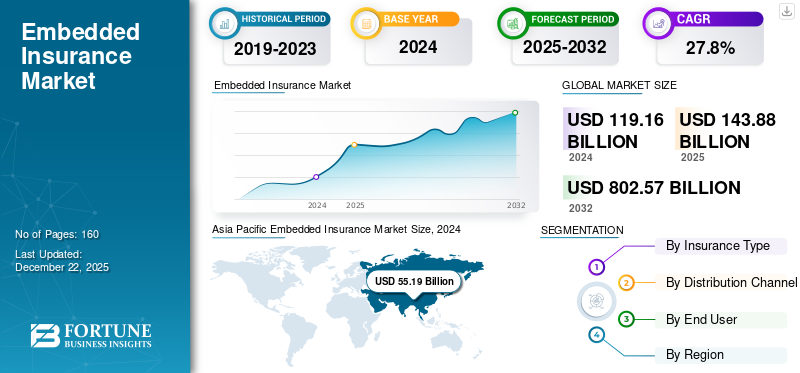
Download Free sample to learn more about this report.
Embedded Insurance Market Key Takeaways
 Global Market Size & Forecast
- 2025 Market Size: USD 143.88 billion
- 2026 Market Size: USD 176.35 billion
- 2034 Forecast Market Size: USD 1,464.42 billion
- CAGR: 30.30% from 2026–2034
 Market Share
- Asia Pacific dominated the embedded insurance market with a 47.60% share in 2025.
- The property insurance segment is expected to account for 30.03% of the market in 2026.
- The e-commerce & online platforms segment is projected to lead the market with a 49.03% share in 2026.
 Key Regional Highlights
Asia Pacific
Asia Pacific held a 47.60% market share in 2025, valued at USD 68.46 billion, and is projected to reach USD 86.22 billion in 2026.
Europe
Europe accounted for USD 41.48 billion in 2025 and is expected to reach USD 50.49 billion in 2026.
North America
North America contributed 16.60% of the global market in 2025, valued at USD 23.91 billion, and is projected to reach USD 28.06 billion in 2026.
U.S.
U.S. The embedded insurance market is projected to reach USD 21.84 billion by 2026.
Japan
Japan The embedded insurance market is projected to reach USD 13.57 billion by 2026.
Read More

IMPACT OF GENERATIVE-AI
Rising AI-driven Chatbots in Embedded Insurance to Boost Market Growth
Generative AI transforms embedded insurance by automating policy generation, personalizing product recommendations based on real time data, and enhancing customer support through AI-driven chatbots. It enables insurers to dynamically tailor micro-insurance offers based on user behavior and transaction context. For instance, when a customer books a flight on an OTA such as Booking.com, GenAI can instantly analyze travel history, trip length, and destination risk to suggest customized travel insurance automatically embedded into the checkout process. Similarly, in e-commerce, GenAI can recommend extended warranty or damage protection plans tailored to the product value and user profile. Companies including Cover Genius and Zego use GenAI to auto-generate dynamic policies, answer customer queries through AI chatbots, and improve conversion by offering relevant, on-demand micro-insurance without manual input. This further drives the embedded insurance market growth.
Download Free sample to learn more about this report.
MARKET DYNAMICS
Market Drivers
Increased Focus on Micro-Insurance and Niche Coverage to Drive Market Expansion
Micro-insurance offers small, affordable coverage for specific needs such as mobile phones, travel, or personal items, making insurance accessible to a broader audience, especially in emerging markets. For instance,
- In October 2024, Life Insurance Corporation of India (LIC) launched its Single Premium Group Micro Term Insurance Plan. This will help to provide affordable life insurance coverage to members of various financial and social groups.
- In 2024, Trov, a leading player in on-demand insurance, embedded micro-insurance options into e-commerce platforms, allowing consumers to purchase coverage for high-value items such as electronics or luggage at the point of sale.
Additionally, platforms such as Cover Genius are embedding specialized travel insurance during booking processes, offering niche coverage tailored to the trip's needs, such as medical expenses, lost baggage, or trip cancellations. The increasing popularity of such on-demand and micro-policies enhances customer experience and accelerates the rise of embedded insurance by making policies more accessible, relevant, and affordable.
Market Restraints
Lack of Awareness and Understanding Can Restrict Market Growth
Many consumers are still unfamiliar with the working process of embedded insurance and are reluctant to adopt it, making them lose benefits, such as the convenience of obtaining coverage at the point of sale. For instance, a consumer purchasing a flight ticket may not understand the added value of instant travel insurance offered at checkout, often perceiving it as an unnecessary expense.
Similarly, in e-commerce, shoppers may fail to understand the need for protection plans, such as accidental damage or warranty coverage, for products they buy.
This lack of knowledge can lead to low adoption rates, even when insurance is seamlessly integrated into the transaction process. Companies such as Cover Genius are working to educate consumers and explain the concept, but the market will struggle to reach its potential without complete awareness.
Market Opportunities
Growing Insurtech-Powered Technological Transformation to Drive Expansion of Market
Technological advancements have created new opportunities for insurers to integrate their products with those of other industries. Through open API-based connections with e-commerce, travel, and healthcare platforms, as well as seamless data sharing, insurers can identify potential customers and offer their products at the point of purchase. For instance,
- Zego, an insurtech company has leveraged API technology to embed flexible commercial insurance into platforms such as Deliveroo and Uber. Delivery personnel and drivers can purchase trip coverage, offering a pay-as-you-go insurance model that seamlessly integrates with their work.
This technological advancement reduces distribution costs significantly, as insurers benefit from the retailer's established trust with customers. Consumers perceive insurance as a value-added service rather than an added expense, shifting the mindset and boosting sales.
Embedded Insurance Market Trends
Changing Customer Expectations in Transaction is Considered to be a Significant Market Trend
Consumers expect more convenience, personalization, and experience of transparency in their transactions. As they increasingly require instant services and friction, insurance companies adapted by integrating the scope of insurance at the selling point, whether in electronic services, travel, or mobile. For example, while booking a flight or buying an online smartphone, customers expect the options to add insurance with minimal effort.
Consumers are also seeking personalized incentives to suit their specific needs, such as tailor-made travel insurance depending on the time of the trip or destination. Changing behavior of consumers motivates insurance companies to leave traditional models and integrate the scope of insurance into daily purchases.
Therefore, companies use technology to meet these expectations by providing instant and demand policies. The trend reflects a broader change for on-site solutions for convenience for consumers, eventually promoting the growth of the market.
Segmentation Analysis
By Insurance Type
Rising Demand for Seamless Coverage During Property Transactions to Drive Property Insurance Segment Growth
Based on insurance type, the market is divided into property insurance, health insurance, auto insurance, travel insurance, cyber insurance, and others.
The property insurance segment is expected to account for 30.03% of the market in 2026, owing to the increasing demand for on-the-spot, seamless coverage during property transactions or rentals. For instance, platforms such as Airbnb have integrated home-sharing insurance directly into bookings. It provides hosts and guests with automatic coverage for liabilities or damages during their stay. Additionally, online real estate platforms such as Zillow have started embedding property insurance options for renters and buyers during their transactions, making it easier to secure protection with minimal effort.
Auto insurance is anticipated to grow at the highest CAGR during the forecast period. It is driven by the rising demand for seamless coverage within the automotive ecosystem. For instance, Uber and Lyft have integrated auto insurance directly into their apps. Tesla has introduced embedded insurance within its vehicles, offering real-time, usage-based policies adjusted based on driving behavior. These integrations cater to consumers' growing desire for convenience and flexibility, allowing them to opt-in for insurance at the point of service without needing separate processes.
By Distribution Channel
Increasing Shift Toward Online Purchasing and Digital Services Propelled E-commerce & Online Platforms Segment Growth
Based on distribution channel, the market is analyzed into e-commerce & online platforms, telecommunications & digital service providers, retail & physical stores, financial institutions & banks, and others.
In 2026, the e-commerce & online platforms segment is projected to lead the market with a 49.03% share. With a rising shift toward online digital services and e-purchasing, consumers expect more convenience, including access to bundled insurance options at the point of sale. Companies including Alibaba, Amazon, and other online retailers have incorporated insurance products into their offerings, catering to an on-demand economy.
Financial institutions & banks are anticipated to grow at a highest CAGR during the forecast period. As regulatory environments evolve to support digital banking and embedded insurance solutions, banks are becoming more adept at offering these services. This integration helps institutions improve customer engagement and provide personalized, comprehensive financial services.
To know how our report can help streamline your business, Speak to Analyst
By End User
Rising Need for Personalized Insurance Products by Individuals to Drive Individual Customers Segment Growth
Based on end user, the market is studied in terms of individual customers, SMEs, and large enterprises.
In 2026, the individual customers segment is projected to lead the market with a 57.68% share, as they increasingly seek personalized insurance products that easily integrate into their daily activities. Further, with the growing adoption of digital platforms, individual consumers are exploring easy, quick, and flexible insurance solutions that can be integrated into their everyday lives.
SMEs are anticipated to grow at a prominent CAGR during the forecast period. Governments and regulators increasingly encourage SMEs to adopt insurance products to improve financial stability and business continuity. This is creating an environment where embedded insurance can thrive. Additionally, the growth of InsurTech innovations, which often target SMEs, further supports this growth.
EMBEDDED INSURANCE MARKET REGIONAL OUTLOOK
By geography, the market is categorized into North America, Europe, Asia Pacific, South America, and the Middle East & Africa.
Asia Pacific
Asia Pacific Embedded Insurance Market Size, 2025 (USD Billion)
To get more information on the regional analysis of this market, Download Free sample
The Asia Pacific market was valued at USD 68.46 billion in 2025, capturing 47.60% of global revenue, and is estimated to reach USD 86.22 billion in 2026, owing to the rise of mobile penetration and fintech innovations. This has facilitated the seamless integration of insurance products into daily transactions. The Japan market is projected to reach USD 13.57 billion by 2026, the China market is projected to reach USD 37.68 billion by 2026, and the India market is projected to reach USD 13.78 billion by 2026. For instance,
- Alibaba has embedded insurance offerings directly into its e-commerce ecosystem, making it easier for consumers to purchase coverage during transactions.
Additionally, the growing middle-class population and increasing awareness of insurance products contribute to the market's expansion. Regulatory support in countries such as India is further accelerating the integration of insurance with financial services and digital platforms.
China holds the largest share of the Asia Pacific market owing to the widespread adoption of e-commerce and fintech services. Alipay and WeChat Pay have integrated embedded insurance products such as travel, health, and product warranties directly into their platforms, offering consumers seamless purchasing options. Additionally, China’s regulatory framework is evolving to support the digital transformation of the insurance sector, encouraging insurers to adopt innovative solutions.
Europe
Europe accounted for USD 41.48 billion in 2025, representing 28.80% of the global market share, and is projected to reach USD 50.49 billion in 2026. In Europe, the rise of InsurTech companies, such as Lemonade and Zego, is driving innovation by integrating insurance products into everyday digital experiences, including e-commerce and gig economy platforms. Zego offers embedded insurance for delivery workers and drivers through its mobile app. Europe's supportive regulatory environment, such as the EU Digital Finance Package, fosters innovation while ensuring consumer protection, also contributing to the region’s growth. The UK market is projected to reach USD 13.39 billion by 2026, while the Germany market is projected to reach USD 11.19 billion by 2026.
North America
North America contributed 16.60% to the global market in 2025, with a valuation of USD 23.91 billion, and is projected to reach USD 28.06 billion in 2026. The high adoption of e-commerce platforms, along with the growing popularity of on-demand services, has led to the expansion of embedded insurance offerings in sectors such as health, auto, and travel. Additionally, regulatory support for digital financial services in both the U.S. and Canada is accelerating the adoption of these solutions. The U.S. market is projected to reach USD 21.84 billion by 2026.
The U.S. embedded insurance market is experiencing significant growth due to the increasing integration of insurance products into digital platforms, e-commerce, and financial services. Consumer demand for seamless, on-demand coverage is driving businesses to offer embedded solutions, particularly in sectors like auto, health, and travel.
Middle East & Africa
The market in Middle East & Africa reached USD 4.02 billion in 2025, representing 2.80% of total market revenue, and is projected to reach USD 4.64 billion in 2026. The MEA region is witnessing considerable demand for the market. In countries such as the UAE and South Africa, embedded insurance is being integrated into e-commerce platforms and mobile apps, making coverage more accessible. Additionally, rising internet penetration and increasing awareness of insurance products among consumers in emerging markets contribute to the sector's expansion.
South America
In 2025, South America generated USD 6 billion, contributing 4.20% to global market revenue, and is projected to grow to USD 6.94 billion in 2026. In South America, the growth of the market is driven by increased internet access and the expansion of e-commerce and fintech services. Platforms in Brazil and Argentina offer insurance products as part of their digital services, particularly in the health, auto, and travel sectors.
Competitive Landscape
KEY INDUSTRY PLAYERS
Broader Service Portfolio & Product Expansion among Key Players to Propel Market Growth
Key players in the embedded insurance market focus on strategic acquisitions, partnerships, and developing comprehensive digital insurance solutions to strengthen their competitive position and broaden market reach. These strategies enable organizations to meet the increasing demand for seamless, on-demand insurance integration within digital platforms. Additionally, players address critical challenges such as data privacy, regulatory compliance, and scalability through advanced technology and robust data management solutions.
Long List of Companies Studied
- Endava (U.K.)
- Chubb (U.S.)
- Accenture (Ireland)
- AXA Insurance (France)
- Lemonade (U.S.)
- Root (U.S.)
- Openkoda (Poland)
- Cover Genius (U.S.)
- Quver (Belgium)
- Tigerlab (Switzerland)
- ERGO Group AG (Germany)
- Extend (Canada)
- Owen (Italy)
- Cheche Group (China)
- Smartplay Corporation (Japan)
- Hepster (Germany)
- Olik (Brazil)
- Carrot (South Korea)
- OneDegree (South Korea)
- And Others
KEY INDUSTRY DEVELOPMENTS
- May 2025: bolttech partnered with Sumitomo Corporation, one of Japan’s trading houses. These two companies entered a joint venture to deliver technology-driven embedded solutions to distribution partners throughout Asian markets.
- March 2025: Smartpay Corporation, a BNPL services provider, partnered with Chubb Insurance Japan. This partnership will help to launch embedded insurance throughout the nation and aims to provide innovation to the Japanese insurance market.
- January 2025: Accenture acquired AOX, a Germany-based company specializing in embedded software for automotive suppliers and manufacturers. This acquisition enhances Accenture’s capabilities to support automotive clients in addressing the challenges of transitioning to software-defined vehicles.
- January 2025: Tint, an embedded insurance platform, announced the launch of a new and innovative range of embedded insurance solutions. The expanded product portfolio now covers mobility, home-sharing, and transportation & logistics sectors, while also marking the company’s entry into entirely new markets.
- August 2024: ERGO, O2 Telefónica, and Telefónica Insurance partnered to offer embedded insurance integrated into O2's products and services. O2 customers will soon be able to easily add supplementary coverage, such as device or travel insurance, digitally and on demand.
INVESTMENT ANALYSIS AND OPPORTUNITIES
The embedded insurance market presents significant investment opportunities, particularly due to the growing adoption of digital platforms and InsurTech innovations. The market is observing a surge in investments as companies recognize the potential of seamless insurance integration in e-commerce, fintech, and mobility services. For instance, Lemonade, a leader in InsurTech, raised substantial funding to expand its solutions into new sectors such as home and health insurance.
Investors are also focused on partnerships, with companies such as Zego partnering with Uber to offer embedded insurance for gig workers. The market's growth is driven by increasing demand for personalized, on-demand insurance solutions, creating opportunities for startups and established players to innovate. Additionally, regulatory advancements in regions including the EU and the U.S. provide a favorable environment for expansion.
REPORT COVERAGE
The report provides a detailed analysis of the market and focuses on key aspects such as leading companies, service types, and leading applications of the service. Besides, the report offers insights into the market trends and highlights key industry developments. In addition to the factors above, the report encompasses several factors that contributed to the market's growth in recent years.
Request for Customization to gain extensive market insights.
REPORT SCOPE & SEGMENTATION
|
ATTRIBUTE |
DETAILS |
|
Study Period |
2021-2034 |
|
Base Year |
2025 |
|
Estimated Year |
2026 |
|
Forecast Period |
2026-2034 |
|
Historical Period |
2021-2024 |
|
Growth Rate |
CAGR of 30.30% from 2026 to 2034 |
|
Unit |
Value (USD Billion) |
|
Segmentation |
By Insurance Type
By Distribution Channel
By End User
By Region
|
|
Companies Profiled in the Report |
|
Frequently Asked Questions
The market is projected to reach USD 1464.42 billion by 2034.
In 2025, the market was valued at USD 143.88 billion.
The market is projected to grow at a CAGR of 30.30% during the forecast period.
By distribution channel, e-commerce & online platform is leading the market.
The growing volume and complexity of data are expected to drive the expansion of the market.
Endava, Chubb, Accenture, AXA Insurance, and Lemonade are the top players in the market.
Asia Pacific is expected to hold the highest market share.



- 2021-2034
- 2025
- 2021-2024
- 160
Get 30-60 hrs Free Customization
Expand Regional and Country Coverage, Segments Analysis, Company Profiles, Competitive Benchmarking, and End-user Insights.













Related Reports
-
US +1 833 909 2966 ( Toll Free )
-
Get In Touch With Us