Healthcare Predictive Analytics Market Size, Share & Industry Analysis, By Component (Software and Hardware), By Application (Clinical Risk Prediction & Decision Support, Population Health & Care Management, Operational & Workforce Analytics, Financial, Revenue Cycle & Fraud Analytics, and Others), By Deployment (Cloud-based, On-Premise, and Hybrid), By End User (Healthcare Providers, Healthcare Payers, Government & Public Health Organizations, and Others), and Regional Forecast, 2026-2034
 Download Free Sample
Healthcare Predictive Analytics Market Size and Future Outlook
 Listen to Audio Version
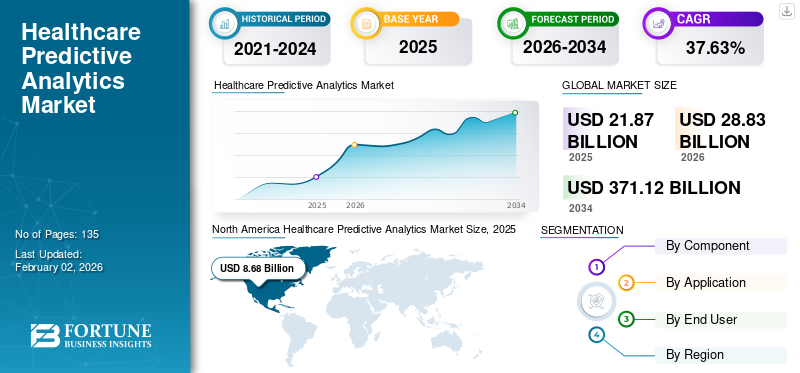
The healthcare predictive analytics market size was valued at USD 21.87 billion in 2025 and is projected to grow from USD 28.69 billion in 2026 to USD 203.70 billion by 2034, exhibiting a CAGR of 27.76% during the forecast period. North America dominated the healthcare predictive analytics market with a market share of 40.65% in 2025.
The market is poised for exponential growth as the demand for these solutions is increasing across various healthcare settings. Hospitals, payers, and other healthcare providers generate large volumes of data through electronic health records, insurance claims, medical devices, diagnostic systems, and remote patient monitoring platforms. These solutions help healthcare organizations shift from reactive decision-making to proactive care planning, improve resource utilization, reduce avoidable healthcare costs, and support improved patient outcomes. The growing adoption of artificial intelligence, cloud based healthcare platforms, and integrated clinical data systems by key operating companies is further expected to increase the use of predictive analytics across healthcare workflows.
- For instance, in July 2025, Innovaccer launched an AI-powered Readmissions Management Solution that combines predictive analytics and advanced predictive modelling to identify patients at high risk of avoidable hospital readmissions. The solution also supports coordinated interventions, transitional care workflows, hospital-capacity optimization, and improved clinical outcomes.
Furthermore, key players, such as Oracle Corporation, Merative, Epic Systems Corporation, and Optum, Inc., are actively participating in new product launches, strategic collaborations, and acquisitions, as well as regulatory approval and investment initiatives to expand market presence.
Download Free sample to learn more about this report.
Latest Product Launches
|
Product Name |
Company Name |
Description |
|
Oracle Life Sciences AI Data Platform |
Oracle Corporation |
January 2026: The generative AI-enabled analytics platform combines organizational and public data with more than 129 million de-identified longitudinal real-world health records. It supports clinical research, safety monitoring, population-level analysis, commercialization, and evidence generation. |
|
Care Gap and Coding Automation Suite |
Qventus |
February 2026: The suite uses predictive identification, chart analysis, workflow automation, and real-time documentation to detect missed diagnoses and care gaps. Its initial Malnutrition Care Automation solution identifies at-risk patients and initiates timely interventions within EHR workflows. |
|
Crimson AI |
Optum, Inc. |
August 2025: Crimson AI is a clinical analytics platform that applies predictive analytics to surgical operations. It analyzes historical and real-time information to identify underused operating-room capacity, predict cases likely to run longer than expected, optimize block utilization, and support workforce and surgical scheduling decisions. |
|
Population Health Navigator (PHN) |
MedeAnalytics / ZeOmega |
July 2025: Population Health Navigator combines predictive analytics with care-management workflows to help healthcare organizations identify patient risk, care gaps, and intervention opportunities. It integrates MedeAnalytics' Health Fabric with ZeOmega's care-management capabilities to enable risk stratification and more targeted interventions at the point of care. |
HEALTHCARE PREDICTIVE ANALYTICS MARKET TRENDS
Growing Integration of Artificial Intelligence and Machine Learning into Predictive Healthcare Platforms is an Emerging Market Trend
The integration of artificial intelligence and machine learning is emerging as one of the prominent market trend. AI and machine learning models can process these datasets to identify hidden patterns and predict patient deterioration, disease progression, hospital readmissions, treatment risks, and future resource requirements. As a result, solution providers are developing advanced platforms that deliver real time risk scores and actionable insights directly within clinical and administrative workflows. This integration helps healthcare professionals identify high-risk patients earlier, improve care planning, reduce avoidable costs, and make more informed decisions, thereby increasing demand for AI-enabled predictive data analytics solutions.
- For instance, in January 2025, Arcadia launched an AI-powered precision medicine solution designed to identify patients with undiagnosed or misdiagnosed conditions and those at risk of poor health outcomes. The solution enables healthcare providers to use data-driven insights to connect high-risk patients with appropriate evidence-based care.
|
Impact of AI on the Healthcare Predictive Analytics Market |
|
MARKET DYNAMICS
MARKET DRIVERS
Download Free sample to learn more about this report.
Growing Volume of Healthcare Data to Drive Demand for Predictive Analytics Solutions
One of the key factors driving the healthcare predictive analytics market growth is widespread use of electronic health records, insurance claims systems, and other remote patient monitoring solutions. Predictive analytics platforms help combine clinical, operational, financial, and patient-generated data to identify patterns and forecast disease progression, hospital readmissions, treatment risks, and resource requirements. As a result, hospitals and payers are adopting these solutions to convert expanding healthcare datasets into actionable insights, support proactive patient management, improve operational planning, and reduce avoidable costs. The continued growth of multimodal healthcare data is therefore expected to increase demand for scalable predictive analytics platforms.
- For instance, in July 2025, Health Catalyst announced the release of 10 AI-integrated healthcare data toolkits on Databricks Marketplace. The toolkits incorporate advanced machine learning models and Health Catalyst’s Healthcare.AI capabilities to predict hospital readmissions, avoidable emergency department visits, patient throughput, inpatient length of stay, and surgical outcomes. The development demonstrates how healthcare organizations are increasingly using integrated clinical and operational datasets to generate predictive insights and support proactive decision-making.
|
Rank |
Market Driver |
Expected Impact on Market Growth |
CAGR Contribution (2026-2034) |
Impact: 2026-2028 |
Impact: 2029-2031 |
Impact: 2032-2034 |
|
1 |
Growing Volume of Healthcare Data and EHR Integration |
High |
8.80% |
High |
High |
High |
|
2 |
Advancements in AI, Machine Learning, and Cloud-based Analytics |
High |
8.10% |
Medium |
High |
High |
|
3 |
Increasing Need to Reduce Healthcare Costs and Improve Clinical Outcomes |
High |
7.20% |
High |
High |
Medium |
|
4 |
Rising Chronic Disease Burden and Population Health Management Requirements |
Medium-High |
6.60% |
Medium |
High |
High |
|
5 |
Expansion of Remote Patient Monitoring, Wearables, and Personalized Healthcare |
Medium |
5.80% |
Medium |
Medium |
High |
|
6 |
Others |
Low |
4.00% |
Low |
Low |
Low |
|
Total Positive Growth Contribution |
40.50% |
MARKET RESTRAINTS
Data Privacy and Cybersecurity Concerns to Restrict Market Growth
Healthcare predictive analytics platforms use large volumes of sensitive patient information. The collection and integration of these datasets across cloud platforms, electronic health records, connected devices, and third-party systems can increase exposure to data breaches and unauthorized access. Healthcare organizations must therefore invest in encryption, access controls, regulatory compliance, cybersecurity monitoring, and incident-response capabilities before deploying advanced analytics solutions. These additional costs and operational requirements can delay implementation, particularly among smaller hospitals and clinics. Concerns regarding patient consent, data ownership, and potential reputational and financial losses may also discourage organizations from sharing the data required to develop accurate predictive models, thereby restraining market growth.
- For instance, in April 2024, UnitedHealth Group reported that personal data could have been affected by the malicious cyberattack on Change Healthcare. The incident required the company to isolate impacted systems, review compromised data, restore disrupted services, and provide support to affected individuals and healthcare providers, demonstrating the operational and data-security risks associated with interconnected healthcare information systems.
|
Rank |
Market Restraint |
Expected Impact on Market Growth |
CAGR Contribution (2026-2034)) |
Impact: 2026-2028 |
Impact: 2029-2031 |
Impact: 2032-2034 |
|
1 |
Data Privacy, Cybersecurity, and Regulatory Compliance Concerns |
High |
4.20% |
High |
High |
Medium |
|
2 |
Poor Data Quality, Interoperability, and Clinical Model Validation Challenges |
Medium-High |
3.50% |
High |
Medium |
Medium |
|
3 |
High Implementation Costs and Shortage of Skilled Analytics Professionals |
Medium |
3.04% |
Medium |
Medium |
Low |
|
4 |
Others |
Low |
2.00% |
Low |
Low |
Low |
|
Total Negative Growth Impact |
12.74% |
MARKET OPPORTUNITIES
Expansion of Predictive Analytics in Personalized and Precision Healthcare to Create Growth Opportunities
The growing focus on personalized and precision healthcare is expected to create significant opportunities for predictive analytics providers. These platforms can combine genomic, clinical, laboratory, imaging, claims, and real-world data to estimate an individual patient’s disease risk and likely response to treatment. These insights can help healthcare professionals identify high-risk patients, select suitable therapies, anticipate adverse outcomes, and adjust care plans according to each patient’s characteristics. As hospitals and life science companies expand the use of multiomics and longitudinal patients’ data, demand is likely to increase for analytics platforms capable of generating accurate predictions, offering growth opportunity.
- For instance, in November 2025, BC Platforms launched BC Catalyst, an AI-native analytics platform that transforms complex genomic and real-world clinical data into actionable insights. The platform is designed to support precision medicine research and enable large-scale data analysis across the drug-development lifecycle, demonstrating the expanding role of advanced analytics in personalized healthcare.
MARKET CHALLENGES
Difficulty in Integrating Predictive Analytics with Legacy Healthcare IT Systems to Challenge Market Expansion
Many healthcare organizations continue to operate legacy electronic health record systems, departmental databases, and clinical applications that were not designed to support real-time data exchange or advanced predictive modelling. Differences in data formats, coding standards, system architectures, and vendor interfaces make it difficult to combine information from multiple sources into a unified analytics environment. Healthcare providers may therefore need substantial investments in application programming interfaces, data warehouses, system upgrades, and specialist integration services before deployment. These challenges are particularly significant for smaller hospitals with limited IT budgets and technical expertise, thereby restricting the widespread adoption of predictive analytics platforms.
- For instance, in May 2024, Health Catalyst launched Health Catalyst Ignite, a next-generation healthcare data and analytics ecosystem intended to address challenges such as rigid legacy technologies, labor-intensive data aggregation, inaccessible data, and fragmented analytics tools. The launch highlights the continued need for modern data infrastructure before healthcare organizations can effectively scale advanced analytics and AI applications.
|
SWOT Analysis |
|
|
Strengths |
|
|
Weaknesses |
|
|
Opportunities |
|
|
Threats |
|
Segmentation Analysis
By Component
Broad Clinical and Operational Applicability Drives Software Segment Dominance
Based on the component, the market is categorized into software and hardware.
In 2025, the software segment dominated the market. Software platforms form the core layer used to integrate healthcare data, build predictive models, generate risk scores, and deliver insights through dashboards and clinical workflows. Healthcare organizations can also expand software usage across departments without making equivalent investments in new physical infrastructure. Moreover, recurring platform upgrades, analytics modules, AI capabilities, and subscription-based licensing generate sustained demand for software solutions.
- For instance, in October 2024, Google Cloud announced the general availability of Vertex AI Search for Healthcare and new features for Healthcare Data Engine. The software offerings enable healthcare organizations to create interoperable longitudinal patient records, generate clinical insights, and provide healthcare professionals with faster access to data required for informed decision-making.
The hardware segment is expected to grow at a CAGR of 25.09% over the forecast period.
To know how our report can help streamline your business, Speak to Analyst
By Application
Direct Impact on Patient Outcomes Supported the Dominance of Clinical Risk Prediction & Decision Support Segment
Based on the application, the market is categorized into clinical risk prediction & decision support, population health & care management, operational & workforce analytics, financial, revenue cycle & fraud analytics, and others.
In 2025, the clinical risk prediction and decision support segment held the largest healthcare predictive analytics market share. This high share was allocated due to the growing need to identify high-risk patients. Predictive solutions can analyze clinical histories, laboratory results, medications, claims, and social determinants of health to estimate the likelihood of hospitalization, readmission, disease progression, or care gaps. These insights allow healthcare professionals to prioritize patients, initiate timely interventions, and select appropriate care pathways. Consequently, the high clinical value and immediate use of risk insights at the point of care supported the segment’s market leadership.
- For instance, in October 2024, Oracle introduced significant enhancements to Oracle Health Data Intelligence, including AI-powered patient prioritization and recommended next-best actions. The capabilities help care teams identify patients most likely to benefit from outreach and take proactive measures to prevent costly emergency visits and hospitalizations.
The population health & care management segment is expected to grow at a CAGR of 29.14% over the forecast period.
By Deployment
Scalability and Faster Access to Healthcare Data Drives Cloud-based Segment Dominance
Based on the deployment, the market is categorized into cloud-based, on-premise, and hybrid.
In 2025, the cloud-based segment dominated the market as healthcare predictive analytics requires substantial computing capacity to process large and continuously expanding datasets. Cloud deployment allows healthcare organizations to scale storage and analytical resources according to data volumes without establishing and maintaining extensive on-site infrastructure. Therefore, faster implementation, flexible scalability, and lower upfront infrastructure requirements encouraged healthcare organizations to select cloud-based predictive analytics solutions.
- For instance, in March 2025, Huntsville Hospital Health System expanded its relationship with Oracle Health and announced plans to deploy Oracle Health Data Intelligence. Built on Oracle Cloud Infrastructure, the platform will integrate clinical, claims, revenue-cycle, pharmacy, and other healthcare data to support predictive care, optimized care plans, and improved patient engagement across the health system.
The hybrid segment is expected to grow at a CAGR of 25.61% over the forecast period.
By End User
High Generation and Utilization of Patient Data Positioned Healthcare Providers as the Leading End-user Segment
Based on the end user, the market is categorized into healthcare providers, healthcare payers, government & public health organizations, and others.
In 2025, healthcare providers segment dominated the market as hospitals, clinics, and health systems generate and use the largest volumes of patient-level clinical and operational data during routine care delivery. These organizations require predictive analytics to identify patient deterioration, reduce readmissions, manage beds and operating rooms, forecast staffing requirements, and improve treatment decisions. Rising patient volumes, workforce shortages, capacity constraints, and pressure to improve quality while controlling costs have further increased adoption among health systems. As a result, the broad range of clinical and operational applications supported the dominance of healthcare providers.
- For instance, in October 2024, Ardent Health selected Qventus’ AI-powered Perioperative Solution to optimize its robotic surgery program and increase surgical capacity. The platform uses electronic health record and claims data to predict unused operating-room time, identify scheduling opportunities, and support more efficient utilization of surgical resources.
The government & public health organizations segment is expected to grow at a CAGR of 29.88% over the forecast period.
Healthcare Predictive Analytics Market Regional Outlook
By geography, the market is categorized into Europe, North America, Asia Pacific, Latin America, and Middle East & Africa.
North America
North America Healthcare Predictive Analytics Market Size, 2025 (USD Billion)
To get more information on the regional analysis of this market, Download Free sample
North America was valued at USD 6.88 billion in 2024 and maintained its growth momentum with a leading position in 2025 at USD 8.89 billion. North America is growing due to widespread EHR adoption, strong healthcare IT infrastructure, and the increasing use of predictive tools for patient-risk assessment, scheduling, billing, and hospital resource planning.
U.S. Healthcare Predictive Analytics Market
Given North America's substantial contribution and the U.S. dominance in the region, the U.S. market is estimated at around USD 10.82 billion in 2026, accounting for roughly 37.70% of the global market.
Europe
Europe is projected to grow with a 27.56% CAGR over the forecast period, the second-highest among all regions, and reach a valuation of USD 7.44 billion by 2026. Europe’s growth is supported by investments in interoperable digital health systems and initiatives enabling the secure exchange and secondary use of healthcare data.
U.K. Healthcare Predictive Analytics Market
The U.K. market is estimated at USD 1.23 billion in 2026, accounting for roughly 4.28% of the global market.
Germany Healthcare Predictive Analytics Market
Germany's market is projected to reach approximately USD 2.38 billion in 2026, equivalent to around 8.30% of the global market.
Asia Pacific
Asia Pacific accounted for the third-largest share in the market in 2025 and is estimated to reach USD 6.21 billion in 2026. Asia Pacific is expanding due to large patient populations, rising burden of chronic conditions, healthcare digitalization, and increasing investment in AI-based clinical and population health solutions.
Japan Healthcare Predictive Analytics Market
The Japanese market in 2026 is estimated at around USD 1.85 billion, accounting for approximately 6.46% of the global market.
China Healthcare Predictive Analytics Market
China's market is projected to be among the largest worldwide, with 2026 revenues estimated at around USD 2.66 billion, accounting for approximately 9.26% of global sales.
India Healthcare Predictive Analytics Market
The Indian market is estimated at around USD 0.39 billion in 2026, accounting for roughly 1.37% of global revenue.
Latin America and the Middle East & Africa
The Latin America and Middle East & Africa regions are expected to witness significant growth during the forecast period. The Latin America region is estimated to reach a valuation of USD 1.65 billion in 2026. The region is witnessing growth as countries modernize public healthcare systems, expand electronic records, and use digital tools to improve access across underserved and remote populations. In the Middle East & Africa, the GCC is set to reach USD 1.26 billion in 2026.
South Africa Healthcare Predictive Analytics Market
The South African market is projected to reach approximately USD 0.36 billion by 2026, accounting for roughly 1.26% of global revenue.
COMPETITIVE LANDSCAPE
Key Industry Players
Focus on Portfolio Expansion and Strategic Innovation by Key Players to Strengthen Market Position
The healthcare predictive analytics market is moderately fragmented, with competition led by companies offering healthcare data platforms, predictive modelling tools, cloud-based analytics infrastructure, clinical decision-support solutions, population health analytics, and operational forecasting software. Major players such as Oracle Corporation, Optum, Inc., SAS Institute Inc., Microsoft Corporation, Epic Systems Corporation, Health Catalyst, Inc., Innovaccer Inc., and Merative are strengthening their market positions through new product launches, AI model development, strategic collaborations, acquisitions, and integration with electronic health record systems.
- For instance, in June 2025, SAS Institute Inc. introduced SAS Health Cost of Care Analytics and new healthcare AI models addressing medication adherence, medical-record review, reimbursement, risk management, and cost-of-care analysis.
Other notable participants in the market include specialized healthcare analytics vendors, medical technology companies, consulting firms, and regional software providers. Established companies are expected to retain stronger near-term shares due to their large healthcare customer bases, extensive datasets, established cloud infrastructure, and ability to integrate analytics directly into clinical workflows. In contrast, specialized vendors such as Health Catalyst, Innovaccer, CitiusTech, and Qventus are likely to compete through healthcare-focused platforms, faster implementation, customized predictive models, and automation of specific clinical and operational workflows.
LIST OF KEY HEALTHCARE PREDICTIVE ANALYTICS COMPANIES PROFILED
- Oracle Corporation (U.S.)
- Merative (U.S.)
- Epic Systems Corporation (U.S.)
- Optum, Inc. (U.S.)
- Microsoft Corporation (U.S.)
- SAS Institute Inc. (U.S.)
- Inovalon Holdings, Inc. (U.S.)
- IQVIA Holdings Inc. (U.S.)
- Amazon Web Services, Inc. (U.S.)
- Veradigm LLC (U.S.)
- Google Cloud (U.S.)
- Health Catalyst, Inc. (U.S.)
- Innovaccer Inc. (U.S.)
- CitiusTech Inc. (U.S.)
- Qventus, Inc. (U.S.)
KEY INDUSTRY DEVELOPMENTS
- March 2026: Innovaccer Inc. launched Galaxy UM, an AI-powered utilization management platform for healthcare payers. The platform automates prior authorization workflows, extracts information from clinical documents, evaluates medical necessity, and supports faster and more transparent care decisions.
- November 2025: Lightbeam Health Solutions and Wakely Consulting Group launched ACO Optimization Retrosight (AOR) and ACO Optimization Futuresight (AOF), predictive analytics tools designed for Accountable Care Organizations.
- April 2025: Health Catalyst, Inc. launched Ignite Spark, a healthcare data and analytics solution developed for community, regional, and specialty health systems. The platform provides smaller healthcare organizations with access to integrated analytics and data-management capabilities without requiring extensive internal infrastructure.
- March 2025: Microsoft Corporation introduced new healthcare AI capabilities across Microsoft Fabric and Azure AI Foundry. The updates included multimodal health-data orchestration and enhanced three-dimensional medical-imaging models to support faster data analysis, diagnosis, and clinical decision-making.
- January 2025: IQVIA Holdings Inc. entered into a strategic collaboration with NVIDIA Corporation to develop advanced agentic AI solutions for healthcare and life sciences. The companies agreed to combine IQVIA’s healthcare data and domain expertise with NVIDIA’s AI infrastructure to improve research, clinical development, and healthcare decision-making.
REPORT COVERAGE
|
Key Strategic Questions Answered by the Report |
|
The healthcare predictive analytics report provides market size and forecast for all the segments included in the report. The market outlook also details the market dynamics and trends expected to influence market growth during the forecast period. It offers information on the adoption of electronic health records, growth of healthcare data, prevalence of chronic diseases, use of artificial intelligence and machine learning, and expansion of cloud-based analytics across key regions and countries. The report also covers key industry developments, new product launches, strategic partnerships, collaborations, mergers, and acquisitions undertaken by major companies. In addition, it provides a comprehensive market analysis. It includes a detailed competitive landscape with information on the market share, product offerings, strategic initiatives, and profiles of key players.
Request for Customization to gain extensive market insights.
Report Scope & Segmentation
| ATTRIBUTE | DETAILS |
| Study Period | 2021-2034 |
| Base Year | 2025 |
| Estimated Year | 2026 |
| Forecast Period | 2026-2034 |
| Historical Period | 2021-2024 |
| Growth Rate | CAGR of 27.76% from 2026-2034 |
| Unit | Value (USD billion) |
| Segmentation | By Component, Application, Deployment, End User, and Region |
| By Component |
|
|
By Application
|
|
|
By Deployment
|
|
| By End User |
|
| By Region |
|
Research Methodology
1. Bottom Up Approaches
Approach 1: Revenues and Market Share of Major Healthcare Predictive Analytics Players
- Collection of healthcare analytics revenues from annual reports, SEC filings, investor presentations, earnings releases, official company announcements, and other public disclosures of key companies such as Oracle, SAS Institute, Merative, Microsoft, Health Catalyst, Innovaccer, Arcadia, Qventus, LeanTaaS, and others.
- Estimation of predictive analytics revenue by separating applicable clinical, operational, financial, population health, payer, and life-sciences analytics revenues from broader cloud, EHR, consulting, and IT-service revenues.
- Estimation of company-level revenues based on software subscription revenues, annual contract values, implementation revenues, analytics-services revenues, number of healthcare clients, installed platforms, and geographic presence.
- Allocation of company revenues across regions using reported geographic revenues, healthcare-client locations, cloud availability, country-level partnerships, regional offices, and product deployments.
- Triangulation of company revenues with healthcare IT expenditure, EHR adoption, hospital digital maturity, value-based care penetration, AI adoption, and healthcare-data availability to derive the global market.
- Mapping of company-level revenues across the finalized market segments and regional markets.
Approach 2: Product-Level Sales and Contract Analysis
- Identification of major healthcare predictive analytics platforms and solutions offered by Oracle, SAS, Health Catalyst, Innovaccer, Arcadia, Qventus, LeanTaaS, Microsoft, Merative, and other relevant companies.
- Collection of product-level information covering subscription prices, annual software contracts, per-user charges, per-member-per-month fees, enterprise licenses, implementation charges, analytics modules, and professional services.
- Estimation of software revenue using the number of healthcare customers, average annual contract value, number of deployed modules, organization size, and contract-renewal rates.
- Estimation of cloud-based revenues using subscribed users, covered lives, data volumes, analytics workloads, and annual platform charges.
- Estimation of service revenues using implementation projects, data-integration requirements, customization, model-development services, consulting fees, and ongoing technical support.
- Country-level product revenues were estimated and aggregated across North America, Europe, Asia Pacific, Latin America, and the Middle East & Africa.
- The summation of product-level revenues and an allowance for smaller local and specialized vendors was used to estimate the global market.
Approach 3: User Adoption and Monetization Model
- Assessment of the number of addressable hospitals, health systems, physician groups, diagnostic organizations, insurers, pharmaceutical companies, public-health agencies, and other healthcare organizations across major countries.
- Mapping of healthcare organizations by size, digital maturity, EHR penetration, cloud adoption, analytics capability, and availability of integrated clinical and claims data.
- Estimation of predictive analytics adoption using the number of eligible healthcare organizations, current analytics penetration, implementation rates, and average number of predictive-use cases per organization.
- Estimation of provider-market revenue using the number of adopting hospitals and health systems multiplied by average annual software and service expenditure.
- Estimation of payer-market revenue using covered members, per-member analytics fees, risk-adjustment requirements, fraud-detection usage, and population-health program adoption.
- Estimation of pharmaceutical and biotechnology demand using clinical-development activity, real-world evidence projects, safety monitoring, patient-identification programs, and commercial analytics expenditure.
- The summation of revenues across providers, payers, pharmaceutical companies, public-health organizations, and other end users was used to arrive at the regional and global market.
2. Top Down Approaches
Approach 1: Parent Market Analysis
- Analysis of parent markets such as the global healthcare IT market, healthcare analytics market, healthcare AI market, clinical decision-support market, population health management market, and healthcare cloud-computing market.
- Estimation of the proportion of parent-market spending attributable specifically to predictive analytics software and related services.
- Application of country-level factors including healthcare IT expenditure, EHR adoption, cloud penetration, hospital digitization, value-based care participation, AI maturity, interoperability, and healthcare-data availability.
- Exclusion of descriptive reporting tools, general business intelligence, standalone EHR systems, non-healthcare analytics, infrastructure-only cloud services, and analytics without a predictive function.
- The summation of predictive analytics expenditure across key countries and regions was used to estimate the global market.
- The resulting market estimate was validated against company-level revenues, product-contract analysis, installed-base calculations, and end-user expenditure.
- The resulting market estimate was validated against company revenues, product subscription revenues, user-based estimates, and regional adoption indicators.
3. List of Key Sources
- Annual reports, 10-K filings, investor presentations, earnings releases, and official company announcements
- Oracle, SAS Institute, Merative, Microsoft, Health Catalyst, Innovaccer, Arcadia, Qventus, LeanTaaS, and other relevant company sources
- Product pages, pricing information, customer announcements, partnership disclosures, case studies, and product-launch releases
- WHO, World Bank, OECD, Eurostat, CDC, CMS, ONC, national health ministries, and national statistical agencies
- FDA, HHS, ONC, European Commission, MHRA, ICO, PMDA, MHLW, NMPA, and other national regulatory bodies
- Hospital statistics, EHR adoption data, healthcare expenditure, insured populations, value-based care participation, and digital-health adoption indicators
- Clinical trials, real-world evidence programs, public procurement databases, and government healthcare-technology contracts
4. Primary Interviews
Supply Side Interviews: 60%
- Key respondents: Discussions with healthcare predictive analytics platform providers, healthcare software companies, cloud vendors, systems integrators, data-management companies, and consulting-service providers.
- Key respondents include senior executives, product managers, data scientists, AI and machine-learning specialists, sales executives, business-development managers, implementation consultants, and channel partners.
- Interviews were used to validate annual contract values, software and service revenue shares, deployment models, customer volumes, geographic revenues, implementation periods, and renewal rates.
- Discussions also covered model-development costs, interoperability, EHR integration, regulatory compliance, competitive positioning, product pipelines, and future adoption.
Demand Side Interviews: 40%
- Key Respondents: Discussions with hospitals, health systems, physician groups, health insurers, pharmaceutical and biotechnology companies, public-health agencies, research organizations, and other healthcare end users.
- Key respondents include CIOs, chief data officers, chief medical information officers, hospital administrators, clinicians, data analysts, population-health managers, payer executives, and procurement managers.
- Interviews were used to analyze predictive analytics budgets, preferred use cases, purchasing criteria, deployment preferences, implementation challenges, model performance, and return on investment.
- Demand-side feedback was used to validate regional adoption, end-user shares, application mix, software and service allocation, deployment-model shares, and forecast growth assumptions.
- The interviews also validated adoption barriers, privacy concerns, clinical-effectiveness expectations, app engagement, and regional purchasing patterns.
- Demand-side feedback was used to validate platform, application, delivery model, business model, payment model, and end-user splits.

Frequently Asked Questions
Fortune Business Insights says that the global market stood at USD 21.87 billion in 2025 and is projected to reach USD 203.70 billion by 2034.
In 2025, North America market stood at USD 8.89 billion.
The market is projected to grow at a CAGR of 27.76%, during the forecast period (2026-2034).
The software segment is leading the market, by component.
The rising integration of AI and the growing volume of healthcare data is projected to drive the market.
Oracle Corporation, Merative, Epic Systems Corporation, and Optum, Inc. are the top players in the market.
North America is expected to hold the highest market share.



- 2021-2034
- 2025
- 2021-2024
- 135
Get 30-60 hrs Free Customization
Expand Regional and Country Coverage, Segments Analysis, Company Profiles, Competitive Benchmarking, and End-user Insights.













.webp)






Related Reports
-
US +1 833 909 2966 ( Toll Free )
-
Get In Touch With Us