AI in Medical Coding Market Size, Share & Industry Analysis, By Component (Software and Services), By Deployment (Cloud-Based, On-Premise, and Hybrid), By Technology (LLMs & Natural Language Processing, Machine Learning & Deep Learning, and Others), By Product Type (Computer-Assisted Coding (CAC), Autonomous Coding Tools, CDI-linked Coding Tools, and Others), By Application (Diagnosis Coding, Procedure Coding, ED/Outpatient Coding, and Others), By End User (Hospitals & Health Systems, Physician Groups/Clinics, RCM Vendors & BPOs, and Others), and Regional Forecast, 2026-2034
 Download Free Sample
AI in Medical Coding Market Size and Future Outlook
 Listen to Audio Version
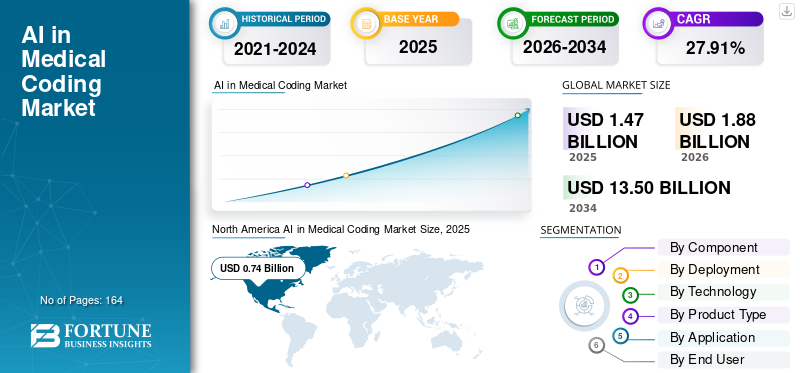
The global AI in medical coding market size was valued at USD 1.47 billion in 2025 and is projected to grow from USD 1.88 billion in 2026 to USD 13.50 billion by 2034, exhibiting a CAGR of 27.91% during the forecast period. North America dominated the AI in medical coding market with a market share of 50.34% in 2025.
The global market for AI in medical coding encompasses software platforms and services used to automate, support, and improve clinical coding workflows across various end users. Rising healthcare claim volumes, growing pressure to reduce coding backlogs, a shortage of certified medical coders, increasing denial management needs, and the shift from traditional computer-assisted coding toward AI-enabled, autonomous, and CDI-linked coding solutions are driving the market.
Key market players in the global market include Solventum, Optum, CodaMetrix, and Fathom, among others. Their competitive positioning is supported by integration with EHR and revenue cycle systems, specialty-specific coding models, autonomous coding capabilities, coding audit and compliance features, and partnerships with health systems and RCM service providers to improve coding accuracy, reduce manual workload, and accelerate reimbursement cycles.
Download Free sample to learn more about this report.
AI in Medical Coding Market KEY TAKEAWAYS
 Global Market Size & Forecast
- 2025 Market Size: USD 1.47 billion
- 2026 Market Size: USD 1.88 billion
- 2034 Forecast Market Size: USD 13.50 billion
- CAGR: 27.91% from 2026–2034
 Market Share
- North America dominated the AI in medical coding market with a 50.34% share in 2025.
- The cloud-based segment accounted for the largest market share in 2025.
- The LLMs & natural language processing segment accounted for the largest market share in 2025.
 Key Regional Highlights
Asia Pacific
Asia Pacific reached USD 0.41 billion in 2026, driven by rapid healthcare digitalization and expanding hospital networks.
North America
North America reached USD 0.74 billion in 2025, supported by high healthcare spending and widespread EHR adoption.
Europe
Europe is driven by healthcare IT modernization and increasing adoption of digital health solutions.
U.S.
U.S. reached USD 0.86 billion in 2026, fueled by advanced revenue cycle automation and mature healthcare infrastructure.
Japan
Japan reached USD 0.07 billion in 2026, driven by growing healthcare digitalization and AI adoption.
Read More

AI in MEDICAL CODING MARKET TRENDS
Shift toward Cloud-Based Healthcare Systems is a Remarkable Market Trend
The transition to cloud-based healthcare systems is becoming a significant trend in the global market, as providers require quicker, more scalable, and easier-to-integrate coding solutions. Cloud-based platforms enable hospitals, physician groups, and RCM vendors to implement AI coding solutions without significant investment in on-premise infrastructure. This enables quicker deployment across various locations, simpler modifications to coding regulations, and improved synergy with EHR and revenue cycle systems.
As healthcare organizations manage increasing claim volumes and a shortage of coders, cloud delivery enables more effective automation of coding workflows. It also allows vendors to offer ongoing model enhancements, centralized data analysis, and remote assistance. This trend is particularly crucial for coding tools linked to CDI and autonomous coding, as it necessitates immediate access to clinical documentation and billing processes. In general, the move to cloud-based platforms is enabling AI coding suppliers to grow more rapidly within health systems and outpatient networks. These factors are supporting the overall global AI in medical coding market growth during the forecast period.
- For instance, in January 2024, Fathom announced that its autonomous medical coding solution was added to the Google Cloud Marketplace, making it more accessible to health systems and physician practices while enabling easier procurement, integration, and deployment through Google Cloud.
MARKET DYNAMICS
MARKET DRIVERS
Download Free sample to learn more about this report.
Increasing Healthcare Digitalization is Propelling Market Growth
The rise in healthcare digitalization is significantly fueling the global market, as hospitals and physician groups swiftly transition from paper-based, manual processes to unified EHRs, clinical documentation, and revenue cycle systems. With the increasing availability of patient records, doctor notes, lab results, discharge summaries, and claim documents in digital formats, AI coding tools can read and interpret this information more efficiently. This enhances healthcare professionals' ability to automate diagnosis coding, procedure coding, CDI review, and coding audit processes.
Digitalization also increases the volume of structured and unstructured clinical data, heightening the need for AI tools that can reduce coder workload and improve claim accuracy. Simultaneously, health systems face pressure to minimize billing delays, coding mistakes, and denials, increasing the importance of AI-driven coding solutions. As healthcare organizations continue to invest in interconnected digital systems, the use of AI in medical coding is projected to increase across inpatient and outpatient settings. All these factors cumulatively drive the overall market growth.
- For instance, in April 2025, the Cleveland Clinic and AKASA announced a strategic collaboration to deploy generative AI tools for revenue cycle workflows, including support for accurate, efficient medical coding across the Cleveland Clinic’s U.S. locations.
MARKET RESTRAINTS
Concerns Associated with Data Privacy to Hamper Market Growth
Data privacy issues pose a significant limitation for the market, as these systems require access to extremely sensitive patient records, physician notes, diagnostic information, insurance details, and billing data. Hospitals and RCM vendors might postpone adoption if they are uncertain about how AI platforms manage, process, or transmit protected health information. This is particularly crucial for cloud-driven and autonomous coding tools, where significant amounts of clinical documentation are transferred between interconnected systems. Any violation can lead to regulatory fines, legal risks, loss of patient trust, and reputational harm for providers.
Consequently, healthcare entities frequently require strict adherence to HIPAA, encryption, audit logs, role-based access controls, and vendor security evaluations prior to deployment. These conditions may prolong sales cycles and raise implementation expenses for AI coding suppliers. Consequently, although AI enhances programming speed and precision, concerns about privacy and cybersecurity persist, hindering broader market acceptance.
- For example, in February 2025, Episource, an Optum subsidiary that provides medical coding, risk adjustment services, and software solutions, experienced a data breach affecting approximately 5.4 million individuals.
MARKET OPPORTUNITIES
Growing Demand for Accurate Clinical Documentation and Coding Solutions to Offer Market Growth Opportunities
The growing demand for accurate clinical documentation and coding solutions is creating a strong opportunity in the global market, as providers seek to reduce coding errors, claim denials, and revenue leakage. Medical coding depends heavily on the quality of clinical documentation, and missing or incomplete details can lead to incorrect diagnosis codes, under-coding, over-coding, delayed reimbursement, and compliance risk. AI-enabled coding and CDI-linked tools help review large volumes of clinical notes, discharge summaries, lab reports, and procedure records more quickly than manual teams. These tools can highlight documentation gaps, suggest appropriate codes, and support coders with evidence from the patient record.
As hospitals and physician groups face coder shortages and rising claim complexity, the demand for accurate, audit-ready coding solutions is increasing. This creates an opportunity for vendors offering autonomous coding, coding audit, and documentation improvement platforms that can improve both revenue cycle efficiency and compliance. Overall, the market opportunity is expanding as healthcare organizations seek solutions that directly link clinical documentation quality to coding accuracy and faster reimbursement. All these factors would drive the market growth in the coming years.
- For instance, in March 2025, AvodahMed and aiHealth announced a strategic partnership to combine AI-driven medical documentation with autonomous medical coding to optimize healthcare revenue cycle operations.
MARKET CHALLENGES
Stringent Healthcare Regulatory Requirements Pose a Prominent Challenge to Market Growth
Stringent healthcare regulatory requirements create a major challenge for the global market, as coding tools must continuously align with changing ICD, CPT, payer, audit, and compliance rules. AI coding platforms cannot only generate fast code suggestions; they must also justify codes with clinical evidence, support audit trails, and reduce the risk of under-coding, over-coding, or unsupported claims. Frequent coding updates make implementation more complex as vendors need to retrain, validate, and update their models regularly.
Hospitals and RCM vendors also remain cautious as incorrect AI-generated codes can lead to claim denials, repayment demands, compliance reviews, and financial penalties. This increases the need for human oversight, regulatory validation, and strong documentation controls, which can slow full automation. As a result, strict healthcare regulations lengthen deployment cycles and make it difficult for vendors to scale autonomous coding solutions quickly across diverse care settings and payer environments. All the factors cumulatively affect the market growth.
- For instance, in September 2024, the American Medical Association released the CPT 2025 code set, which included 420 updates, such as 270 new codes, 112 deletions, and 38 revisions. Such annual coding changes show why AI medical coding vendors must continuously update and validate their platforms to remain compliant with evolving medical procedure and billing standards.
Segmentation Analysis
By Component
Software Segment Dominated Due to Strong Adoption of AI Coding Platforms Across Revenue Cycle Workflows
In terms of component, the market is divided into software and services.
The software segment captured the largest global AI in medical coding market share in 2025. The segment’s dominance is due to AI in medical coding being primarily delivered through platforms that automate diagnosis coding, procedure coding, charge capture, CDI review, and coding audit workflows. The segment is also supported by the growing adoption of cloud-based, EHR-integrated autonomous coding tools, which enable vendors to continuously update coding rules, AI models, and compliance features. As coding volumes rise and certified coder shortages continue, providers are prioritizing software-led automation, thereby driving segmental growth.
- For instance, in May 2025, Commure announced that OB Hospitalist Group had implemented Commure Autonomous Coding across its hospital network. The AI program autonomously creates CPT codes, ICD-10 diagnoses, and modifiers from clinical records, and the firm indicated that AI was coding more than 85% of all charges within three months, demonstrating the increasing importance of software platforms in automating medical coding.
The services segment is anticipated to rise with a CAGR of 23.26% over the forecast period.
To know how our report can help streamline your business, Speak to Analyst
By Deployment
Faster Deployment and Easier Scaling of AI Coding Platforms Led to Cloud-Based Segment Dominance
On the basis of deployment, the market is divided into cloud-based, on-premise, and hybrid.
The cloud-based segment accounted for the largest global market share in 2025. Cloud deployment enables hospitals, physician groups, and RCM vendors to implement coding automation more quickly without a heavy investment in local IT infrastructure. Moreover, large health systems prefer cloud-based platforms as they can scale coding automation across inpatient, outpatient, emergency, and specialty settings from a centralized environment. Furthermore, the segment is set to hold 63.2% share in 2026.
- For instance, in June 2025, CodaMetrix announced that health systems representing USD 180 billion in net patient revenue had selected its AI-powered autonomous coding platform. The company has also launched a contextual coding automation platform and a new Emergency Department solution.
The hybrid segment is projected to grow at a CAGR of 26.28% over the forecast period.
By Technology
LLMs & Natural Language Processing Segment Dominated Due to High Use in Reading Clinical Notes and Generating Accurate Codes
Based on technology, the market is classified into machine learning & deep learning, LLMs & natural language processing, rules/RPA-based automation, and others.
The LLMs & natural language processing segment dominated the global market in 2025 as medical coding depends heavily on understanding unstructured clinical text, such as physician notes, discharge summaries, operative reports, pathology reports, and encounter documentation. LLMs and NLP help coding platforms read these documents, identify relevant diagnoses and procedures, extract clinical evidence, and suggest accurate ICD, CPT, and modifier codes. Moreover, these technologies are better suited for complex language, specialty-specific documentation, and coding cases where context is important. They also support CDI-linked coding by identifying missing documentation and helping coders justify code selection with evidence from the medical record. Furthermore, the segment is set to hold 55.2% share in 2026.
- For instance, in 2025, CorroHealth highlighted that its PULSE Coding Automation Technology uses large language models and natural language processing to automate medical coding for outpatient providers and risk-based payer reimbursement workflows. The platform’s use of LLMs and NLP shows how these technologies are becoming central to scalable, AI-driven medical coding automation.
The machine learning & deep learning segment is anticipated to rise with a CAGR of 27.92% over the forecast period.
By Product Type
Computer-Assisted Coding (CAC) Segment Led Market Due to Its Established Use Across Hospital Coding Workflows
In terms of product type, the market is divided into computer-assisted coding (CAC), autonomous coding tools, CDI-linked coding tools, coding audit & compliance tools, charge capture tools, and others.
The computer-assisted coding (CAC) segment captured the highest share of the global market in 2025. This is due to it being the most established AI-enabled coding solution used by hospitals and health systems. The segment is also supported by its integration with CDI, auditing, professional coding, and revenue cycle workflows, which allows providers to improve documentation quality and reimbursement accuracy from a single platform. Furthermore, the segment is set to hold 31.8% share in 2026.
- For instance, Solventum’s 360 Encompass Computer-Assisted Coding system is used by thousands of hospitals in the U.S. to automate coding workflows using expert-guided AI. The platform integrates facility coding with professional services coding, CDI, real-time clinical intelligence reporting, and auditing tools, showing why CAC remains a core product type for hospitals adopting AI-supported medical coding.
The autonomous coding tools segment is anticipated to rise with a CAGR of 36.74% over the forecast period.
By Application
Diagnosis Coding Segment Dominated Due to High ICD Code Volumes Across Patient Encounters
On the basis of application, the market is divided into diagnosis coding, procedure coding, ED/outpatient coding, inpatient coding, coding audit & compliance, and others.
The diagnosis coding segment captured the highest share of the global market in 2025. Diagnosis coding is used across inpatient, outpatient, emergency, specialty, and physician practice settings, giving it a broader application base than procedure-only coding. The segment is also complex, as coders must interpret physician notes, discharge summaries, lab results, and clinical evidence to select the most specific ICD codes. AI tools are increasingly used in this area to reduce missed diagnoses, improve documentation support, and lower the risk of denials linked to incomplete or inaccurate coding. Diagnosis codes also influence risk adjustment, quality reporting, population health analytics, and payer reimbursement, which makes accuracy highly important for providers and payers. Furthermore, the segment is set to hold 21.9% share in 2026.
- For instance, in May 2025, Ambience Healthcare announced that its AI platform outperformed board-certified physicians in ICD-10 coding accuracy by 27%. The company stated that its model identifies precise ICD-10 codes from patient encounters and targets errors in diagnosis coding and documentation substantiation, underscoring the growing role of AI in improving diagnosis coding accuracy.
The coding audit & compliance segment is anticipated to rise with a CAGR of 29.86% over the forecast period.
By End User
Hospitals & Health Systems Segment Dominated Due to High Coding Volumes and Complex Revenue Cycle Workflows
In terms of end user, the market is segmented into hospitals & health systems, physician groups/clinics, RCM vendors & BPOs, payers, and others.
In 2025, the hospitals & health systems segment held the leading position in the global market. The segment’s dominance can be attributed to its high usage by these end users, who manage the highest volume of inpatient, outpatient, emergency, radiology, surgical, and specialty encounters. Moreover, large health systems also have stronger budgets and enterprise IT teams, which make them early adopters of EHR-integrated, cloud-based coding automation platforms. As hospitals face coder shortages, rising administrative costs, and pressure to improve reimbursement accuracy, demand for AI coding solutions remains high. Furthermore, the segment is set to hold 44.8% share in 2026.
- For instance, in May 2025, Ensemble and Solventum announced a strategic partnership to advance autonomous inpatient coding with AI. Ensemble planned to implement the solution across its client base of health systems representing around USD 40 billion in net patient revenue, highlighting strong demand for AI coding automation across large hospital and health system networks.
RCM vendors & BPOs are projected to witness 29.90% growth rate during the forecast period.
AI in Medical Coding Market Regional Outlook
By geography, the market is divided into North America, Latin America, Asia Pacific, Europe, and the Middle East & Africa.
North America
North America AI in Medical Coding Market Size, 2025 (USD Billion)
To get more information on the regional analysis of this market, Download Free sample
The North America market reached USD 0.59 billion in 2024 and led the global market. In 2025, the region maintained its leading position, with USD 0.74 billion. High healthcare spending, mature EHR adoption, complex reimbursement systems, and strong use of revenue cycle automation support the regional market growth.
U.S. AI in Medical Coding Market
The U.S. dominated the North American market and can be analytically approximated at around USD 0.86 billion in 2026, accounting for roughly 45.6% of global revenues.
Europe
The European market is anticipated to grow at a 27.25% CAGR during the forecast period. Europe is growing steadily due to healthcare IT modernization, rising EHR adoption, and increasing need for coding accuracy across public and private healthcare systems. Moreover, countries such as Germany, the U.K., France, and the Nordics are investing in digital health infrastructure, thereby supporting regional market growth.
U.K. AI in Medical Coding Market
The U.K. market in 2026 is estimated at around USD 0.08 billion, representing roughly 4.3% of global revenues.
Germany AI in Medical Coding Market
Germany's market size is projected to reach approximately USD 0.09 billion in 2026, equivalent to around 5.0% of global sales.
Asia Pacific
The Asia Pacific market is expected to reach USD 0.41 billion in 2026. Asia Pacific is expected to be the fastest-growing region, supported by rapid healthcare digitalization, expanding hospital networks, rising patient volumes, and increasing healthcare insurance coverage.
Japan AI in Medical Coding Market
The Japanese market in 2026 is estimated at around USD 0.07 billion, accounting for roughly 3.8% of global revenues.
China AI in Medical Coding Market
China’s market is projected to reach revenues of around USD 0.15 billion in 2026, representing roughly 7.9% of global sales.
India AI in Medical Coding Market
The Indian market in 2026 is estimated at around USD 0.05 billion, accounting for roughly 2.9% of global revenues.
Latin America and Middle East & Africa
The Middle East & Africa and Latin America regions are likely to witness a slower growth throughout the forecast period. The market in Latin America is projected to attain a valuation of USD 0.10 billion in 2026. Prominent factors such as increased investment in digital health, EHR adoption, billing modernization, and revenue cycle improvements, among others, are boosting market growth in these regions.
In the Middle East & Africa region, the GCC market is projected to reach approximately USD 0.02 billion in 2026, representing about 0.8% of global revenues.
COMPETITIVE LANDSCAPE
Key Industry Players
AI Coding Platforms, RCM Integration, and Autonomous Coding Capabilities to Support Players’ Market Position
The global AI in medical coding market features a moderately fragmented competitive landscape, with major companies such as Solventum, Optum, CodaMetrix, and Fathom, among others. The considerable market presence of these companies is owing to their strong portfolios across computer-assisted coding, autonomous coding, CDI-linked coding, charge capture, audit support, and revenue cycle automation. These players are focusing on EHR integration, cloud-based deployment, specialty-specific AI models, compliance-ready workflows, and partnerships with hospitals, health systems, and RCM vendors to improve coding accuracy and reduce claim delays.
Additional key contributors include Nym, Dolbey, Commure, R1 RCM, Maverick AI, CorroHealth Inc., and others. These companies are also emphasizing autonomous coding, clinical documentation improvement, coding audit, denial prevention, and payer-specific coding workflows to strengthen their market presence.
- For instance, in August 2025, Infinx announced a strategic investment in Maverick AI to bring real-time autonomous medical coding into revenue cycle management. The partnership combines Maverick AI’s GenAI-powered coding agents with Infinx’s RCM expertise to improve coding accuracy, reduce coding backlogs, and accelerate reimbursement for healthcare providers.
LIST OF KEY AI in MEDICAL CODING COMPANIES PROFILED
- Solventum (U.S.)
- Optum (U.S.)
- CodaMetrix (U.S.)
- Fathom, Inc. (U.S.)
- NYM (U.S.)
- Dolbey (U.S.)
- Commure (U.S.)
- R1 (U.S.)
- CorroHealth, Inc. (U.S.)
- Maverick (U.S.)
KEY INDUSTRY DEVELOPMENTS
- April 2026: Arintra expanded its autonomous medical coding platform with new capabilities for documentation improvement. The new capability helps health systems and physician groups identify documentation gaps that affect reimbursement and cause denials, strengthening the link between coding automation, CDI, and revenue assurance.
- October 2025: R1 announced an agreement to acquire Phare Health, an AI-native platform focused on inpatient coding and pre-bill clinical documentation improvement. The acquisition is expected to expand R1’s agentic AI capabilities for providers across coding, CDI, DRG validation, and revenue cycle operations.
- August 2025: HGM Limited announced that its U.S. subsidiary Healthcare Capital Holdings entered into a definitive agreement to acquire Aidéo Technologies, a U.S.-based provider of AI-powered autonomous coding solutions. The acquisition strengthens HGM’s AI-driven healthcare services platform.
- August 2025: Arintra raised USD 21 million in Series A funding to expand beyond autonomous medical coding and build its revenue assurance platform. The company stated that its platform combines GenAI-native coding automation, provider-specific CDI, and payer-aware denial insights.
- November 2023: Nym expanded its autonomous medical coding capabilities into inpatient care settings by adding new RCM solution capabilities to help hospitals and health systems automate inpatient medical coding, after building traction in outpatient areas such as emergency medicine, radiology, and outpatient surgery.
REPORT COVERAGE
The global AI in medical coding market analysis encompasses an extensive examination of the market size and projections for all market segments featured in the report. It provides information on market dynamics and trends expected to propel the market during the forecast period. It offers insights into crucial elements, such as product innovations, the regulatory landscape, and new product introductions. Furthermore, it outlines collaborations, mergers & acquisitions, and significant industry advancements in the market. The global market forecast report also provides a comprehensive competitive landscape, including market share and profiles of major active participants.
Request for Customization to gain extensive market insights.
Report Scope & Segmentation
| ATTRIBUTE | DETAILS |
| Study Period | 2021-2034 |
| Base Year | 2025 |
| Estimated Year | 2026 |
| Forecast Period | 2026-2034 |
| Historical Period | 2021-2024 |
| Growth Rate | CAGR of 27.91% from 2026 to 2034 |
| Unit | Value (USD Billion) |
| Segmentation | By Component, Deployment, Technology, Product Type, Application, End User, and Region |
| By Component |
|
| By Deployment |
|
| By Technology |
|
| By Product Type |
|
| By Application |
|
| By End User |
|
| By Region |
|
Frequently Asked Questions
According to Fortune Business Insights, the global market value stood at USD 1.47 billion in 2025 and is projected to reach USD 13.50 billion by 2034.
In 2025, the market value in North America stood at USD 0.74 billion.
The market is expected to exhibit a CAGR of 27.91% during the forecast period of 2026-2034.
By component, the software segment led the market in 2025.
Increasing healthcare digitalization is driving market expansion.
Solventum, Optum, Fathom, and CodaMetrix are prominent players in the global market.
North America dominated the market in 2025.



- 2021-2034
- 2025
- 2021-2024
- 164
Get 30-60 hrs Free Customization
Expand Regional and Country Coverage, Segments Analysis, Company Profiles, Competitive Benchmarking, and End-user Insights.













.webp)






Related Reports
-
US +1 833 909 2966 ( Toll Free )
-
Get In Touch With Us