AI in Nurse Staffing Market Size, Share & Industry Analysis, By Component (Software/Platforms and Services), By Technology (Machine Learning & Predictive Analytics, Optimization Algorithms, NLP/Generative AI, and Others), By Deployment (Cloud-Based, On-Premise, and Hybrid), By Application (Demand Forecasting, Shift Scheduling & Optimization, Float Pool & Resource Allocation, Overtime & Agency Spend Reduction, and Others), By End User (Hospitals & Health Systems, Long-term Care Facilities, Staffing Agencies, Ambulatory/Outpatient Centers, and Others), and Regional Forecast, 2026-2034
 Download Free Sample
AI in Nurse Staffing Market Size and Future Outlook
 Listen to Audio Version
The AI in nurse staffing market size was valued at USD 632.3 million in 2025. The market is projected to grow from USD 823.3 million in 2026 to USD 6,800.0 million by 2034, exhibiting a CAGR of 30.20% during the forecast period. North America dominated the ai in nurse staffing market with a market share of 44.99% in 2025.
The market comprises AI-enabled workforce scheduling platforms, predictive staffing tools, nurse shift optimization systems, acuity-based staffing components, and workforce analytics platforms used by hospitals, healthcare providers, and staffing agencies. The demand for these components is increasing as healthcare providers face nurse shortages, high overtime costs, fluctuating patient census, and rising pressure to maintain safe nurse-to-patient coverage. As a result, AI is being used to forecast staffing demand, automate shift planning, match nurse availability to patient acuity, reduce reliance on last-minute agencies, and improve staff satisfaction, among other key applications. Major operating entities are actively participating in investment initiatives to capitalize on the market's exponential growth potential.
- For instance, in May 2024, In-House Health raised a USD 4 million seed round and launched its AI-powered scheduling platform to address the nurse shortage crisis. The platform uses AI to predict staffing requirements for future shifts, helping nursing teams improve scheduling accuracy and workforce planning.
Furthermore, major players, such as QGenda, LLC, symplr, AMN Healthcare, and Aya Healthcare, are actively participating in strategic collaborations and acquisitions to expand their offerings, facilitate interchangeability, enhance market access, and strengthen their market presence.
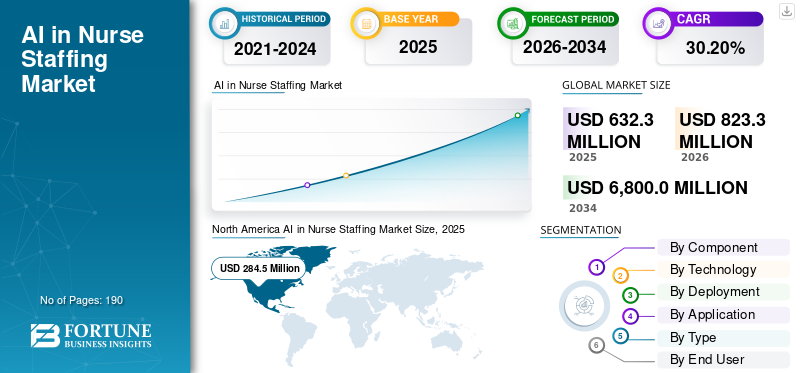
Download Free sample to learn more about this report.
AI in Nurse Staffing Market KEY TAKEAWAYS
 Global Market Size & Forecast
- 2025 Market Size: USD 632.3 million
- 2026 Market Size: USD 823.3 million
- 2034 Forecast Market Size: USD 6,800.0 million
- CAGR: 30.20% during 2026–2034
 Market Share
- North America dominated the global market with a 44.99% share in 2025.
- Machine Learning & Predictive Analytics dominated the technology segment in 2025.
- Hospitals & Health Systems held the largest end-user share in 2025.
 Key Regional Highlights
North America
Dominated the market with a valuation of USD 284.5 million in 2025, supported by severe nurse shortages.
Europe
The market is projected to reach USD 187.5 million in 2026 and grow at a 28.89% rate.
Asia Pacific
The market is estimated to reach USD 214.0 million in 2026, supported by rising hospital infrastructure.
U.S.
The market is estimated at approximately USD 332.4 million in 2026.
Japan
The market is estimated at approximately USD 46.3 million in 2026.
Read More

AI IN NURSE STAFFING MARKET TRENDS
Rising Adoption of Predictive Analytics to Improve Nurse Workforce Planning Is a Prominent Market Trend
A significant market trend observed is the shift toward predictive analytics to manage better nurse shortages, fluctuating patient demand, and rising labor costs. Traditional staffing methods often depend on manual schedules, historical averages, and last-minute adjustments, which can lead to overtime, agency dependence, and uneven workload distribution. As a result, healthcare providers are increasingly using AI-enabled predictive tools to forecast future staffing needs based on patient volume, acuity, admissions, discharges, and workforce availability. These factors help nursing leaders plan shifts, reduce staffing gaps, improve schedule fairness, and support safer patient care. The trend is expected to strengthen as hospitals continue to focus on workforce efficiency, nurse retention, and cost control.
- For instance, in December 2025, hospitals across England reportedly used an AI-powered A&E forecasting tool to predict peak emergency department demand by analyzing historical demand patterns, weather trends, school holidays, and flu/COVID rates. The tool helps NHS trusts plan staffing and bed capacity more effectively during high-pressure periods, showing how predictive analytics is increasingly being applied to improve workforce and resource planning in healthcare settings.
MARKET DYNAMICS
MARKET DRIVERS
Download Free sample to learn more about this report.
Persistent Nurse Shortages Leads to Adoption of AI-Based Staffing Components and Propels Market Growth
One of the prominent factors driving the AI in nurse staffing market growth is the ongoing shortage of nursing staff, high turnover, and rising pressure to maintain safe patient coverage. When nurse availability is limited, manual scheduling becomes less effective as managers must simultaneously balance patient volume, staff preferences, skill levels, overtime limits, and last-minute absences. These factors create a strong need for AI-based staffing tools that can forecast shift-level demand, identify staffing gaps early, and recommend better schedules using real-time workforce and patient data. This demand is expected to remain strong as providers focus on maintaining care quality while managing labor cost pressures and encouraging new product launches.
- For instance, in January 2024, ShiftMed launched ShiftAdvisor, an AI-powered personalized scheduling solution for nurses. The feature uses AI algorithms to provide personalized shift recommendations based on nurses’ past shift data, preferences, skills, financial goals, day, time, pay, and location preferences. It also supports healthcare facilities by reducing the risk of last-minute cancellations and improving staffing efficiency, directly helping hospitals facing nurse shortages and shift coverage challenges.
MARKET RESTRAINTS
High Implementation and Integration Costs to Restrain Market Expansion
The market is growing as hospitals look for better ways to manage nurse shortages, overtime costs, and fluctuating patient demand. However, high implementation and integration costs can slow adoption, especially among small hospitals, long-term care facilities, and healthcare providers with limited IT budgets. AI-based nurse staffing platforms often need to connect with EHRs, HR systems, payroll tools, timekeeping platforms, and patient acuity data, which increases deployment cost and implementation complexity. Also, hospitals may need to redesign workflows, train staff, standardize data, implement cybersecurity controls, and continuously monitor systems before components can deliver reliable staffing recommendations. These factors collectively limit the faster expansion of AI-based nurse staffing components.
- For instance, in 2025, Acta Biomed published an article titled ‘The Integration of Artificial Intelligence in Nursing Practice Opportunities and Challenges’ which highlighted that AI adoption in nursing faces several challenges, including high implementation costs, data privacy concerns, resistance to technological adoption, insufficient digital literacy among nurses, and a lack of standardized guidelines. These factors show that even though AI can improve workforce planning and nursing workflows, cost and operational readiness remain key barriers to wider adoption of the solution.
MARKET OPPORTUNITIES
Expansion of AI-Enabled Flexible Staffing Platforms to Create New Growth Opportunities
The market is expected to create strong growth opportunities as healthcare providers move toward more flexible, real-time workforce models. Hospitals often face sudden changes in patient census, nurse absences, and unit-level workload, which makes manual scheduling slow and less effective. This creates an opportunity for AI-based staffing platforms that can predict demand, identify open shifts, match nurses based on skills and availability, and reduce dependence on high-cost contract labor. As health systems continue to focus on labor cost control, nurse retention, and operational efficiency, vendors offering AI-driven scheduling, internal float pool management, and intelligent shift-fulfillment tools are likely to see greater adoption. This opportunity is especially strong among large hospital networks that need centralized visibility across multiple facilities and faster decision-making for daily staffing needs.
- For instance, in July 2025, ShiftMed launched its AI-powered Workforce Management Suite to help health systems reduce costs and improve workforce efficiency through AI-driven scheduling and intelligent automation. The company stated that the platform embeds AI across the shift fulfillment process, integrates with existing HR and scheduling systems, and helps healthcare leaders optimize labor, minimize contract spend, and gain better control over operations.
MARKET CHALLENGES
Limited Nurse Trust in AI-Generated Scheduling Decisions to Challenge Market Adoption
The market is expected to face adoption challenges as nurse scheduling directly affects workload balance, shift fairness, work-life balance, and staff morale. If AI-generated schedules are not transparent or do not clearly consider nurse preferences, fatigue, skill mix, patient acuity, and unit-level realities, nursing teams may view these tools as top-down control systems rather than support tools. This can reduce trust, create resistance during deployment, and slow the shift from manual scheduling to AI-enabled workforce planning. Healthcare providers may also need additional training, staff consultation, and explainable scheduling rules before nurses and managers fully accept these platforms. As a result, limited nurse trust in AI-driven scheduling decisions can become a major challenge for vendors and hospitals, especially where labor relations, union rules, and staff retention pressures are already sensitive.
- For instance, in May 2026, Axios reported survey findings from Elsevier showing that AI adoption among nurses was lower than among physicians, with only 41.0% of nurses using AI tools frequently compared with 57.0% of doctors. The report also noted that many nurses felt excluded from AI decision-making and that AI use had become a labor-management issue in hospitals, including contractual safeguards negotiated by nurses in New York City.
Segmentation Analysis
By Component
Software/Platforms Dominated Due to Rising Need for Automated Workforce Planning
Based on the component, the market is categorized into software/platforms and services.
By component, the software/ platforms segment dominated the market. Healthcare providers mainly require digital tools to automate nurse scheduling, forecast staffing demand, analyze workforce availability, and support real-time shift decisions that drive segmental growth. Hospitals are moving away from manual spreadsheets and basic scheduling systems. As a result, AI-enabled platforms are gaining higher adoption as they provide centralized workforce visibility, predictive staffing insights, and faster decision-making across multiple units. The segment also benefits from recurring SaaS-based revenue models, easier scalability, and integration with HR, payroll, timekeeping, and scheduling systems.
- For instance, in July 2025, ShiftMed launched its AI-powered Workforce Management Suite to help health systems reduce costs and improve workforce efficiency. The company stated that the platform embeds AI across the shift fulfillment process, integrates with existing HR and scheduling systems, and helps healthcare leaders optimize labor and minimize contract spend.
The services segment is expected to grow at a CAGR of 23.96% over the forecast period.
To know how our report can help streamline your business, Speak to Analyst
By Technology
Machine Learning & Predictive Analytics Led the Market Owing to Strong Demand for Staffing Forecast Accuracy
Based on technology, the market is segmented into machine learning & predictive analytics, optimization algorithms, NLP/generative AI, and others.
In 2025, machine learning & predictive analytics dominated the market. This high segmental share was allocated as nurse staffing depends heavily on forecasting future demand and matching available staff with changing patient needs. Hospitals need to predict admissions, discharges, patient acuity, seasonal demand, absenteeism, and open-shift risk before staffing gaps occur. This makes predictive analytics highly valuable as it helps staffing teams move from reactive scheduling to proactive workforce planning. As a result, healthcare organizations are increasingly using machine learning models to improve schedule accuracy, reduce overtime, lower agency dependency, and support better nurse workload balance. Increasing investment initiatives by key companies in the market reiterate this strong dominance.
- For instance, in May 2026, Chromie Health raised USD 2.0 million in pre-seed funding, alongside the launch of Chromie Dispatch, its flagship SMS AI-driven staffing agent.
The optimization algorithms segment is projected to grow at a 30.65% CAGR during the forecast period.
By Deployment
Cloud-Based Deployment Dominated Due to Scalability and Real-Time Workforce Access
Based on deployment, the market is segmented into cloud-based, on-premise, and hybrid.
The cloud-based solutions held the largest share in the market, as hospitals and health systems need scalable, remotely accessible, and quickly deployable nurse staffing solutions across multiple facilities. Cloud platforms enable workforce managers, nurse leaders, and staff to access schedules, open shifts, alerts, and analytics from anywhere, without the heavy on-premises infrastructure. As a result, cloud-based AI staffing tools are highly preferred as they reduce IT burden, support faster updates, enable mobile access, and make it easier to integrate workforce data across facilities.
- For instance, in July 2025, AMN Healthcare announced the sale of its Smart Square scheduling software to Symplr. It formed a commercial partnership to deliver workforce planning, staffing, scheduling, talent acquisition, and workforce deployment solutions that adapt to evolving healthcare workforce needs.
The hybrid segment is projected to grow at a CAGR of 27.66% during the forecast period.
By Application
Shift Scheduling & Optimization Dominated as Hospitals Prioritized Efficient Nurse Allocation
Based on the application, the market is segmented into demand forecasting, shift scheduling & optimization, float pool & resource allocation, overtime & agency spend reduction, absenteeism/burnout risk prediction, compliance & credential matching, and others.
The shift scheduling and optimization segment dominated the market as scheduling is the core operational pain point in nurse staffing. Healthcare providers must manage shift preferences, patient coverage, skill mix, overtime limits, absences, and last-minute vacancies while maintaining safe staffing levels. Manual scheduling often increases administrative workload and can lead to uneven shift distribution, nurse dissatisfaction, and higher labor costs. As a result, AI-based scheduling and optimization tools are widely adopted to automate shift planning, recommend staffing adjustments, fill open shifts more quickly, and improve workforce efficiency and nurse experience.
- For instance, in January 2024, ShiftMed launched ShiftAdvisor, an AI-powered personalized scheduling solution for nurses. The company stated that the feature was designed to transform nurse scheduling and improve staffing efficiency for healthcare facilities.
The absenteeism/burnout risk prediction segment is projected to grow at a CAGR of 31.58% during the forecast period.
By Type
Standalone Solutions Dominated Due to Faster Deployment and Focused Staffing Optimization Benefits
Based on type, the market is segmented into standalone and integrated.
In 2025, standalone solutions dominated the market. Standalone platforms are easier to evaluate, deploy, and scale for a specific staffing problem, especially when hospitals need quick improvement in scheduling accuracy, overtime control, and open-shift management. These solutions also allow healthcare organizations to modernize workforce planning without replacing their entire HR, payroll, or EHR ecosystem. As a result, standalone AI nurse staffing tools are gaining adoption among providers seeking faster deployment and measurable workforce-efficiency benefits.
- For instance, in March 2026, Xpress Health, an Ireland-based healthcare staffing company, launched an AI-powered platform to connect healthcare facilities with qualified nurses, healthcare assistants, and other healthcare professionals across Ireland. The platform aims to address the ongoing nursing shortage affecting hospitals, nursing homes, and care facilities nationwide.
The integrated segment is projected to grow at a CAGR of 34.42% over the study period.
By End User
Hospitals & Health Systems Dominated Due to High Staffing Complexity and Continuous Care Demand
Based on end user, the market is segmented into hospitals & health systems, long-term care facilities, staffing agencies, ambulatory/outpatient centers, and others.
In 2025, hospitals & health systems held the largest AI in nurse staffing market share due to the highest nurse staffing complexity. These organizations manage multiple departments, fluctuating patient volumes, specialized nurse skill requirements, overtime costs, and dependence on agency staffing. As a result, hospitals have a stronger need for AI-based workforce platforms that can improve demand forecasting, optimize schedules, manage internal float pools, and provide system-wide visibility. Large health systems also have higher digital budgets and stronger integration requirements, which makes them early adopters of AI-enabled nurse staffing solutions.
- For instance, in June 2026, OSF HealthCare selected hellocare.ai’s Intelligent Hospital Room platform for enterprise-wide deployment across its inpatient environments, bringing together Virtual Nursing, Virtual Sitting, AI-Assisted Patient Safety, Digital Whiteboards, Digital Room Signs, and Patient Engagement into a unified platform.
The ambulatory/outpatient centers segment is projected to grow at a CAGR of 34.21% over the forecast period.
AI in Nurse Staffing Market Regional Outlook
By geography, the market is categorized into Europe, North America, Asia Pacific, Latin America, and Middle East & Africa.
North America
North America AI in Nurse Staffing Market Size, 2025 (USD Million)
To get more information on the regional analysis of this market, Download Free sample
North America held the dominant share in 2024 at USD 224.6 million and maintained its leading position in 2025 at USD 284.5 million. The market is growing in North America due to severe nurse shortages, high labor costs, and strong adoption of digital workforce management platforms. Hospitals and health systems are using AI staffing tools to reduce overtime, manage float pools, and improve shift coverage.
U.S. AI in Nurse Staffing Market
Given North America's substantial contribution, the U.S. market is estimated at around USD 332.4 million in 2026, accounting for roughly 40.38% of the global sales.
Europe
Europe is projected to grow at 28.89% over the coming years, the second-highest among all regions, and reach a valuation of USD 187.5 million by 2026. Meanwhile, Europe is witnessing growth as hospitals face workforce shortages, population aging, and an increasing need for efficient nurse deployment. AI-based staffing tools help healthcare providers manage shift planning, labor rule compliance, and staff utilization across public and private healthcare systems. Growing digital health adoption and focus on workforce efficiency are supporting market expansion.
U.K. AI in Nurse Staffing Market
The U.K. market is estimated at USD 39.1 million in 2026, accounting for roughly 4.75% of the global market.
Germany AI in Nurse Staffing Market
Germany's market is projected to reach approximately USD 45.0 million in 2026, equivalent to around 5.47% of the global market.
Asia Pacific
Asia Pacific is estimated to reach USD 214.0 million in 2026 and secure the position of the third-largest region in the market. The market is growing due to rising hospital infrastructure, increasing patient volumes, and growing demand for efficient healthcare workforce planning. AI staffing tools are gaining relevance as healthcare providers seek to manage large patient loads with limited nursing resources.
Japan AI in Nurse Staffing Market
The Japanese market in 2026 is estimated at around USD 46.3 million, accounting for approximately 5.62% of the global market.
China AI in Nurse Staffing Market
China's market is projected to be among the largest worldwide, with 2026 revenues estimated at around USD 67.3 million, accounting for approximately 5.62% of global sales.
India AI in Nurse Staffing Market
The Indian market in 2026 is estimated at around USD 24.4 million, accounting for roughly 2.96% of global revenue.
Latin America and the Middle East & Africa
The Latin America and Middle East & Africa regions are expected to witness significant growth in this market during the forecast period. The market in Latin America is estimated to reach a valuation of USD 42.1 million in 2026. The region is witnessing growth as hospitals and private healthcare networks look for better ways to manage staffing gaps, rising care demand, and operational inefficiencies. AI-based scheduling can help reduce manual workforce planning and improve nurse deployment across facilities. In the Middle East & Africa, the GCC is set to reach USD 8.4 million in 2026.
South Africa AI in Nurse Staffing Market
The South African market is projected to reach approximately USD 2.2 million by 2026, accounting for roughly 0.26% of global revenue.
COMPETITIVE LANDSCAPE
Key Industry Players
New Product Launches by Key Companies to Propel Market Competition
The market is moderately fragmented, with competition led by companies offering predictive staffing platforms, nurse scheduling software, workforce analytics tools, and flexible healthcare staffing marketplaces. Major players such as QGenda, LLC, Symplr, AMN Healthcare, Aya Healthcare, ShiftMed, UKG, Inc., and Oracle Corporation, are strengthening their market positions through AI-enabled scheduling, demand forecasting, float pool management, open-shift fulfillment, labor cost optimization, and workforce intelligence solutions. The increasing pressure on hospitals to reduce overtime, manage nurse shortages, and improve shift coverage is expected to accelerate commercial adoption and expand future workforce planning through AI-based staffing technologies.
- For instance, in July 2025, ShiftMed launched its AI-powered Workforce Management Suite to help health systems improve workforce efficiency and reduce labor costs. The platform embeds AI across the shift fulfillment process, integrates with existing HR and scheduling systems, and supports healthcare leaders in optimizing labor and minimizing contract spend.
Other notable participants in the market are expected to focus on product innovation, mobile-first scheduling, AI-based staffing recommendations, internal resource pool management, and strategic partnerships to improve their competitive position. The market remains innovation-driven, with enterprise workforce vendors holding strong hospital relationships. Similarly, AI-native and flexible staffing companies compete by deploying faster, fulfilling shifts in real time, and improving nurse engagement.
LIST OF KEY AI IN NURSE STAFFING COMPANIES PROFILED
- QGenda, LLC (U.S.)
- Symplr (U.S.)
- AMN Healthcare (U.S.)
- Aya Healthcare (U.S.)
- ShiftMed (U.S.)
- UKG Inc. (U.S.)
- Oracle Corporation (U.S.)
- Workday, Inc. (U.S.)
- HealthStream, Inc. (U.S.)
- RLDatix (U.S.)
- IntelyCare (U.S.)
- ShiftKey (U.S.)
KEY INDUSTRY DEVELOPMENTS
- April 2026: Smartlinx acquired StafferLink to streamline healthcare workforce operations. The acquisition added contingent inpatient staffing management software, including vendor management and agency staffing tools, helping senior care and healthcare organizations address critical staffing challenges.
- November 2025: UKG launched the Workforce Intelligence Hub, an AI-driven solution that unifies workforce information from schedules, time tracking, hiring, performance, pay, and industry trends into one real-time view. This development aimed to improve workforce visibility and data-driven staffing decisions.
- July 2025: M7 Health raised USD 10.0 million Series A funding to redefine staffing, scheduling, and employee experience for the nursing workforce. The funding will support its platform focused on nurse staffing and scheduling, helping hospitals improve workforce planning and employee experience.
- June 2025: QGenda acquired New Innovations, a provider of Residency Management Software (RMS). Hospitals and health systems use New Innovations’ specialized software to manage all aspects of their physician graduate medical education programs.
- March 2025: Kevala integrated with PointClickCare via Marketplace to optimize workforce management for skilled nursing facilities. The integration allowed skilled nursing facilities to use real-time census and acuity data to support smarter staffing decisions and better workforce planning.
REPORT COVERAGE
The report provides a detailed AI in nurse staffing market analysis across the healthcare workforce management value chain. The report covers key market segments and region to understand where demand is strongest and how adoption is changing across global healthcare systems. Additionally, the report examines competitive positioning, recent solution developments, partnerships, collaborations, and technological advancements by key players in the market. This helps stakeholders understand current market dynamics, identify high-growth areas, and plan better workforce optimization, digital transformation, and healthcare staffing strategies.
Request for Customization to gain extensive market insights.
Report Scope & Segmentation
| ATTRIBUTE | DETAILS |
| Study Period | 2021-2034 |
| Base Year | 2025 |
| Estimated Year | 2026 |
| Forecast Period | 2026-2034 |
| Historical Period | 2021-2024 |
| Growth Rate | CAGR of 30.20% from 2026 to 2034 |
| Unit | Value (USD Million) |
| Segmentation | By Component, Technology, Deployment, Application, Type, End User, and Region |
| By Component |
|
| By Technology |
|
| By Deployment |
|
| By Application |
|
| By Type |
|
| By End User |
|
| By Region |
|
Frequently Asked Questions
According to Fortune Business Insights, the global market value stood at USD 632.3 million in 2025 and is projected to reach USD 6,800.0 million by 2034.
In 2025, North America market value stood at USD 284.5 million.
The market is expected to grow at a CAGR of 30.20% over the forecast period of 2026-2034.
The software/platforms segment is expected to lead the market.
Persistent nurse shortages driving adoption of AI-based staffing solutions to propel market growth.
QGenda, LLC, symplr, AMN Healthcare, and Aya Healthcare are among the major players in the global market.
North America dominated the market in 2025.



- 2021-2034
- 2025
- 2021-2024
- 190
Get 30-60 hrs Free Customization
Expand Regional and Country Coverage, Segments Analysis, Company Profiles, Competitive Benchmarking, and End-user Insights.













.webp)






Related Reports
-
US +1 833 909 2966 ( Toll Free )
-
Get In Touch With Us