AI in Stroke Triage Market Size, Share & Industry Analysis, By Component (Software/Platforms and Services), By Deployment (Cloud-based, On-Premise, and Hybrid), By Technology (Computer Vision, Machine Learning & Deep Learning, and Others), By Modality (CT/CTA, CT Perfusion, MRI, Multi-modality, and Others), By Application (Large Vessel Occlusion Detection, Intracranial Hemorrhage Detection, Case Prioritization & Alerting, and Others), By End User (Hospitals & Stroke Centers, Emergency Departments, Radiology Groups, Tele-stroke Networks, and Others), and Regional Forecast, 2026-2034
 Download Free Sample
AI in Stroke Triage Market Size and Future Outlook
 Listen to Audio Version
The AI in stroke triage market size was valued at USD 602.4 million in 2025. The market is projected to grow from USD 793.6 million in 2026 to USD 7,200.0 million by 2034, exhibiting a CAGR of 31.74% during the forecast period. North America dominated the AI in stroke triage market with a market share of 45.% in 2025.
The market comprises AI-enabled stroke imaging platforms, automated detection algorithms, clinical notification tools, and care coordination software used to identify and prioritize suspected stroke cases. The demand for these solutions is increasing as hospitals face growing emergency imaging volumes, limited specialist availability, and pressure to reduce the time between scan, diagnosis, transfer, and treatment. As a result, AI is being used by emergency departments, radiology teams, neurologists, and stroke networks to detect large vessel occlusion, intracranial hemorrhage, and other critical stroke findings more quickly. These platforms help improve communication between care teams, reduce workflow delays, support faster treatment decisions, and improve the chances of better clinical outcomes.
- For instance, in March 2026, Harrison.ai received FDA 510(k) clearance for acute infarct triage on non-contrast CT Brain. Harrison.ai's triage covers six vascular territories and mechanisms of infarct, prioritizing ischemic strokes across the full geography of the brain.
Furthermore, major players, such as Viz.ai, Inc., RapidAI, Brainomix Limited, and Aidoc, are actively pursuing strategic collaborations and acquisitions, as well as investment initiatives to expand their offerings, enhance access, and strengthen their market presence.
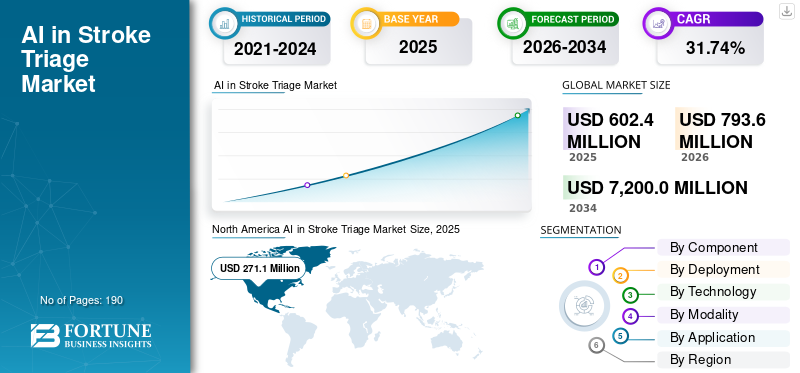
Download Free sample to learn more about this report.
AI in Stroke Triage Market KEY TAKEAWAYS
 Global Market Size & Forecast
- 2025 Market Size: USD 602.4 million
- 2026 Market Size: USD 793.6 million
- 2034 Forecast Market Size: USD 7,200.0 million
- CAGR: 31.74% from 2026–2034
 Market Share
- North America dominated the AI in stroke triage market with a 45% share in 2025.
- The software/platforms segment is projected to grow at the fastest CAGR of 32.30% during the forecast period.
- The hybrid segment is projected to grow at a CAGR of 30.14% during the forecast period.
 Key Regional Highlights
Asia Pacific
Asia Pacific reached USD 191.3 million in 2026, driven by rising stroke burden and digital health adoption.
North America
North America reached USD 271.1 million in 2025, supported by AI triage adoption and advanced stroke care.
Europe
Europe reached USD 0.34 billion in 2026, driven by national stroke programs and faster diagnosis initiatives.
U.S.
U.S. reached USD 323.8 million in 2026, fueled by demand for AI-enabled stroke workflows.
Japan
Japan reached USD 40.1 million in 2026, driven by growing adoption of AI-based healthcare solutions.
Read More

AI IN STROKE TRIAGE MARKET TRENDS
Integration of AI Stroke Triage Platforms with Hospital Stroke Networks is an Emerging Trend Observed
The integration of AI stroke triage platforms with hospital stroke networks is emerging as a key market trend. Stroke care depends on fast coordination between emergency departments, radiology teams, neurologists, interventional specialists, and transfer centers. As patient scans and clinical decisions are transferred between primary and comprehensive stroke centers, communication delays can affect treatment timelines. As a result, hospitals are adopting AI-enabled platforms that not only detect potential stroke signs but also send real-time alerts, support image sharing, and connect multiple care teams within a single workflow. These features are helping stroke networks to reduce diagnosis-to-treatment delays, avoid unnecessary transfers, and improve access to timely intervention for eligible patients.
- For instance, in February 2025, Viz.ai announced new clinical data presented at the International Stroke Conference 2025 showing that its AI-powered stroke solution improved real-world stroke treatment times and hospital economics. The company highlighted the role of AI-powered disease detection and intelligent care coordination in advancing neurovascular care.
MARKET DYNAMICS
MARKET DRIVERS
Download Free sample to learn more about this report.
Growing Need to Reduce Door-to-Treatment Time to Supports Market Growth
The growing need to reduce door-to-treatment time is a key driver of the AI in stroke triage market growth. Stroke treatment is highly time-sensitive, and even small delays in scan review, specialist notification, patient transfer, or treatment decision-making can affect recovery outcomes. As emergency departments and radiology teams manage increasing imaging volumes, manual review and fragmented communication can slow down the treatment pathway. As a result, hospitals are adopting AI stroke triage platforms that automatically analyze brain scans, flag suspected large vessel occlusion or hemorrhage cases, and notify stroke teams in real time. These factors help care teams make faster treatment decisions, prioritize urgent patients, improve transfer coordination, and support timely access to thrombolysis or thrombectomy.
- For instance, in December 2025, Brainomix announced that a study published in The Lancet Digital Health showed its Brainomix 360 Stroke platform was associated with a 100% increase in endovascular thrombectomy rates across NHS England hospitals, with a notable reduction in transfer delays. The study covered more than 450,000 patients across 107 NHS England hospitals over five years.
MARKET RESTRAINTS
High Implementation and Subscription Costs to Limit Adoption Among Smaller Stroke Centers
High implementation and subscription costs are a major restraint for the market. These platforms usually require recurring software licensing, cloud deployment, PACS/RIS integration, cybersecurity checks, staff training, workflow redesign, and ongoing technical support. As a result, large, comprehensive stroke centers may adopt these tools more quickly. Similarly, smaller hospitals, rural facilities, and low-resource health systems may delay purchasing decisions due to limited budgets. This can slow market penetration even when the clinical need for faster stroke triage is high.
- For instance, in March 2026, MDPI published an article titled ‘Transforming Stroke Diagnosis with Artificial Intelligence: A Scoping Review of Brainomix e-Stroke, Aidoc, RapidAI, and Viz.ai’ highlighting that AI systems used in stroke diagnostics can entail high implementation costs, particularly due to subscription-based software-as-a-service The article also noted that these systems require integration with existing hospital infrastructure, which can create additional adoption barriers for healthcare providers.
MARKET OPPORTUNITIES
Expansion of AI Stroke Triage into Pre-hospital and Community Stroke Care to Create Growth Opportunities
The expansion of AI stroke triage beyond large hospitals into pre-hospital care, community hospitals, and primary stroke centers is creating a strong growth opportunity for the market. Many stroke patients first arrive at smaller hospitals or are assessed by emergency medical teams before reaching a comprehensive stroke center. In such settings, limited access to stroke specialists and delayed imaging review can slow down transfer decisions and treatment planning. As a result, AI-based triage tools that support early stroke assessment, faster scan interpretation, real-time alerts, and coordinated referrals can help bridge the gap between first contact and specialist intervention. These factors create an opportunity for vendors to expand from hospital-based imaging AI into broader stroke networks, ambulance pathways, rural care settings, and hub-and-spoke stroke systems.
- For instance, in November 2025, AI-Stroke announced a USD 4.6 million seed funding round to advance its AI-powered stroke triaging solution before a CT scan. The company stated that its smartphone/tablet-based tool allows paramedics or triage nurses to record a short video, which the AI analyzes for facial symmetry, arm movement, and speech to detect stroke signs within seconds before hospital imaging. The funding will support its FDA regulatory pathway and multi-site clinical studies across leading U.S. stroke centers.
MARKET CHALLENGES
Algorithm Performance Variation Across Patient Groups and Imaging Protocols to Create Reliability Concerns
Algorithm performance variation is a key challenge for the market, as stroke imaging varies across hospitals, scanner models, imaging protocols, patient characteristics, and stroke severity levels. AI tools trained on limited or specific datasets may not perform with the same accuracy when used in different clinical settings, especially in smaller hospitals, rural centers, or facilities using different CT/CTA/CTP workflows. This creates a risk of false positives, false negatives, alert fatigue, or missed subtle stroke findings, which can affect physician confidence in AI-supported triage. As a result, hospitals may require stronger external validation, local performance testing, and continuous monitoring before fully integrating AI into urgent stroke decision-making, thereby slowing wider market adoption.
- For instance, in October 2025, Frontiers in Neuroimaging published an article titled ‘Assessing the accuracy of automated CT perfusion software in excluding acute stroke: a comparative study of two software packages’, which reported that automated CT perfusion software may miss small lacunar infarcts, leading to false negatives and the need for additional imaging.
Segmentation Analysis
By Component
Services Segment Dominated Due to the Need for Integration, Training, and Workflow Support
Based on the component, the market is categorized into software/platforms and services.
By component, services dominated the global market. Hospitals need workflow mapping, PACS/RIS integration, cloud configuration, staff training, cybersecurity review, and continuous technical support to make AI alerts usable in real-time stroke pathways. As a result, service providers play a critical role in connecting emergency departments, radiology teams, neurologists, and interventional stroke centers. This makes services highly important, especially for multi-site stroke networks and hospitals with limited in-house digital health expertise.
- For instance, in June 2025, 3DR Labs and Brainomix announced a strategic partnership to support acute stroke care in the U.S. through the FDA-cleared Brainomix 360 Stroke platform. This release highlights the role of post-processing services, clinical deployment support, and AI imaging workflow enablement in helping providers assess patient eligibility for interventions such as thrombectomy.
The software/platforms segment is expected to grow at a CAGR of 32.30% over the forecast period.
To know how our report can help streamline your business, Speak to Analyst
By Deployment
Cloud-based Segment Dominated Due to Real-time Image Sharing and Multi-Site Stroke Coordination
Based on deployment, the market is segmented into cloud-based, on-premise, and hybrid.
In 2025, cloud-based deployment dominated the market as stroke triage often requires rapid communication across multiple care locations, including emergency departments, primary stroke centers, and comprehensive stroke centers. Cloud platforms enable scans, alerts, and care team updates to be shared quickly without relying solely on local hospital infrastructure. As a result, hospitals prefer cloud-based AI systems that can support remote specialist review, centralized workflow visibility, and faster transfer decisions. This deployment model is especially useful for hub-and-spoke stroke networks where treatment decisions must be coordinated across different sites.
- For instance, in November 2024, Viz.ai collaborated with Microsoft to deliver Viz.ai’s AI models and care coordination solution through Microsoft’s Precision Imaging Network, part of Microsoft Cloud for Healthcare. The Viz.ai One supports stroke, hemorrhage, pulmonary embolism, and other care pathways through AI-powered clinical workflow coordination.
The hybrid segment is projected to grow at a 30.14% CAGR during the forecast period.
By Technology
Computer Vision Segment Dominated Due to Its Critical Role in Rapid Stroke Image Detection
Based on technology, the market is segmented into computer vision, machine learning & deep learning, and others.
By technology, the computer vision segment held the largest AI in stroke triage market share. Computer vision-based AI algorithms are widely used to scan imaging data, highlight critical findings, prioritize urgent cases, and alert stroke teams in real time. This makes computer vision the core technology behind AI stroke triage platforms, especially in emergency departments and stroke centers, where faster image review directly supports quicker treatment decisions. Also, regulatory approvals by key players will further intensify the segmental growth.
- For instance, in October 2025, Methinks AI received its second U.S. FDA 510(k) clearance for Methinks CTA Stroke. This AI-based software solution detects suspected large-vessel occlusions in CT angiography scans. The tool demonstrated high sensitivity and specificity for LVO detection, supporting faster stroke triage through automated imaging analysis.
The machine learning & deep learning segment is projected to grow at a CAGR of 30.68% during the forecast period.
By Modality
CT/CTA Segment Dominated Due to its Central Role in Emergency Stroke Imaging
Based on the modality, the market is segmented into CT/CTA, CT perfusion, MRI, multi-modality, and others.
CT/CTA segment dominates the market as it is widely used as the first-line imaging approach for suspected stroke patients in emergency settings. Non-contrast CT helps identify hemorrhage, while CTA supports the detection of large-vessel occlusion and vascular abnormalities that may require urgent intervention. As these scans are fast, broadly available, and embedded in emergency stroke protocols, AI vendors are prioritizing CT/CTA-based tools for rapid triage and treatment decision support. As a result, CT/CTA-based AI platforms gain strong adoption across hospitals, stroke centers, and emergency imaging workflows.
- For instance, in 2025, Qure.ai announced its 19th U.S. FDA clearance for qER-CTA, an AI tool designed to aid stroke triage. The clearance strengthens its neurocritical AI portfolio and supports time-critical decision-making in emergency imaging pathways.
The CT perfusion segment is projected to grow at a CAGR of 32.41% during the forecast period.
By Application
Intracranial Hemorrhage Detection Segment Dominated Due to the Need for Immediate Case Prioritization
Based on application, the market is segmented into large vessel occlusion detection, intracranial hemorrhage detection, perfusion/ischemic core assessment, case prioritization & alerting, care team communication & coordination, transfer/hub-spoke workflow support, and others.
In 2025, intracranial hemorrhage detection dominated the market as brain bleeding is one of the most urgent findings in emergency neuroimaging. Delayed identification can affect treatment planning, specialist involvement, and patient outcomes, while rapid detection helps radiologists and emergency teams prioritize critical cases. As emergency departments handle large CT volumes, AI tools that automatically flag suspected hemorrhage reduce the risk of delayed review and support faster escalation. This makes ICH detection one of the most commercially important and clinically adopted use cases within AI stroke triage.
- For instance, in February 2024, Viz.ai announced FDA 510(k) clearance for Viz ICH Plus, an AI algorithm for quantifying intracerebral hemorrhage. The tool automates identification, labeling, and volume measurement of brain bleeds on non-contrast CT images to support timely treatment decisions.
The care team communication & coordination segment is projected to grow at a CAGR of 33.27% over the forecast period.
By End User
Emergency Departments Segment Dominated Due to Their Role as First Point of Stroke Evaluation
Based on end user, the market is segmented into hospitals & stroke centers, emergency departments, radiology groups, tele-stroke networks, and others.
In 2025, emergency departments dominated the market as they are usually the first clinical setting where suspected stroke patients are evaluated, imaged, and prioritized. ED teams need rapid scan interpretation, immediate specialist notification, and quick decisions on treatment or transfer, especially when dealing with large vessel occlusion or intracranial hemorrhage. As patient inflow increases and stroke symptoms overlap with other emergency conditions, AI triage tools help ED teams identify critical cases faster and reduce delays in the care pathway. This makes emergency departments the most important adoption point for AI-enabled stroke triage solutions.
- For instance, in April 2023, Medtronic India and Qure.ai announced a partnership to advance AI-enabled stroke management in India. The release stated that Qure’s qER and Qure app would support faster head CT interpretation, multidisciplinary communication, and hub-and-spoke stroke triage across comprehensive and primary stroke centers.
The tele-stroke networks segment is projected to grow at a CAGR of 36.74% over the forecast period.
AI in Stroke Triage Market Regional Outlook
By geography, the market is categorized into Europe, North America, Asia Pacific, Latin America, and Middle East & Africa.
North America
North America AI in Stroke Triage Market Size, 2025 (USD Million)
To get more information on the regional analysis of this market, Download Free sample
North America held the dominant share in 2024 at USD 211.5 million and maintained its leading position in 2025 at USD 271.1 million. The market is growing in North America as hospitals invest in AI triage tools to reduce door-to-treatment time, improve transfer decisions, and expedite access to thrombectomy. Strong regulatory clearances and the presence of leading AI stroke triage companies further support regional growth.
U.S. AI in Stroke Triage Market
Given North America's substantial contribution, the U.S. market is estimated at around USD 323.8 million in 2026, accounting for roughly 40.79% of the market sales.
Europe
Europe is projected to grow at 29.87% over the coming years, the second-highest among all regions, and reach a valuation of USD 0.34 million by 2026. Europe is witnessing growth as national stroke programs and hospital networks increasingly focus on faster diagnosis and treatment coordination. Wider deployment across NHS hospitals and European stroke centers is helping improve access to timely intervention.
U.K. AI in Stroke Triage Market
The U.K. market is estimated at USD 39.0 million in 2026, accounting for roughly 4.92% of the global market.
Germany AI in Stroke Triage Market
Germany's market is projected to reach approximately USD 44.9 million in 2026, equivalent to around 5.66% of the global market.
Asia Pacific
Asia Pacific is estimated to reach USD 191.3 million in 2026 and secure third place in the market. Asia Pacific is growing due to a rising stroke burden, expanding emergency imaging infrastructure, and increasing digital health adoption. The need to serve large patient populations more quickly is driving strong demand for scalable AI triage platforms.
Japan AI in Stroke Triage Market
The Japanese market, in 2026, is estimated at around USD 40.1 million, accounting for approximately 5.05% of the global market.
China AI in Stroke Triage Market
China's market is projected to be among the largest worldwide, with 2026 revenues estimated at around USD 62.8 million, accounting for approximately 7.91% of global sales.
India AI in Stroke Triage Market
The Indian market, in 2026, is estimated at around USD 24.7 million, accounting for roughly 3.11% of global revenue.
Latin America and the Middle East & Africa
The Latin America and Middle East & Africa regions are expected to witness significant growth in this market during the forecast period. The market in Latin America is estimated to reach a valuation of USD 40.6 million in 2026. Latin America is showing gradual growth as hospitals seek cost-effective ways to improve emergency stroke workflows and reduce delays in specialist consultation. This growth is also supported by increasing modernization of hospital imaging and rising awareness of time-sensitive stroke treatment. In the Middle East & Africa, the GCC is set to reach USD 8.6 million in 2026.
South Africa AI in Stroke Triage Market
The South African market is projected to reach approximately USD 2.1 million by 2026, accounting for roughly 0.87% of global revenue.
COMPETITIVE LANDSCAPE
Key Industry Players
Strategic Collaboration Among Key Companies to Propel Market Competition
The AI in stroke triage market is moderately consolidated, with competition led by companies with approved AI imaging algorithms, strong hospital adoption, and integrated stroke workflow platforms. Major players in the market include Viz.ai, RapidAI, Brainomix Limited, Aidoc, Avicenna.AI, Qure.ai, and Nicolab B.V. These market players are strengthening their positions through FDA-cleared solutions, cloud-based platforms, care coordination tools, clinical validation, and partnerships with hospitals and imaging technology providers. The increasing use of AI for large-vessel occlusion detection, intracranial hemorrhage detection, CT/CTA-based triage, ischemic core assessment, and stroke team notification is expected to improve commercial adoption and expand the future treatment and triage base for these solutions.
- For instance, in March 2025, Medtronic partnered with Methinks to advance stroke care development across Central and Eastern Europe, Africa, Türkiye, and the Middle East. The collaboration focuses on using Methinks’ AI-powered stroke triage technology to accelerate the identification of suspected stroke cases and improve access to timely treatment in underserved and emerging healthcare regions.
Other notable participants are expected to focus on advanced CT/CTA analysis, perfusion imaging, non-contrast CT-based stroke assessment, mobile alerting, cloud-based workflow coordination, and AI-enabled transfer decision support. The market remains strongly innovation-driven, with approved product launches, clinical evidence generation, hospital network partnerships, and regional expansion serving as major growth strategies for leading and emerging companies.
LIST OF KEY AI IN STROKE TRIAGE COMPANIES PROFILED
- ai, Inc. (U.S.)
- RapidAI (U.S.)
- Brainomix Limited (U.S.)
- Aidoc (Israel)
- AI (France)
- ai (India)
- Nicolab B.V. (The Netherlands)
- Cercare Medical A/S (Denmark)
- Methinks Software S.L. (Spain)
- JLK, Inc. (South Korea)
KEY INDUSTRY DEVELOPMENTS
- March 2026: Brainomix announced the deployment of Brainomix 360 Stroke across all 25 WVU Health System sites, giving the network access to a unified AI platform for faster, more consistent acute stroke decision-making.
- December 2025: Aidoc announced strategic partnerships with Cercare Medical and Circle CVI to expand its neurosciences portfolio with advanced MR perfusion and automated ASPECTS capabilities, helping connect fragmented neuro workflows.
- November 2025: RapidAI announced FDA clearance for five imaging modules: Rapid DeltaFuse, Rapid LMVO, Rapid MLS, Rapid OH, and Rapid Aortic, expanding its Rapid Enterprise platform across neurovascular and vascular imaging workflows.
- October 2025: Nicolab and Philips launched StrokeViewer in India, aimed at improving AI-powered stroke treatment workflows and enabling faster care coordination nationwide.
- June 2025: Brainomix and 3DR Labs announced a strategic partnership to support acute stroke care in the U.S. through the FDA-cleared Brainomix 360 Stroke platform. The partnership strengthens post-processing and AI-enabled access to stroke imaging for hospitals.
REPORT COVERAGE
The report provides a detailed global AI in stroke triage market analysis across key segments and region. Additionally, the report examines competitive positioning, recent product launches, regulatory approvals, partnerships, collaborations, and technological advancements by key players in the market. This helps stakeholders understand current market dynamics, identify high-growth areas, and plan better product development, hospital adoption, regional expansion, and commercialization strategies.
Request for Customization to gain extensive market insights.
Report Scope & Segmentation
| ATTRIBUTE | DETAILS |
| Study Period | 2021-2034 |
| Base Year | 2025 |
| Estimated Year | 2026 |
| Forecast Period | 2026-2034 |
| Historical Period | 2021-2024 |
| Growth Rate | CAGR of 31.74% from 2026 to 2034 |
| Unit | Value (USD Million) |
| Segmentation | By Component, Deployment, Technology, Modality, Application, End User, and Region |
| By Component |
|
| By Deployment |
|
| By Technology |
|
| By Modality |
|
| By Application |
|
| By End User |
|
| By Region |
|
Frequently Asked Questions
According to Fortune Business Insights, the global market value stood at USD 602.4 million in 2025 and is projected to reach USD 7,200.0 million by 2034.
In 2025, the North America market value stood at USD 271.1 million.
The market is expected to grow at a CAGR of 31.74% over the forecast period of 2026-2034.
The market is expected to grow at a CAGR of 31.74% over the forecast period of 2026-2034.
Growing need to reduce door-to-treatment time support market growth.
Viz.ai, Inc., RapidAI. Brainomix Limited and Aidoc are among the major players in the global market.
North America accounted for the largest share of the market in 2025.



- 2021-2034
- 2025
- 2021-2024
- 190
Get 30-60 hrs Free Customization
Expand Regional and Country Coverage, Segments Analysis, Company Profiles, Competitive Benchmarking, and End-user Insights.













.webp)






-
US +1 833 909 2966 ( Toll Free )
-
Get In Touch With Us