Self-Driving Bus Market Size, Share & Industry Analysis, By Automation Level (Level 3 Autonomous Bus, Level 4 Autonomous Bus, and Level 5 Autonomous Bus), By Propulsion Type (ICE and BEV), By Bus Type (Shuttle Bus, City Transit Bus, Intercity Bus, and Airport Bus), By Seating Capacity (Below 15 Seats, 15–30 Seats, and Above 30 Seats), By Component (Hardware and Software), and Regional Forecast, 2026–2034
 Download Free Sample
(Offer valid till 30th Sep 2026)

Self-Driving Bus Market Size and Future Outlook
 Listen to Audio Version
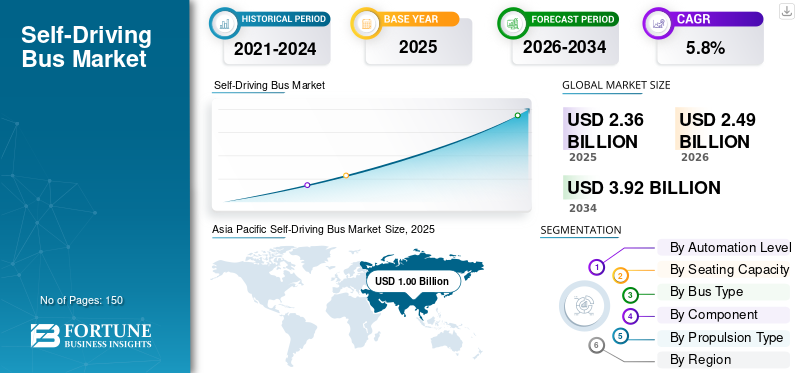
The global self-driving bus market size was valued at USD 2.36 billion in 2025 and is projected to grow from USD 2.49 billion in 2026 to USD 3.92 billion by 2034, exhibiting a CAGR of 5.8% during the forecast period. Asia Pacific dominated the self-driving bus market with a market share of 42.37% in 2025.
The global market refers to the development, deployment, and commercialization of autonomous buses equipped with advanced sensors, cameras, LiDAR, radar, GPS, artificial intelligence, and vehicle-to-everything communication systems. These buses operate with minimal or no human intervention across urban bus rapid transit, airports, campuses, smart cities, and shuttle services. The market is driven by demand for safer, efficient, low-emission public transport, reduced driver dependency, and growing investments in autonomous mobility infrastructure.
Key drivers of the global market include rising demand for safer and more efficient public transportation systems, growing smart city development, and increasing investments in autonomous driving technology. Supportive government initiatives, labor shortage concerns, and the need to reduce operating costs are accelerating adoption. Advancements in autonomous vehicle technologies such as LiDAR, radar, AI, V2X connectivity, and electric bus platforms further support market growth.
Major players in the market include EasyMile, Navya, May Mobility, Baidu Apollo, and ZF Friedrichshafen AG, competing through autonomous shuttle platforms, advanced sensor fusion, AI-based navigation, vehicle-to-everything connectivity, and safety-focused driverless public transport solutions.
Download Free sample to learn more about this report.
SELF-DRIVING BUS MARKET TRENDS
Electric Autonomous Bus Platforms to Shape Market Trends
The shift toward electric autonomous bus platforms are a major trend in the global market. Most new self-driving bus projects are being designed around electric drivetrains as they support zero-emission mobility, lower noise levels, and reduced operating costs. Electric platforms also align well with smart city goals, clean transportation policies, and fleet electrification programs. Combining autonomy with electric propulsion allows operators to improve route efficiency, energy management, and predictive maintenance. Battery improvements, fast charging systems, and vehicle connectivity are making autonomous electric buses more practical for shuttle and urban transit operations. This trend is also encouraging partnerships between autonomous technology providers, electric bus manufacturers, software companies, and public transport authorities to develop integrated mobility solutions.
MARKET DYNAMICS
MARKET DRIVERS
Download Free sample to learn more about this report.
Smart City Investments to Drive Self-Driving Bus Adoption
The growing development of smart cities is a major driver for the global self-driving bus market growth. Governments and city authorities are increasingly investing in intelligent transport systems, connected infrastructure, and low-emission public mobility solutions to reduce congestion and improve urban transport efficiency. Self-driving buses support these goals by offering automated, predictable, and safer transit services on fixed or semi-fixed routes. Their use in campuses, airports, business parks, and urban shuttle corridors is expanding as operators seek reliable mobility with lower operating costs. Integration of AI, LiDAR, radar, cameras, GPS, and V2X communication further improves navigation and passenger safety. As cities modernize transport networks, autonomous buses are expected to become an important part of sustainable public mobility.
Market Drivers - Impact & CAGR Contribution (2026–2034)
| Rank | Market Drivers | Overall Impact Rank | CAGR Contribution (2026–2034) (2026-2034) |
Impact: 2026-2028 | Impact: 2029-2031 | Impact: 2032-2034 |
|---|---|---|---|---|---|---|
| 1 | Smart City Investments to Drive Self-Driving Bus Adoption | High | 2.4% | High | High | High |
| 2 | Need to improve transit operating efficiency and address driver shortages | High | 1.9% | High | High | Medium |
| 3 | Government-supported autonomous bus pilots, smart mobility programs and regulatory development | High | 1.7% | Medium | High | Medium |
| 4 | Growing demand for safer, reliable and flexible public transportation services | High | 1.5% | Medium | High | High |
| 5 | Expansion of connected infrastructure, V2X, 5G and smart-city transportation ecosystems | Medium-High | 1.2% | Medium | High | High |
| 6 | Others | Low | 0.8% | Low | Low | Low |
| Total Positive Growth Contribution | 9.50% | |||||
Source: Fortune Business Insights
MARKET RESTRAINTS
High Deployment Cost and Infrastructure Gaps to Restrain Market Growth
High initial investment remains a key restraint for the global market. Autonomous buses require expensive hardware such as LiDAR, radar, cameras, control units, high-performance computing systems, and advanced software platforms. In addition, successful deployment often depends on supportive road infrastructure, high-quality digital maps, reliable connectivity, charging facilities, and dedicated testing zones. Many cities, especially in developing regions, lack the required infrastructure and regulatory framework readiness for large-scale autonomous bus operations. Operators may also face additional costs related to safety validation, cybersecurity, insurance, maintenance, and remote monitoring systems. These factors can slow adoption, particularly among public transit agencies with limited budgets. Until costs decline and infrastructure improves, deployment may remain concentrated in pilot projects and controlled environments.
Market Restraints - Impact & Negative CAGR Contribution (2026–2034)
| Rank | Market Restraints | Overall Impact Rank | Negative CAGR contribution (2026–2034) (2026-2034) |
Impact: 2026-2028 | Impact: 2029-2031 | Impact: 2032-2034 |
|---|---|---|---|---|---|---|
| 1 | High Deployment Cost and Infrastructure Gaps to Restrain Market Growth | High | 1.4% | High | High | Medium |
| 2 | Safety validation, regulatory approval and liability challenges | Medium-High | 1.2% | High | High | Medium |
| 3 | Cybersecurity, system reliability and public acceptance concerns | High | 0.8% | Medium | Medium | Medium |
| 4 | Others | Low | 0.3% | Low | Low | Low |
| Negative Impact | 3.70% | |||||
Source: Fortune Business Insights
MARKET OPPORTUNITIES
Growing Demand for First- and Last-Mile Mobility to Create New Opportunities
Rising demand for first- and last-mile connectivity presents a strong opportunity for the market. Many urban areas face mobility gaps between homes, offices, metro stations, airports, campuses, and transit hubs. Self-driving buses can address this need by operating on short, repetitive, and low-speed routes where automation is easier to manage, and passenger demand is consistent. These vehicles are well suited for university campuses, industrial parks, smart communities, tourist zones, and airport terminals. Transit agencies and private operators can use autonomous shuttles to improve accessibility while reducing dependence on traditional driver-operated services. As cities expand multimodal transport networks, autonomous buses can become an important link between mass transit systems and local mobility demand.
MARKET CHALLENGES
Safety Validation and Public Acceptance to Challenge Commercial Deployment
Safety validation and public acceptance remain major challenges for the global market. Autonomous buses must operate safely in complex traffic conditions involving pedestrians, cyclists, mixed vehicles, changing weather, roadworks, and unpredictable human behavior. Even small system failures can affect public trust and delay regulatory approvals. Developers need extensive real-world testing, simulation, cybersecurity protection, fail-safe systems, and remote monitoring to prove operational reliability. Public confidence is also essential, as passengers may hesitate to use driverless buses without clear evidence of safety and emergency response capability. Transit agencies must communicate benefits, conduct controlled pilots, and ensure transparent safety standards. Building trust among regulators, operators, and passengers will be critical for wider commercial adoption.
Segmentation Analysis
By Automation Level
Regulatory Readiness and Controlled-Route Deployment to Propel Level 4 Autonomous Bus Segment’s Dominance
Based on automation level, the market is categorized into Level 3 autonomous bus, Level 4 autonomous bus, and Level 5 autonomous bus.
The Level 4 autonomous bus segment dominated the market in 2025 due to its strong suitability for controlled and geo-fenced operations such as campuses, airports, business parks, smart city corridors, and dedicated shuttle routes. These buses can operate without driver intervention within predefined areas, making them more commercially practical than fully autonomous Level 5 systems. Transit agencies and mobility providers prefer Level 4 buses as they balance automation capability, safety validation, regulatory acceptance, and operational feasibility. Growing pilot programs, V2X integration, and electric autonomous shuttle deployment further strengthen segment dominance.
The Level 5 autonomous bus segment is projected to grow at a CAGR of 5.3% over the forecast period. Growth is supported by long-term advancements in AI decision-making, sensor fusion, high-definition mapping, and vehicle autonomy, although large-scale adoption remains gradual due to complex traffic environments and regulatory challenges.
To know how our report can help streamline your business, Speak to Analyst
By Seating Capacity
Operational Flexibility and Urban Shuttle Demand to Propel 15–30 Seats Segment’s Dominance
Based on seating capacity, the market is categorized into below 15 seats, 15–30 seats, and above 30 seats.
The 15–30 seats segment dominated the self-driving bus market share in 2025 due to its strong suitability for urban shuttles, airport transfers, smart campuses, business parks, and first- and last-mile mobility routes. This seating range offers an effective balance between passenger capacity, vehicle size, route flexibility, and autonomous system efficiency. Transit operators prefer 15–30 seat autonomous buses for controlled-route deployment, as they can serve moderate passenger volumes without requiring large road space or complex maneuvering. Growing smart city mobility pilots and electric autonomous shuttle programs further support the segment’s dominance.
The above 30 seats segment is projected to grow at a CAGR of 6.2% over the forecast period. Growth is supported by increasing interest in autonomous public transit for high-capacity urban corridors, intercity routes, and mass transport applications, particularly where cities seek driverless solutions for larger passenger volumes.
By Bus Type
Urban Public Transit Modernization to Propel City Transit Bus Segment’s Dominance
Based on bus type, the market is categorized into shuttle bus, city transit bus, intercity bus, and airport bus.
The city transit bus segment dominated the market in 2025 due to rising demand for efficient, safe, and low-emission public transportation in urban areas. City routes provide predictable operating conditions, fixed stops, and repeatable driving patterns, making them suitable for autonomous deployment. Municipal agencies are adopting self-driving buses to reduce driver dependency, improve service frequency, and support smart city mobility goals. Growing investment in electric bus fleets, V2X infrastructure, and pilot autonomous transit corridors further strengthens the dominance of city transit buses.
The intercity bus segment is projected to grow at a CAGR of 6.8% over the forecast period. Growth is supported by rising interest in autonomous mobility for medium-distance travel, highway-based routes, and regional connectivity, where advanced driver assistance, route automation, and fleet efficiency can reduce operating costs.
By Component
Sensor Integration and Control Systems to Propel Hardware Segment’s Dominance
Based on component, the market is categorized into hardware and software.
The hardware segment dominated the market in 2025 due to the high value and critical role of LiDAR, radar, cameras, GPS units, onboard processors, control modules, braking systems, and steering actuators. These components enable real-time perception, navigation, obstacle detection, and vehicle control, making them essential for autonomous operations. Hardware accounts for a major share of vehicle cost, especially in Level 4 autonomous buses operating on city transit and shuttle routes. Continuous upgrades in sensor accuracy, computing power, and safety redundancy further support the segment’s dominance.
The software segment is projected to grow at a CAGR of 6.5% over the forecast period. Growth is supported by rising demand for AI-based perception, route optimization, fleet management, cybersecurity, simulation, over-the-air updates, and autonomous driving algorithms across connected self-driving bus platforms.
By Propulsion type
Fleet Electrification and Clean Mobility Policies to Propel BEV Segment’s Dominance
Based on propulsion type, the market is categorized into ICE and BEV.
The BEV segment dominated the market in 2025 due to strong alignment with zero-emission public transportation goals, smart city programs, and fleet electrification policies. Battery electric buses are well suited for autonomous deployment as they offer lower operating costs, quieter operation, simplified drivetrain architecture, and easier integration with digital control systems. Transit agencies, airports, and campuses increasingly prefer BEV-based autonomous buses for fixed-route and shuttle services. Expanding charging infrastructure, battery improvements, and government support for electric public transport further strengthens the segment’s dominance.
The ICE segment is projected to grow at a CAGR of 4.2% over the forecast period. Growth is supported by selective use in regions with limited charging infrastructure, longer operating routes, and transitional autonomous bus deployments where conventional fuel platforms remain more practical.
Self-Driving Bus Market Regional Outlook
By region, the market is categorized into Europe, North America, Asia Pacific, Latin America, and the Middle East & Africa.
Asia Pacific
Asia Pacific Self-Driving Bus Market Size, 2025 (USD Billion)
To get more information on the regional analysis of this market, Download Free sample
Asia Pacific dominates the market due to strong smart city development, rapid urbanization, and rising investment in electric and autonomous public transport. China, Japan, South Korea, and Singapore are actively supporting autonomous shuttle pilots, connected mobility corridors, and low-emission transit systems. The region benefits from strong EV manufacturing capacity, advanced sensor technology adoption, and government-backed mobility modernization programs. Growing demand for safer, efficient, and scalable urban transport further strengthens Asia Pacific’s leadership in the market.
China Self-Driving Bus Market
The China market in 2026 is estimated at around USD 0.58 billion, supported by large-scale smart urbanization, electric bus manufacturing strength, AI mobility platforms, and government-backed autonomous transport initiatives.
Japan Self-Driving Bus Market
The Japan market in 2026 is estimated at around USD 0.09 billion, driven by aging population mobility needs, smart community projects, autonomous shuttle testing, and demand for efficient public transport automation.
Europe
Europe holds the second-largest market share and is projected to grow at a CAGR of 5.2% over the forecast period. Growth is supported by strict emission regulations, public transport electrification, and strong adoption of autonomous mobility pilots across Germany, France, the U.K., and the Nordic countries. European cities are testing self-driving buses for first- and last-mile connectivity, campus mobility, and low-speed urban routes. Supportive safety frameworks, sustainability goals, and smart infrastructure investments continue to strengthen regional market expansion.
U.K. Self-Driving Bus Market
The U.K. market in 2026 is estimated at around USD 0.12 billion, driven by autonomous shuttle trials, smart city mobility programs, fleet electrification, and demand for safer urban transit.
Germany Self-Driving Bus Market
The Germany market in 2026 is estimated at around USD 0.16 billion, supported by strong automotive engineering, Level 4 testing approvals, smart mobility investments, and autonomous public transport pilots.
North America
North America is the third-largest market, driven by autonomous vehicle testing, smart city initiatives, and growing demand for advanced public mobility solutions. The U.S. leads regional adoption with pilot deployments in campuses, airports, business districts, and urban shuttle services. Technology companies, transit agencies, and mobility startups are investing in Level 4 autonomous bus platforms. Canada is also supporting clean transit and connected infrastructure. However, regulatory complexity and high deployment costs moderate large-scale commercialization.
U.S. Self-Driving Bus Market
The U.S. market in 2026 is estimated at around USD 0.42 billion, driven by autonomous vehicle testing, campus shuttle deployments, airport mobility projects, and smart transit modernization programs.
Middle East & Africa
The Middle East & Africa market is gradually expanding, supported by smart city projects, airport modernization, and investment in future mobility solutions. Countries such as the UAE and Saudi Arabia are testing autonomous shuttles as part of urban transformation and sustainability programs. Self-driving buses are gaining attention for controlled environments such as airports, business zones, tourism destinations, and planned cities. In Africa, adoption remains limited due to infrastructure and cost barriers, but long-term potential exists in urban mobility modernization.
UAE Self-Driving Bus Market
The UAE market in 2026 is estimated at around USD 0.09 billion, supported by smart mobility projects, airport automation, future mobility initiatives, and self-driving shuttle trials in controlled urban environments.
Latin America
Latin America is an emerging market for self-driving buses, supported by rising urban congestion, public transport modernization, and growing interest in electric mobility. Brazil, Mexico, and Chile are expected to lead early adoption through smart city projects and pilot autonomous shuttle programs. The region’s need for affordable, efficient, and cleaner autonomous public transportation creates long-term opportunities. However, limited autonomous infrastructure, budget constraints, and slower regulatory development may restrict near-term deployment, keeping growth focused on trials and selected urban corridors.
Brazil Self-Driving Bus Market
The Brazil market in 2026 is estimated at around USD 0.04 billion, driven by urban transit modernization, rising congestion, electric mobility interest, and early-stage autonomous shuttle pilot opportunities.
COMPETITIVE LANDSCAPE
Key Industry Players
Major Players Focus on Strategic Partnerships and Technology Integration to Shape Competitive Landscape
The global self-driving bus market is moderately consolidated, with competition shaped by autonomous technology capability, vehicle integration expertise, safety validation, and partnerships with public transport authorities. Key players such as EasyMile, Navya, May Mobility, Baidu Apollo, and ZF Friedrichshafen AG focus on Level 4 autonomous platforms, sensor fusion, AI-based navigation, and connected fleet management. Companies are competing through pilot deployments, electric autonomous shuttle development, remote monitoring systems, and collaborations with cities, airports, campuses, and mobility operators to strengthen commercial readiness.
Competition is also increasing as traditional bus manufacturers, automotive suppliers, software firms, and mobility startups enter the market with integrated autonomous transport solutions. Players are prioritizing regulatory compliance, passenger safety, cybersecurity, and cost-efficient deployment models to gain trust from transit agencies. Strategic partnerships, public-private pilot projects, and continuous software upgrades are becoming key differentiators. As demand grows for smart, low-emission, and driverless public mobility, companies with proven real-world deployments and scalable autonomous bus platforms are expected to secure stronger market positions.
LIST OF KEY SELF-DRIVING BUS COMPANIES PROFILED
- EasyMile (France)
- Navya Mobility (France)
- May Mobility (U.S.)
- Baidu Apollo (China)
- ZF Friedrichshafen AG (Germany)
- WeRide (China)
- Beep, Inc. (U.S.)
- Karsan (Turkey)
- Aurrigo International plc (U.K.)
KEY INDUSTRY DEVELOPMENTS
- July 2026: Baidu expanded its Apollo Go autonomous mobility strategy through a multi-year partnership with Uber to deploy thousands of autonomous vehicles across global markets, strengthening Baidu’s position in driverless public and shared mobility ecosystems.
- February 2026: Mobileye participated as a key partner at India’s ADAS Show 2026 at ARAI Pune’s dedicated test city, supporting autonomous and advanced driver-assistance technology validation for future smart mobility applications.
- June 2025: Beep secured a USD 36 million contract from the Jacksonville Transportation Authority to operate NAVI, described as the first fully autonomous public transit system in the U.S., marking a key commercialization milestone.
- May 2025: EasyMile supported TractEasy in deploying an EZTow autonomous tow tractor at Airbus’ Saint-Nazaire site, demonstrating Level 4 autonomous vehicle capability in controlled transport environments relevant to shuttle automation.
- January 2025: May Mobility unveiled a high-capacity electric autonomous minibus with Tecnobus at CES 2025. The platform supports up to 30 passengers, wheelchair accessibility, swappable batteries, and deployment across the U.S., Canada, and Europe.
- October 2024: Beep and Mississippi State University launched the Campus Autonomous Bus pilot, marking Mississippi and the Southeastern Conference’s first autonomous shuttle project and expanding campus-based autonomous public mobility testing.
- June 2024: Beti, Groupe Bertolami, and EasyMile deployed a fully autonomous Level 4 shuttle service without an onboard operator on a private site, transporting employees across a 15-hectare controlled operating environment.
REPORT COVERAGE
The global self-driving bus market analysis provides an in-depth study of market size and forecast by all the market segments included in the report. It includes details on the market dynamics and market trends expected to drive the market in the forecast period. It offers information on the technological advancements, new product launches, key industry developments, and details on partnerships, mergers & acquisitions. The market research report also encompasses a detailed competitive landscape, including market share and profiles of key operating players.
Request for Customization to gain extensive market insights.
Report Scope & Segmentation
| ATTRIBUTE | DETAILS |
| Study Period | 2021-2034 |
| Base Year | 2025 |
| Estimated Year | 2026 |
| Forecast Period | 2026-2034 |
| Historical Period | 2021-2024 |
| Growth Rate | CAGR of 5.8% from 2026-2034 |
| Unit | Value (USD Billion) |
| Segmentation | By Automation Level, By Seating Capacity, By Bus Type, By Component, By Propulsion Type, and By Region |
| By Automation Level |
|
| By Propulsion Type |
|
| By Bus Type |
|
| By Seating Capacity |
|
| By Component |
|
| By Region |
|
Frequently Asked Questions
Fortune Business Insights says that the global market value stood at USD 2.36 billion in 2025 and is projected to reach USD 3.92 billion by 2034.
In 2025, the market value stood at USD 1.00 billion.
The market is expected to exhibit a CAGR of 5.8% during the forecast period.
The BEV segment led the market by propulsion type.
Smart city investments to drive market adoption.
Asia Pacific dominated the market in 2025.



- 2021-2034
- 2025
- 150
-
(Offer valid till 30th Sep 2026)
Get 30-60 hrs Free Customization
Expand Regional and Country Coverage, Segments Analysis, Company Profiles, Competitive Benchmarking, and End-user Insights.




















Related Reports
-
US +1 833 909 2966 ( Toll Free )
-
Get In Touch With Us