Air Crane Helicopter Market Size, Share & Industry Analysis, By Endurance (Up to 15,000 Feet and Above 15,000 Feet), By External Load Capacity (Up to 10,000 Pounds, 10,000 to 20,000 Pounds, and Above 20,000 Pounds), By Application (Power Line Construction, Aerial Firefighting, Oil & Gas, Logistics Operations, and Others), By End-User (Civil & Commercial and Military), and Regional Forecast, 2026-2034
 Download Free Sample
KEY MARKET INSIGHTS
 Listen to Audio Version
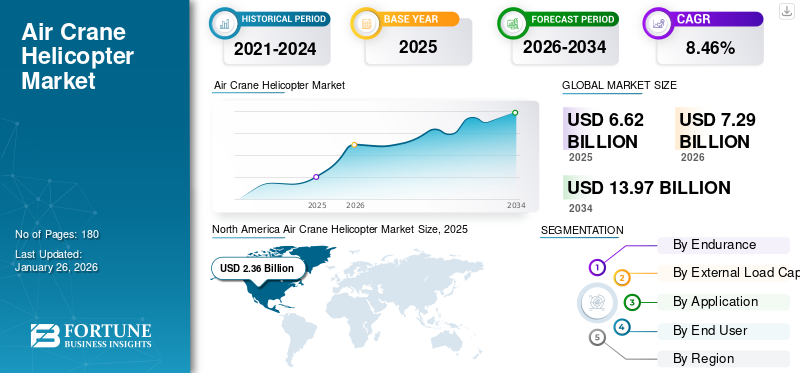
The global air crane helicopter market size was valued at USD 6.62 billion in 2025. The market is projected to grow from USD 7.29 billion in 2026 to USD 13.97 billion by 2034, exhibiting a CAGR of 8.46% over the forecast period. North America dominated the air crane helicopter market with a market share of 35.71% in 2025.
Air crane helicopter, also referred to as aerial cranes or flying cranes, is a heavy-lift chopper created for transporting sizable and heavy cargo. They serve diverse commercial functions, including firefighting, construction, logging, and other heavy-lifting tasks. They transport loads linked to long cables or slings to position heavy machinery, carry bulky materials, install rooftop units, undertake utility construction projects, and others.
Initially, aerial cranes are used by the U.S. military for heavy lifting loads, typically around 2,000 to 3,000 pounds. The lifting capabilities of helicopters have greatly increased over time due to technological advancements. As a result, aerial cranes have become a widely used and preferred method for heavy lifting in industries such as construction and utilities, with the ability to lift loads of over 30,000 to 40,000 pounds. The global market is expected to surge due to the growing demand for air cranes from firefighting and infrastructure projects.
The COVID-19 pandemic hindered the growth of the market. The slowdown in construction and infrastructure projects, which heavily rely on these helicopters, led to a significant drop in the demand for aerial cranes. In addition, numerous nations enforced travel restrictions and lockdowns resulting in a drop in air travel. This affected the market growth as these helicopters are frequently utilized for transporting people and cargo. Moreover, disruptions in the supply chain affected the production of air crane helicopters, as multiple manufacturing facilities were either closed or functioning at lower capacity.
Download Free sample to learn more about this report.
Air Crane Helicopter Market Key Takeaways
 Global Market Size & Forecast
- 2025 Market Size: USD 6.62 billion
- 2026 Market Size: USD 7.29 billion
- 2034 Forecast Market Size: USD 13.97 billion
- CAGR: 8.46% from 2026–2034
 Market Share
- North America dominated the air crane helicopter market with a 35.71% share in 2025.
- The above 15,000 feet segment is expected to account for 60.55% of the market share in 2026.
- The above 20,000 pounds external load capacity segment is projected to hold 41.11% of the market share in 2026.
 Key Regional Highlights
North America
led the global air crane helicopter market with a 35.71% market share in 2025.
Asia Pacific
is expected to witness steady growth due to rising investments in utility, construction, and disaster response operations.
Europe
is anticipated to experience stable demand, supported by increasing aerial firefighting and infrastructure maintenance activities.
U.S
The U.S. remains a major market driven by strong demand from military, utility, and emergency response applications.
Japan
Demand is supported by disaster response and rescue operations.
Read More

MARKET DYNAMICS
Market Drivers
Rising Demand from Defense Sector for Aerial Crane Helicopters to Augment Market Growth
Military forces frequently utilize air crane helicopters for various missions, such as moving troops and supplies, carrying out search and rescue operations, and offering assistance during disaster relief activities. They have the ability to transport heavy loads, making them perfect for moving large military gear such as tanks, artillery, and other heavy vehicles. Their ability to lift heavy loads and adaptability render them appropriate for defense organizations to carry out various tasks.
Additionally, increased defense expenditure leads to heavy investments in advanced helicopters to ferry cargo and other logistics. For instance, in December 2022, the U.S. Navy approved full-rate production for the Sikorsky CH-53K. The CH-53K King Stallion is a heavy-lift helicopter designed to transport equipment, supplies, and personnel over long distances in land and sea environments. Sikorsky has a contract with the U.S. Navy to build 200 CH-53K rotorcrafts, with the first deliveries expected to begin in 2023.
Growing Demand for Aerial Firefighting Helicopters to Propel Market Expansion
Aerial firefighting or water bombing is the use of helicopters to suppress wildfires. Air crane helicopters have become an essential tool in fighting wildfires around the world. They are equipped with belly tanks, snorkel systems, and water buckets to store water for firefighting. Some aerial cranes may also be equipped with other firefighting equipment, such as foam systems, to help extinguish fires.
The rising occurrence and intensity of wildfires boost the need for aerial cranes in firefighting efforts. These helicopters can release significant quantities of water or fire-suppressant chemicals from above to manage the spread of fires. Additionally, the increasing volume of construction and infrastructure initiatives worldwide necessitates the movement of heavy machinery and supplies to distant or difficult-to-access areas, which is expected to spur market expansion.
Market Restraints
High Operational and Maintenance Costs May Hamper Market Growth
Aerial cranes are complex machines that require significant upkeep to function safely and efficiently. Especially for older models, maintenance costs can be extremely high as replacement parts grow costlier and difficult to locate. Furthermore, skilled pilots and technicians are essential for the operation and upkeep of air crane helicopters. Extended repair and maintenance lead times, along with increased training costs, might ensue, potentially affecting the productivity and efficiency of the industry.
In addition, operating such helicopters is more expensive than using an alternative due to the cost of fuel and insurance. During 2025-2032, these issues are anticipated to impede the air crane helicopter market growth.
Market Challenges
Environmental and Safety Regulations Challenges Market Growth
The air crane helicopter market faces several regulatory challenges that impact its growth and operational flexibility. Air crane helicopters must comply with strict aviation regulations to ensure safety during low-altitude, heavy-lift operations. While these standards aim to mitigate risks, they impose significant operational constraints, including extensive permitting requirements, restrictions on operating locations and times, and mandated equipment modifications. Such compliance requirements increase fixed costs and limit operational flexibility, particularly for smaller operators.
Environmental concerns also play a role in regulatory challenges. Air crane operations often involve noise pollution and emissions, which are subject to local and international environmental laws. Compliance with these regulations may require modifications to aircraft systems or operational practices, further adding to costs.
Air crane operators often work across multiple jurisdictions, each with its own set of aviation laws. Navigating these varied regulatory landscapes requires substantial resources for compliance, further complicating operations.
Market Opportunities
Increase in Worldwide Energy Production Presents Significant Growth Opportunity for Air Crane Helicopter Sector
The increase in global energy demands has led oil and gas companies to invest more in production through offshore platforms and onshore wells. Air crane helicopters assist in moving drilling gear, examining pipelines, and lifting machinery into hard-to-reach locations. Wind energy relies on air cranes to assemble tall towers.
Fossil fuels still satisfy the majority of increasing worldwide energy demands. The growth of oil and gas extraction relies on air cranes for the rapid transport of distant drilling equipment over pipelines and towers. Their lifting capabilities streamline intricate rigging tasks. Renewable energy sources such as wind and solar depend on helicopters to build extremely tall structures. With energy serving as a crucial economic force, the adaptability of air crane helicopters positions them as a valuable asset throughout the production value chain.
As emerging economies expand and increase energy capacity, there has been a global rise in oil, gas, and alternative energy initiatives. Investigating and extracting offshore oil and gas necessitates a wide range of specialized machinery to construct drilling platforms, rigs, and associated infrastructure. The magnitude of new offshore energy activities has grown significantly in recent years. Air crane helicopters offer unparalleled abilities for lifting, moving, and positioning the large modules and equipment required for constructing these offshore facilities.
Constructing and sustaining offshore rigs of this magnitude would be unfeasible without air cranes. Their significant vertical lift capabilities have been essential for growth in regions such as the Gulf of Mexico, North Sea, and South China Sea. Key operators heavily depend on aerial crane helicopters from companies such as Sikorsky, Erickson Incorporated, and others while executing billion-dollar offshore oil and gas projects.
Moreover, companies involved in renewable energy construction have embraced air cranes for equipment transport and to minimize their carbon footprint. For example, in September 2023, ENOWA, NEOM's water and electricity division, introduced an environmentally responsible method for constructing high-voltage infrastructure. In recent tests, helicopters transported modular transmission towers via air.
AIR CRANE HELICOPTER MARKET TRENDS
Technological Advancements and Product Developments to Fuel Market Growth
Key players are focusing on the development and deployment of advanced systems in helicopters to make them suitable for multiple missions. For instance, in March 2022, Erickson Incorporated, a Canada-based operator, unveiled the next generation water cannon. This accessory can be installed on the S-64 Air Crane® helicopter within a shorter period. The system offers benefits such as increased water flow, stabilization, and maximum water reach distance, and articulation of water cannon in all directions. Operators use data analytics to improve safety, optimize repair and maintenance schedules, and cut costs. Such advancements are anticipated to transform the market outlook.
Download Free sample to learn more about this report.
SEGMENTATION ANALYSIS
By Endurance
Above 15,000 feet Segment to Lead Owing to the Rising Demand for Aerial Cranes at High Altitudes
By endurance, the market is segmented into up to 15,000 feet and above 15,000 feet.
The above 15,000 feet segment is anticipated to hold a dominant market share of 60.55% in 2026 and is projected to grow at the fastest pace during the forecast period. Helicopters with endurance abilities exceeding 15,000 feet are intended for specialized uses such as high-altitude search and rescue missions, mountain tasks, and others. These increasing applications are anticipated to promote segment growth.
The up to 15,000 feet segment is anticipated to increase substantially due to its cost efficiency. Helicopters capable of operating at altitudes of up to 15,000 feet are generally smaller and more affordable than those engineered for greater heights.
By External Load Capacity
Above 20,000 Pounds Segment to Dominate Owing to Increased Demand for High Maximum Takeoff Weight (MTOW) Helicopters
By external load capacity, the market is segmented into up to 10,000 pounds, 10,000 to 20,000 pounds, and above 20,000 pounds.
The external load capacity of a helicopter indicates the highest weight of cargo, gear, or other items that can be transported externally below its fuselage through the use of its external hooks, expected for 41.11% market share in 2026. The segment above 20,000 pounds leads the air crane helicopter market share as a result of the increasing need for heavy lift helicopters for multiple uses. The segment above 20,000 pounds is expected to lead the air crane helicopter market, primarily due to rising demand for High Maximum Takeoff Weight (MTOW) helicopters across multiple applications, including military operations, utility services, and aerial firefighting.
The 10,000 to 20,000 segment is predicted to depict the fastest growth during 2026-2034. The segment growth is favored by the rising demand of aerial cranes from the utility sector. The demand for air crane helicopters, especially those capable of lifting between 10,000 to 20,000 pounds, is set to rise significantly due to factors such as increased investment in construction and utility sectors, alongside the critical role these helicopters play in aerial firefighting and disaster management. As market players adapt to these trends, opportunities for growth within this segment are substantial.
To know how our report can help streamline your business, Speak to Analyst
By Application Analysis
Power Line Construction Segment Dominates Owing to Growing Infrastructure Development
Based on application, the market is categorized into power line construction, aerial firefighting, oil & gas, logistics operations, and others.
The power line construction segment is projected to dominate due to rising infrastructure needs, urbanization trends, and the expanding energy sector, with a expected share of 31.74% in 2026. Their unique capabilities make them indispensable for heavy-lift operations across various industries, particularly in challenging environments where traditional methods may fall short. As technological advancements continue and strategic collaborations emerge, the market is expected to thrive well into the future.
The aerial firefighting segment is expected to witness the fastest growth during 2025-2032 due to the escalating demand for aerial firefighting solutions, driven by environmental challenges and infrastructural needs. As climate change exacerbates wildfire risks and urban development continues, air crane helicopters will remain vital assets in emergency response and construction efforts globally.
By End-User Analysis
Military Segment Dominates Owing to Rising Fleet of Air Crane Helicopter for Military Applications
Based on end-user, the market is segmented into civil & commercial and military.
The civil & commercial segment is estimated to be fastest growing due to the rising demand for emergency services and the escalated demand for logistics transportation, with a expected share of 59.44% in 2026. The market is poised for continued expansion, supported by technological advancements and increasing applications across civil and commercial sectors. Companies are focusing on developing next-generation helicopters that offer improved safety features and environmental sustainability, further enhancing their appeal in the market.
The military segment is predicted to witness moderate growth during 2025-2032. The dominance of the segment is owing to the replacement and modernization of an aging fleet and increasing use in disaster relief and humanitarian missions. The segment is poised for substantial growth due to its critical role in modern military operations. With advancements in technology and a focus on heavy-lift capabilities, manufacturers are expected to continue developing solutions that meet the specific needs of defense forces globally.
AIR CRANE HELICOPTER MARKET REGIONAL OUTLOOK
In terms of geography, the market is divided into North America, Europe, Asia Pacific, and the rest of the world.
North America Air Crane Helicopter Market Size, 2025 (USD Billion)
To get more information on the regional analysis of this market, Download Free sample
North America
The North America market was valued at USD 2.36 billion in 2025, capturing 35.71% of global revenue, and is estimated to reach USD 2.62 billion in 2026. The regional growth is due to the increasing demand for heavy lift helicopters and fleet modernization. For instance, in October 2022, the U.S. army ordered two additional Boeing CH-47F Block II Chinook helicopters as a part of modernizing its heavy-lift cargo helicopter fleet. The Boeing Company has received a USD 136 million contract from the Army to manufacture four CH-47F Block II helicopters in 2021. The Army has further announced a USD 63 million Lot 2 order, bringing the total number of contracted heavy-lift helicopters to six. The U.S. air crane helicopter market is poised for substantial growth due to its critical applications across multiple sectors, although it faces challenges related to costs and regulations. Air cranes are essential for transporting oversized materials to remote locations, particularly where traditional cranes cannot operate effectively. The U.S. market is estimated to reach USD 2 billion by 2026.
Europe
In 2025, Europe held 26.66% of the global market, reaching a valuation of USD 1.76 billion, and is projected to grow to USD 1.92 billion in 2026. Europe holds the second-largest share owing to the rising demand for air crane rotorcrafts in logistics operations. These helicopters are particularly useful in the transportation of heavy cargo, such as oil and gas equipment, machinery, and other large items. The UK market is estimated to reach USD 0.22 billion by 2026, while the Germany market is estimated to reach USD 0.18 billion by 2026.
Asia Pacific
The market in Asia Pacific reached USD 1.77 billion in 2025, representing 26.82% of total market revenue, and is projected to reach USD 1.99 billion in 2026. Asia Pacific is the fastest-growing region owing to a surge in construction and infrastructure development projects driven by increasing demand across various industries such as construction, oil and gas, and firefighting. These projects require the transportation of heavy materials and equipment. The Japan market is estimated to reach USD 0.19 billion by 2026, the China market is estimated to reach USD 0.37 billion by 2026, and the India market is estimated to reach USD 0.3 billion by 2026.
Rest of the World
In 2025, Rest of the World generated USD 0.72 billion, contributing 10.81% to global market revenue, and is projected to grow to USD 0.77 billion in 2026. This is due to rising oil and gas exploration activities as aerial cranes are used to transport cargo and other equipment to oilrigs and other remote locations in oil and gas industry.
COMPETITIVE LANDSCAPE
Key Industry Players
Expanding Applications, Developing Advanced Avionics, and New Systems, are Key Focus of Leading Players
The Boeing Company, Textron Inc., Columbia Helicopters Incorporated, Airbus Helicopters SAS, Lockheed Martin Corporation, and a few more major competitors dominate the global market. These companies hold a majority of the market share and invest in R&D activities to create new systems, upgrade avionics, and extend applications. For instance, Rocket Lab, a U.S.-based aerospace company and launch service provider, used a Sikorsky S-92 helicopter equipped with a hook on a long line to catch the first stage returning rocket parachute line at 6,500 feet after launching into space in May 2022.
LIST OF KEY AIR CRANE HELICOPTER COMPANIES PROFILED:
- Airbus Helicopters SAS (France)
- Lockheed Martin Corporation (U.S.)
- The Boeing Company (U.S.)
- Textron Inc. (U.S.)
- Russian Helicopters (Russia)
- Leonardo S.p.A. (Italy)
- Hindustan Aeronautics Limited. (India)
- Kaman Corporation (U.S.)
- Kawasaki Heavy Industries Ltd. (Japan)
- The Robinson Helicopter Company (U.S.)
KEY INDUSTRY DEVELOPMENTS
- January 2023 – Sikorsky, a subsidiary of Lockheed Martin, supplied the UH-60M Black Hawk to the U.S. Army, marking the 5,000th "Hawk" variant helicopter. This helicopter would offer medium-lift assistance to the U.S. military and global operators over an extended duration.
- August 2022 – Rotak Helicopter Services, a utility helicopter operator from the U.S., teamed up with Helitak Firefighting Equipment, an Australian company specializing in fire-fighting equipment design, to create an advanced, multi-functional fire-fighting platform for the Boeing CH-47D/234 Chinook. The FT12K CH-47 collapsible belly-mounted fire suppression tank is a cutting-edge solution that has been specially engineered to be light and carry a maximum of 11,350 liters (3,000 U.S. gallons) of water.
- March 2022 – Himalayan Heli Services Pvt. Ltd, an India-based helicopter operator involved in aerial work and pilgrimage services, added its seventh Airbus H125 helicopter to its fleet. The helicopter would serve for aerial operations and transporting passengers.
- January 2022 – The Turkish Ministry of Agriculture and Forestry (Tarimorman) launched a tender for the acquisition of new aircraft to support upcoming firefighting efforts related to wildfires. According to the announcement, the ministry initiated the bidding process for procuring a total of 75 aircraft, which includes 55 helicopters, 10 small tanker planes, five large tanker planes, and five amphibious planes.
- March 2021 – Erickson Incorporated, a U.S.-based operator, maintainer, and manufacturer of utility aircraft, is creating an air crane that could serve as a pilotless combat logistics helicopter. Erickson aims to create the S-64 Air Crane helicopter, which features an advanced robotic flight control system for transporting vehicles and large cargo to U.S. military personnel in the field without pilots onboard.
REPORT COVERAGE
The air crane helicopter market research report provides a detailed analysis. It comprises all major aspects, such as R&D capabilities and optimization of the manufacturing process. Moreover, the report offer insights into growth opportunities and primarily highlights key industry developments along with latest market forecast. In addition to the above-mentioned factors, it mainly focuses on several factors that have contributed to the market growth over recent years. The market presents substantial investment opportunities driven by diverse applications across construction, firefighting, military, and disaster relief sectors. With a favorable growth outlook supported by technological advancements and increasing demand for heavy-lift capabilities, stakeholders can capitalize on emerging trends while navigating potential challenges through strategic partnerships and innovation initiatives.
Request for Customization to gain extensive market insights.
Report Scope & Segmentation
|
ATTRIBUTE |
DETAILS |
|
Study Period |
2021-2034 |
|
Base Year |
2025 |
|
Estimated Year |
2026 |
|
Forecast Period |
2026-2034 |
|
Historical Period |
2021-2024 |
|
Growth Rate |
CAGR of 8.46% from 2026 to 2034 |
|
Unit |
Value (USD Billion) |
|
Segmentation |
By Endurance
|
|
By External Load Capacity
|
|
|
By Application
|
|
|
By End-User
|
|
|
By Region
|
Frequently Asked Questions
As per a study by Fortune Business Insights, the global market size stood at USD 6.62 billion in 2025.
The market is likely to grow at a CAGR of 8.46% over the forecast period (2026-2034).
By external load capacity, the above 20,000 pounds segment is the leading segment in the market due to the increased demand for high Maximum Takeoff Weight (MTOW) helicopters globally.
North Americas market size stood at USD 2.36 billion in 2025.
Rising demand from defense sector for aerial cranes and the growing demand for aerial firefighting helicopters are key factors driving the market.
Some of the top players in the market are Airbus Helicopters SAS, Lockheed Martin Corporation, The Boeing Company, Textron Inc., Columbia Helicopters Incorporated, and others.
The North America dominated the market in the market in 2025.
High operational and maintenance costs may hamper the market.



- 2021-2034
- 2025
- 2021-2024
- 180
Get 30-60 hrs Free Customization
Expand Regional and Country Coverage, Segments Analysis, Company Profiles, Competitive Benchmarking, and End-user Insights.




















-
US +1 833 909 2966 ( Toll Free )
-
Get In Touch With Us