Avionics Market Size, Share & Industry Analysis, By Offering (Hardware, Software, and Services), By System Type (Flight Deck & Cockpit Avionics, Communication Avionics, and Navigation Avionics), By Aircraft Platform (Commercial Aviation, Business & General Aviation, and Military Aviation), By Commercial Aviation (Narrow-body, Wide-body, and Regional Jets Aircraft), By Military Aviation (Fighter, Trainer, and Transport Aircraft), By Fitment (Line-Fit, Forward-Fit, and Retrofit), By Technology Generation (Analog, Digital, and Integrated Modular Avionics), and Regional Forecast, 2026-2034
 Download Free Sample
Avionics Market Size and Future Outlook
 Listen to Audio Version
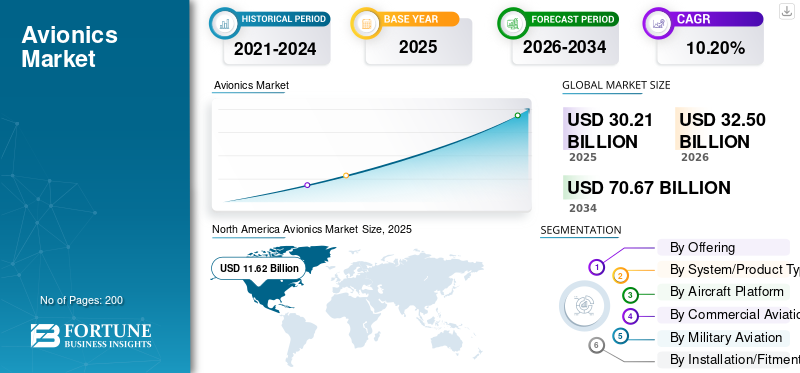
The global avionics market size was valued at USD 30.21 billion in 2025 and is projected to grow from USD 32.50 billion in 2026 to USD 70.67 billion by 2034, exhibiting a CAGR of 10.20% during the forecast period. North America dominated the avionics market with a market share of 38.46% in 2025.
The global market comprises electronic hardware, software, sensors, displays, communication, navigation, surveillance, flight-control and aircraft-management systems installed across commercial, military, business and general aviation platforms. The market covers both original equipment supplied for new aircraft and retrofit or aftermarket solutions used to modernize existing fleets, improve situational awareness and reduce pilot workload.
The market’s growth is being driven by increasing production of different aircraft types, expanding passenger traffic, military fleet modernization, and the replacement of ageing cockpit systems. According to the International Air Transport Association (IATA), global passenger traffic increased by 5.3% in 2025, while long-term fleet expansion continues to support demand for integrated flight decks, satellite connectivity, predictive maintenance, cybersecurity, and software-based avionics upgrades.
Major participants include RTX Corporation (Collins Aerospace), Honeywell, Thales, Garmin, and Safran. Collectively, these companies are pursuing growth through open-architecture and integrated avionics platforms, connected-aircraft solutions, AI-enabled pilot assistance, autonomous flight technologies, cybersecurity improvements, and expanded retrofit and lifecycle-support services.
Download Free sample to learn more about this report.
Avionics Market Trends
Growing Demand for Software-Defined, Open-Architecture, and AI-Enabled Avionics are Becoming Central Product-Development Strategies
The industry is shifting from separate electronic boxes for individual functions toward centralized computing platforms that host multiple avionics applications. Software-defined architectures allow manufacturers to introduce new functionality through controlled software releases while retaining common computing hardware. Honeywell Anthem reflects this direction through its connected, customizable flight-deck architecture, while Collins Aerospace is developing open-system autonomy software that can integrate with different mission platforms. Connected aircraft systems are also linking onboard avionics with airline operations, maintenance teams, and ground infrastructure to support predictive maintenance and faster operational decisions, boosting avionics market growth.
Major suppliers are therefore investing in common platforms, modular hardware, artificial intelligence, touchscreen displays, and open interfaces. Retrofit products are increasingly designed to combine navigation, communication, display, and flight-control functions, reducing equipment weight and simplifying installation. OEMs are also using partnerships and acquisitions to add specialized software, communications and navigation capabilities rather than developing every technology internally.
For instance, in July 2026, Garmin introduced AXIS, a new generation of highly integrated flight displays for certified piston aircraft, experimental aircraft and light-sport aircraft. The system integrates flight displays, IFR GPS navigation, navigation/communication radio, and audio-panel capabilities, reflecting the wider movement toward compact multifunction avionics.
Market Dynamics
MARKET DRIVERS
Download Free sample to learn more about this report.
Fleet Modernization and Shift toward Connected Aircraft are Accelerating Avionics Demand
Commercial airlines, defense forces, and business-aircraft operators are replacing analogue and first-generation digital systems with integrated flight decks, advanced communication systems, digital autopilots, satellite navigation, and electronic surveillance equipment. Aircraft manufacturers are also increasing the electronic parts of new platforms to improve safety, fuel efficiency, situational awareness, and pilot workload management.
Military modernization programs require secure data links, digital mission computers, sensor-fusion systems, and modular avionics that can receive capability upgrades throughout the aircraft lifecycle. Furthermore, FAA airspace modernization is supporting demand for satellite-based navigation, digital communication, and interoperable surveillance systems.
For instance, in April 2026, Bell awarded Collins Aerospace multiple contracts to supply five critical systems for the U.S. Army’s MV-75 Future Long Range Assault Aircraft, including the SmartProbe air-data system.
MARKET RESTRAINTS
Stringent Certification and Regulatory Requirements to Restrict Product Adoption
Avionics systems are safety-critical and must complete extensive design assurance, software validation, environmental testing, electromagnetic compatibility testing, and aircraft-level certification. The Federal Aviation Administration (FAA) describes aircraft certification as a rigorous seven-phase process covering standards, definition, detailed design, manufacturing, testing, certification, and production approval. A substantial hardware or software modification may require additional documentation, flight testing, and supplemental type certification, increasing development cost and time. These requirements can slow the introduction of artificial intelligence, touch-based interfaces, autonomous functions, and software-defined avionics, particularly when certification standards are still evolving.
For instance, in June 2026, the Federal Aviation Administration (FAA) and European Union Aviation Safety Agency (EASA) committed to harmonizing certification pathways and streamlining approvals for advanced aviation technologies, including automated flight-deck systems.
MARKET OPPORTUNITIES
Government Support for Advanced Aircraft Technologies is Creating New Growth Opportunities
Electric vertical take-off and landing aircraft, unmanned aircraft, collaborative combat aircraft and optionally piloted platforms require highly integrated avionics architectures from the initial design stage. These platforms need fly-by-wire controls, high-integrity navigation, detect-and-avoid systems, vehicle-health monitoring, secure connectivity, lightweight sensors, and automated mission-management software. Avionics value per aircraft may therefore be significant, even when emerging platforms are smaller than conventional commercial aircraft. Government-funded testing programs and military autonomy initiatives are helping these technologies progress from demonstration to operational deployment.
For instance, in June 2026, the U.S. Department of Transportation and Federal Aviation Administration (FAA) began developing an approximately USD 8.3 million Vertical Take-Off and Landing Procedures and Analysis Range in Oklahoma City.
MARKET CHALLENGES
Cybersecurity Threats, GNSS Interference, and Legacy-System Obsolescence are Increasing Lifecycle Risk
Greater aircraft connectivity improves operational efficiency but also increases exposure to cyber intrusion, unauthorized data access, and interference with communication or navigation functions. Satellite navigation systems face an additional operational threat from GNSS jamming and spoofing, particularly near conflict zones and geopolitically sensitive regions. Avionics suppliers must therefore develop resilient positioning, navigation and timing systems using inertial sensors, multi-constellation receivers, signal authentication, sensor fusion and alternative navigation sources. Secure data links, protected software environments and continuous threat monitoring are becoming essential design requirements rather than optional capabilities.
SEGMENTATION ANALYSIS
By Offering
Software Segment to Witness Fastest Growth, Driven by the Growing Use of Digital Cockpit Applications
The global market, by offering, is classified into hardware, software, and services.
The software segment is estimated to be the fastest-growing, registering the highest CAGR of 11.58% during the forecast period (2026-2034). Growth is supported by the increasing use of software-defined flight controls, digital cockpit applications, mission-planning tools, aircraft-health monitoring, and connected-aircraft platforms.
The hardware segment accounted for the largest market share of 9.62% in 2025. In addition, the segment is projected to grow at a CAGR of 57.13% during the forecast period.
By System/Product Type
Multi-Domain Mission Requirements and Sensor Integration Boosted Mission Avionics Growth
The global market, by system/product type, is classified into flight deck & cockpit avionics, communication avionics, navigation avionics, surveillance & safety avionics, flight control & automation avionics, engine, power & utility control avionics, mission avionics, aircraft data, recording & health management avionics, and avionics computing & network infrastructure.
The mission avionics segment is estimated to be the fastest-growing, registering the highest CAGR of 12.97% during the forecast period (2026-2034). In addition, this segment accounted for the largest market share of 19.87% in 2025. Modern military aircraft require mission computers, tactical data links, sensor-management systems, electronic warfare interfaces, targeting functions, and secure communication equipment to operate in increasingly complex environments. The need to combine radar, electro-optical, navigation, and intelligence data into a common operational picture is increasing the avionics value installed on each platform.
The flight deck & cockpit avionics segment accounted for the second-largest market share of 14.88% in 2025. In addition, the segment is projected to grow at a CAGR of 8.58% during the forecast period.
By Aircraft Platform
Autonomy and Electric Flight Development Accelerate Unmanned & Advanced Air Mobility Avionics Demand
The global market, by aircraft platform, is classified into commercial aviation, business & general aviation, military aviation, rotorcraft, and unmanned & advanced air mobility.
The unmanned & advanced air mobility segment is estimated to be the fastest-growing, registering the highest CAGR of 12.16% during the forecast period (2026-2034). Unmanned aircraft, autonomous military platforms, and electric vertical take-off and landing aircraft require advanced flight controls, compact navigation systems, secure connectivity, detect-and-avoid equipment, and redundant computing architectures. These platforms generally depend more heavily on avionics as many functions traditionally managed by pilots must be performed automatically.
The commercial aviation segment accounted for the largest market share of 41.04% in 2025. In addition, the segment is projected to grow at a CAGR of 10.13% during the forecast period.
By Commercial Aviation
High Delivery Volumes and Fleet Expansion Make Narrow-Body Aircraft the Fastest Growing Segment
The global market, by commercial aviation, is classified into narrow-body aircraft, wide-body aircraft, regional jets, turboprop aircraft, and cargo aircraft.
The narrow-body aircraft segment is estimated to be the fastest-growing, registering a CAGR of 11.00% during the forecast period (2026-2034). In addition, this segment accounted for the largest market share of 51.45% in 2025. Airlines continue to use narrow-body aircraft for high-frequency domestic, regional, and increasingly longer-range services as these platforms offer lower trip costs and greater route flexibility. Their comparatively high production volumes generate substantial demand for line-fit flight decks, communication systems, navigation equipment, surveillance systems, and aircraft health monitoring solutions.
The wide-body aircraft segment accounted for the second-largest market share of 25.13% in 2025. In addition, the segment is projected to grow at a CAGR of 9.84% during the forecast period.
By Military Aviation
ISR Aircraft Segment to Showcase Fastest Growth, Driven by Persistent Surveillance and Networked Operations
The global market, by military aviation, is classified into fighter aircraft, trainer aircraft, military transport aircraft, special mission aircraft, maritime patrol aircraft, AEW&C aircraft, ISR aircraft, combat helicopters, and utility helicopters.
The ISR aircraft segment is estimated to be the fastest-growing, registering the highest CAGR of 13.04% during the forecast period (2026-2034). Demand for ISR aircraft is growing due to the armed forces requiring persistent monitoring of air, land, and maritime areas to detect threats, track movements, and provide timely intelligence to commanders. This increases demand for high-value avionics such as mission computers, radar-processing systems, electronic intelligence equipment, secure data links, satellite communications, and multi-sensor fusion software.
The fighter aircraft segment accounted for the largest market share of 31.64% in 2025. In addition, the segment is projected to grow at a CAGR of 12.61% during the forecast period.
By Installation/Fitment
Aging Fleets and Obsolescence Management Accelerate Upgrade / Modernization Demand
The global market, by installation/fitment, is classified into line-fit, forward-fit, retrofit, upgrade /modernization, and replacement.
The upgrade/modernization segment is estimated to be the fastest-growing with the highest CAGR of 11.30% during the forecast period (2026-2034). Commercial and military operators are retaining aircraft for longer periods, creating a need to replace obsolete displays, processors, navigation equipment, communication systems, and mission computers. Modernization allows operators to improve safety, mission effectiveness, and airspace compliance without incurring the higher costs and longer delivery lead times associated with purchasing new aircraft.
The line-fit segment accounted for the largest market share of 32.15% in 2025. In addition, the segment is projected to grow at a CAGR of 10.37% during the forecast period.
By Technology Generation
AI-Based Decision Support and Autonomy Make AI-Assisted Avionics the Fastest-Growing Technology
The global market, by technology generation, is classified into analog avionics, digital avionics, federated avionics, glass cockpit, integrated modular avionics, connected avionics, software-defined avionics, open architecture avionics, and AI-assisted avionics.
The AI-assisted avionics segment is estimated to be the fastest-growing, registering the highest CAGR of 13.87% during the forecast period (2026-2034). AI is being introduced into pilot decision support, route optimization, predictive maintenance, sensor-data analysis, threat recognition, and autonomous flight-control applications. These systems can process large volumes of aircraft and environmental data more quickly, helping crews identify abnormal conditions and make better operational decisions.
The integrated modular avionics segment accounted for the largest market share of 17.47% in 2025. In addition, the segment is projected to grow at a CAGR of 11.12% during the forecast period.
By Sales Channel
To know how our report can help streamline your business, Speak to Analyst
Defense Prime Contractor Channel Segment to Witness Fastest Growth, Fueled by Large Defense Programs and System-Level Integration
The global market, by sales channel, is classified into direct OEM supply, tier-1 avionics integration, aircraft OEM line-fit channel, defense prime contractor channel, and MRO retrofit channel.
The defense prime contractor channel segment is estimated to be the fastest-growing, registering the highest CAGR of 12.02% during the forecast period (2026-2034). Military avionics is usually purchased as part of a complete aircraft production, modernization, or mission-system program rather than as an independent component. Defense prime contractors manage platform integration, cybersecurity, airworthiness, testing, and long-term sustainment, placing them at the center of avionics procurement.
The aircraft OEM line-fit channel segment accounted for the largest market share of 24.38% in 2025. In addition, the segment is projected to grow at a CAGR of 9.60% during the forecast period.
Avionics Market Regional Outlook
By region, the market is categorized into Europe, North America, Asia Pacific, the Middle East & Africa, and Latin America.
North America
North America Avionics Market Size, 2025 (USD Billion)
To get more information on the regional analysis of this market, Download Free sample
North America accounted for the largest avionics market share in 2025, valued at USD 11.62 billion, and will also maintain its leading position in 2026, reaching USD 12.31 billion. The region's growth is supported by the FAA’s NextGen program, which has deployed data communications, digital flight-data management, and satellite-based surveillance technologies. As a result, U.S. operators are upgrading communication, navigation, surveillance, and connected-cockpit systems to improve operational efficiency.
U.S. Avionics Market
Based on North America's strong contribution and the U.S. dominance within the region, the U.S. market reached USD 10.39 billion in 2025 and is estimated to hold a CAGR of 8.13% during the forecast period.
Europe
Europe is projected to be the fastest-growing region with the highest CAGR of 12.31% during the forecast period. In 2025, the market value stood at USD 7.20 billion. Europe is implementing the SESAR Digital European Sky initiatives and strengthening protection against GNSS jamming and spoofing. In addition, airlines are adopting trajectory-based navigation, digital communication, and resilient positioning systems.
U.K. Avionics Market
The U.K. market was valued at USD 1.32 billion in 2025 and is estimated to grow at a rate of 12.50% during the forecast period.
Germany Avionics Market
Germany was valued at USD 1.50 billion in 2025 and is estimated to grow at a rate of 13.35% during the forecast period.
France Avionics Market
The market in France was valued at USD 1.68 billion in 2025 and is estimated to grow at a CAGR of 11.16% during the forecast period.
Asia Pacific
The Asia Pacific market was valued at USD 8.20 billion in 2025 and secures the position of the second-largest region in the market. India is expanding its GAGAN satellite navigation, Japan is implementing CARATS 2040, and Australia is replacing separate civil and military ATM systems through OneSKY. These initiatives are increasing demand for aircraft equipped with compatible navigation, surveillance, and digital communication systems.
China Avionics Market
The China market was valued at USD 2.95 billion in 2025 and is estimated to grow at a rate of 10.51% during the forecast period.
India Avionics Market
The Indian market was valued at USD 1.54 billion in 2025 and is estimated to grow at a rate of 13.15% during the forecast period.
Japan Avionics Market
The Japan market was valued at USD 1.18 billion in 2025 and is estimated to grow at a rate of 9.34% during the forecast period.
Middle East & Africa
The Middle East & Africa market was valued at USD 2.51 billion in 2025. Saudi Arabia aims to handle 330 million passengers and serve more than 250 destinations by 2030. Fleet additions and airport-capacity expansion are increasing requirements for line-fit cockpits, communication systems, and aircraft-health monitoring. The UAE’s integrated airspace plan and Africa’s effort to improve compliance with International Civil Aviation Organization (ICAO) safety and air-navigation standards are also driving upgrades to CNS, surveillance, navigation, and flight-safety avionics.
Gulf Countries Avionics Market
The Gulf Countries market was valued at USD 1.10 billion in 2025 and is estimated to grow at a rate of 10.48% during the forecast period.
Latin America
The Latin America market was valued at USD 0.67 billion in 2025. As Brazil’s SIRIUS program is modernizing communication, navigation, and surveillance infrastructure in response to rising traffic and increasingly diverse aircraft operations, regional operators require compatible PBN, ADS-B, and data-link systems.
Brazil Avionics Market
The Brazil market was valued at USD 0.29 billion in 2025 and is estimated to grow at a rate of 6.68% during the forecast period.
COMPETITIVE LANDSCAPE
Key Industry Players
Software-Defined Platforms, Open Architectures, and Portfolio Expansion Intensify Market Competition
Competition in the global avionics market is shifting from individual hardware products toward integrated, software-led cockpit and mission-system platforms. Honeywell, Thales, Garmin, and L3Harris are developing connected flight decks, high-performance computing, touchscreen interfaces, AI-supported functions, and modular open-system architectures that allow software and third-party applications to be upgraded without replacing the complete system.
Market participants are also expanding their technology coverage through acquisitions, platform agreements, and long-term aftermarket support. As aircraft programs remain in operation for several decades, competition increasingly depends on securing early OEM selections and generating recurring revenue through software updates, retrofit packages, repairs, database services, and fleet modernization.
LIST OF KEY AVIONICS COMPANIES PROFILED
- Honeywell Aerospace (U.S.)
- RTX Corporation (Collins Aerospace) (U.S.)
- Thales S.A. (France)
- Safran Electronics & Defense SAS (France)
- Garmin Ltd. (U.S.)
- GE Aerospace (U.S.)
- BAE Systems plc (U.K.)
- L3Harris Technologies, Inc. (U.S.)
- Elbit Systems Ltd. (Israel)
- Leonardo S.p.A. (Italy)
- Teledyne Technologies Incorporated (Teledyne Controls) (U.S.)
- Curtiss-Wright Corporation (U.S.)
- CMC Electronics Inc. (Canada)
- Becker Avionics GmbH (Germany)
- Trig Avionics Limited (U.K.)
KEY INDUSTRY DEVELOPMENTS
- February 2026: BAE Systems received USD 137 million in Foreign Military Sales contracts from the U.S. Army to supply AN/AAR-57 Common Missile Warning Systems to allied countries, enabling aircraft to detect missile threats and automatically activate countermeasures.
- December 2025: BAE Systems received a USD 11 million contract from Korea Aerospace Industries to integrate AN/APX-127(V)1 Combined Interrogator Transponders into KF-21 Boramae fighters, providing encrypted identification, anti-jamming, and coalition-interoperability capabilities.
- October 2025: L3Harris Technologies received a contract from the Republic of Korea Air Force for a program valued at more than USD 2.26 billion to deliver modified Bombardier Global 6500 AEW&C aircraft equipped with AESA radar, advanced communications, and networked mission systems.
- July 2025: L3Harris Technologies received a USD 300 million contract from the Italian Ministry of Defence to deliver two Gulfstream G550 aircraft prepared for advanced electromagnetic-warfare systems, providing long-range airborne jamming against hostile radars, communications, and navigation networks.
- February 2025: L3Harris Technologies received a maximum USD 35.77 million contract from the U.S. Air Force Life Cycle Management Center, supporting the Royal Saudi Air Force’s King Air 350ER special-mission fleet through technical services, core support, and avionics-obsolescence management.
REPORT COVERAGE
The global avionics market analysis includes a comprehensive study of the market size & forecast by all the market segments included in the report. It contains details on the market dynamics and global avionics market trends expected to drive the market over the forecast period. It provides information on key aspects, including an overview of technological advancements, pipeline candidates, the regulatory environment, and product launches. Additionally, it details partnerships, mergers & acquisitions, as well as key aviation industry developments. The global market research report also provides a detailed competitive landscape with information on the market share and profiles of key operating players.
Request for Customization to gain extensive market insights.
Report Scope & Segmentation
| ATTRIBUTE | DETAILS |
| Study Period | 2021-2034 |
| Base Year | 2025 |
| Estimated Year | 2026 |
| Forecast Period | 2026-2034 |
| Historical Period | 2021-2024 |
| Growth Rate | CAGR of 10.20% from 2026-2034 |
| Unit | Value (USD Billion) |
|
Segmentation |
By Offering
By System/Product Type
By Aircraft Platform
By Commercial Aviation
By Military Aviation
By Installation/Fitment
By Technology Generation
By Sales Channel
By Geographic
|
Frequently Asked Questions
Fortune Business Insights says that the global market value stood at USD 30.21 billion in 2025 and is projected to reach USD 70.67 billion by 2034.
In 2025, Europe’s market value stood at USD 7.20 billion.
The market is expected to exhibit a CAGR of 10.20% during the forecast period.
By sales channel, the defense prime contractor channel segment is expected to hold the highest CAGR over the forecast period.
Fleet modernization and shift toward connected aircraft are the key factors driving the market.
Honeywell, Thales, Garmin, and Safran are the top key players in the market.
North America dominated the market in 2025.



- 2021-2034
- 2025
- 2021-2024
- 200
Get 30-60 hrs Free Customization
Expand Regional and Country Coverage, Segments Analysis, Company Profiles, Competitive Benchmarking, and End-user Insights.




















Related Reports
-
US +1 833 909 2966 ( Toll Free )
-
Get In Touch With Us