Aircraft Window Frame Market Size, Share & Industry Analysis, By Material (Metal and Composites), By Type (Passenger Cabin, Cockpit, and Emergency Exit), By Platform (Fixed Wing Aircraft and Rotary Wing Aircraft), By Design (Fixed Frame, Lift Type Frame, Bonded Frame, and Flush Mounted Frame), By Sales Channel (OEM and Aftermarket), and Regional Forecast, 2026-2034
 Download Free Sample
Aircraft Window Frame Market Size
 Listen to Audio Version
The global aircraft window frame market size was valued at USD 267.9 billion in 2025. The market is projected to grow from USD 285.9 billion in 2026 to USD 435.8 billion by 2034, exhibiting a CAGR of 5.40% during the forecast period. North America dominated the aircraft window frame market with a market share of 25.70% in 2025.
An aircraft window frame is a structural component that supports and secures the transparent window panes within an aircraft’s fuselage. It serves as the interface between the fuselage skin and the window assembly, maintaining cabin pressurization integrity while withstanding aerodynamic loads, vibration, and temperature variations. These frames are typically made from aluminum alloys, titanium, or composite materials, depending on the aircraft type and weight optimization goals. The manufacturing of aircraft window frames involves using advanced lightweight materials such as composites, aluminum, and titanium to enhance fuel efficiency and structural durability.
Key players such as Parker Hannifin, PPG Aerospace, GKN Aerospace, FACC AG, and Spirit AeroSystems form the core supply base for window frame assemblies and integrated transparencies across commercial, business, and military aircraft programs. Downstream, major OEMs including Airbus, Boeing, Embraer, and Dassault Aviation integrate certified window frame systems into fuselage sections and cockpit modules to enhance aerodynamic performance, visibility, and cabin safety. Emerging technologies such as composite layup, additive manufacturing, and laser machining are transforming production efficiency, enabling lighter, corrosion-resistant frames tailored for next-generation airframes such as the A350, B787, and C919.
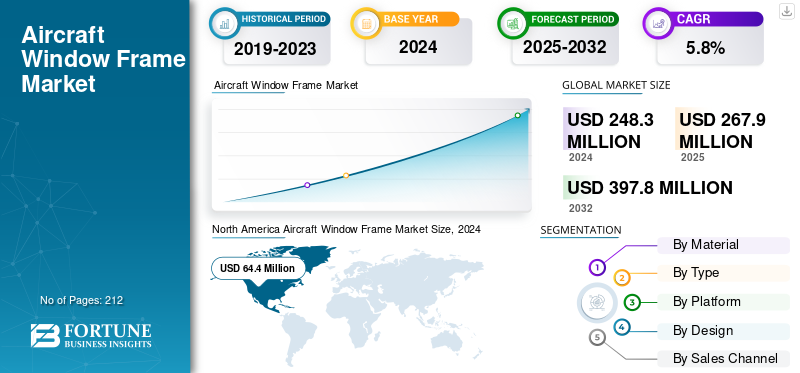
Download Free sample to learn more about this report.
Aircraft Window Frame MARKET KEY TAKEAWAYS
 Market Size & Forecast
- 2025 Market Size: USD 267.9 billion
- 2026 Market Size: USD 285.9 billion
- 2034 Forecast Market Size: USD 435.8 billion
- CAGR: 5.40% from 2026–2034
 Market Share
- Asia Pacific dominated the aircraft window frame market with a 40.20% share in 2025.
- Metal segment led the market with an 80.05% share in 2026 due to strong structural strength and durability requirements.
- Passenger cabin segment held a 74.24% share in 2026 driven by high aircraft cabin installation and comfort-focused designs.
 Key Regional Highlights
North American
North America reached USD 73.07 billion in 2026, driven by OEM presence and fleet modernization programs.
Europe
Europe recorded USD 55.40 billion in 2026, supported by sustainable aviation initiatives and advanced aerospace manufacturing.
Asia Pacific
Asia Pacific led the market with USD 116.08 billion in 2026, supported by rapid fleet expansion and strong aircraft manufacturing growth.
U.S.
Market estimated at USD 64.37 billion in 2026, driven by rising aircraft deliveries and demand for lightweight components.
Japan
Market estimated at USD 16.83 billion in 2026, supported by aircraft procurement and aerospace manufacturing activities.
Read More

MARKET DYNAMICS
MARKET DRIVERS
Increasing Aircraft Production Directly Drives Window Frame Demand
The rising monthly production rates at Airbus and Boeing act as a direct and essential catalyst for demand in the market. Each additional aircraft produced requires a specific set of window frames for passengers, cockpit, and emergency exits. Thus, the increased OEM production volumes directly lead to more shipsets and greater volume predictability for suppliers. Higher build rates also lead airlines and maintenance organizations to expand safety stock inventories to support larger active fleets, which reinforces steady demand not only from original installations but also from the aftermarket segment.
Simultaneously, the OEMs' emphasis on weight reduction is accelerating the transition to titanium and composite window frames, thereby increasing the value per shipset even as the total number of units grows. Fleet renewal further concentrates demand on next-generation aircraft models that standardize the use of these lighter frames, creating recurring program-level demand.
MARKET RESTRAINTS
Regulatory Compliance and Safety Standards to Limit Market Expansion
A significant restraint for the market is the stringent regulatory compliance and safety standards imposed by aviation authorities globally. Manufacturers must meet rigorous certification processes, including extensive testing for structural integrity, pressure resistance, thermal insulation, and impact resistance. These regulations increase the complexity, time, and cost of product development and certification, potentially delaying new product introductions and increasing overall costs for suppliers.
MARKET OPPORTUNITIES
Increasing Adoption of Advanced Lightweight Materials Provides Significant Market Opportunities
There is an increasing adoption of advanced lightweight materials such as composites and titanium alloys. These materials offer superior strength-to-weight ratios, corrosion resistance, and durability compared to traditional metal frames. This shift is driven by the aerospace industry's focus on reducing aircraft weight for improved fuel efficiency and lower emissions. As next-generation commercial and business aircraft integrate these materials, demand for modern window-frame designs that accommodate such innovations rises. Manufacturers developing frames with enhanced performance characteristics are well-positioned to capitalize on this trend, supported by ongoing fleet modernization and new aircraft programs worldwide.
AIRCRAFT WINDOW FRAME MARKET TRENDS
Growing Demand for Enhanced Passenger Experience and Safety Features is a Key Trend
A prominent trend that drives the aircraft window frame market growth is the growing demand for enhanced passenger experience and safety features. Aircraft manufacturers are increasingly focusing on designing window frames that integrate larger window sizes, improved transparency, and smart glass technologies such as electrochromic dimming. These innovations aim to enhance natural light entry, reduce glare, and allow passengers to control window tinting, thereby improving comfort during flights.
MARKET CHALLENGES
Supply Chain Disruptions Impacting Aircraft Window Frame Production
A notable challenge in the market is the vulnerability of the supply chain, particularly for advanced materials such as aluminum alloys and composites used in frame manufacturing. Disruptions in the supply of raw materials and components can lead to production delays, affecting delivery schedules and increasing operational costs for manufacturers and airlines alike. Moreover, issues such as logistical bottlenecks, shortages of skilled labor, and quality control complexities further exacerbate supply chain fragility.
Download Free sample to learn more about this report.
Segmentation Analysis
By Material
High-Strength-to-Weight Advantage and Fatigue Resistance Boosted Metal Segment Growth
On the basis of material, the market is classified into metal and composites. The metal segment is subdivided into aluminum alloys and titanium.
In 2026, Metal dominated the segment with a market share of 80.05% due to established use in critical aircraft structures that demand high strength, durability, and thermal resistance. Metals, primarily aluminum alloys and titanium, are used in both airframe and engine applications, offering a proven balance between structural performance and manufacturability.
The composites segment is projected to witness the fastest growth during the forecast period, driven by the aerospace industry’s shift toward advanced lightweight materials to enhance fuel efficiency and passenger comfort. Composites offer superior fatigue resistance, corrosion immunity, and design flexibility, making them ideal for complex aerodynamic parts such as window frames, fuselage sections, and fairings in next-generation aircraft.
By Type
Fleet Expansion and Increased Passenger Capacity Fueled Passenger Cabin Segment Growth
Based on type, the market is segmented into passenger cabin, cockpit, and emergency exit.
In 2026, Passenger Cabin dominated the segment with a market share of 74.24%, owing to their ubiquitous presence in every commercial and business aircraft and the continual push for improved passenger comfort, larger viewing apertures, and advanced materials (e.g., lightweight acrylics, polycarbonates).
The emergency exit window type is projected to register the fastest growth during the forecast period, driven by increased fleet expansions (especially narrow-body aircraft in emerging markets), regulatory requirements for evacuation visibility, and the retrofit of older aircraft with improved over-wing exit assemblies.
To know how our report can help streamline your business, Speak to Analyst
By Platform
Fixed Wing Aircraft Segment Led Due to Rise in Passenger Volumes
Based on the platform, the market is segmented into fixed wing aircraft and rotary wing aircraft. The fixed wing segment is subdivided into commercial aircraft, business aircraft, general aviation aircraft, and military aircraft. The rotary wing aircraft segment is sub-segmented into military helicopters and civil helicopters.
The fixed wing aircraft segment accounted for the largest share in 2024, driven by its dominant role in commercial air travel, cargo transport, business aviation, and a wide variety of military missions. The continuous rise in passenger volumes and surge in global air transport are expected to drive the growth of the segment.
The rotary wing aircraft segment is projected to be the fastest-growing during the forecast period, albeit from a smaller base. Demand for air ambulance (HEMS), firefighting, law enforcement, and search & rescue (SAR) helicopters is rising worldwide, especially in regions with rugged terrain or limited fixed-wing airport infrastructure. All such factors are expected to increase the demand for aircraft window frames used in rotary wing aircraft.
By Design
Standardization across Commercial and Regional Aircraft Augmented Fixed Frame Segment Growth
Based on design, the market is classified into fixed frame, lift type frame, bonded frame, and flush mounted frame.
In 2026, Fixed Frame dominated the segment with a market share of 51.85%, as it represents the standard configuration across nearly all passenger cabin and emergency exit windows in commercial and regional aircraft. These frames are permanently integrated into the fuselage structure, designed to withstand repeated pressurization cycles while ensuring cabin integrity and passenger safety.
The bonded frame segment is projected to register the fastest growth during the forecast period, propelled by the accelerating adoption of composite fuselage architectures and aerodynamic integration trends in next-generation aircraft. Bonded frames, which utilize advanced structural adhesives instead of traditional fasteners, enable lower weight, reduced assembly time, and improved galvanic corrosion resistance at composite-metal interfaces.
By Sales Channel
High Volume of New Aircraft Deliveries and Backlogged Orders Drive OEM Segment Growth
Based on the sales channel, the market is bifurcated into OEM and aftermarket.
The OEM (Original Equipment Manufacturer) segment accounted for the largest share of the market in 2024, primarily driven by the surge in global aircraft production and the extensive backlog of new commercial and defense programs. Each newly manufactured aircraft is equipped with a complete set of window frames, transparencies, and windshield assemblies directly supplied through OEM contracts, positioning this channel as the dominant contributor to market revenues. Major airframers such as Airbus, Boeing, Embraer, and Bombardier continue to scale up production to meet strong fleet replacement and expansion demand, generating consistent procurement volumes for OEM suppliers.
The aftermarket segment is projected to register the fastest growth during the forecast period, supported by fleet aging, intensifying flight utilization, and an expanding global maintenance, repair, and overhaul (MRO) network. Aircraft windows, windshields, and frame assemblies are among the most frequently replaced components in long-term service cycles, particularly due to erosion, cracking, and environmental degradation as airlines extend the operational lifespan of legacy fleets and retrofit older aircraft with lighter, impact-resistant, and smart transparency systems.
Aircraft Window Frame Market Regional Outlook
By region, the market is divided into North America, Europe, Asia Pacific, the Middle East & Africa, and Latin America.
North America
North America Aircraft Window Frame Market Size, 2025 (USD Million)
To get more information on the regional analysis of this market, Download Free sample
North America maintained a strong presence in the global market, reaching USD 68.97 Billion in 2025, accounting for 25.70% share, and is expected to reach USD 73.07 Billion in 2026. The region’s growth is supported by the strong manufacturing presence of major aircraft OEMs, ongoing fleet modernization programs, rising business jet demand, and increasing defense aircraft production. The adoption of lightweight materials, including titanium and composite structures, continues to drive innovation in aircraft window frame manufacturing. The U.S. market is projected to reach USD 64.37 Billion in 2026, supported by increasing commercial aircraft deliveries and growing demand for fuel-efficient aircraft components.
Europe
In 2025, Europe generated USD 52.50 Billion, contributing 19.60% to global market revenue, and is projected to grow to USD 55.40 Billion in 2026. The market benefits from strong aircraft production activities, growing investments in sustainable aviation technologies, and increasing adoption of lightweight materials across commercial and defense aircraft platforms. Continued advancements in aerospace manufacturing and cabin modernization programs further support regional demand. The U.K. and Germany markets are projected to reach USD 11.03 Billion and USD 11.58 Billion in 2026, respectively.
Asia Pacific
The Asia Pacific market accounted for USD 107.77 Billion in 2025, representing 40.20% of the global industry, and is expected to reach USD 116.08 Billion in 2026. The region remains the largest market due to rapid fleet expansion, rising air passenger traffic, increasing aircraft procurement, and growing domestic aerospace manufacturing capabilities. Expanding MRO activities and localization initiatives across major aviation markets are further strengthening demand for advanced aircraft window frame systems. The China market is projected to reach USD 46.34 Billion in 2026, while India and Japan are expected to reach USD 22.85 Billion and USD 16.83 Billion, respectively.
Latin America
Latin America contributed 5.10% to the global market in 2025, with a valuation of USD 13.68 Billion, and is projected to reach USD 14.55 Billion in 2026. Growth in the region is supported by expanding air connectivity, increasing aircraft maintenance and retrofit activities, and continued investments in regional aviation infrastructure. Fleet modernization initiatives and growing demand for lightweight aircraft components are also supporting market expansion.
Middle East & Africa
In 2025, the Middle East & Africa market represented USD 24.96 Billion, accounting for 9.30% of the worldwide market, and is projected to grow to USD 26.73 Billion in 2026. The region’s growth is driven by sustained aircraft procurement programs, expanding MRO infrastructure, and investments in aerospace manufacturing capabilities. Rising defense aviation spending and ongoing efforts to strengthen local aerospace supply chains continue to create opportunities for aircraft window frame manufacturers.
COMPETITIVE LANDSCAPE
Key Industry Players
Lightweight Composite Advancements, Fleet Modernization, and Regional Expansion Propel Market Growth
The aircraft window frame market is characterized by innovation in lightweight composite materials, which provide superior durability, corrosion resistance, and weight savings compared to traditional metals. Several key players are currently operating in the market, including ACE Advanced Composite Engineering GmbH, Nordam Group, GKN Aerospace, and Hexcel Corporation, which are known for manufacturing innovative composite and metal window frames for commercial and military aircraft. Industry leaders such as GKN Aerospace, Sonaca (LMI Aerospace), The Nordam Group LLC, and ACE Advanced Composite Engineering GmbH have been instrumental in pioneering composite frame technologies used in next-generation aircraft such as the Boeing 787 and Airbus A350XWB. These advancements support the goals of fuel efficiency and reduced emissions set by airlines while enhancing passenger safety and cabin durability.
Further, ongoing fleet modernization efforts drive demand for replacement and retrofit programs, increasing aftermarket opportunities alongside OEM installations. Established global players maintain a competitive advantage through integrated supply chains and strategic partnerships with major aircraft manufacturers. Emerging regional players are adding competitive pressure by leveraging localized manufacturing capabilities and cost efficiencies.
LIST OF KEY AIRCRAFT WINDOW FRAME COMPANIES PROFILED
- GKN Aerospace (U.K.)
- Spirit AeroSystems, Inc. (U.S.)
- Triumph Group, Inc. (U.S.)
- Safran Group (France)
- Collins Aerospace (U.S.)
- PPG Industries Inc (U.S.)
- Saint-Gobain Aerospace (France)
- Nordam Group, Inc. (U.S.)
- Lee Aerospace, Inc. (U.S.)
- LMI Aerospace (U.S.)
KEY INDUSTRY DEVELOPMENTS
- September 2025: Satair renewed its distribution agreement with Saint-Gobain Sully for distributing Saint-Gobain Sully cabin windows worldwide and retained Asia Pacific rights for cockpit windows (Airbus, ATR, BAE 146, Dornier 328).
- October 2025: BBG delivered an end-to-end CFRP production line to ACE Advanced Composite Engineering for Airbus A350 window frames, with industrialization targeting up to ~80,000 frames/year at scale.
- July 2025: GKN Aerospace signed a six-year follow-on contract with BAE Systems for the manufacture of transparencies (windows/canopies) through to the end of 2030, supporting the Typhoon fleet.
- April 2025: Airbus (Airbus SE) signed a definitive agreement with Spirit AeroSystems to acquire industrial assets dedicated to commercial aircraft programmes (including sites/components) as part of a strategic re-structuring.
- July 2023: Textron Aviation announced that the new Beechcraft King Air 260/360 is expected to receive Lee Aerospace CoolView windows from early 2024.
REPORT COVERAGE
Request for Customization to gain extensive market insights.
Report Scope & Segmentation
|
ATTRIBUTE |
DETAILS |
|
Study Period |
2021-2034 |
|
Base Year |
2025 |
|
Estimated Year |
2026 |
|
Forecast Period |
2026-2034 |
|
Historical Period |
2021-2024 |
|
Growth Rate |
CAGR of 5.40% from 2026-2034 |
|
Unit |
Value (USD Billion) |
|
Segmentation |
By Material, By Type, By Platform, By Design, By Sales Channel, and Region |
|
By Material |
· Metal o Aluminum Alloys o Titanium · Composites |
|
By Type |
· Passenger Cabin · Cockpit · Emergency Exit |
|
By Platform |
· Fixed Wing Aircraft o Commercial Aircraft o Business Aircraft o General Aviation Aircraft o Military Aircraft · Rotary Wing Aircraft o Military Helicopters o Civil Helicopters |
|
By Design |
· Fixed Frame · Lift Type Frame · Bonded Frame · Flush Mounted Frame |
|
By Sales Channel |
· OEM · Aftermarket |
|
By Region |
· North America (By Material, By Type, By Platform, By Design, By Sales Channel, and Country) o U.S. (By Platform) o Canada (By Platform) · Europe (By Material, By Type, By Platform, By Design, By Sales Channel, and Country) o UK (By Platform) o Germany (By Platform) o France (By Platform) o Italy (By Platform) o Spain (By Platform) o Rest of Europe (By Platform) · Asia Pacific (By Material, By Type, By Platform, By Design, By Sales Channel, and Country) o China (By Platform) o Japan (By Platform) o India (By Platform) o South Korea (By Platform) o Australia (By Platform) o Rest of Asia Pacific (By Platform) · Latin America (By Material, By Type, By Platform, By Design, By Sales Channel, and Country) o Brazil (By Platform) o Mexico (By Platform) o Argentina (By Platform) o Rest of Latin America (By Platform) · Middle East & Africa (By Material, By Type, By Platform, By Design, By Sales Channel, and Country) o UAE (By Platform) o Saudi Arabia (By Platform) o Israel (By Platform) o South Africa (By Platform) o Rest of Middle East & Africa (By Platform) |
Frequently Asked Questions
Fortune Business Insights says that the global market value stood at USD 267.9 billion in 2025 and is projected to reach USD 435.8 billion by 2034.
In 2025, the market value stood at USD 68.97 billion.
The market is growing at a CAGR of 5.40% during the forecast period of 2026-2034.
The metal segment led the market by material.
The key factors driving the market are the growth of the market are increasing aircraft production and the development of advanced lightweight materials.
Saint-Gobain Aerospace (France), Nordam Group, Inc. (U.S.), and GKN Aerospace (U.S.) are some of the prominent players in the market.
North America dominated the market in 2025.



- 2021-2034
- 2025
- 2021-2024
- 212
Get 30-60 hrs Free Customization
Expand Regional and Country Coverage, Segments Analysis, Company Profiles, Competitive Benchmarking, and End-user Insights.




















Related Reports
-
US +1 833 909 2966 ( Toll Free )
-
Get In Touch With Us