Airport Passenger Flow Analytics Market Size, Share & Industry Analysis, By Type (Software/Analytics Platforms, Hardware/Sensors & Data Capture Systems, and Services), By Software/Analytics Platforms (Passenger Flow & Queue Analytics, Biometric/Digital Identity Flow Analytics, and Others), By Application (Security Screening & Queue Management, Immigration/Border Control, and Others), By Deployment (Cloud/SaaS, Hybrid/Edge-Cloud, and On-premise), By Airport Size, By End User (Airport Operators, Government/Border & Security Agencies, Airlines, and Others), and Regional Forecast, 2026-2034
 Download Free Sample
 Airport Passenger Flow Analytics Market Size and Future Outlook
 Listen to Audio Version
The global airport passenger flow analytics market size was valued at USD 2.30 billion in 2025. The market is projected to grow from USD 2.59 billion in 2026 to USD 6.64 billion by 2034, exhibiting a CAGR of 12.49% during the forecast period. North America dominated the airport passenger flow analytics market with a market share of 39.13% in 2025.
Airport passenger flow analytics involves using AI, IoT sensors, cameras, and data platforms to monitor, analyze, and optimize passenger movements in terminals from curbside to gate. It encompasses software for real-time monitoring insights on queues, density, dwell times, and throughput; hardware such as LiDAR and cameras for data capture; and services for implementation across check-in, security, baggage, and retail areas. Deployed mainly in international and domestic airports for terminal management, congestion reduction, and resource allocation. Key drivers include surging air travel volumes, demand for enhanced passenger experiences, operational efficiency, safety regulations, and smart airport technology integration.
Key players such as SITA offer Passenger Intelligent Journey for 360-degree flow views and optimization. Veovo provides AI-driven platforms that connect flights and flows across 150+ airports. NEC delivers real-time passenger tracking via cameras and sensors. Honeywell and Siemens supply integrated analytics suites.
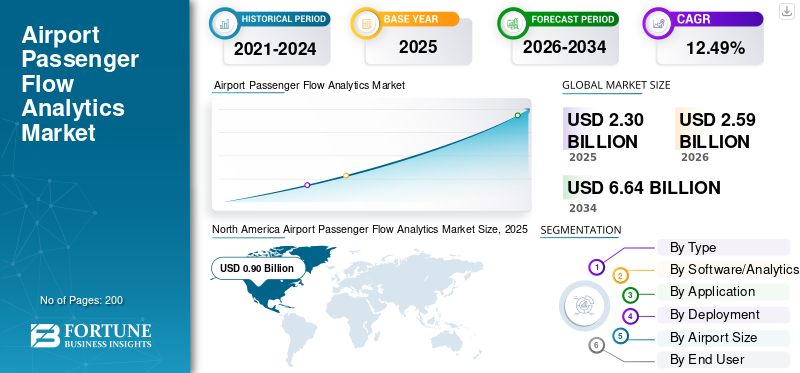
Download Free sample to learn more about this report.
Airport Passenger Flow Analytics Market Takaways
 Global Market Size & Forecast
- 2025 Market Size: USD 2.30 billion
- 2026 Market Size: USD 2.59 billion
- 2034 Forecast Market Size: USD 6.64 billion
- CAGR: 12.49% from 2026–2034
 Market Share
- North America dominated the airport passenger flow analytics market with a 39.13% share in 2025.
- The hardware/sensors & data capture systems segment is projected to grow at a 11.86% CAGR during the forecast period.
- The biometric/digital identity flow analytics segment is expected to expand at a 13.62% CAGR over the forecast period.
 Key Regional Highlights
North America
North America maintained its leading position, with the market increasing from USD 0.76 billion in 2024 to USD 0.90 billion in 2025.
Europe
Europe is projected to grow at a 12.53% CAGR and reach USD 0.62 billion by 2026, making it the second-largest regional market.
Asia Pacific
Asia Pacific is expected to reach USD 0.57 billion by 2026, emerging as the third-largest and fastest-growing regional market.
U.S.
The market is estimated to reach approximately USD 0.63 billion by 2026, expanding at a 12.74% CAGR during the forecast period.
Japan
The market is projected to reach around USD 0.10 billion by 2026, registering a 13.02% CAGR during the forecast period.
Read More

AIRPORT PASSENGER FLOW ANALYTICS MARKET TRENDS
Integration of AI-Driven Predictive Analytics is a Market Trend
Integration of AI-driven predictive analytics marks a pivotal trend in the market, enabling proactive risk mitigation. The FAA's Aviation Risk Identification and Assessment (ARIA) tool fuses surveillance data to predict collision risks on runways through vertical, lateral, and speed analyses, supporting data-driven decisions at equipped airports.
In March 2025, to identify runway incursions, the Federal Aviation Administration announced that it would install improved safety systems at 74 airports by the end of 2026. The Runway Incursion Device, a memory assist for air traffic controllers that shows when a runway is occupied, is being installed by the FAA. ICAO-endorsed systems leverage video analytics for FOD detection and surface defect prediction, cutting incidents by up to 30%. These advancements shift from reactive to predictive safety amid rising traffic.
MARKET DYNAMICS
MARKET DRIVERS
Download Free sample to learn more about this report.
Rising Non-Aeronautical Revenue Needs is Driving Market Growth
Airports worldwide depend less on aeronautical fees and more on retail, F&B, and lounges for revenue, driving demand for passenger flow analytics to capture every dwell minute profitably. Real-time heatmaps reveal peak shopping zones, enabling dynamic staffing and targeted digital ads that lift sales 15-25% at hubs such as Dubai and Singapore Changi. Analytics integrate with CRM systems for personalized offers based on flow patterns, turning congestion data into loyalty programs that boost repeat visits. Operators leverage predictive models to forecast retail traffic from flight banks, optimizing layouts and promotions for maximum yield. Regulatory nods to data monetization further propel investments, positioning analytics as core to financial sustainability amid flat infrastructure budgets. This is fueling the airport passenger flow analytics market growth.
MARKET RESTRAINTS
Stringent Data Privacy Regulations is a Market Restraint
GDPR, CCPA, and aviation-specific rules such as EASA data mandates create compliance barriers, forcing analytics providers to embed costly anonymization, consent tracking, and audit trails from day one. European airports face fines up to 4% of revenue for breaches, prompting cautious pilots over full deployments. Cross-border passenger data flows trigger sovereignty issues, fragmenting solutions and hiking legal fees. Smaller operators balk at recurring certification costs, delaying ROI realization despite efficiency promises. Legacy privacy silos clash with integrated platforms, necessitating expensive middleware. As a result, the broader adoption of passenger analytics and airport digitalization platforms is being slowed down by data privacy compliance.
MARKET OPPORTUNITIES
Smart Airport Initiatives Expansion Generates New Growth Opportunities
Nationwide smart airport programs in India, UAE, and China, alongside ICAO's digital skyline vision, fuel massive tenders for flow analytics in greenfield terminals equipped with 5G backbones. Retrofitting 500+ mid-sized facilities offer low-hanging fruit, blending LiDAR with existing CCTV for instant SLAs on queue times. Biometric handoffs to airlines unlock ecosystem revenues, while sustainability KPIs tie grants to density-optimized energy use.
MARKET CHALLENGES
Cybersecurity Vulnerabilities in IoT are a Market Challenge
Rising IoT endpoints such as cameras, beacons, and gates multiply attack surfaces, exposing airport operations to ransomware and disruptions that halt critical flows. Real-time data mandates clash with encryption needs, risking latency during peak hours. Evolving threats outpace security patches, eroding trust among operators and regulators wary of systemic risks. Vendor fragmentation creates seams in multi-supplier ecosystems, hindering unified defenses and visibility.
Segmentation Analysis
By Type
AI-Powered Predictive Insights to Boost Software/Analytics Platforms Segment Growth
Based on the type, the market is segmented into software/analytics platforms, hardware/sensors & data capture systems, and services.
The software/analytics platforms segment is anticipated to account for the largest market share. The segmental growth is driven by AI-powered predictive insights in software/analytics platforms, as these platforms harness machine learning to forecast passenger surges from flight schedules and external factors.
The hardware/sensors & data capture systems segment is anticipated to rise with a CAGR of 11.86% over the forecast period.
By Software/Analytics Platforms
Real-Time Queue Visibility Boosted Passenger Flow & Queue Analytics Segment Growth
Based on software/analytics platforms, the market is segmented into passenger flow & queue analytics, biometric/digital identity flow analytics, video analytics & computer vision, predictive & prescriptive analytics, wayfinding & passenger engagement analytics, and commercial/retail flow analytics.
In 2025, the passenger flow & queue analytics segment dominated the global market. The segmental growth is driven by real-time queue visibility in passenger flow & queue analytics, as it empowers airports to dynamically adjust staffing, open lanes, and reroute passengers during peaks, directly cutting wait times and boosting satisfaction scores across high-volume terminals.
The biometric/digital identity flow analytics segment is projected to grow at a high CAGR of 13.62% over the forecast period.
By Application
Security Screening & Queue Management Segment to Lead as It Enables Seamless Passenger Verification at Checkpoints
Based on the application, the market is segmented into security screening & queue management, immigration/border control, check-in & self bag drop, boarding & gate management, transfer passenger management, curbside/parking/terminal entry, baggage claim & arrivals, and others.
The security screening & queue management segment is anticipated to witness a dominating market share over the forecast period. The segmental growth is driven by biometric integration in security screening & queue management applications, as it enables seamless passenger verification at checkpoints while predicting queue buildup from flight banks, ensuring compliance with aviation security standards without compromising flow efficiency.
The immigration/border control segment is projected to grow at a high CAGR of 13.23% over the forecast period.
By Deployment
Subscription Scalability Fueled Cloud/SaaS Segment Growth
Based on deployment, the market is segmented into cloud/SaaS, hybrid/edge-cloud, and on-premise.
The cloud/SaaS segment dominated the market share. The segmental growth is driven by subscription scalability in Cloud/SaaS deployments, as airports avoid heavy CapEx on servers and gain instant access to AI updates, multi-terminal dashboards, and pay-per-use models that align with fluctuating traffic patterns.
The hybrid/edge-cloud segment is projected to grow at a CAGR of 12.60% during the study period.
To know how our report can help streamline your business, Speak to Analyst
By Airport Size
High-Volume Complexity Propelled Large/Hub Airports Segment Growth
Based on airport size, the market is segmented into large/hub airports, medium airports, and small airports.
The large/hub airports segment dominated the market share. The segmental growth in the market is driven by peak-volume complexity in large/hub airports, as these facilities manage millions of connecting passengers daily, requiring advanced predictive modeling to synchronize gates, lounges, and retail zones for optimal throughput and ancillary revenue capture.
In addition, medium airports are projected to grow at a CAGR of 13.11% during the study period.
By End User
Operational Service Level Agreement (SLA) Pressures Fostered Airport Operators Segment Growth
Based on end user, the market is segmented into airport operators, government/border & security agencies, airlines, ground handlers, retail/commercial operators, and others.
The airport operators segment dominated the market share. The segmental growth is driven by operational SLA pressures on airport operators, as they face mandates for maximum wait times and density limits, leveraging analytics for proactive orchestration that meets regulatory scrutiny while enhancing competitiveness against rival hubs.
In addition, government/border & security agencies are projected to grow at a CAGR of 13.26% during the study period.
Airport Passenger Flow Analytics Market Regional Outlook
By geography, the market is categorized into Europe, North America, Asia Pacific, and the Rest of the World.
North America
North America Airport Passenger Flow Analytics Market Size, 2025 (USD Billion)
To get more information on the regional analysis of this market, Download Free sample
North America held the dominant share in 2024, valued at USD 0.76 billion, and also maintained the leading share in 2025, with USD 0.90 billion. North America leads in passenger flow analytics adoption due to high-traffic hubs and advanced infrastructure, with airports deploying Wi-Fi and camera-based systems for real-time density tracking.
U.S. Airport Passenger Flow Analytics Market
Based on North America’s strong contribution and the U.S. dominance within the region, the U.S. market can be analytically approximated at around USD 0.63 billion in 2026, accounting for roughly 12.74% CAGR. U.S. airports prioritize analytics amid record enplanements, using FAA data for capacity planning and congestion mitigation at busy terminals.
Europe
Europe is projected to record a steady growth rate of 12.53% during the forecast period, which is the second highest among all regions, and reach a valuation of USD 0.62 billion in 2026. Europe advances through EU Entry/Exit biometrics and predictive analytics, improving on-time performance at digitized terminals. Munich employs digital twins for flow simulation, while Hamburg deploys Amadeus Flow Cloud for check-in to boarding orchestration.
U.K. Airport Passenger Flow Analytics Market
The U.K. market in 2026 is estimated at around USD 0.20 billion, representing roughly 13.01% CAGR during the study period. U.K. airports combat capacity caps via AI workflows and LiDAR for queue intelligence at security and immigration. Heathrow and Gatwick integrate real-time passenger notifications and dynamic lane controls to unlock virtual throughput.
Germany Airport Passenger Flow Analytics Market
Germany’s market is projected to reach approximately USD 0.17 billion in 2026. Germany focuses on sustainability and resilience, with Munich's digital twin enabling proactive adjustments during disruptions.
Asia Pacific
Asia Pacific is estimated to reach USD 0.57 billion in 2026 and secure the position of the third-largest region in the market and fastest-growing during the study period. Asia Pacific surges through capacity expansions and digital upgrades at new terminals. Hyderabad Airport deploys IoT smart trolleys for real-time baggage flow, alongside DigiYatra biometrics at Delhi and Mumbai. Veovo India connects numerous regional airports through passenger flow management, queue analytics, and operational decision-support tools, helping airports improve terminal visibility, reduce congestion, and manage rising passenger volumes more efficiently.
Japan Airport Passenger Flow Analytics Market
The Japanese market in 2026 is estimated at around USD 0.10 billion, accounting for roughly 13.02% of the compound annual growth rate (CAGR) during the forecast period. Japan emphasizes precision ops at Narita and Haneda, using analytics to support earthquake-resilient flows and handle tourism surges.
China Airport Passenger Flow Analytics Market
China’s market is projected to be one of the largest in Asia Pacific, with 2026 revenues estimated at around USD 0.18 billion. China rebounds with strong outbound traffic and massive airport investments, funding overseas projects via state entities.
India Airport Passenger Flow Analytics Market
The India market in 2026 is estimated at around USD 0.16 billion. India transforms via DigiYatra facial recognition at 15+ airports and IoT at Hyderabad for baggage tracking.
Rest of the World
The rest of the world includes the Middle East & Africa and Latin America. Emerging regions modernize via PPPs and tourism, with Latin America focusing on connectivity and the Middle East and North Africa on expansions. Dubai and Abu Dhabi lead the Middle East & North Africa region with Veovo spatial intelligence, and São Paulo advances cloud-based platforms and solutions. The Middle East & Africa and Latin America markets are set to reach valuations of USD 0.23 billion and USD 0.15 billion, respectively, in 2026.
COMPETITIVE LANDSCAPE
Key Industry Players
Strategic Partnerships Fuel Market Expansion
The airport passenger flow analytics market remains moderately consolidated, with established aviation technology leaders such as SITA, Veovo, NEC, Honeywell, and Copenhagen Optimization commanding major shares through AI-driven platforms, computer vision systems, and real-time queue management solutions tailored for high-volume international terminals and regional hubs.
As passenger volumes intensify, these firms prioritize predictive flow modeling, biometric integration, and density heatmapping to meet rising ICAO passenger/customer experience standards and operational SLAs. Rapid adoption accelerates via strategic partnerships for instance, SITA collaborates with global airport groups on Passenger Intelligent Journey implementations at hubs such as Heathrow and Singapore Changi, Veovo partners with Emu Analytics for spatial intelligence upgrades across 150+ facilities, NEC teams with Asian operators on camera-based tracking at Narita and Incheon, Honeywell integrates analytics into U.S. TSA checkpoint modernizations; and Copenhagen Optimization works with European airports on simulation-driven queue optimization during peak recovery.
LIST OF KEY AIRPORT PASSENGER FLOW ANALYTICS COMPANIES PROFILED
- SITA (Switzerland)
- Veovo(Australia)
- NEC Corporation (Japan)
- Honeywell International (U.S.)
- Amadeus IT Group (Spain)
- Siemens AG (Germany)
- Xovis AG (Switzerland)
- Copenhagen Optimization (Denmark)
- FootfallCam(Malaysia)
- Quanergy Systems (U.S.)
KEY INDUSTRY DEVELOPMENTS
- February 2026: The Veovo Intelligent Airport Platform has gone live at Melbourne Airport, marking a significant turning point in a long-term collaboration centered on robust, integrated airport operations.
- September 2025: Ariadne announced that Oakland International Airport (OAK) has given it a contract to install its cutting-edge passenger travel intelligence system. AK will use Ariadne's state-of-the-art technology to record and analyze movement, dwell periods, and passenger counts throughout the airport.
- June 2025: To optimizes the management of airport ground operations and aircraft turnaround times prior to takeoff, Link Securities entered into a strategic partnership with Finnish airport operator Finavia to install its A-CDM/i-AOP collaborative decision-making system at Helsinki Airport.
- April 2025: Veovo and London Gatwick announced the partnership to create an integrated, predictive airport control system. This partnership will hasten Gatwick's transition to Total Airport Management and establish a more connected, predictive environment for operational decision-making.
- April 2025: NEC Corporation (NEC), a global leader in biometric authentication technologies, and SITA, a leader in air transport technology and border management, inked a deal to hasten the travel industry's adoption of digital identification technology.
REPORT COVERAGE
The global airport passenger flow analytics industry analysis includes a comprehensive study of the market size & forecast across all market segments covered in the report. It includes details on the market dynamics and market trends expected to drive the market over the forecast period. It provides information on key aspects, including an overview of technological advancements, the regulatory environment, Porter’s Five Forces analysis, company profiles, and the retrofitting program. Additionally, it details partnerships, mergers & acquisitions, and key aviation industry developments, as well as their prevalence by key regions. The global market report also provides a detailed competitive landscape with information on the market share and profiles of key operating players.
Request for Customization to gain extensive market insights.
Report Scope & Segmentation
| ATTRIBUTE | DETAILS |
| Study Period | 2021-2034 |
| Base Year | 2025 |
| Estimated Year | 2026 |
| Forecast Period | 2026-2034 |
| Historical Period | 2021-2024 |
| Growth Rate | CAGR of 12.49% from 2026-2034 |
| Unit | Value (USD Billion) |
| Segmentation | By Type, Software/Analytics Platforms, Application, Deployment, Airport Size, End User, and Region |
| By Type |
|
| By Software/ Analytics Platforms |
|
| By Application |
|
| By Deployment |
|
| By Airport Size |
|
| By End User |
|
| By Region |
|
Frequently Asked Questions
According to Fortune Business Insights, the global market value stood at USD 2.30 billion in 2025 and is projected to reach USD 6.64 billion by 2034.
In 2025, the market value in North America stood at USD 0.90 billion.
The market is expected to exhibit a CAGR of 12.49% during the forecast period of 2026-2034.
By type, the software/analytics platforms segment is expected to dominate the market.
Rising non-aeronautical revenue needs are driving market growth.
Veovo, NEC Corporation, Honeywell International, Amadeus IT Group, and Siemens AG are a few key players in the global market.
North America dominated the market in 2025



- 2021-2034
- 2025
- 2021-2024
- 200
Get 30-60 hrs Free Customization
Expand Regional and Country Coverage, Segments Analysis, Company Profiles, Competitive Benchmarking, and End-user Insights.




















-
US +1 833 909 2966 ( Toll Free )
-
Get In Touch With Us