Security Screening Market Size, Share & Industry Analysis, By Technology (X-ray Imaging Systems, Computed Tomography (CT), Metal Detectors, Biometric Systems, and Others), By Application (Passenger / People Screening, Baggage Screening, Cargo Screening, Vehicle Screening, and Others), By End User (Transportation, Government & Defense, Commercial Buildings, Industrial Facilities, and Others), and Regional Forecast, 2026 - 2034
 Download Free Sample
Security Screening Market Overview
 Listen to Audio Version
The global security screening market size was valued at USD 9.99 billion in 2025. The market is projected to grow from USD 10.74 billion in 2026 to USD 22.09 billion by 2034, exhibiting a CAGR of 9.4% during the forecast period. North America dominated the security screening market with a market share of 34.73% in 2025.
The security screening market is evolving from stand-alone inspection equipment into a digitally enabled, intelligence-driven security platform focused on real-time threat detection, automation, and integrated decision support. Growth is being fueled by rising passenger and cargo volumes, stricter aviation and border security regulations, modernization mandates for legacy screening infrastructure, and expanding adoption beyond airports into rail, ports, government facilities, commercial buildings, and large public venues.
End users are increasingly prioritizing higher detection accuracy, faster throughput, and reduced false alarm rates while maintaining compliance with evolving regulatory standards. There is strong demand for advanced imaging technologies such as CT and millimeter-wave scanners, AI-based automated threat recognition, and multi-sensor systems capable of detecting metallic and non-metallic threats. Buyers also emphasize operational efficiency, including minimal checkpoint footprint, lower total cost of ownership, high system uptime, and adaptability across diverse operating environments ranging from high-traffic airports to remote border locations.
Furthermore, leading security screening vendors such as Smiths Detection, OSI Systems (Rapiscan), Leidos, L3Harris, Nuctech, and Analogic are strengthening their positions by shifting from hardware-centric offerings toward end-to-end screening ecosystems. Smiths Detection focuses on advanced CT, AI-enabled threat detection, and lifecycle services to support regulatory compliance and throughput optimization.
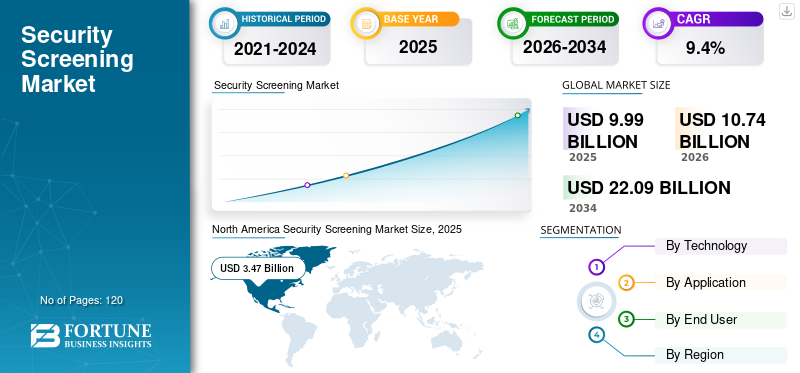
Download Free sample to learn more about this report.
Security Screening Market Key Takeaways
 Market Size & Forecast
- 2025 Market Size: USD 9.99 billion
- 2026 Market Size: USD 10.74 billion
- 2034 Forecast Market Size: USD 22.09 billion
- CAGR: 9.40% from 2026–2034
 Market Share
- North America dominated the security screening market with a 34.73% share in 2025.
- The transportation segment accounted for the largest market share in 2025.
- The X-ray imaging systems segment accounted for the largest market share in 2025.
 Key Regional Highlights
North America
North America held a 34.73% share in 2025, valued at USD 3.47 billion.
Asia Pacific
Asia Pacific held approximately 22.92% share in 2025, valued at USD 2.29 billion.
Europe
Europe accounted for approximately 26.83% share in 2025, valued at USD 2.68 billion.
U.S.
The market valued at USD 2.30 billion in 2025.
Japan
Th market valued at USD 0.40 billion in 2025.
Read More

Generative-AI Impact
Rising Integration of Generative AI in Security Screening is Emerging as a Key Market Catalyst
In screening environments, generative AI enhances automated threat recognition by learning from vast image libraries, operator decisions, and false-alarm patterns, continuously refining detection accuracy. It supports security operators by generating natural-language explanations of detected anomalies, prioritizing alerts, and recommending secondary screening actions, thereby reducing operator fatigue and improving checkpoint throughput without compromising security standards.
Generative AI is being applied to predictive maintenance and system health management. AI models analyze equipment performance data, image quality trends, and component usage patterns to forecast failures, generate maintenance actions, and optimize spare-parts planning. This reduces unplanned downtime and lowers the total cost of ownership for large installed screening fleets. For instance,
- In January 2026, the U.S. Department of Homeland Security (DHS) reported that 200 AI use cases were deployed or in development, nearly a 40% increase since mid-2025, indicating increased reliance on AI for real-time analysis and threat detection in border and security environments.
Security Screening Market Trends
Rising Expansion in Advanced Imaging Technologies is a Major Trend Observed in Market
Rising adoption of advanced imaging technologies is a major trend in the security screening market, as governments and infrastructure operators prioritize higher detection accuracy and faster throughput. Conventional 2D X ray systems are increasingly being replaced by computed tomography and millimeter wave imaging, which provide volumetric and high resolution views of scanned objects and individuals. These technologies enable automated threat recognition by clearly differentiating between materials such as explosives, liquids, and metals. Airports are a key driver of this trend, as passenger volumes continue to rise and regulators mandate next generation screening systems to improve safety. For instance,
- In October 2025, John F. Kennedy International Airport announced the rollout of advanced passenger security checkpoints in its new Terminal One, incorporating Computed Tomography (CT) X-ray scanners that produce three-dimensional images to streamline baggage screening.
Download Free sample to learn more about this report.
MARKET DYNAMICS
MARKET DRIVERS
Rising Adoption of Portable and Networked Screening Solutions to Drive the Market Growth
Rising adoption of portable and networked screening solutions is driving demand as security needs extend beyond fixed checkpoints. Governments and private operators increasingly require flexible screening systems that can be rapidly deployed at temporary locations such as public events, emergency response zones, border crossings, and remote infrastructure sites. Portable X ray scanners, handheld detectors, and mobile vehicle inspection systems allow authorities to scale security operations without permanent installations.
At the same time, networked screening solutions enable multiple portable units to be connected to centralized command centers, allowing real time data sharing, remote image analysis, and coordinated threat response. This connectivity improves situational awareness and consistency of screening outcomes across dispersed locations.
MARKET RESTRAINTS
High Capital and Lifecycle Cost Restricting Market Growth
High capital and lifecycle costs are key factors restricting the growth of the market, particularly for advanced screening technologies. Modern systems such as CT based baggage scanners and millimeter wave body scanners require substantial upfront investment in equipment procurement and infrastructure upgrades. Beyond initial installation, operators face ongoing expenses for software licensing, system calibration, preventive maintenance, and component replacement.
Large screening fleets also require periodic technology refreshes to meet evolving regulatory standards, adding to long term costs. For smaller airports, transit authorities, and public facilities, these financial requirements can delay or limit adoption. Budget constraints in developing regions further intensify this challenge.
MARKET OPPORTUNITIES
Growth in Cargo and Parcel Screening to Offer Market Growth Opportunities in Coming Years
Growth in cargo and parcel screening is expected to offer significant market opportunities in the coming years as global trade and e-commerce volumes continue to rise. The increasing movement of goods across borders has heightened concerns around smuggling, contraband, and explosive threats, driving stricter inspection requirements. Regulatory bodies are mandating higher screening standards for air cargo, express parcels, and logistics hubs. This is accelerating demand for high throughput X ray and CT based screening systems capable of handling dense and complex shipments. Automated threat detection is becoming critical to maintain speed while improving accuracy. Logistics operators are also investing in inline and networked screening solutions to support large scale distribution centers. For instance,
- In October 2025, Smiths Detection announced the launch of a new advanced hold baggage and air cargo screening system, the SDX 10080 SCT, which integrates dual-energy Computed Tomography (CT) imaging to deliver higher detection accuracy and efficiency for both baggage and cargo security screening operations.
Segmentation Analysis
By Technology
Rising Deployment of X-Ray Imaging Systems to Propel Segmental Growth
Based on the technology, the market is divided into X-ray imaging systems, Computed Tomography (CT), metal detectors, biometric systems, and others.
X-ray imaging systems segment accounted for the largest market share due to their widespread deployment across airports, government buildings, transit hubs, and commercial facilities. These systems have been the backbone of security screening for decades, making them deeply embedded in existing infrastructure. Their relatively lower cost compared to advanced technologies makes them accessible for both large scale and budget constrained operators. X ray systems also offer high throughput, which is critical in high traffic environments such as airports and metro stations.
Computed Tomography (CT) segment is anticipated to rise with a CAGR of 14.5% over the forecast period, owing to its superior detection accuracy and ability to generate detailed 3D volumetric images. CT systems significantly reduce false alarms and manual bag checks, improving passenger flow and operational efficiency.
By Application
Rising Need for Passenger Screening across Aviation and Public Infrastructure Drives Passenger/People Screening Segment Growth
Based on the application, the market is divided into passenger / people screening, baggage screening, cargo screening, vehicle screening, and others.
Passenger / people screening segment accounted for the largest market share mainly due to the mandatory nature of passenger screening across aviation and public infrastructure. Passenger screening is a regulatory requirement at airports, border checkpoints, and sensitive government facilities, making it unavoidable and consistently funded. Unlike other applications, people screening must be conducted on every individual, regardless of threat level or traffic volume, ensuring continuous system utilization. Aviation security regulations globally require 100% passenger screening, driving large scale, and recurring deployments.
Cargo screening segment is anticipated to grow at a CAGR of 13.4% over the forecast period, driven by the rapid expansion of e-commerce and express parcel volumes. The exponential growth of cross border e-commerce has sharply increased the number of small parcels moving through air cargo and logistics networks. Each parcel must be screened without disrupting delivery timelines, creating strong demand for high throughput and automated screening systems.
By End User
To know how our report can help streamline your business, Speak to Analyst
Large Scale Deployment of GPS and Telematics Systems Across Commercial Vehicle to Propel Segmental Growth
Based on the end user, the market is divided into transportation, government & defense, commercial buildings, industrial facilities, and others.
Transportation segment accounted for the largest security Screening market share, owing to the large scale deployment of GPS and telematics systems across commercial vehicle fleets. Transportation operators rely heavily on real time location tracking to manage fleet utilization, route efficiency, fuel consumption, and delivery timelines. GPS tracking has become a core operational requirement for logistics, public transport, ride hailing, and freight movement, rather than an optional technology. High vehicle density and continuous daily usage generate sustained demand for tracking hardware, software platforms, and analytics services.
Government & defense segment is anticipated to rise with a CAGR of 12.0% over the forecast period, driven by increasing investments in national security and surveillance infrastructure. Governments are expanding the use of tracking technologies to support border security, military logistics, emergency response, and critical asset monitoring.
Security Screening Market Regional Outlook
By geography, the market is categorized into Europe, North America, Asia Pacific, South America, and the Middle East & Africa.
North America
North America Security Screening Market Size, 2025 (USD Billion)
To get more information on the regional analysis of this market, Download Free sample
North America held the dominant share in 2024, valued at USD 3.26 billion, and also maintained the leading share in 2025, with USD 3.47 billion. The market growth in North America is driven by stringent regulatory mandates for security screening modernization. Regulatory authorities require airports, border checkpoints, and critical infrastructure to comply with continuously evolving security standards, forcing operators to upgrade and replace legacy screening systems. These mandatory compliance requirements ensure sustained and predictable investment in advanced screening technologies across the region.
U.S. Security Screening Market
Based on North America’s strong contribution and the U.S. dominance within the region, the U.S. market is set to reach USD 2.30 billion in 2025, accounting for roughly 23.0% of global sales.
Europe
Europe is expected to record a growth rate of 8.9% over the coming years, the second highest among all regions. It reached a valuation of USD 2.68 billion in 2025. This growth is owing to strict aviation security regulations across the European Union that mandate the adoption of advanced screening technologies. EU wide compliance requirements for next generation baggage and passenger screening systems are compelling airports and transport hubs to upgrade legacy equipment. Regulatory driven modernization programs across major European airports are ensuring steady investment in CT and advanced imaging solutions, supporting consistent regional market expansion.
U.K. Security Screening Market
The U.K. market was valued at USD 0.58 billion in 2025, representing roughly 6.0% of global revenues.
Germany Security Screening Market
Germany’s market is projected to reach around USD 0.50 billion in 2025, equivalent to around 5.0% of global sales.
Asia Pacific
Asia Pacific is projected to record the highest growth rate of 12.0% in the coming years. The region reached a valuation of USD 2.29 billion in 2025. The Asia Pacific security Screening market growth is driven by the rapid expansion of airport and transportation infrastructure across emerging economies. Countries such as India, China, and Southeast Asian nations are investing heavily in new airports, metro networks, and border security facilities to support rising passenger and trade volumes.
Japan Security Screening Market
The Japanese market in 2025 was valued at USD 0.40 billion, accounting for roughly 4.0% of global revenues. Japan’s market growth is driven by the ongoing modernization of its transportation and critical infrastructure security systems. The country maintains strict safety standards across airports, rail networks, and public venues, leading to the steady replacement of legacy screening equipment with advanced imaging technologies.
China Security Screening Market
China’s market is anticipated to be one of the largest worldwide, with 2025 revenues valued at around USD 0.73 billion, representing roughly 7% of global sales.
India Security Screening Market
The Indian market in 2025 reached a valuation of USD 0.39 billion, accounting for roughly 4% of global revenues.
South America and the Middle East & Africa
The South America and the Middle East & Africa regions are likely to experience moderate growth in this market over the forecast period. The South America market reached a valuation of USD 0.71 billion in 2025. The South America and the Middle East & Africa market growth is owing to expanding airport and border security infrastructure investments. Governments across these regions are allocating funds to strengthen aviation and cross border security systems, leading to increased deployment of modern screening technologies. In the Middle East & Africa, the GCC market reached a value of USD 0.39 billion in 2025.
COMPETITIVE LANDSCAPE
Key Industry Players
Market Players Adopting Capacity Expansion and Long Term Contracting Strategies to Strengthen Market Position
Security screening companies are increasingly focusing on production capacity expansion and long term service contracts to drive market progress. Leading manufacturers are investing in new manufacturing facilities and expanding assembly lines to meet rising global demand for advanced screening systems. This strategy ensures faster delivery timelines, especially for large airport and border security projects.
Vendors are also securing multiyear framework agreements with airport authorities and government agencies, providing stable revenue visibility and recurring service income. These long term contracts typically include installation, maintenance, software upgrades, and lifecycle support, thereby strengthening customer retention.
LIST OF KEY SECURITY SCREENING COMPANIES PROFILED
- Smiths Detection Group Ltd (U.K.)
- OSI Systems, Inc. (U.S.)
- Leidos Holdings, Inc (U.S.)
- Vanderlande Industries B.V. (Netherlands)
- Nuctech Company Limited (China)
- Analogic Corporation (U.S.)
- Security Electronic Equipment Co. Ltd. (China)
- CEIA S.p.A (Italy)
- Astrophysics Inc (U.S.)
- Rapiscan Systems (U.S.)
- Unisys (U.S.)
- Garrett Electronics (U.S.)
- Autoclear LLC (U.S.)
- VOTI Detection (Canada)
KEY INDUSTRY DEVELOPMENTS
- February 2026: ScanTech AI Systems launched a collaborative pilot program with the City of Atlanta to deploy its Sentinel AI CT Scanner System for municipal and event facilities, specifically in preparation for the 2026 FIFA World Cup.
- January 2026: Transportation Security Administration (TSA) announced a contract with Rohde & Schwarz to deploy QPS201 Advanced Imaging Technology (AIT) scanners at security checkpoints in U.S. airports. The systems, which are AI-based and use millimeter-wave technology, are designed for high-volume, touchless screening.
- January 2026: S. Customs and Border Protection and Philadelphia International Airport launched Enhanced Passenger Processing technology. Enhanced Passenger Processing utilizes advanced facial comparison technology and biometric software to provide U.S. citizens with a touchless, seamless, and secure international arrivals experience.
- November 2025: K2 Security Screening Group partnered with SeeTrue, an AI-powered security screening provider. The joint initiative will enable airports to achieve new benchmarks in efficiency, detection accuracy, and the employee experience.
- September 2025: Agilent Technologies Inc. launched its new Insight Series Alarm Resolution Systems, designed to enhance safety and streamline operations at airport and security checkpoints worldwide. This includes Insight300M and InsightBLS, advanced Liquid Explosive Detection Systems (LEDs) that meet global regulations for screening Liquids, Aerosols and Gels (LAGs).
REPORT COVERAGE
The global security screening market analysis includes a comprehensive study of the market size and forecast for all the market segments included in the report. It includes details on the market dynamics and trends expected to drive the market over the forecast period. It provides information on key aspects, including an overview of technological advancements, pipeline candidates, the regulatory environment, and product launches. Additionally, it details partnerships, mergers, and acquisitions, as well as key industry developments and prevalence by key regions. The global market research report also provides a depth competitive landscape with information on the market share and profiles of key operating players.
Request for Customization to gain extensive market insights.
Report Scope & Segmentation
| ATTRIBUTE | DETAILS |
| Study Period | 2021-2034 |
| Base Year | 2025 |
| Estimated Year | 2026 |
| Forecast Period | 2026-2034 |
| Historical Period | 2021-2024 |
| Growth Rate | CAGR of 9.4% from 2026-2034 |
| Unit | Value (USD Billion) |
| Segmentation | By Technology, By Application, By End User, and Region |
| By Technology |
|
| By Application |
|
| By End User |
|
| By Country |
|
Frequently Asked Questions
According to Fortune Business Insights, the global market value stood at USD 9.99 billion in 2025 and is projected to reach USD 22.09 billion by 2034.
In 2025, the North American market value stood at USD 3.47 billion.
The market is expected to exhibit a CAGR of 9.4% during the forecast period.
By end user, the transportation segment led the market.
Rising adoption of portable and networked screening solutions are the key factors driving the market.
Smiths, OSI, CEIA, Unisys are the major players in the global market.
North America dominated the market in 2025 with the largest share.



- 2021-2034
- 2025
- 2021-2024
- 120
Get 30-60 hrs Free Customization
Expand Regional and Country Coverage, Segments Analysis, Company Profiles, Competitive Benchmarking, and End-user Insights.




















Related Reports
-
US +1 833 909 2966 ( Toll Free )
-
Get In Touch With Us