Airport Sleeping Pods Market Size, Share & Industry Analysis, By Platform Type (Airside Terminals, Landside Terminals, Satellite/Remote Terminals, and Airside Lounges (Alliances/VIP)), By Technology (Basic Analog Pods, Semi-Smart Pods, and Fully Digital Pods), By Operation & Maintenance Model (OEMs, MRO/Upgrades, and Operators/Concessionaires), By System Type (Mechanical Cabin Systems, Electronic/Control Systems, and Smart/Integrated Systems), By End-Use (Commercial Passenger Operations, Private/VIP Terminals, and Crew Rest/Airport Staff Zones), and Regional Forecast, 2026-2034
 Download Free Sample
KEY MARKET INSIGHTS
 Listen to Audio Version
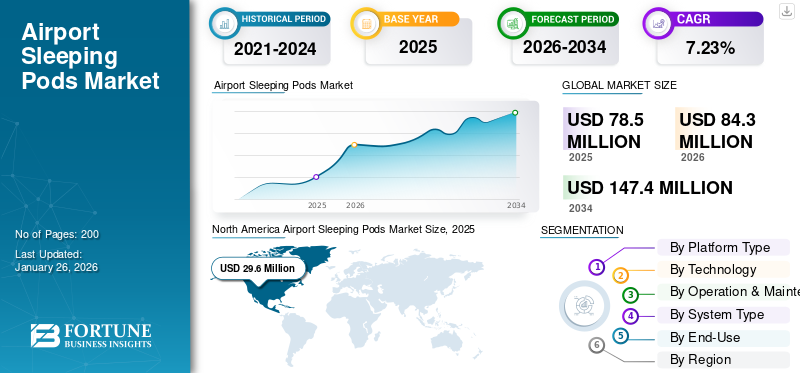
The global airport sleeping pods market size was valued at USD 78.5 million in 2025 and is projected to grow from USD 84.3 million in 2026 to USD 147.4 million by 2034, exhibiting a CAGR of 7.23% during the forecast period. North America dominated the global market with a share of 37.7% in 2025.
The global airport sleeping pods market represents a fusion of aerospace engineering precision and hospitality design, offering compact, private rest modules within airport terminals. These pods have evolved from basic sleeping units into intelligent, digitally connected systems integrated with airport infrastructure. Growing air passenger traffic, especially through long-haul hubs, has made fatigue management and traveler comfort key priorities for airport operators. Smart pods equipped with app-based booking, biometric access, and automated ventilation now form part of “next-generation terminal ecosystems.” Airports in Asia Pacific, the Middle East, and Europe are leading adoption as part of broader modernization and passenger experience programs.
Leading companies in this market include GoSleep (Finland), Napcabs GmbH (Germany), Sleepbox (U.S.), YOTELAir (U.K.), Minute Suites (U.S.), Sleep ‘n Fly/Airport Dimensions (U.K./UAE), ZzzleepandGo (Italy), RelaxBox (Italy), MetroNaps (U.S.), and SnoozeCube (UAE). These firms operate across the value chain as system OEMs, integrators, and service concessionaires. Their engineering approaches draw from aerospace design principles, lightweight materials, modular construction, and environmental control integration. Each player contributes uniquely to digital automation, ergonomic comfort, and sustainable infrastructure, collectively advancing airports toward seamless, technology-driven passenger rest solutions.
Download Free sample to learn more about this report.
AIRPORT SLEEPING PODS MARKET KEY TAKEAWAYS
 Market Size & Forecast
- 2025 Market Size: USD 78.5 million
- 2026 Market Size: USD 84.3 million
- 2034 Forecast Market Size: USD 147.4 million
- CAGR: 7.23% from 2026–2034
 Market Share
- North America dominated the airport sleeping pods market with a 37.70% share in 2025.
- Airside terminals led the platform type segment with a 42.77% market share in 2026.
- Semi-smart pods dominated the technology segment with a 42.56% market share in 2026.
 Key Regional Highlights
North America
North America accounted for USD 29.6 million in 2025 and is projected to reach USD 31.8 million in 2026, driven by airport modernization projects, rising passenger traffic, and increasing adoption of sleeping pods at major transit hubs.
Europe
Europe generated USD 23.3 million in 2025 and is expected to reach USD 25.0 million in 2026, supported by strong demand for passenger comfort solutions, digital hospitality innovations, and sustainable airport infrastructure.
Asia Pacific
Asia Pacific was valued at USD 11.2 million in 2025 and is projected to reach USD 12.1 million in 2026, fueled by rapid air traffic growth, smart airport initiatives, and expanding aviation infrastructure across emerging hubs.
U.S.
The market is estimated to reach USD 27.5 million in 2025, supported by strong adoption of sleeping pods at major airports such as JFK, Hartsfield-Jackson, and Philadelphia to enhance passenger experience and non-aeronautical revenue.
Japan
The airport sleeping pods market is projected to reach USD 2.8 million in 2026, driven by smart airport programs, growing transit passenger volumes, and increasing deployment of digitally enabled pod solutions.
Read More

AIRPORT SLEEPING PODS MARKET TRENDS
Transition Toward Smart, Self-Service, and Digitally Connected Airport Rest Modules is the Recent Market Trend
The airport sleeping pods market is undergoing a technological and operational transition from basic resting capsules to intelligent, self-service rest environments that align with the broader digital transformation of airports. Early installations emphasized compactness and cost-efficiency, but the new trend focuses on connectivity, automation, and hygiene-driven design. Post-pandemic traveler behavior has shifted toward privacy and personal space, encouraging airports to replace shared lounges with modular sleeping pods featuring biometric entry, UV sterilization, and app-based reservations. This shift mirrors aerospace’s move toward smart cabin systems integrating environmental control, lighting, and monitoring sensors. Moreover, airport authorities are adopting data analytics to manage occupancy, energy consumption, and maintenance cycles in real time, optimizing passenger throughput and operational efficiency. Sustainability is another major theme, as newer pods use recycled materials, low-power lighting, and modular setups that can be relocated to new terminals with minimal construction. Collectively, these trends show a convergence between aerospace engineering precision and hospitality convenience, positioning sleeping pods as part of the “smart terminal” ecosystem rather than a niche amenity.
Download Free sample to learn more about this report.
MARKET DYNAMICS
MARKET DRIVERS
Increasing Passenger Fatigue Management and Digital Hospitality Integration to Boost Market Growth
The primary driver propelling the airport sleeping pods market growth is the rising focus on passenger fatigue management, coupled with the digitalization of airport hospitality. Long-haul travelers and business passengers increasingly seek personal, hygienic spaces to rest, recharge devices, and work privately during layovers. Unlike traditional lounges or hotels, pods provide flexible, short-term rest with minimal space and energy requirements. Airports observe them as scalable systems that enhance customer satisfaction and dwell-time monetization, converting idle passengers into paying users. The digital integration of pods through biometric entry, contactless payments, and mobile booking has transformed them into intelligent service units rather than static enclosures. From an aerospace engineering perspective, this driver reflects a shift toward “smart cabin environments,” where data and comfort systems converge. Additionally, increased competition among hub airports has made passenger experience a measurable KPI, with sleeping pods offering tangible improvements in satisfaction ratings. Government investments in airport modernization programs, especially in the Asia Pacific and the Middle East, further amplify the demand. In short, the driver is rooted in the twin imperatives of comfort through automation and profitability through micro-infrastructure.
MARKET RESTRAINTS
High Capital Cost and Limited Standardization across Terminals May Hamper Market Growth
Despite their promise, airport sleeping pods face several structural restraints that hinder rapid scaling. The foremost is the high upfront capital cost in manufacturing and installation. Unlike retail kiosks or vending units, pods require complex integrations for power, ventilation, fire safety, and data connectivity, each tailored to specific terminal layouts. The lack of industry-wide design and safety standards further complicates adoption. Different airports enforce varying electrical, acoustic, and sanitation codes, increasing customization costs for OEMs. Moreover, maintenance cycles remain a challenge; pods must be frequently sanitized and serviced, which raises operational expenses and reduces utilization efficiency. Another restraint is space competition, airports prioritize retail concessions, airline lounges, or security expansions over rest pods, especially in older terminals with limited square footage. Additionally, the revenue model depends on occupancy turnover; during off-peak seasons, pods can remain underutilized, affecting ROI. Public awareness and cultural acceptance vary widely, while travelers in Asia and Europe embrace capsule resting, adoption in North America and parts of Africa remains cautious. Together, these restraints create friction between product innovation and airport operational realities.
MARKET OPPORTUNITIES
Rising Layover Durations and Growth of Global Transit Hubs to Accentuate Market Growth
The most significant opportunity for airport sleeping pods lies in the rapid growth of global air passenger traffic and the increasing number of connecting flights passing through international hubs. With aviation networks expanding across Asia, the Middle East, and Africa, transit times are lengthening, creating a rising demand for short-term rest facilities within secure zones. Airports are under pressure to improve passenger comfort without adding permanent hotel infrastructure, making modular pods a cost-effective and space-efficient alternative. Technological innovation further enhances the opportunity: digital booking systems, AI-based pricing, and IoT maintenance management allow operators to scale profitably. Additionally, new greenfield airports in emerging economies such as India, Indonesia, and Saudi Arabia are being designed with sleeping pods integrated into their architectural master plans. This proactive integration opens doors for long-term supply contracts, OEM partnerships, and concession agreements. As competition among airports intensifies, comfort-driven differentiation becomes a key passenger retention strategy, positioning sleeping pods not merely as amenities but as strategic assets. The opportunity is particularly strong for players offering smart, connected systems that can align with airport-wide automation and passenger analytics platforms.
MARKET CHALLENGES
Integration Complexity, Hygiene Automation, and Return-On-Investment Uncertainty Are Major Challenges in the Market
The airport sleeping pods market faces complex challenges centered on integration, maintenance automation, and long-term financial viability. From an engineering standpoint, installing pods in busy terminals involves difficult interfacing with airport infrastructure, HVAC ducts, fire suppression systems, power grids, and digital access networks, making plug-and-play deployment more aspirational than routine. Hygiene automation is another persistent challenge; travelers expect pods to be visibly clean, yet automated self-sanitization technologies remain expensive and sometimes unreliable. Operators also grapple with uneven passenger flow, peak demand during night or delay periods contrasts sharply with long idle intervals, complicating capacity planning. On the financial side, return-on-investment uncertainty remains high: airports must weigh the cost of installation, maintenance, and staffing against unpredictable utilization rates. Additionally, cybersecurity concerns have emerged as connected pods handle personal and payment data through IoT networks. In addition, regulatory ambiguities, particularly around fire safety and occupancy classification, slow approvals in certain jurisdictions. Collectively, these challenges mirror the broader aerospace issue of integrating high-tech subsystems into legacy environments, which are technically feasible but operationally intricate. Success depends on partnerships between OEMs, airport authorities, and digital service providers to standardize design and ensure sustainable profitability.
SEGMENTATION ANALYSIS
By Platform Type
Airside Terminals Segment Dominates Due to Rising Demand for Secure and Convenient Rest Spaces
By platform type, the market is segmented into airside terminals, landside terminals, satellite/remote terminals, and airside lounges (alliances/VIP).
The airside terminals segment led the market accounting for 42.77% market share in 2026. Demand for airport sleeping pods in airside terminals is accelerating as long-haul travelers seek secure, private rest spaces between connecting flights. With airports prioritizing comfort within departure zones, airside installations enable quick access without re-clearing security, boosting passenger volumes, and generating additional non-aeronautical revenue for terminal operators.
The landside terminals segment is expected to grow at a CAGR of 7.4% over the forecast period.
To know how our report can help streamline your business, Speak to Analyst
By Technology
Rising Demand for Affordable, Digitally-Enabled Res Solutions Fuels Adoption of Semi-Smart Pods
The technology segment is classified into basic analog pods, semi-smart pods, and fully digital pods.
The semi-smart pods segment dominated the market accounting for 42.56% market share in 2026. Semi-smart pods are in strong demand because they offer essential digital functions, lighting control, ventilation, and access systems without the high cost of full automation. Airports prefer these mid-tier solutions as transitional models, combining reliability, hygiene, and lower maintenance costs while aligning with gradual digital transformation programs.
The fully digital pods segment is expected to grow at a CAGR of 7.9% during the forecast period.
By Operation & Maintenance Model
Outsourced Management and Performance-based Models Drive Operators/Concessionaires Segment Growth
The operation & maintenance model segment is classified into OEMs, MRO/Upgrades, and operators/concessionaires.
The operators/concessionaires segment is expected to lead the market, contributing 48.72% globally in 2026. Operator-led or concessionaire models are gaining demand as airports outsource pod management to private partners. This allows airports to reduce capital expenditure while ensuring efficient operation, dynamic pricing, and 24/7 service availability. The model aligns with global trends toward privatized airport operations and performance-based concession frameworks.
The OEMs segment is expected to grow at a CAGR of 7.3% over the forecast period.
By System Type
Smart/Integrated Systems Lead Due to Advanced Connectivity and Smart Terminal Alignment
By system type, the market is classified into mechanical cabin systems, electronic/control systems, and smart/integrated systems.
The smart/integrated systems segment will account for 39.43% market share in 2026. Demand for smart, integrated pod systems is surging due to airport digitalization initiatives. These pods connect with airport networks for biometric access, energy monitoring, and predictive maintenance. Airports favor them for their data analytics, hygiene automation, and energy efficiency, aligning with next-generation “smart terminal” infrastructure strategies.
The electronic/control systems segment is expected to grow at a CAGR of 7.4% over the forecast period.
By End-Use
Expanding Air Traffic and Layovers Fuel Commercial Passenger Operations Growth
By end-use, the market is classified into commercial passenger operations, private/VIP terminals, and crew rest/airport staff zones.
The commercial passenger operations segment will lead the market in 2025 with a dominant 72.83% market share and also dominated the market in 2024. Commercial passenger operations remain the primary demand source, driven by rising global air traffic and extended layover durations. Airports serving intercontinental routes observe pods as essential infrastructure to enhance comfort, reduce crowding in lounges, and improve traveler well-being, converting idle dwell time into revenue opportunities.
The crew rest/airport staff zones augmentation segment is expected to grow at a CAGR of 7.0% over the forecast period.
AIRPORT SLEEPING PODS MARKET REGIONAL OUTLOOK
In terms of geography, the market is divided into North America, Europe, Asia Pacific, and the rest of the world.
North America
North America Airport Sleeping Pods Market Size, 2025 (USD Million)
To get more information on the regional analysis of this market, Download Free sample
In 2025, North America represented USD 29.6 million, accounting for 37.70% of the worldwide market, and is expected to reach USD 31.8 million in 2026. The region’s primary growth drives are expanding air travel, longer layovers, and airport infrastructure upgrades. Major hubs such as Atlanta, Dallas, and Toronto are integrating sleeping pods to enhance passenger comfort and generate non-aeronautical revenue, with strong adoption led by private concession operators and smart terminal initiatives.
In 2025, the U.S. market is estimated to reach USD 27.5 million as airports pursue non-aeronautical revenue and passenger comfort upgrades. Facilities such as JFK, Hartsfield-Jackson, and Philadelphia are adopting pods operated by brands including Minute Suites and Sleepbox, driven by high domestic traffic, long layovers, and business traveler convenience needs.
Europe
The Europe market generated USD 23.3 million in 2025, representing 29.71% of the global market landscape, and is expected to reach USD 25 million in 2026. Airports such as Munich, London, and Helsinki pioneered pod integration to improve comfort for transfer passengers. Strong design orientation, sustainability goals, and digital hospitality innovation sustain continued growth across Western and Northern Europe. The UK market is projected to reach USD 7 million by 2026, while the Germany market is projected to reach USD 6.5 million by 2026.
Asia Pacific
Asia Pacific contributed 14.23% to the global market in 2025, with a valuation of USD 11.2 million, and is expected to reach USD 12.1 million in 2026 as the region’s high demand is led by rapid air traffic growth, emerging aviation hubs, and airport expansion in China, India, Singapore, and South Korea. Governments’ smart airport programs and passenger experience mandates are accelerating the adoption of digital, automated sleeping pods integrated with biometric and IoT infrastructure. The Japan market is projected to reach USD 2.8 million by 2026, the China market is projected to reach USD 4 million by 2026, and the India market is projected to reach USD 3.2 million by 2026.
Rest of the World
Rest of the World contributed approximately USD 14.4 million to the global market in 2025, accounting for 18.36% share, and is expected to reach USD 15.4 million in 2026. In the Middle East, Africa, and Latin America, the demand is rising from new international hubs in Dubai, Doha, Riyadh, and São Paulo. Premium terminals are adopting sleeping pods to attract transit passengers, while secondary airports are beginning to explore low-cost modular installations.
COMPETITIVE LANDSCAPE
KEY INDUSTRY PLAYERS
Key Players are Integrating Aerospace Precision with Passenger-Centric Design to Gain Competitive Edge
The airport sleeping pods market is shaped by ten pioneering players that blend engineering innovation with comfort-oriented design. GoSleep and Napcabs lead in modular structural systems using aerospace-grade materials. Sleepbox and ZzzleepandGo drive the digital transformation with IoT-enabled, self-sanitizing pods. YOTELAir and Minute Suites function as large-scale operators, offering automated micro-hotels in major hubs. Sleep ’n Fly / Airport Dimensions specializes in premium concession models across Middle Eastern and European airports. Meanwhile, RelaxBox, MetroNaps, and SnoozeCube focus on ergonomic design, lightweight assembly, and regional adaptability, collectively defining the technological and operational core of this evolving market.
LIST OF KEY AIRPORT SLEEPING PODS COMPANIES PROFILED
- GoSleep Oy (Finland)
- Napcabs GmbH (Germany)
- Sleepbox Inc. (U.S.)
- YOTELAir (Yotel Ltd.) (U.K.)
- Minute Suites LLC (U.S.)
- Sleep ‘n Fly (U.K.)
- ZzzleepandGo Srl (Italy)
- RelaxBox Srl (Italy)
- MetroNaps Inc. (U.S.)
- SnoozeCube FZE (UAE)
KEY INDUSTRY DEVELOPMENTS
- May 2025 - Shanghai Pudong International Airport publicly announced to introduce sleep pods and shower facilities in Terminals 1 and 2. Installation work is expected to be completed by the second quarter of 2025.”
- January 2020 - Istanbul Airport has introduced 25 sleeping pods for travelers seeking rest before, after, or during their flights. The "iGA Sleepod" service is available for rental on an hourly basis, costing USD 6 per hour from 7 am to 7 pm, and USD 10 per hour from 7 pm to 7 am.
REPORT COVERAGE
The research report regarding the expansion of the airport sleeping pods market provides an in-depth analysis by identifying the key companies, product categories, and main applications within the industry. Additionally, the report highlights market trends and notable developments in this field. In conjunction with the aforementioned aspects, the report includes several factors that have contributed to the rapid market growth seen in recent years.
Request for Customization to gain extensive market insights.
REPORT SCOPE AND SEGMENTATION
|
ATTRIBUTE |
DETAILS |
|
Study Period |
2021-2034 |
|
Base Year |
2025 |
|
Estimated Year |
2026 |
|
Forecast Period |
2026-2034 |
|
Historical Period |
2021-2024 |
|
Growth Rate |
CAGR of 7.23% from 2026-2034 |
|
Unit |
Value (USD Million) |
|
Segmentation |
By Platform Type · Airside Terminals · Landside Terminals · Satellite/Remote Terminals · Airside Lounges (Alliances/VIP) |
|
By Technology · Basic Analog Pods · Semi-Smart Pods · Fully Digital Pods |
|
|
By Operation & Maintenance Model · OEMs · MRO/Upgrades · Operators/Concessionaires |
|
|
By System Type · Mechanical Cabin Systems · Electronic/Control Systems · Smart/Integrated Systems |
|
|
By End-Use · Commercial Passenger Operations · Private/VIP Terminals · Crew Rest/Airport Staff Zones |
|
|
By Geography · North America (By Platform Type, Technology, Operation & Maintenance Model, System Type, and End-Use) o U.S. (By Platform Type) o Canada (By Platform Type) · Europe (By Platform Type, Technology, Operation & Maintenance Model, System Type, and End-Use) o U.K. (By Platform Type) o Germany (By Platform Type) o France (By Platform Type) o Russia (By Platform Type) o Rest of Europe (By Platform Type) · Asia Pacific (By Platform Type, Technology, Operation & Maintenance Model, System Type, and End-Use) o China (By Platform Type) o Japan (By Platform Type) o India (By Platform Type) o Rest of Asia Pacific (By Platform Type) · Rest of the World (By Platform Type, Technology, Operation & Maintenance Model, System Type, and End-Use) o Middle East and Africa (By Platform Type) o Latin America (By Platform Type) |
Frequently Asked Questions
Fortune Business Insights says the market value stood at USD 78.5 million in 2025 and is estimated to reach USD 147.4 million by 2034.
The market is growing at a CAGR of 7.23% during the projection period.
The semi-smart pods is the leading segment in this market by technology type.
The airside terminals segment is the leading segment in this market, by platform type.
GoSleep Oy (Finland), Napcabs GmbH (Germany), Sleepbox Inc. (U.S.), YOTELAir (Yotel Ltd.) (U.K.), Minute Suites LLC (U.S.), and Sleep ‘n Fly (U.K.) are some of the leading OEMs in the market.
North America is projected to capture the largest market share.



- 2021-2034
- 2025
- 2021-2024
- 200
Get 30-60 hrs Free Customization
Expand Regional and Country Coverage, Segments Analysis, Company Profiles, Competitive Benchmarking, and End-user Insights.




















-
US +1 833 909 2966 ( Toll Free )
-
Get In Touch With Us