Airport Infrastructure Market Size, Share, Industry Analysis, By Operation (Airside Operation (Runway & Taxiway, Lighting and Navigation, Refueling and drainage, and Others) Terminal Operations (Baggage handling, Security equipment and infrastructure, Airport Management System, Airport Retail, Food & Beverages, and Others), Landside Operations (Car Parking, Car Rental, and Others)), By Infrastructure Type (Greenfield and Brownfield), By Airport Type (Domestic and International), and Regional Forecast, 2026-2034
 Download Free Sample
KEY MARKET INSIGHTS
 Listen to Audio Version
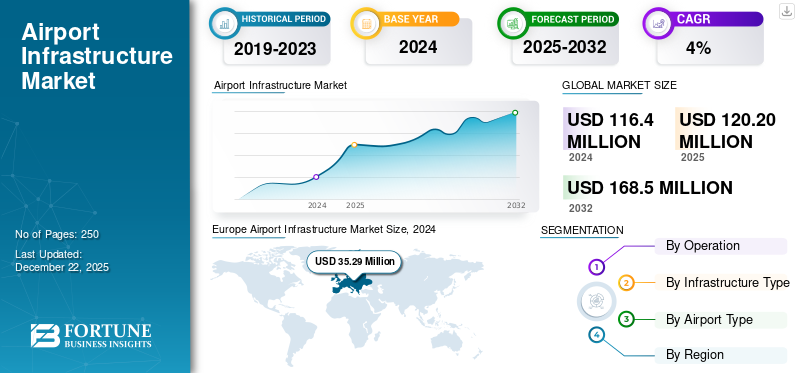
The global airport infrastructure market size was valued at USD 120.20 billion in 2025. The market is projected to grow from USD 124.83 billion in 2026 to USD 186.45 billion by 2034, exhibiting a CAGR of 5.14% during the forecast period. Europe dominated the airport infrastructure market with a market share of 30.10% in 2025.
The market is set for growth, driven by an increasing number of infrastructure projects and recent developments, along with numerous sustainable advancements being made to support the market growth in various regions. Key players in the market include Dnata, Fraport AG, among others, which compete in the global market.
The market refers to all infrastructure present on the airport, involves construction, renovation, and maintenance of significant airport infrastructure globally. They comprise runways, passenger numbers, control towers, taxiways, and so on. It is driven by increasing air travel demand, government expenditure, and technological advancements to improve the process efficiency and security. Factors like increasing passenger traffic, increasing air cargo, and demands for newer and greener airports are driving the market. Expansion and investment in new technologies allow airports to transport more passengers and freight more effectively.
Download Free sample to learn more about this report.
AIRPORT INFRASTRUCTURE MARKET KEY TAKEAWAYS
 Market Size & Forecast
- 2025 Market Size: USD 120.20 billion
- 2026 Market Size: USD 124.83 billion
- 2034 Forecast Market Size: USD 186.45 billion
- CAGR: 5.14% from 2026–2034
 Market Share
- Europe dominated the airport infrastructure market with a 30.10% share in 2025.
- The Airside operation segment is projected to hold a 56.73% market share in 2026.
- The Domestic airport segment is expected to account for 69.54% of the market in 2026.
 Key Regional Highlights
Europe
Europe reached USD 36.18 billion in 2025, accounting for 30.10% of the global market, and is projected to reach USD 37.29 billion in 2026.
Asia Pacific
Asia Pacific was valued at USD 35.08 billion in 2025, representing 29.18% of global demand, and is projected to reach USD 36.98 billion in 2026.
North America
North America accounted for USD 31.70 billion in 2025, representing 26.37% of global revenue, and is projected to reach USD 32.84 billion in 2026.
U.S.
The airport infrastructure market is estimated to reach USD 30.30 billion in 2026
Japan
The airport infrastructure market is projected to reach USD 3.51 billion in 2026
Read More

Market Dynamics
Market Driver
Increased Airport Modernization And Government Initiatives To Lead To Substantial Market Growth
Modernization at airports includes the development of airport infrastructure for improved efficiency, passenger comfort, and operating capabilities. Some of these projects involve building new terminals, adding facilities to existing ones, and integrating new technologies. Modernization is intended to ease increasing air traffic, enhance security, and minimize environmental degradation. John Glenn International Airport in Columbus, Ohio, for instance, is facing a USD 2 billion development project to replace its existing terminal with a new, larger, and more advanced facility. Pittsburgh International Airport is also updating its landslide terminal in a USD 1.57 billion project.
Government programmes are the driving force behind airport infrastructure growth. Initiatives such as India's UDAN (Ude Desh ka Aam Naagrik) help enhance regional air connectivity by modernizing airstrips and terminals at regional airports34. The updated UDAN program intends to link 120 new cities, with over Rs 91,000 crore (USD 10.9 billion) of investment coming from the Indian government and private players between FY20 and FY25 for airport expansion and technological upgrade. The U.S. government is also investing in this through the Infrastructure Investment and Jobs Act, making funds available for projects such as the Sacramento International Airport's USD 1.3 billion development program.
Market Restraint
Longer Project Lead Time To Restrain Market Growth
Project lead times, that is, the time elapsed between initiating a project and completing it, can strictly constrain airport infrastructure development. Prolonged lead times, as a result, can slow down day-to-day operations and create customer frustrations. Protracted lead times are brought about by complex regulatory clearances, land acquisition, environmental concerns, and fund procurement. For instance, West Bengal's Bagdogra Airport terminal is expected to be ready by March 2027. Technicalities involved in airport projects and logistics involved in supply chains can also delay delivery. Besides, flawed assumptions regarding air travel demand and passenger needs can delay and require changes in the project. All these issues can be avoided by making intense planning with short-term, medium-term, and long-term goals.
Market Opportunities
Increase in Sustainability Initiatives to Act as a Major Market Opportunity
Airport sustainability initiatives are increasingly essential as the airline industry attempts to keep its impacts minimal on the world. Airports are getting different means to become sustainable, including wind power and solar. Denver International Airport, for instance, boasts the U.S.'s biggest commercial airport solar farm and generates as much electricity to power thousands of homes. Besides, airports like Singapore Changi and Amsterdam Schiphol are turning to electrically operated ground support equipment to minimize emissions and noise pollution.
Water conservation is also in the limelight with airports like San Francisco International having rainwater harvesting and wastewater recycling for irrigation and toilet flushing. Most of the airports are also going carbon neutral through investment in energy efficiency through smart technology and sustainable aviation fuel (SAF) transport industry development. Indira Gandhi International Airport, for instance, has reached 100% renewable energy usage and has gone green with mass-scale green building. Not only are all these activities eco-friendly, but they also provide operational efficiency and customer satisfaction, hence airports are at the forefront of sustainable.
Market Challenge
Airport Capacity Constraints To Challenge Market Development
Capacity constraints refer to an airport's inability to accommodate the need for air traffic, resulting in congestion and delay. Capacity constraints are caused by limited runway utilization, noise mitigation, and the environment. Congestion leads to queueing for aircraft, delayed departures, and higher prices. Restricted airport capacity can dampen airline rivalry and prevent entry by new competition. Investment in increased capacity is imperative to relieve congestion, decrease scarcity rents, and decrease air fares. Airports handling over 60% of their capacity for over 50% of the time are deemed to be congested.
Airport Infrastructure Market Trends
Emerging Technologies such as AI, IoT, and Robotics are expected To Act As Major Market Trends
Artificial Intelligence (AI), automation and robotics, predictive analytics, and Internet of Things (IoT) are transforming airport infrastructure through improvement in efficiency, security, and the passenger experience. Automation is gaining ground among airports for application in tasks such as baggage handling and passenger service, with robots doing physically laborious and repetitive tasks, making tasks more precise and reducing the chances of injury.
Changi Airport, for instance, has signed with Aurrigo to pilot autonomous baggage vehicles. Addverb provides the Dynamo, a material-moving Autonomous Mobile Robot (AMR), and Zippy, a speed sortation robot. AI is being used to process data in real-time, responding to varying circumstances, and streamlining procedures like luggage transport, crowd handling, and security screening. AI robots are being tested at Dublin Airport to guide passengers with unseen disabilities. Predictive analytics allows airports to foretell congestion points, which contributes to more effective resource planning and better service. IoT technologies revolutionize airport infrastructure by making real-time asset monitoring and tracking of operations.
Sensors monitor the movement of passengers, baggage management, and increase operational efficiency. 5G connectivity enhances data transfer rates and communication, supporting high-definition monitoring and real-time situational analysis of data. Security robots are turning into indispensable units in airport activities, offering augmented surveillance, danger detection, and enhanced safety systems. The robots employ sophisticated sensors, cameras, and AI solutions to scan airport grounds and recognize suspicious behavior.
AAT Automation GmbH provides a robot that aims to contribute to the future of airport activities, ranging from the loading and unloading of luggage to security checks. Overall, these technologies are designed to automate airport operations, improve passenger experiences, and position airports for future expansion.
Download Free sample to learn more about this report.
Impact of COVID-19
The COVID-19 pandemic greatly affected airport infrastructure market growth due to the drastic decline in air traffic and revenues. All expansion and upgrading work was halted since airports could not sustain operational expenses. The crisis, however, accelerated digital integration and automation, and airports shifted their focus to business continuity, cost management, and regulatory compliance. Lawmakers and trade organizations called for government help to sustain the global aviation industry. Airports Council International (ACI) encouraged governments to take action to protect airport revenues and provide financial relief. Traffic and revenue are recovering, while during the pandemic, it has reshaped priorities and solutions in the airport infrastructure market.
Segmentation Analysis
By Operation
Growth in robotics and AI Propelled Terminal Segment Growth
On the basis of operation, the market has been divided into airside, terminal, and landside operations.
The terminal operation segment accounted for the largest market share in 2024 and is expected to grow at the highest CAGR in the forecast period. The airport terminal operations segment is expected to register sustained growth mainly based on retail and technological trends. Due to mounting passenger safety considerations, airport managers worldwide are abandoning existing baggage checking systems and turning towards emerging technologies such as AI and RFID in order to create smooth operations. Analogic Corporation's computed tomography (CT) systems, for example, are being rolled out in airports across the U.S. for a better level of security protection. In addition, airport retail expansion is also making terminals shopping hubs and increasing non-aeronautical revenues. Recent investment, for instance, is like Heathrow Airport's USD 2.86 billion expansion plan focused on building service and operational resilience, which indicates this trend. Robotics and automation are streamlining baggage handling to enhance the passenger experience. Further, long-term market growth is expected to be driven by the Asia Pacific region due to ongoing airport construction and development in countries like India and China. Overall, the initiatives are indicative of an emphasis on enhancing efficiency and customer satisfaction in airport service. The baggage handling segment is likely to hold 21% of the market share in 2025. Airport management system is projected to record a CAGR of 6.29% during the forecast period.
The airside segment accounted for a significant market share of 56.73% in 2026. As air traffic increases, the most efficient utilization of taxiways and runways is of utmost concern. Airports are heavily investing in advanced emerging technologies to achieve the maximum runway occupancy time and optimize the effectiveness of aircraft turnaround. This entails the use of intelligent systems that monitor traffic flow and provide air traffic controllers with real-time data. Additionally, more efficient lighting systems and aids to navigation must be provided to ensure the safety of the plane flight, particularly in bad weather. Airports are incorporating innovative light technologies to enhance the sight and safety of aviation operations with minimal energy use.
Runway & taxiway is anticipated to capture 43% of the market share in 2025, and likely to exhibit a CAGR of 5.53% during the forecast period.
By landslide operation, car parking segment is likely to hold 46% of the market share in 2025. Car rental segment is projected to exhibit a CAGR of 5.44% during the forecast period.
By Infrastructure Type
Modernization Of Old Airports To Augment Segmental Growth of Brownfield
Based on infrastructure type, the market is segmented into greenfield and brownfield.
The brownfield segment is expected to account for 55.48% of the market share in 2026. Current airports are being expanded and upgraded to increase capacity and make facilities more modern. This includes upgrading terminal operations, baggage handling systems, and security. Spending on brownfield projects is necessary to stay competitive in an ever-changing aviation industry.
The greenfield segment accounted for a substantial market share in 2024 and is expected to grow at the highest CAGR of 5.77% during the forecast period. These greenfield airports are built on new land, which allows for creative design with a prime focus on efficiency and sustainability. The government has approved over 20 greenfield airports to boost connectivity and ease passenger traffic at the current urban airports. With a projection that over 120 new airports would be required by 2030 to accommodate growing passenger volumes, greenfield development is critical in meeting future demand while maintaining minimal environmental footprints. Therefore, projects like the Noida International Airport are typical of this trend, which is aimed at decongesting congested airports.
By Airport Type
To know how our report can help streamline your business, Speak to Analyst
Growth in Tourism To Boost The Growth of Domestic Segment
Based on airport type, the market is segmented into domestic and international.
The domestic segment will account for 69.54% market share in 2026. Urbanization and increases in disposable income are the drivers of local airport development as a result of increasing demand for air travel. Government assistance in the form of airport development grants is also a major driver of enhanced connectivity and economic development. Expansion of airports at present airport sites focuses on accommodating greater numbers of travelers and developing better operational efficiency, as in the case of gateway airports like Dallas-Fort Worth International Airport. Apart from that, the use of advanced technology such as check-in automation and live baggage tracking enhances the customers' experience. They make efforts toward the development of domestic airport structures to meet the rising demands of commuters.
The international segment accounted for a significant market share in 2024 and is expected to grow at the highest CAGR in the market during the forecast period. Global air travel expansion is driven by expanding business activity, relaxed visa policies, and more airline routes. With the rise in international connectivity, countries are making investments in foreign airport infrastructure to handle rising passenger volumes and cargo shipments. New terminals and longer runways have been undertaken recently to accommodate the expansion. Overall, the interplay between domestic and international demand is propelling massive investments in airport infrastructure worldwide.
Airport Infrastructure Market Regional Outlook
North America
Europe Airport Infrastructure Market Size, 2025 (USD Million)
To get more information on the regional analysis of this market, Download Free sample
The market in North America reached USD 31.7 billion in 2025, representing 26.37% of total market revenue, and is projected to reach USD 32.84 billion in 2026, exhibiting the second-fastest CAGR of 4.69% during the forecast period. Expansion of the North American airport infrastructure sector is fueled mainly by increasing air travel demand, requiring enormous investments in expansion and upgradation. With an estimated requirement of over USD 151 billion for maintenance and upgradation between 2023 and 2027, airports are reacting to increased passenger volumes and commercial traffic. Government support in the form of around USD 1 billion in Airport Infrastructure Grants also fuels these developments. Large airports such as Hartsfield-Jackson Atlanta and Dallas-Fort Worth have major upgrades installed to boost capacity and efficiency. Furthermore, initiatives on green designs are more prominently incorporated into development projects to ensure that infrastructure will be responsive to future aviation demand while keeping ecological footprints in check.
The U.S. market size is estimated to be USD 30.30 billion in 2026. The U.S. airport infrastructure market accounted for the dominating market share in the North America region due to the prevalence of major market players in the region. Companies such as Air General and Parsons are major growth drivers in the market. Additionally, various technological trends and the integration of new-age technologies in airport infrastructure propel market growth in the forecast period.
Europe
Europe contributed approximately USD 36.18 billion to the global market in 2025, accounting for 30.10% share, and is expected to reach USD 37.29 billion in 2026. The European market is forecasted to achieve a higher growth rate in the coming years. The European airport infrastructure market's expansion is driven by various forces such as mounting air passenger traffic, government expenditures, and attempts at modernization. With huge passenger growth of 98% in 2022 alone, airports are making new expansions to handle this pressure. Governments in Europe are heavily investing in airport expansion and developments, along with the development of the Solidarity Hub at Warsaw and new expansions at Heathrow and Frankfurt. Besides, the deployment of sophisticated technologies in smart airports facilitates operational effectiveness and customer satisfaction, which again accelerates the development of infrastructure throughout the region. The market in U.K. is expected to be USD 4.30 billion in 2026, whereas Germany is anticipated to hit USD 1.60 billion in 2026 and France is projected to reach USD 1.02 million in 2025.
Asia Pacific
In 2025, the Asia Pacific market stood at USD 35.08 billion, representing 29.18% of global demand, and is projected to grow to USD 36.98 billion in 2026. Growth in the Asia Pacific airport infrastructure market is heavily fueled by growing air travel demand, government expenditures, and rapid economic growth. Urbanization in the region is at a rapid rate, and increasing middle-class citizens' disposable income in the region translates into increasing air passenger traffic and demand for new airport development as well as upgrading current facilities. High governmental spending in terms of local airport grants and upgrade plans in Vietnam and India is also driving growth. Furthermore, technology advancements such as smart airport solutions and green activities are reshaping the market to meet evolving passenger and environmental needs. The market in China is expected to be USD 7.45 billion in 2026, whereas India is anticipated to hit USD 3.99 billion and Japan is projected to reach USD 3.51 million in 2026.
Latin America
The Latin America market accounted for USD 7.41 billion in 2025, representing 6.16% of the global industry, and is expected to reach USD 7.62 billion in 2026. everal key drivers drive the growth of Latin America's airport infrastructure. The aviation demand, due to a growing middle class and expanding low-cost carrier routes, requires significant spending on airport terminals. State schemes also contribute considerably, as governments invest in airport expansion and the development of new airports to improve connectivity, led by Brazil and Mexico. Additionally, the fact that no other form of transport can be used, with inadequate rail coverage being one, means that people have to travel by air, which further propels infrastructural growth throughout the region.
Middle East & Africa
Middle East & Africa maintained a strong presence in the global market, reaching USD 9.84 billion in 2025, accounting for 8.19% share, and is expected to reach USD 10.1 billion in 2026. The region is likely to be the fourth-largest market with a value of USD 10.10 billion in 2026. A highly complex mix of drivers triggers Middle East and Africa airport development. Growing economic expansion and air travel demand are two of the strongest drivers, with one billion international air travelers passing through the region in 2040. Multibillion-dollar developments like the USD 31 billion King Abdulaziz International Airport expansion are carried out to enhance connectivity and capacity. The governments themselves are driving the development of the infrastructure as a way of creating their respective nations into world-class aviation centers through initiatives like the expansion project of Al Maktoum International Airport in Dubai. Technology and sustainability initiatives are also revolutionizing the operation of airports, which in turn affects the development of the infrastructure in the region. The UAE market size is estimated to be USD 4.17 million in 2025.
Competitive Landscape
Key Market Players
New Initiatives By Market Players In Airport Infrastructure Development To Enhance Their Market Positioning
The competitive landscape of the global airport infrastructure market offers insights into various competitors. This includes an overview of each company, their financial performance, revenue generation, market potential, investments in research and development, new initiatives, strengths and weaknesses, product and brand portfolios, product launches, mergers and acquisitions, and their applications. The data provided focuses specifically on the companies' engagement within the market.
List of Key Companies Profiled In The Report
- Beijing Capital International Airport Co. Limited (China)
- Fraport AG Frankfurt Airport Services Worldwide (Germany)
- Parsons Corporation (U.S.)
- Air General Inc. (U.S.)
- Dnata (UAE)
- Worldwide Flight Services (France)
- S.A.S. Services Group, Inc. (U.S.)
- LHR Airports Limited (U.K.)
- Renaatus Projects Private Limited (India)
- Signature Aviation plc (U.S.)
- Tokyo International Air Terminal Corporation (Japan)
- Çelebi Aviation (Turkey)
- Airports de Paris SA (France)
- Acciona (Spain)
Key Industry Developments
- February 2025- Noida International Air terminal (NIA) partnered with Indraprastha Gas Limited (IGL) to set up a Compressed Natural Gas (CNG) infrastructure, assisting its commitment to sustainable transport. As part of the organization, IGL is expected to construct two CNG stations—one within the west precinct and another within the airside zone.
- February 2025 – Eve Discuss Portability is joining with foundation pros in Brazil to plan the foundation for supporting eVTOL airship operations within the South American nation. The Embraer branch, which is creating a four-passenger eVTOL show, marked an agreement with PRS Aeroportos and VertiMob Framework to together take an interest in a 24-month sandbox work out started by the Brazilian civil navigation authority ANAC.
- November 2024- A public-private organization in Jamaica has driven a considerable overhaul of the Norman Manley International Airport in Kingston, coming about within the creation of jobs and providing an income share to the government.
- November 2024- Scandinavian airlines partnered in a point of interest move towards a feasible flying industry, SAS, Copenhagen Airport Accomplices, Copenhagen Airplane terminal, and Aalborg Airplane terminal have marked a collaboration agreement to create a joint and joined together front, supporting Danish generation of Economical Flying Fuel (eSAF).
- January 2021- Speculation finance Worldwide Foundation Accomplices (GIP) has outbid its rivals Blackstone and Charge Gates' riches administration company Cascade Speculation with a concurred buy cost of £3.4bn for private fly administrations company Signature Flying. GIP, which claims Edinburgh Airplane terminal and was already the biggest shareholder at London's Gatwick Airport, struck a USD 3.4 billion bargain to purchase the company, which runs bases utilized by private planes around the world. GIP sold London City Airport for almost £2 billion (USD 2.27 Billion).
Report Coverage
The report analyzes the market in depth and highlights crucial aspects, such as prominent companies, market segmentation, competitive landscape, airport types, and technology adoption. Besides this, it provides insights into the market trends and highlights significant industry developments. In addition to the aspects mentioned earlier, the report encompasses several factors contributing to the market's growth over the years.
Request for Customization to gain extensive market insights.
Report Scope & Segmentation
|
ATTRIBUTE |
DETAILS |
|
Study Period |
2021-2034 |
|
Base Year |
2025 |
|
Estimated Year |
2026 |
|
Forecast Period |
2026-2034 |
|
Historical Period |
2021-2024 |
|
Growth Rate |
CAGR of 5.14% from 2026 to 2034 |
|
Unit |
Value (USD Million) |
|
Segmentation |
By Operation
By Infrastructure Type
By Airport Type
By Region
|
Frequently Asked Questions
The market was valued at USD 124.83 billion in 2026 and is projected to reach USD 186.45 billion by 2034.
The market is projected to record a CAGR of 5.14% during the forecast period.
The domestic segment accounted for a majority of the market share in 2025.
Increased airport modernization and government initiatives to lead to substantial market growth.
Dnata, Fraport AG, and others are some of the leading players in the market.
Europe dominated the global market in 2025.



- 2021-2034
- 2025
- 2021-2024
- 250
Get 30-60 hrs Free Customization
Expand Regional and Country Coverage, Segments Analysis, Company Profiles, Competitive Benchmarking, and End-user Insights.




















Related Reports
-
US +1 833 909 2966 ( Toll Free )
-
Get In Touch With Us