Airport Stands Equipment Market Size, Share & Industry Analysis, By Automation Level (Semi-Automated, Fully Automated & Manual), By System Type (Conveyor Systems, Elevators and Escalators, Communication and Navigation Systems, Security and Surveillance Systems & Other Systems), By Application (Cargo Handling, Passenger Handling, Ground Operations, Security Safety Maintenance and Repair), By Power Source (Electric, Hydraulic, Diesel, Solar and Hybrid), By Equipment Type (Apron Equipment, Baggage Handling Equipment, Passenger Boarding Systems, & Others), and Regional Forecast, 2026-2034
 Download Free Sample
KEY MARKET INSIGHTS
 Listen to Audio Version
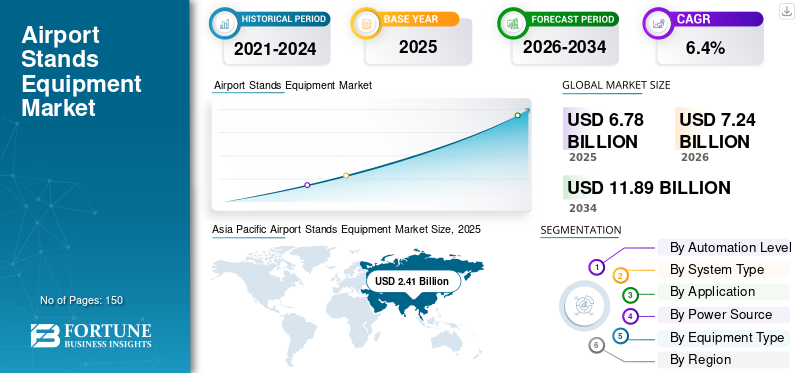
The global airport stands equipment market size was valued at USD 6.78 billion in 2025. The market is projected to grow from USD 7.24 billion in 2026 to USD 11.89 billion by 2034, exhibiting a CAGR of 6.4% during the forecast period. Asia Pacific dominated the global market with a market share of 35.39% in 2025.
The market covers gate and apron systems that enable safe aircraft docking, passenger boarding, and efficient ground servicing such as passenger boarding bridges, stand guidance, 400Hz ground power, PCA, monitoring and adjacent stand GSE/utilities. The market growth is due to airport expansion in high-growth regions and retrofit programs across mature industries where aging infrastructure needs replacement. Additionally the focus on decarbonize and decongest with electrifying gates, digitizing stand operations, and improving reliability to protect on-time performance also contributes to the market growth. Over time, more automated and connected systems will increase utilization and reduce turnaround variability.
CIMC Tianda, TK Elevator, ADELTE, Oshkosh AeroTech, Textron GSE, TLD, ITW GSE, GUINAULT, ADB SAFEGATE, and Cavotec compete on reliability, integration capability and lifecycle service support.
Download Free sample to learn more about this report.
AIRPORT STANDS EQUIPMENT MARKET KEY TAKEAWAYS
 Global Market Size & Forecast
- 2025 Market Size: USD 6.78 billion
- 2026 Market Size: USD 7.24 billion
- 2034 Forecast Market Size: USD 11.89 billion
- CAGR: 6.4% from 2026–2034
 Market Share
- Asia Pacific dominated the global market with a market share of 35.39% in 2025.
- The Semi-Automated segment is anticipated to rise with a CAGR of 6.5% over the forecast period.
- The communication and navigation systems segment is projected to grow at a CAGR of 7.0% over the forecast period.
 Key Regional Highlights
North America
In 2025, the North America market value stood at USD 1.55 billion and is estimated to reach USD 1.65 billion in 2026.
Europe
Europe is projected to record a growth rate during the forecast period of 5.6%.
Asia Pacific
Asia Pacific held the dominant share in 2024, valuing at USD 2.24 billion, and also maintained the leading share in 2025, with USD 2.41 billion.
U.S.
U.S. market can be analytically approximated at around USD 1.35 billion in 2026.
Japan
The Japan market share in 2026 is estimated at around USD 0.38 billion, accounting for roughly 6.3% of CAGR during the forecast period.
Read More

AIRPORT STANDS EQUIPMENT MARKET TRENDS
Stand Electrification and Connected Gates is Emerging Market Trend
Airports are shifting from isolated equipment purchases to integrated, data-driven stand ecosystems. Gate electrification (400Hz and PCA) is increasingly bundled with monitoring, docking guidance and energy management to cut APU runtime, reduce emissions and stabilize turnaround performance. Similarly, more airports are standardizing equipment specifications across terminals to simplify maintenance and spares, while pushing suppliers toward modular designs that can be installed with minimal disruption. Another clear trend is lifecycle contracting airports and handlers want uptime guarantees, remote diagnostics and faster service response rather than only upfront capex deals.
Download Free sample to learn more about this report.
MARKET DYNAMICS
MARKET DRIVERS
Gate Electrification and Turnaround-Time Pressure are Driving Market Growth
Airports are upgrading stand equipment as they need faster, more predictable turnarounds while cutting local emissions. Gate electrification 400Hz ground power and pre-conditioned air reduces APU use, fuel burn, noise and maintenance, making it one of the clearest ROI levers at busy gates. At the same time, rising passenger volumes and tighter on-time performance targets push investment in safer, more digital stand operations such as docking guidance, monitoring, and integrated control. For airports, these upgrades improve capacity without building new runways, and for ground handlers they reduce operating cost per turn. These factors collectively boost the Airport Stands Equipment market growth.
MARKET RESTRAINTS
High Capex, Civil-Works Disruption and Long Procurement Cycles are Key Market Restraints
Stand equipment projects are capital intensive and often require civil works, power upgrades, and shutdown planning at active gates so airports delay decisions or phase programs over many years. Procurement is also slow as stakeholders (airport operator, airline, ground handler, regulator) and technical specifications can be rigid, especially for safety-critical systems. In emerging markets, funding constraints and currency volatility can postpone modernization even when demand exists. Finally, equipment standardization varies by airport, creating customization and integration work that increases cost and lengthens delivery schedules.
MARKET OPPORTUNITIES
Retrofitting Existing Gates with Power, Cooling and Smart Controls Are Market Opportunity
The market opportunity lies in replacement and retrofit demand. High-utilization fleets wear mounts faster, and operators increasingly replace “just-in-time” to avoid knock-on failures and downtime. Cabin refresh programs, avionics upgrades and adding new antennas/sensors create fresh isolation needs even on mid-life aircraft. Additionally, rapid capability insertions EW, ISR pods, SATCOM and mission computers often trigger new mounting and shock/vibration redesign. Suppliers that can offer drop-in qualified alternatives, faster lead times, and repairable or re-bushable designs can win recurring revenue. The real prize is bundling mounts with installation kits, field support and reliability analytics.
MARKET CHALLENGES
Integration Complexity and Grid/Charging Readiness Are Major Market Challenges
The toughest execution risk is integration stand equipment must work with airport IT/OT networks, gate management, safety systems and airline procedures without creating downtime. Cybersecurity and data governance requirements add friction as more stand assets become connected. Electrification also exposes grid constraints such as insufficient power capacity, transformer limitations, and the need for coordinated charging strategies for electric GSE. Supply-chain lead times for power electronics, cables and controls can further stretch schedules. Airports that underestimate commissioning, training and spares planning often see delayed benefits and higher total cost.
Segmentation Analysis
By Automation Level
Manual Segment Dominates Due to Lower Capex and Easier Maintenance
Based on the automation level, the market is segmented into Semi-Automated, Fully Automated, and Manual.
The manual segment is anticipated to account for the largest market share. Manual operations still dominate many stands, especially at smaller airports, due to lower capex and simpler maintenance. There is also a growing demand for rugged, easy-to-service equipment, though automation gradually replaces it at busier gates.
The Semi-Automated segment is anticipated to rise with a CAGR of 6.5% over the forecast period.
By System Type
Security & Surveillance Segment Leads Due to Higher Threat Awareness and Operational Visibility Needs
Based on System Type, the market is segmented into Conveyor Systems, Elevators and Escalators, Communication and Navigation Systems, Security and Surveillance Systems, and Other Systems.
In 2025, the Security and Surveillance Systems segment held highest airport stands equipment market share. This is attributed to airports harden perimeters, monitor stands, and manage crowd risk. Upgrades focus on integrated cameras, analytics, access control and real-time alerting that ties into airport operations centers.
The communication and navigation systems segment is projected to grow at a CAGR of 7.0% over the forecast period.
By Application
Passenger Handling Segment Dominates Due to Terminal Congestion and Service-Level Pressure
Based on the application, the market is segmented into Cargo Handling, Passenger Handling, Ground Operations, Security and Safety and Maintenance and Repair.
The passenger handling segment is anticipated to witness a dominating market share over the forecast period. Passenger handling demand tracks terminal congestion and service quality targets. Airports invest in faster boarding and queuing solutions, smarter gates and equipment that reduces turnaround time while improving accessibility and on-time performance.
The Security and Safety segment is projected to grow at a high CAGR of 7.6% over the forecast period.
To know how our report can help streamline your business, Speak to Analyst
By Power Source
Electric Segment Demand Accelerates Due to Decarbonization Targets and Fuel/Noise Cost Pressure
Based on Power Source, the market is segmented into Electric, Hydraulic, Diesel, Solar, and Hybrid.
The Electric segment dominated the market share. This is due to airport decarbonization plans and operating-cost pressure. Gate electrification (400Hz and PCA) reduces APU use, while electric ramp equipment cuts local emissions and improves noise performance.
In addition, Solar are projected to grow at a CAGR of 7.2% during the study period.
By Equipment Type
Ground Support Equipment Demand Sustains Due to Faster Turnarounds and Fleet Replacement Cycles
Based on Equipment Type, the market is segmented into Apron Equipment, Baggage Handling Equipment, Passenger Boarding Systems, Ground Support Equipment, and Utilities Equipment.
The Ground Support Equipment segment dominated the market share. This is driven by turnaround speed and fleet replacement needs. Airports and handlers increasingly adopt electric tugs, loaders and tractors where charging infrastructure exists, while keeping mixed fleets for heavy-duty or remote stands.
In addition, utilities equipment segment is projected to grow at a CAGR of 7.3% during the study period.
Airport Stands Equipment Market Regional Outlook
By geography, the market is categorized into North America, Europe, Asia Pacific and Rest of the World.
North America
Asia Pacific Airport Stands Equipment Market Size, 2025 (USD Billion)
To get more information on the regional analysis of this market, Download Free sample
In 2025, the North America market value stood at USD 1.55 billion and is estimated to reach USD 1.65 billion in 2026 and secure the position of second largest region in the market. North American demand is driven by gate modernization, terminal refurbishments, and electrification at major hubs. Expenditure prioritizes reliability, safety and faster turnarounds, with steady replacement of aging bridges, GPUs and stand systems.
U.S Airport Stands Equipment Market
Based on North America’s strong U.S. market can be analytically approximated at around USD 1.35 billion in 2026, accounting for roughly 6.1% of CAGR. The market growth is anchored in large hub retrofits and federally supported infrastructure programs. Airports prioritize gate power and cooling upgrades, passenger flow and ramp efficiency, with procurement emphasizing lifecycle cost and uptime.
Europe
Europe is projected to record a growth rate during the forecast period of 5.6%, which is the third highest among all regions, and reach a valuation of USD 2.02 billion by 2026. Europe’s demand is shaped by stricter sustainability targets and noise/emissions control at airports. Operators invest in 400Hz and PCA upgrades, smarter stand guidance, and security systems, while balancing tight procurement and lengthy approvals.
U.K Airport Stands Equipment Market
The U.K. market growth in 2026 is estimated at around USD 0.32 billion, representing roughly 5.7% CAGR. This concentrates on capacity optimization rather than new-build scale. Airports invest in boarding bridge reliability, stand electrification, security upgrades, and smoother passenger handling, especially around constrained runway and terminal operations.
Germany Airport Stands Equipment Market
Germany’s market is projected to reach approximately USD 0.39 billion in 2026. This growth is modernization-heavy, focused on energy-efficient gate systems and high-reliability passenger infrastructure. Projects emphasize compliance, security and electrification, with careful supplier qualification and integration into existing terminals.
Asia Pacific
Asia Pacific held the dominant share in 2024, valuing at USD 2.24 billion, and also maintained the leading share in 2025, with USD 2.41 billion. Asia Pacific demand is expanding due to new terminals, new stands and capacity builds at fast-growing airports. Buyers favor scalable stand utilities, automated guidance and high-throughput passenger systems to cut congestion and delays.
Japan Airport Stands Equipment Market
The Japan market share in 2026 is estimated at around USD 0.38 billion, accounting for roughly 6.3% of CAGR during the forecast period. Japan demand is growing due to replacement cycles, resilience upgrades and smoother passenger movement. Airports invest in safety/security modernization and efficient stand utilities, with strong preference for proven systems and low-disruption installation.
China Airport Stands Equipment Market
China’s market is projected to be one of the largest in Asia Pacific, with 2026 revenues estimated at around USD 0.92 billion. China demand remains volume-driven due to large airports and expanding regional networks keep ordering stand systems and passenger infrastructure. Buyers increasingly specify automated stand guidance, integrated surveillance and standardized electric utilities across new gates.
India Airport Stands Equipment Market
The India market in 2026 is estimated at around USD 0.55 billion. India demand is expanding due to more stands, faster turnarounds and higher passenger throughput. Airports prioritize cost-effective electrification, robust ground equipment and security systems that can scale quickly across new terminals.
Rest of the World
The rest of the world include Middle East & Africa and Latin America. These regions are expected to witness moderate growth in this market space during the forecast period. The Middle East & Africa and Latin America market is set to reach a valuation of USD 0.62 billion and USD 0.37 billion in 2026. Rest of the World demand is uneven but rising in Gulf mega-hubs and select African upgrades, plus Latin American renewals. Projects focus on stand utilities, safety/security and rugged equipment with easier maintenance.
COMPETITIVE LANDSCAPE
Key Industry Players
Airport Electrification and Digital Stand Modernization Are Powering Key Player Growth
Growth among key players is increasingly tied to airport electrification, digital stand operations, and lifecycle service contracts. CIMC Tianda, TK Elevator and ADELTE benefits from new terminal builds and passenger boarding bridge replacements, while Oshkosh AeroTech, Textron GSE, TLD, ITW GSE and GUINAULT ride the shift toward electric and hybrid ground fleets, charging ecosystems, and higher equipment utilization. ADB SAFEGATE gains from airport-wide upgrades in airfield/stand safety, guidance, and integrated monitoring, where compliance and reliability drive repeat business. Cavotec is well-positioned where airports prioritize gate power distribution, cable management, and energy optimization turning “decarbonize and decongest” programs into multi-year order backlogs.
LIST OF KEY AIRPORT STANDS EQUIPMENT COMPANIES PROFILED
- CIMC Tianda (China)
- TK Elevator (Germany)
- ADELTE Group (Spain)
- Oshkosh AeroTech (U.S.)
- Textron GSE (U.S.)
- TLD Group (France)
- ITW GSE (Denmark)
- GUINAULT (France)
- ADB SAFEGATE (Belgium)
- Cavotec (Switzerland)
KEY INDUSTRY DEVELOPMENTS
- July 2024: CVC DIF (via CVC’s CIF III fund) signed and completed a deal to buy HiSERV, a major German aviation GSE leasing provider, from AVECO Holding.
- June 2024: IATA launched a push to speed up adoption of Enhanced GSE, including the IATA Enhanced GSE Recognition Programme to highlight ground handlers leading fleet modernization.
- May 2024: dnata announced major agreements with leading OEMs at the Dubai Airport Show, setting up five-year global framework contracts for new GSE worth over USD 210 million across the contract period.
- April 2024: Mallaghan introduced the SkyBelt, an advanced conventional belt loader. Production is planned at its sites in Dungannon, Northern Ireland, and Atlanta, Georgia, positioning it as a notable step forward in baggage-loader design.
- March 2023: Institut Teknologi Sepuluh Nopember (ITS) and PT GMF AeroAsia rolled out two eco-friendly GSE developments: an electric RC pushback tug and a material-handling vehicle.
REPORT COVERAGE
The Airport Stands Equipment market report provides a detailed snapshot of market size and forecasts across all included segments. It explains what’s driving demand, what’s holding it back, where the opportunities are, and the trends most likely to shape growth over the forecast period. It also uses Porter’s Five Forces to assess competitive pressure and the negotiating leverage of suppliers and customers. The report examines retrofit and cabin-upgrade activity that can lift aftermarket demand, and it tracks key competitive moves such as partnerships, strategic deals, M&A, and other notable developments. It compares regional footprint across major geographies and closes with a competitive landscape featuring estimated market shares and profiles of the leading companies.
Request for Customization to gain extensive market insights.
Report Scope & Segmentation
|
ATTRIBUTE |
DETAILS |
|
Study Period |
2021-2034 |
|
Base Year |
2025 |
|
Estimated Year |
2026 |
|
Forecast Period |
2026-2034 |
|
Historical Period |
2021-2024 |
|
Growth Rate |
CAGR of 6.4% from 2026-2034 |
|
Unit |
Value (USD Billion) |
|
Segmentation |
By Automation Level, By System Type, By Application, By Power Source, and Region |
|
By Automation Level |
· Semi-Automated · Fully Automated · Manual |
|
By System Type |
· Conveyor Systems · Elevators and Escalators · Communication and Navigation Systems · Security and Surveillance Systems · Other Systems |
|
By Application |
· Cargo Handling · Passenger Handling · Ground Operations · Security and Safety · Maintenance and Repair |
|
By Power Source |
· Electric · Hydraulic · Diesel · Solar · Hybrid |
|
By Equipment Type |
· Apron Equipment · Baggage Handling Equipment · Passenger Boarding Systems · Ground Support Equipment · Utilities Equipment |
|
By Region |
· North America (By Automation Level, System Type, Application, Power Source, Equipment Type and Country) o U.S. (Automation Level) o Canada (Automation Level) · Europe (By Automation Level, System Type, Application, Power Source, Equipment Type and Country/Sub-region) o U.K. (Automation Level) o Germany (Automation Level) o France (Automation Level) o Russia (Automation Level) o Rest of Europe (Automation Level) · Asia Pacific (By Automation Level, System Type, Application, Power Source, Equipment Type, and Country/Sub-region) o China (Automation Level) o India (Automation Level) o Japan (Automation Level) o Rest of Asia Pacific (Automation Level) · Rest of the World (By Automation Level, System Type, Application, Power Source, Equipment Type, and Country/Sub-region) o Middle East & Africa (Automation Level) o Latin America (Automation Level) |
Frequently Asked Questions
According to Fortune Business Insights, the global market value stood at USD 6.78 billion in 2025 and is projected to reach USD 11.89 billion by 2034.
In 2025, the market value stood at USD 1.55 billion.
The market is expected to exhibit a CAGR of 6.4% during the forecast period of 2026-2034.
By application, Passenger Handling segment is expected to dominate the market.
Gate Electrification and Turnaround-Time Pressure are driving the Market Growth
CIMC Tianda, TK Elevator, ADELTE Group, Oshkosh AeroTech, Textron GSE, TLD Group are few major players in the global market.
Asia Pacific dominated the market in 2025.



- 2021-2034
- 2025
- 2021-2024
- 150
Get 30-60 hrs Free Customization
Expand Regional and Country Coverage, Segments Analysis, Company Profiles, Competitive Benchmarking, and End-user Insights.




















Related Reports
-
US +1 833 909 2966 ( Toll Free )
-
Get In Touch With Us