Alternative Accommodation Market Size, Share & Industry Analysis, By Type (Vacation Rentals, Hostels, Homestays, Camping, and Others), By Booking Mode (Online and Offline), and Regional Forecast, 2026-2034
 Download Free Sample
(Offer valid till 30th Sep 2026)

KEY MARKET INSIGHTS
 Listen to Audio Version
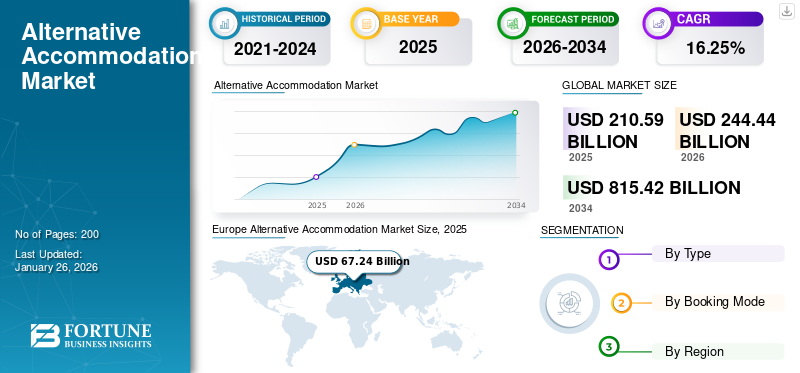
The global alternative accommodation market size was valued at USD 210.59 billion in 2025 and is projected to grow from USD 244.44 billion in 2026 to USD 815.42 billion by 2034, exhibiting a CAGR of 16.25% over the forecast period. Europe dominated the alternative accommodation market with a market share of 31.93% in 2025.
Alternative accommodations are properties, such as hostels, homestays, and vacation rentals designed to provide users with affordable living options and unique experiences. They are highly demanded by travelers seeking budget-friendly options. They also provide large spaces suitable for large groups, including adventure and business travelers. Rising interest in exploring new and attractive destinations will trigger the market growth. Furthermore, various prominent players are operating in the market, including MakeMyTrip Limited, Airbnb, Inc., Booking.com, TripAdvisor, Inc., and HomeToGo.
Download Free sample to learn more about this report.
Alternative Accommodation Market Key Takeaways
 Global Market Size & Forecast
- 2025 Market Size: USD 210.59 billion
- 2026 Market Size: USD 244.44 billion
- 2034 Forecast Market Size: USD 815.42 billion
- CAGR: 16.25% from 2026–2034
 Market Share
- Europe dominated the market with a 31.93% share in 2025.
- Vacation Rentals segment is expected to account for 44.41% of the market in 2026.
- Online booking mode is expected to account for 78.67% of the market in 2026.
 Key Regional Highlights
North America
The market reached USD 55.24 billion in 2025 and is projected to reach USD 64.43 billion in 2026.
Asia Pacific
The market reached USD 45.57 billion in 2025 and is projected to reach USD 53.63 billion in 2026.
Europe
The market reached USD 67.24 billion in 2025 and is projected to reach USD 77.83 billion in 2026.
U.S.
The market is projected to reach USD 41.30 billion by 2026.
Japan
The market is projected to reach USD 6.64 billion by 2026.
Read More

Alternative Accommodation Market Trends
Increasing Demand for Unique Lodgings to Boost Market Growth
In recent years, travelers' preferences for accommodation have changed. Individuals are seeking options that provide a more personalized experience and home comfort, which increases the popularity of non-traditional accommodations that align with the user's priorities. Moreover, travelers, notably millennials and Gen Z, demand unique accommodations, such as tree-houses and boathouses, which go beyond traditional stays and enhance the overall travel experience. As a result, developing unique accommodation properties assists market players in appealing to modern travelers and accelerates the market’s growth.
- Europe witnessed alternative accommodation market growth from USD 50.27 billion in 2023 to USD 58.12 billion in 2024.
Download Free sample to learn more about this report.
MARKET DYNAMICS
Market Drivers
Increasing Number of Travelers to Drive Accommodation Demand
Numerous individuals travel across the world for various purposes, including business, attending events, seeking adventure, and pursuing specific interests. The number of travelers is increasing with rising disposable incomes, availability of affordable travel options, and focus on exploring new destinations. For instance, according to the International Trade Administration, a U.S.-based government agency promoting investment and trade, in 2023, international visitor arrivals in the U.S. stood at 66.5 million, a 31% or 15.7 million increase compared to 2022 (50.8 million). In this respect, the growing number of travelers will drive the demand for multiple affordable accommodation properties, supporting the global alternative accommodation market growth.
Increasing Investment in Tourism to Fuel Market Expansion
Governments across the world are prioritizing investing in tourism as it assists in economic growth. For instance, in August 2024, the U.S. Department of Commerce offered funds worth around USD 1.2 million to increase tourism in Cuero, Texas. The investment will also assist in business growth across the region. Such government investments increase cultural, adventure, sports, and MICE tourism, contributing to the market's growth. Furthermore, changing lifestyles, awareness regarding attractive tourist destinations, and increasing spending on adventure is boosting the number of tourists. As tourist footfall in countries increases, the demand for accommodations, such as homestays, hostels, short term rentals, and camping raises will also rise.
Market Restraints
High Preference for Hotels to Impede Market Growth
A sizable number of travelers globally prefer hotels for staying during their trip instead of non-traditional accommodations as hotels provide multiple amenities and services, such as restaurants, housekeeping, spas, fitness centers, and high-end décor. Hotels and resorts are also considered safer and more comfortable stay options. Alternative lodgings provide limited facilities, and guests typically have to manage their meals and laundry during their stay. These factors increase consumer inclination toward traditional hotels and resorts, declining the demand for non-traditional options, which impedes the market expansion.
Market Opportunity
Online Booking Systems to Provide Market Growth Opportunities
Recent years have witnessed growth of online accommodation booking systems, such as online travel agents, social media pages, websites, and rental portals including Airbnb, Makemytrip, Goibibo, and Booking.com. Rising technological awareness, easy accessibility, and convenience have resulted in an increasing interest in these online systems, which provides growth opportunities to industry participants. Non-traditional accommodation providers can focus on developing their social media pages and making their websites user-friendly and attractive to appeal to more customers. Furthermore, collaborating with prominent online travel agents will help market players expand their customer base.
Market Challenges
Safety Concerns and Variability in Standards to Hamper Demand
Safety concerns related to non-traditional accommodation properties, such as fire safety, hygiene, access to emergency services, and security reduce interest in them and negatively influence the global alternative accommodation market forecast. Furthermore, unique lodgings, such as homestays, hostels, and camping can be differentiated widely in terms of comfort, facilities, and quality. In this respect, variability in standards is a significant factor hampering the demand for non-traditional accommodations. Moreover, the limited availability of these properties compared to resort and hotel chains can impede the industry's expansion.
Impact of COVID-19
The COVID-19 outbreak significantly declined the demand for alternative accommodations due to a considerable dip in global travel. Numerous tourist destinations across the world were closed to curb the spread of the virus, which sharply reduced the number of guests in accommodation properties. Individuals also prevented traveling and staying in hostels, homestays, and vacation rentals due to hygiene and safety reasons, notably in 2020. However, the global industry gradually started recovering as restrictions on travel and social distancing were lifted in several countries in 2021.
SEGMENTATION ANALYSIS
By Type
Comfort, Privacy, and Large Space Accelerated Vacation Rental Segment Growth
Based on type, the market is divided into vacation rentals, hostels, homestays, camping, and others.
The vacation rentals segment is projected to account for 44.41% of the market share in 2026. Vacation rentals include villas, apartments, or cottages that are rented to individuals for a short term. They are designed to provide home-like comfort and typically offer facilities, such as laundry and kitchen. The benefits of these properties, such as privacy and large space make them a preferred choice among large groups of travelers and families, supporting the segment’s growth.
The hostels segment holds the second-largest market share, backed by the affordability of these properties, which makes them popular among budget-conscious individuals, notably across Asian countries. Numerous solo travelers are also interested in hostels as they typically offer shared facilities that provide the opportunity to interact with other individuals and enhance the overall experience.
To know how our report can help streamline your business, Speak to Analyst
By Booking Mode
Convenience & Special Discounts to Support Online Segment Expansion
Based on booking mode, the global market is bifurcated into online and offline.
The online booking mode is expected to represent 78.67% of the total market share in 2026. Numerous tech-savvy individuals prefer online booking channels, such as online travel agencies and direct website bookings due to their flexibility and convenience. They are easily accessible and assist travelers in comparing prices. Furthermore, special discounts and secure payment options provided by online booking channels will drive the segment's expansion. The online segment is anticipating to hold the market share in 2025 by 78.37%.
Offline accommodation booking reduces the risk of miscommunication and can offer expert advice and personal services. These factors contribute to the offline segment's growth. The offline accommodation is expected to exhibit a CAGR of 14.55% during the forecast period.
Alternative Accommodation Market Regional Outlook
Geographically, the global market is segmented into North America, Europe, Asia Pacific, South America, and the Middle East & Africa.
Europe
Europe Alternative Accommodation Market Size, 2025 (USD Billion)
To get more information on the regional analysis of this market, Download Free sample
Europe market size led the market in 2024 with USD 58.12 billion and in 2023, USD 50.27 billion. Europe leads the global alternative accommodation market share driven by high tourism in countries, such as France, Germany, the U.K, Spain, and Italy. The presence of numerous tourist destinations across the region, such as the Eiffel Tower, the Tower of London, the Tower of Pisa, the British Museum, and Disneyland Paris, has increased tourism in Europe and escalated the demand for alternative lodgings. For instance, according to Eurostat, a Luxembourg-based government agency providing statistical data, in 2022, approximately 62% of European individuals made at least one personal tourism trip. The UK market is projected to reach USD 11.87 billion by 2026, while the Germany market is projected to reach USD 12.77 billion by 2026. The Europe market was valued at USD 67.24 billion in 2025, capturing 31.93% of global revenue, and is estimated to reach USD 77.83 billion in 2026.
Asia Pacific
Asia Pacific is anticipated to be the third-largest market with USD 45.57 billion in 2025, and record the highest CAGR during the forecast period. Growing awareness regarding numerous attractive destinations in countries, such as Thailand, Vietnam, Maldives, Singapore, and China is expected to increase the number of guests in non-traditional accommodations in the region. Rapidly growing population and easy availability of affordable travel options are also expected to increase the demand for lodging properties in the region. In addition, increasing consumer spending power and expansion of online accommodation booking channels will boost the regional market’s growth. The Japan market is projected to reach USD 6.64 billion by 2026, the China market is projected to reach USD 13.38 billion by 2026, and the India market is projected to reach USD 10.98 billion by 2026. In 2025, Asia Pacific held 21.64% of the global market, reaching a valuation of USD 45.57 billion, and is projected to grow to USD 53.63 billion in 2026.
North America
North America held the second-largest market share in 2024, benefitting from the increasing number of individuals traveling in the region for purposes, such as business and adventure. North America is proposed to be the second-largest market with USD 55.24 billion in 2025, exhibiting the second-largest CAGR of 16.76% during the forecast period. High consumer disposable income and changing lifestyles will also trigger the regional market’s growth. In addition, governments emphasizing increasing investment to accelerate tourism will fuel the demand for alternative accommodations. The U.S. is the most prominent market in North America, backed by growing demand for unique and affordable accommodation properties, especially among the youth. The country also has a strong travel infrastructure, including airports, roads, and ports. In addition, key travel companies play a key role in increasing consumers’ knowledge regarding attractive non-traditional accommodation facilities in the U.S. The U.S. market is projected to acquire USD 35.25 billion in 2025. For instance, in March 2024, Vrbo, a U.S.-based travel website company, introduced its 2024 vacation rentals list, recognizing attractive properties across Arizona, Texas, Florida, and Georgia. The U.S. market is projected to reach USD 41.3 billion by 2026. North America accounted for USD 55.24 billion in 2025, representing 26.23% of the global market share, and is projected to reach USD 64.43 billion in 2026.
South America
South America is projected to gain USD 23.40 billion in 2025, making it the fourth-largest regional market. Rising consumer preference for cost-effective, unique, and personalized accommodation experiences will fuel the South American market’s expansion. Furthermore, the growth of online travel agencies and spending on leisure travel will provide growth opportunities to non-traditional accommodation property operators in South America. Social media influencers' rising knowledge regarding appealing alternative lodging options will also accelerate the regional market’s growth. The South America market accounted for USD 23.4 billion in 2025, representing 11.11% of the global industry, and is expected to reach USD 26.81 billion in 2026.
Middle East & Africa
Robust travel and tourism infrastructure, paired with the increased popularity of outdoor adventure spots, will fuel the Middle East & Africa market’s growth. Moreover, the introduction of new alternative lodging properties will increase the regional market’s expansion in the coming years. The UAE market is anticipated to hit USD 8.55 billion in 2025. For instance, in September 2021, Vista Rooms, an India-based vacation home rental company, introduced new properties in Dubai. Middle East & Africa contributed approximately USD 19.14 billion to the global market in 2025, accounting for 9.09% share, and is expected to reach USD 21.73 billion in 2026.
COMPETITIVE LANDSCAPE
Key Industry Players
Launching New Properties & Providing Various Facilities to Help Market Players Increase Their Customer Base
The global alternative accommodation market includes numerous large-scale and mid-scale players that are prioritizing the launch of new properties at prominent locations across countries to increase the number of guests. Providing multiple facilities, such as laundry, parking, kitchen, air conditioning, pet friendly environment, and outdoor amenities to enhance customer experience will provide alternative lodging property operators with lucrative growth opportunities. Partnering with online travel agents and developing a user-friendly website will also assist industry participants in increasing their global alternative accommodation market share. Moreover, investment in social media marketing and providing special discounts can help them become appealing for potential end users.
List of Key Alternative Accommodation Companies Profiled
- MakeMyTrip Limited (India)
- Airbnb, Inc. (U.S)
- Booking.com (Netherlands)
- TripAdvisor, Inc. (U.S)
- HomeToGo (Germany)
- Vrbo (U.S)
- Trivago N.V. (Germany)
- Trip.com Group Limited (Singapore)
- Wyndham Destinations Inc. (U.S)
- holidu.co.uk (U.K)
KEY INDUSTRY DEVELOPMENTS
- December 2024: Eric Breon, founder of Vacasa, a U.S.-based vacation rental management company, launched Fairly, a vacation rental management startup.
- April 2023: Bob W., a Finland-based accommodation specialist, acquired Charly Hospitality, an apartment rental agency operating in the Netherlands and Germany. The acquisition assisted the company in entering new markets.
- January 2022: HomeToGo SE, a Luxembourg-based vacation rental company, acquired AMIVAC, a France-based vacation rental business.
- April 2021: RESIDE Worldwide, Inc., a U.S.-based alternative accommodation company, collaborated with Homelike, a European prop-tech startup. Under the partnership, Homelike properties were added to 3SIXTY (RESIDE's aggregator platform).
- January 2021: Leisure Hotels Limited, an India-based hospitality company, introduced "the hideaway beds," an alternative accommodation facility in Rishikesh, India. The new property features private sit-outs, smart guest rooms, and premium bunk accommodations.
Investment Analysis and Opportunities
The market report provides comprehensive investment analysis and opportunities in the alternative accommodation industry to provide investors and business leaders with actionable insights. The report also highlights potential investment opportunities, including technology integration, partnerships, collaborations, and geographic expansion.
REPORT COVERAGE
The report analyzes the market in-depth and highlights crucial aspects, such as prominent companies, types, and booking modes. Besides this, it also provides insights into the world travel market, along with market share and market trends analysis.
Request for Customization to gain extensive market insights.
Report Scope & Segmentation
|
ATTRIBUTE |
DETAILS |
|
Study Period |
2021–2034 |
|
Base Year |
2025 |
|
Estimated Year |
2026 |
|
Forecast Period |
2026-2034 |
|
Historical Period |
2021–2024 |
|
Growth Rate |
CAGR of 16.25% from 2026 to 2034 |
|
Unit |
Value (USD Billion) |
|
Segmentation |
By Type
|
|
By Booking Mode
|
|
|
By Region
|
Frequently Asked Questions
According to Fortune Business Insights, the global alternative accommodation market size was valued at USD 210.59 billion in 2025 and is projected to grow to USD 815.42 billion by 2034, exhibiting a CAGR of 16.25% during the forecast period.
Recording a CAGR of 16.25% , the global market will exhibit steady growth over the forecast period.
Alternative accommodations refer to non-traditional lodging options such as hostels, homestays, vacation rentals, and camping sites that offer travelers affordable and unique living experiences outside of typical hotels and resorts.
Key drivers include the increasing number of global travelers, rising disposable incomes, government investments in tourism infrastructure, and growing demand for personalized and affordable lodging experiences.
Europe leads the market with a 32.02% share as of 2024, supported by high tourism in countries like France, Germany, and the U.K. Asia Pacific is anticipated to record the highest CAGR, fueled by growing awareness of attractive travel destinations and increasing consumer spending.
Challenges include safety concerns, variability in standards of accommodations, limited availability compared to hotels, and a strong consumer preference for traditional hotel amenities and services.
Trends include the rising demand for unique and personalized lodging options like treehouses and boathouses, the growth of online booking platforms, and the increasing focus on sustainable and experience-driven travel.



- 2021-2034
- 2025
- 2021-2024
- 200
-
(Offer valid till 30th Sep 2026)
Get 30-60 hrs Free Customization
Expand Regional and Country Coverage, Segments Analysis, Company Profiles, Competitive Benchmarking, and End-user Insights.



















Related Reports
-
US +1 833 909 2966 ( Toll Free )
-
Get In Touch With Us