Ammonium Phosphate Market Size, Share & Industry Analysis, By Product Type (Monoammonium Phosphate (MAP), Diammonium Phosphate (DAP), Ammonium Polyphosphate (APP), and Others), By Application (Fertilizers, Flame Retardants, Water Treatment, Feed & Food-Grade Uses, Industrial Processing, and Others), and Regional Forecast, 2026-2034
 Download Free Sample
Ammonium Phosphate Market Size and Future Outlook
 Listen to Audio Version
The global ammonium phosphate market size was valued at USD 106.67 billion in 2025. The market is projected to grow from USD 114.58 billion in 2026 to USD 182.48 billion by 2034, exhibiting a CAGR of 6.0% during the forecast period. Asia Pacific dominated the ammonium phosphate market with a market share of 54.36% in 2025.
Ammonium phosphate refers to phosphate-based ammonium salts used as high-analysis fertilizers and, to a smaller extent, in flame-retardant systems, water-treatment formulations, feed and food-grade phosphate applications, and selected industrial processes. Commercial demand centers on Monoammonium Phosphate (MAP), Diammonium Phosphate (DAP), Ammonium Polyphosphate (APP), and other specialty ammonium phosphate grades. These products are supplied in solid and liquid forms depending on nutrient profile, handling characteristics, and application requirements.
The market is growing due to the need for concentrated phosphorus nutrition in cereals, oilseeds, plantation crops, and horticulture, and the agronomic importance of nitrogen-phosphorus fertilizers in large-scale crop systems. The growth in the market is supported by nutrient-efficiency programs, fertilizer-blending flexibility, and the role of MAP and DAP in global phosphate trade and domestic food-security strategies.
The market comprises several major players, including The Mosaic Company, OCP Group, Nutrien Ltd., Yara International ASA, and EuroChem Group, along with regional phosphate producers and compound-fertilizer suppliers serving agriculture, feed phosphates, and selected specialty applications. Integrated rock-to-acid-to-fertilizer value chains, strong export infrastructure, feedstock security, product mix, and extensive distribution networks support the competitive positioning of these companies within the global market.
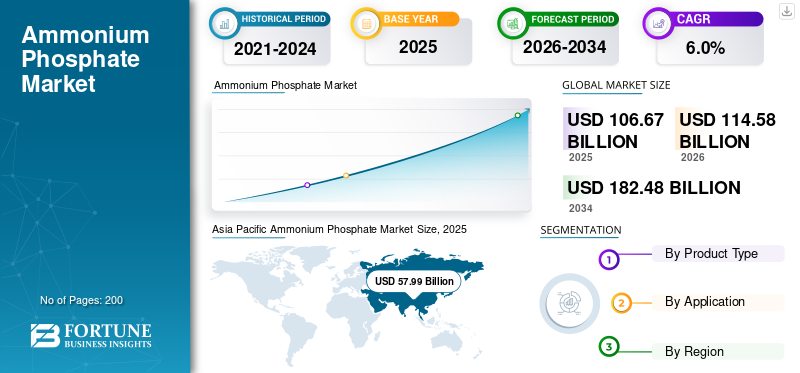
Download Free sample to learn more about this report.
Ammonium Phosphate Market Key Takeaways
 Market Size & Forecast
- 2025 Market Size: USD 106.67 billion
- 2026 Market Size: USD 114.58 billion
- 2034 Forecast Market Size: USD 182.48 billion
- CAGR: 6.0% from 2026–2034
 Market Share
- Asia Pacific dominated the ammonium phosphate market with a 54.36% share in 2025.
- The diammonium phosphate segment accounted for the largest market share of 29.2% in 2025.
- The fertilizers segment led the market with an 89.5% share in 2025.
 Key Regional Highlights
Asia Pacific
Reached USD 57.99 billion in 2025 and is projected to reach USD 62.77 billion in 2026, driven by agriculture and fertilizer demand.
North America
Projected to reach USD 11.12 billion in 2026, supported by phosphate fertilizer use and processing capacity.
Europe
Expected to reach USD 14.41 billion in 2026 at a CAGR of 4.4%, driven by nutrient efficiency demand.
U.S
Reached USD 8.62 billion in 2025, supported by strong agriculture and phosphate product demand.
Japan
Growth is supported by stable fertilizer demand and regional supply integration.
Read More

AMMONIUM PHOSPHATE MARKET TRENDS
Sustained Use of MAP and DAP in Field Crops is a Significant Market Trend
Demand is increasingly shaped by crop-intensity requirements, nutrient-use-efficiency priorities, and trade realignment across major importing and exporting regions. Large agricultural markets continue to prioritize concentrated phosphate fertilizers that offer high nutrient density, compatibility with blending systems, and broad agronomic acceptance. This trend supports the sustained use of MAP and DAP in field crops and plantation systems, as procurement strategies become more responsive to freight economics, fertilizer subsidy frameworks, and the availability of alternative phosphate-bearing products.
Alongside bulk fertilizer demand, manufacturers are placing greater attention on APP-based liquid nutrition programs, specialty flame-retardant systems, and value-added feed or technical grades that can improve realization beyond bulk fertilizer markets. Portfolio strategies increasingly emphasize upstream integration, product differentiation, and distribution flexibility to manage cyclicality in the phosphate chain. As food security, soil productivity, and input-efficiency targets remain central across agricultural systems, suppliers are also highlighting agronomic performance, formulation versatility, and logistics reliability to strengthen customer retention.
- For instance, MAP and DAP remain two of the most widely used phosphorus fertilizers globally, while APP continues to retain relevance in liquid fertilizer formulations and intumescent flame-retardant systems.
MARKET DYNAMICS
MARKET DRIVERS
Download Free sample to learn more about this report.
Role of Ammoniated Phosphates in International Trade Drives Market Growth
Fertilizers remain the dominant demand center for ammonium phosphate, supported by the need to supply phosphorus and nitrogen in concentrated, transport-efficient forms across major agricultural regions. MAP and DAP are widely used in cereals, oilseeds, plantation crops, and horticulture as they combine nutrient density with broad compatibility for direct application and fertilizer-blending systems. This creates a large and relatively resilient demand base across regions where soil phosphorus replenishment and crop-yield optimization remain strategic priorities.
Beyond conventional fertilizer use, liquid nutrition programs built around APP, technical phosphate applications, and selected feed-grade uses continue to support ammonium phosphate market growth. Producers are expanding product flexibility, logistics reach, and agronomic positioning to improve market access in geographies where fertilizer timing, subsidy systems, and seasonal crop rotations shape buying behavior. Demand is further reinforced by the role of ammoniated phosphates in international trade, particularly where domestic phosphate processing capacity is limited.
- For instance, ammoniated phosphate fertilizers continue to be prioritized in import-dependent agricultural markets, as they offer nutrient concentration, relatively efficient transport economics, and well-established crop response profiles.
MARKET RESTRAINTS
Freight-rate Volatility and Export Restrictions Can Restrict Market Expansion
Despite their essential role in modern crop systems, the ammonium phosphate market remains sensitive to volatility in the economics of key upstream feedstocks, including ammonia, sulfur, phosphate rock, and phosphoric acid. Production costs can rise quickly when upstream feedstocks tighten or when energy markets disrupt ammonia availability, reducing pricing stability for MAP, DAP, and APP. In addition, freight-rate volatility, export restrictions, sanctions risk, and policy-driven procurement measures can distort regional availability and complicate purchasing decisions for import-reliant markets.
Application-specific substitution also presents a restraint in certain regions. Compound fertilizers, NPK blends, TSP, SSP, and crop-specific nutrient programs may reduce the intensity of direct MAP or DAP use depending on agronomic practice, local subsidy structures, and price relationships. These factors can lengthen buying cycles, increase channel inventory risk, and put pressure on supplier margins during periods of unstable nutrient pricing.
MARKET OPPORTUNITIES
Wider Adoption of Liquid Fertilizer Programs to Create Lucrative Growth Opportunities
Opportunities are emerging from precision agriculture, higher-value cropping systems, and the wider adoption of liquid fertilizer programs to improve nutrient placement and operational efficiency. APP benefits from these trends due to its compatibility with fluid fertilizer systems used in row crops and specialty agriculture, while MAP and DAP remain central to blended and direct-application programs. Markets that are modernizing fertilizer distribution networks and strengthening agronomic advisory services can therefore support higher-value product positioning and stronger customer stickiness.
Additional opportunities are developing in feed phosphates, technical-grade phosphates, and non-halogen flame-retardant systems where ammonium phosphate chemistries can provide differentiated performance. Suppliers that combine upstream integration with formulation support, reliable delivery, and crop-specific guidance are better positioned to capture incremental value in both mainstream and specialty channels. These capabilities support improved conversion rates, pricing resilience, and customer loyalty, especially in regions with complex sourcing conditions.
MARKET CHALLENGES
Increasingly Focused On Nutrient Efficiency to Hamper Market Growth
Producers and distributors in the market must navigate anti-dumping duties, fertilizer subsidy adjustments, evolving nutrient management regulations, and country-specific product registration requirements while responding to shifting farm economics. These factors create uncertainty around inventory timing, import planning, and customer contracting, particularly for regions with limited domestic phosphate capacity.
In addition, end users are increasingly focused on nutrient efficiency, balanced fertilization, and total input cost rather than simply maximizing tonnage. This shift requires suppliers to need strong agronomic support, dependable supply chains, and offer a flexible product portfolio to maintain customer confidence while sustaining long-term growth. Specialty uses, such as flame retardants and feed phosphate uses, also require higher consistency, technical validation, and application assurance than bulk fertilizer channels.
Segmentation Analysis
By Product Type
Diammonium Phosphate (DAP) Segment Dominated Due to its Broad Use in Large-acreage Agriculture
Based on product type, the market is segmented into monoammonium phosphate (MAP), diammonium phosphate (DAP), ammonium polyphosphate (APP), and others.
The diammonium phosphate segment accounted for the largest ammonium phosphate market share of 29.2% in 2025. The segment’s growth is driven by its broad use in large-acreage agriculture, strong positioning in international phosphate fertilizer trade, and suitability for direct application and blending across grain and oilseed crop systems.
The ammonium polyphosphate segment is expected to grow significantly, driven by rising use in liquid fertilizer systems, crop-specific precision nutrition programs, and selected flame-retardant applications where APP offers functionality beyond bulk commodity fertilizer markets. The ammonium polyphosphate (DAP) segment is projected to grow at a 5.9% CAGR during the study period.
By Application
To know how our report can help streamline your business, Speak to Analyst
Fertilizers Segment Dominated the Market Due to the Need to Supply Concentrated Phosphorus
By application, the market is categorized into fertilizers, flame retardants, water treatment, feed & food-grade uses, industrial processing, and others.
The fertilizers segment accounted for the largest share of 89.5% in 2025. The segment’s growth is driven by the need to supply concentrated phosphorus and nitrogen nutrition across large crop systems, plantation crops, and fertilizer-blending chains in both importing and producing regions.
The flame retardants segment is expected to grow at a CAGR of 5.5% over the forecast period. The segment’s demand is driven by the established use of APP in intumescent coatings and related non-halogen flame-retardant systems, where phosphorus-nitrogen chemistry supports fire protection and formulation performance.
Ammonium Phosphate Market Regional Outlook
By geography, the market is categorized into North America, Europe, Asia Pacific, Latin America, and the Middle East & Africa.
Asia Pacific
Asia Pacific Ammonium Phosphate Market Size, 2025 (USD Billion)
To get more information on the regional analysis of this market, Download Free sample
Asia Pacific held the dominant share in 2025, valued at USD 57.99 billion, and is expected to maintain its leading share in 2026, valued at USD 62.77 billion. The region benefits from large-scale agriculture, strong demand for phosphate fertilizers, extensive cereal and oilseed cultivation, and the central role of China and India in global phosphate consumption and trade. China remains the largest market, while India, Japan, South Korea, and the broader Asia Pacific region continue to support demand, driven by crop-intensity requirements, fertilizer subsidies, import programs, and seasonally strong nutrient-application needs.
China Ammonium Phosphate Market
In 2025, the Chinese market reached USD 19.03 billion. China’s market demand is supported by its large agricultural base, a major position in phosphate processing, a strong MAP and DAP production ecosystem, and the sustained use of concentrated phosphate fertilizers across broad-acre crops and compound fertilizer chains.
To know how our report can help streamline your business, Speak to Analyst
North America
North America is also a significant contributor to the market. The region is estimated to reach USD 11.12 billion by 2026, driven by concentrated use of phosphate fertilizer in row crops, the strength of the regional phosphate-processing base, and continued use of APP in fluid fertilizer systems. Application intensity remains strong in the U.S., supported by established crop nutrient programs, integrated production capacity, and technical-service-driven agronomic adoption.
U.S. Ammonium Phosphate Market
In 2025, the U.S. market reached USD 8.62 billion. The U.S. dominates regional consumption due to its large agricultural base, significant phosphate-processing capacity, and established demand for MAP, DAP, and APP across cereals, oilseeds, and fluid-fertilizer programs.
Europe
Europe is expected to experience significant growth in the coming years. During the forecast period, the region is projected to grow at a CAGR of 4.4%, reaching a valuation of USD 14.41 billion in 2026. The market’s growth is supported by demand for efficient phosphate nutrition, continued reliance on imports of ammoniated phosphates, and the use of selected specialty APPs in flame-retardant and technical applications. The region benefits from mature agronomic practices, strong formulation know-how, and an emphasis on nutrient efficiency and supply security.
U.K. Ammonium Phosphate Market
The U.K. market in 2025 reached around USD 1.54 billion, representing approximately 3.8% of global market revenues.
Germany Ammonium Phosphate Market
Germany’s market reached approximately USD 3.08 billion in 2025, accounting for about 4.8% of global sales.
Latin America
Latin America is experiencing steady growth and is expected to reach a valuation of USD 5.65 billion by 2026. The demand is concentrated in large-scale crop production, especially soybeans, corn, and sugarcane, and in plantation agriculture, with relatively high dependence on imported phosphate fertilizers. Strong crop-export economics and nutrient-intensive agricultural systems continue to support regional demand for the product.
Brazil Ammoniated Phosphates Market
Brazil’s market reached approximately USD 3.10 billion in 2025, equivalent to around 5.6% of global sales.
Middle East & Africa
The Middle East & Africa region is gradually expanding, driven by food-security priorities, rising fertilizer use in import-dependent agricultural systems, and the strategic role of regional phosphate producers and exporters. Fertilizers remain the region’s most important application, while feed phosphates and selected technical uses continue to contribute incremental demand growth.
GCC Ammoniated Phosphates Market
GCC reached USD 5.94 billion in 2025, accounting for approximately 5.6% of global revenues. GCC demand is supported by integrated phosphate production, export-oriented value chains, and continued use of in controlled agricultural systems and industrial channels.
COMPETITIVE LANDSCAPE
Key Industry Players
Key Players are Focusing on Expanding Specialty Grades to Maintain Their Positions in the Market
The market includes a mix of integrated phosphate producers, ammoniated fertilizer manufacturers, compound fertilizer suppliers, and feed phosphate specialists that supply bulk and specialty ammonium phosphate products for agricultural and selected industrial end uses. Competition is shaped by access to phosphate rock and ammonia, phosphoric acid integration, freight advantage, distribution strength, agronomic support, and the ability to provide a reliable supply across crop seasons and importing geographies. Leading companies differentiate through rock-to-fertilizer integration, port and terminal infrastructure, blending reach, and the ability to shift product mix between MAP, DAP, feed ingredients, and specialty phosphates. Some key market players include The Mosaic Company, OCP Group, Nutrien Ltd., Yara International ASA, and EuroChem Group.
LIST OF KEY AMMONIUM PHOSPHATE COMPANIES PROFILED
- The Mosaic Company (U.S.)
- OCP Group (Morocco)
- Maaden (Saudi Arabia)
- Nutrien Ltd. (Canada)
- ICL Group Ltd. (Israel)
- Coromandel International Ltd. (India)
- PhosAgro Group (Russia)
- Yara International ASA (Norway)
- EuroChem Group (Switzerland)
- Wengfu & Zijin Chemical Industry Co., Ltd. (China)
- Gujarat State Fertilizers & Chemicals Limited (GSFC) (India)
KEY INDUSTRY DEVELOPMENTS
- July 2024: OCP commissioned a new fertilizer production unit at Jorf Lasfar, adding 1 million metric tons equivalent of DAP capacity, while also progressing Phase I of its TSP Hub program, signaling new phosphate fertilizer supply entering the market.
- May 2024: EuroChem produced the first batch of MAP at its Serra do Salitre phosphate complex in Brazil, marking the start of local monoammonium phosphate production and strengthening domestic phosphate fertilizer supply in one of the world’s largest agricultural markets.
REPORT COVERAGE
The global market analysis provides an in-depth study of market size & forecast by all the market segments included in the report. It includes details on market dynamics and trends expected to drive the market during the forecast period. It offers information on technological advancements, new product launches, key industry developments, and partnerships, mergers & acquisitions. The market research report also includes a detailed competitive landscape, providing market share and profiles of key players.
Request for Customization to gain extensive market insights.
Report Scope & Segmentation
| ATTRIBUTE | DETAILS |
| Study Period | 2021-2034 |
| Base Year | 2025 |
| Estimated Year | 2026 |
| Forecast Period | 2026-2034 |
| Historical Period | 2021-2024 |
| Growth Rate | CAGR of 6.0% from 2026 to 2034 |
| Unit | Value (USD Billion) Volume (Kiloton) |
| Segmentation | By Product Type, Application, and Region |
| By Product Type |
|
| By Application |
|
| By Geography |
|
Frequently Asked Questions
Fortune Business Insights estimates that the global market size was valued at USD 106.67 billion in 2025 and is projected to reach USD 182.48 billion by 2034.
Recording a CAGR of 6.0%, the market is slated to exhibit steady growth during the forecast period.
By application, the fertilizer segment led the market in 2025.
Asia Pacific held the highest market share in 2025.
The Mosaic Company, OCP Group, Nutrien Ltd., Yara International ASA, and EuroChem Group are some of the top players in the market.
The key factor driving market growth is the sustained use of MAP and DAP in field crops.
Wider adoption of liquid fertilizer programs is a major factor that is expected to favor product adoption.



- 2021-2034
- 2025
- 2021-2024
- 200
Get 30-60 hrs Free Customization
Expand Regional and Country Coverage, Segments Analysis, Company Profiles, Competitive Benchmarking, and End-user Insights.


















Related Reports
-
US +1 833 909 2966 ( Toll Free )
-
Get In Touch With Us