Anti-Money Laundering Software Market Size, Share & Industry Analysis, By Functionalities (Customer Due Diligence (CDD) & Know Your Customer (KYC), Transaction Monitoring, AML Risk Assessment and Analytics, Sanctions and Watchlist Screening, Regulatory Reporting, and Others), By Deployment (On-premise and Cloud), By Enterprise Type (Large Enterprises and SMEs), By End-user (BFSI, Government, Online Gaming Operators, Cryptocurrency, and Others), and Regional Forecast, 2026 – 2034
 Download Free Sample
ANTI-MONEY LAUNDERING SOFTWARE MARKET SIZE AND FUTURE OUTLOOK
 Listen to Audio Version
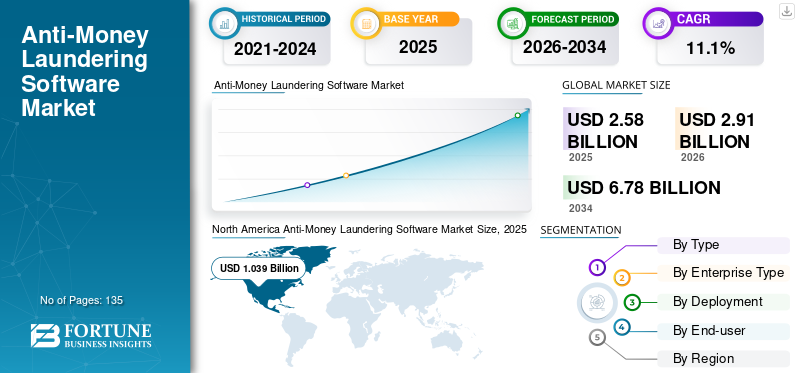
The global anti-money laundering software market size was valued at USD 2.58 billion in 2025. The market is projected to grow from USD 2.81 billion in 2026 to USD 6.82 billion by 2034, exhibiting a CAGR of 11.7% during the forecast period.
Anti-money laundering (AML) software consists of online platforms that provide businesses with the ability to detect, investigate, and report potentially suspicious financial operations. These programs make it possible to use transaction monitoring, customer due diligence, sanctions screening, risk assessment, and reporting on compliance to authorities. Banks, fintech firms, cryptocurrency companies, and other organizations subject to regulatory oversight face increasing regulatory scrutiny and the growing complexity of financial crimes carried out in the digital realm, which encourages them to implement automated AML compliance solutions.
Furthermore, many key market players, such as NICE Ltd., Oracle Corporation, SAS Institute Inc., Nasdaq, Inc., and LexisNexis Risk Solutions operating in the market, are investing in AI-enabled cloud AML platforms and strategic partnerships to automate compliance workflows, reduce false-positive alerts, improve investigation efficiency, and expand their customer reach.
Download Free sample to learn more about this report.
IMPACT OF GENERATIVE AI
Increasing Deployment of Generative AI Improving Financial Crime Detection and Reporting
The AML software is being changed by the use of generative AI, which is leading to the use of AI technology to perform tasks such as customer research, summarize alerts, document cases, perform due diligence, and prepare reports. Generative AI gives compliance managers an opportunity to analyze money laundering activities alert faster, manage structured and unstructured data more efficiently, prioritize alerts, and speed up investigations. Moreover, generative AI will bring about a decrease in repetitive manual activities and unneeded analysis of results, while guiding people to the most interesting cases of financial crime. In addition, there is a growing demand for explainable models, human oversight, audit trails, and other necessary measures to eliminate errors. For instance,
- In July 2025, Nasdaq Verafin launched its Agentic AI Workforce, a suite of digital workers designed to automate high-volume AML processes such as sanctions alert review and enhanced due diligence.
Thus, this factor fuels the anti-money laundering software market growth in the coming years.
ANTI-MONEY LAUNDERING SOFTWARE MARKET TRENDS
Expansion of Graph Analytics and Entity Resolution to Fuel Market Growth
Graph analytics and entity resolution are increasingly crucial components of AML solutions, as financial organizations have to uncover hidden connections between clients, accounts, transactions, counterparties, devices, beneficial ownerships, and firms. While entity resolution allows getting rid of duplicate or disparate records, thereby obtaining a holistic view of a person or a company, graph analytics creates a map of the connections between these entities in order to reveal suspicious networks and series of transactions. These abilities make it possible for compliance teams to identify complicated money laundering schemes based on the use of shell companies, money mules, layered transactions, and interrelated accounts, which might go unnoticed in the case of traditional rule-based systems. Among other things, graph analytics and entity resolution can improve risk scoring, lower the number of false positives, and give some investigative contexts to the investigators regarding high-priority cases. Therefore, the AML solutions providers are increasingly incorporating graph analytics and advanced entity matching into their monitoring and investigation tools. For instance,
- In September 2025, Quantexa launched Cloud AML, a SaaS-based AML solution for U.S. mid-size and community banks that uses AI-powered entity resolution and contextual analytics to unify customer and counterparty information.
MARKET DYNAMICS
MARKET DRIVERS
Download Free sample to learn more about this report.
Expansion of Digital Payments and Financial Transaction Volumes Drives Market Growth
The swift development of mobile banking, digital wallets, contactless payments, instant transfers, and online shopping is causing an increase in the amount of transactions that businesses have to keep an eye on. As the quantities of transactions go higher, there will be more customer information, device data, merchant data and geographical information, which makes it harder for organizations to do manual money laundering checks. As a result, payment companies and banks will need to use computers to do money laundering checks, set risk scores, find suspicious transactions and process alerts. Furthermore, the increase in the number of instant payments and cross-border transactions means that there is less time to stop possible illegal transfers. For instance,
- In June 2025, Microsoft introduced the Common Knowledge Graph in Copilot Studio, enabling AI agents to connect with enterprise systems through enhanced connectors while simplifying RAG indexing and integration.
Market Drivers - Impact & CAGR Contribution (2026–2034)
| Rank | Market Drivers | Overall Impact Rank | CAGR Contribution (2026–2034) | Impact: 2026-2028 | Impact: 2029-2031 | Impact: 2032-2034 |
|---|---|---|---|---|---|---|
| 1 | Increasing Regulatory Enforcement and Compliance Scrutiny | High | 4.1% | High | High | High |
| 2 | Expansion of Digital Payments and Financial Transaction Volumes | High | 3.4% | High | High | High |
| 3 | Extension of AML Obligations to Non-financial Industries | Medium-High | 3.0% | Medium-High | High | High |
| 4 | Stricter Customer Due Diligence and Beneficial Ownership Requirements | Medium-High | 2.7% | High | High | Medium-High |
| 5 | Modernization of Legacy Compliance Infrastructure | Medium | 2.4% | High | Medium-High | Medium |
| 6 | Others (FATF Evaluations and National AML Remediation Programs, Growth of Cross-border Payments, etc.) | Medium-Low | 2.0% | Medium | Medium-High | Medium-High |
| Total Positive CAGR Contribution | 17.60% | |||||
Source: Fortune Business Insights
MARKET RESTRAINTS
High Implementation and Operating Costs May Hinder Market Growth
In order to implement AML software effectively, financial institutions need to spend significantly on licenses, customization, data transfer, legacy system integration, cybersecurity, and employee training. In addition, they need to pay regular costs for software support, regulatory updates, model validation, alert investigation, and access to sanction or risk intelligence databases. Thus, such cost increases the purchasing period and limits the use of that software by small banks, fintech companies, gambling businesses, and other companies not necessarily connected with finance. Such difficult implementations may interfere in the activities of other departments and require additional specialists. All this leads to significantly high ownership costs, which stop AML software from being adopted in the markets that are sensitive to price or developing.
Market Restraints - Impact & Negative CAGR Contribution (2026–2034)
| Rank | Market Restraints | Overall Impact Rank | Negative CAGR Contribution (2026-2034) | Impact: 2026-2028 | Impact: 2029-2031 | Impact: 2032-2034 |
|---|---|---|---|---|---|---|
| 1 | High Implementation, Customization, and Operating Costs | High | -1.1% | High | High | Medium-High |
| 2 | Fragmented Data and Complex Legacy System Integration | High | -1.4% | High | Medium-High | Medium |
| 3 | High False-positive Alerts and Investigation Workloads | Medium-High | -1.6% | Medium | Medium-High | Medium |
| 4 | Others (Data Privacy, Localization, and Cross-border Information-sharing Restrictions, Shortage of Skilled Professionals, etc.) | Medium | -1.8% | Medium | Medium | Medium-Low |
| Total Negative Growth Impact | -5.90% | |||||
Source: Fortune Business Insights
MARKET OPPORTUNITIES
Rising Demand for Cryptocurrency and Virtual-Asset Monitoring Creates New Opportunities for Market Growth
The growth of cryptocurrency exchanges, stablecoins, digital wallets, decentralized finance platforms and tokenized assets represents a significant opportunity for vendors of AML software. Regulated institutions demand the use of blockchain analytics, wallet screening, cross-chain tracing, monitoring of transactions, and Travel Rule capabilities when it comes to detecting illegal money transfers in one or more digital assets. Traditional banks and payment service providers are also forced to combine on-chain intelligence with data on customers, accounts and fiat transactions in order to launch crypto services. Thus, AML providers can enter the crypto market through the provision of integrated digital asset compliance solutions to businesses in the field of cryptocurrencies, financial institutions, regulators, and law enforcement agencies. For instance,
- In July 2026, Elliptic launched its next-generation Continuous Monitoring solution, which continuously reassesses wallet and transaction risks based on changes in fund flows, counterparties, address clusters, and exposure to illicit entities.
Segmentation Analysis
By Functionalities
Rising Digital Transaction Volumes Strengthened Demand for Continuous AML Transaction Monitoring
Based on functionalities, the market is categorized into customer due diligence (CDD) & know your customer (KYC), transaction monitoring, AML risk assessment and analytics, sanctions and watchlist screening, regulatory reporting, and others (case management, AML data integration, etc.).
Transaction monitoring segment accounted for the largest anti-money laundering software market share in 2025. As it helps banks and other regulated organizations establish continuous detection of suspicious transaction trends, unusual movements of funds, and potential cases of money laundering. The leading position is also due to increasing volumes of digital payments, strict regulations concerning reporting and the need for automating a big amount of transactions across different channels.
AML risk assessment and analytics segment is anticipated to grow at the highest CAGR of 14.3% over the forecast period. This is owing to financial institutions increasingly adopt AI-driven risk scoring, predictive analytics, and network analysis to identify complex laundering patterns and prioritize high-risk alerts more accurately.
By Deployment
Growing Adoption of Cloud-based AML Platforms Supported Scalable and Cost-efficient Compliance Operations
Based on deployment, the market is bifurcated into on-premise and cloud.
Cloud segment led the market share in 2025 and is expected to grow at the highest CAGR of 14.3% during the forecast period. This is owing to its scalable infrastructure, the lower upfront costs of using a cloud-based service, quicker deployment of the solution, and the frequency with which it complied with the various software and regulatory updates. The rise of cloud services was further supported by the increased uptake by fintech companies, payment services, and smaller regulated entities that needed to utilize the cloud service-based AML solutions without needing to deploy a complicated IT infrastructure in-house.
On-premise segment is anticipated to grow at a moderate CAGR of 6.5% over the forecast period. As large financial institutions continue to prioritize direct data control, customized security, and regulatory compliance, although high implementation costs and growing cloud adoption will limit faster expansion.
By Enterprise Type
High Transaction Volumes and Regulatory Exposure Strengthening Large Enterprise Adoption of AML Software
Based on enterprise type, the market is divided into large enterprises and SMEs.
Large Enterprises segment dominated the market share in 2025. This is owing to their transaction volumes, complicated cross-border transactions, higher regulation exposure, and huge technology budgets for compliance. Their requirement for enterprise-wide transaction observation, identification of company customers, sanctions analyzing, risk analytics, and regulation reporting makes the requirement for AML software more apparent.
SMEs segment is anticipated to grow at the highest CAGR of 15.4% over the forecast period. As affordable cloud-based subscriptions, standardized integrations, and increasing regulatory obligations make advanced AML software more accessible to smaller financial and non-financial organizations.
By End-user
To know how our report can help streamline your business, Speak to Analyst
Rising Need for Transaction Monitoring Strengthened AML Adoption in BFSI
Based on end-user, the market is classified into BFSI, government, online gaming operators, cryptocurrency, and others (retail, real estate, etc.).
BFSI segment led the market share in 2025. As banks, insurers, payment providers, and investment firms process high volumes of complex transactions and face stringent AML, KYC, sanctions-screening, and reporting obligations. Their substantial compliance budgets, extensive customer bases, and high exposure to financial crime drove sustained investment in transaction monitoring, risk analytics, and investigation software.
Online gaming operators segment is anticipated to grow at the highest CAGR of 19.8% during the forecast period. This is owing to the rapid expansion of digital betting, increasing transaction volumes, and stricter customer verification and AML regulations driving adoption of automated monitoring and compliance solutions.
Anti-Money Laundering Software Market Regional Outlook
By geography, the market is categorized into North America, South America, Europe, the Middle East & Africa, and Asia Pacific.
North America
North America Anti-Money Laundering Software Market Size, 2025 (USD Billion)
To get more information on the regional analysis of this market, Download Free sample
North America held the largest market share in 2024, valuing at USD 0.96 billion, and also maintained the leading share in 2025, with USD 1.03 billion. The market in North America is expected to increase, owing to the presence of a major number of banks and payment institutions, strict compliance with AML/CFT supervision, higher costs of compliance, and early acceptance of cloud-based analytics and automated transaction monitoring systems. The ongoing improvement in the AML systems of the U.S. and Canada, along with the strong technology-provider ecosystem present in the region, served as a basis of continuous requirement for improved software for risk assessment, screening, investigation, and reporting. For instance,
- In September 2025, Nasdaq Verafin and BioCatch formed a strategic partnership to integrate Verafin’s consortium-based transaction intelligence with BioCatch’s behavioral and device analytics for more effective financial-crime detection.
U.S. Anti-Money Laundering Software Market
Based on North America’s strong contribution and the U.S. dominance within the region, the U.S. market can be analytically approximated at around USD 0.80 billion in 2026, accounting for roughly 28.5% of global sales.
To know how our report can help streamline your business, Speak to Analyst
Europe
In Europe the market is projected to record a growth rate of 10.6% in the coming years, which is the fourth highest among all regions, and reach a valuation of USD 0.83 billion by 2026. Harmonized AML/CFT regulations and better regulations have led to the marketplace in Europe growing. Similarly, this is compelling entities such as banks, payment service providers, cryptocurrency firms, gaming operators, and others to enhance their transaction monitoring and customer verification systems. In addition to the above-mentioned factors, the increase in cross-border financial services and the improvement of obsolete legacy compliance infrastructure have also contributed to the need for cloud-based analytics-driven systems for AML compliance.
U.K. Anti-Money Laundering Software Market
The U.K. market is estimated at around USD 0.18 billion in 2026, representing roughly 6.4% of global revenues.
Germany Anti-Money Laundering Software Market
Germany’s market is projected to reach approximately USD 0.15 billion in 2026, equivalent to around 5.3% of global sales.
Asia Pacific
Asia Pacific region is estimated to reach USD 0.62 billion in 2026 and is expected to grow at the highest CAGR of 16.4% during the forecast period. In Asia Pacific, there is a rising demand for compliance software owing to the surge in the adoption of online payment systems, including fintech platforms, overseas transactions, and virtual assets. Moreover, the regulatory reforms are increasing the population under regulation, as AUSTRAC estimates show that the number of regulated enterprises in Australia would grow from around 17,000 to approximately 100,000. For instance,
- In April 2025, Napier AI announced an accelerated expansion across Asia Pacific following a majority growth investment from Marlin Equity Partners, which manages more than USD 9 billion in capital commitments.
China Anti-Money Laundering Software Market
China’s market is projected to be one of the largest globally, with 2026 revenues estimated at around USD 0.17 billion, representing roughly 6.0% of global sales. China’s market is expanding as the revised Anti-Money Laundering Law, effective January 2025, strengthens requirements for customer due diligence, beneficial ownership verification, suspicious transaction reporting, risk-based monitoring, and AML information systems across financial and specified non-financial institutions.
Japan Anti-Money Laundering Software Market
The Japanese market is estimated at around USD 0.12 billion in 2026, accounting for roughly 4.3% of global revenues.
India Anti-Money Laundering Software Market
The Indian market is estimated at around USD 0.09 billion in 2026, accounting for roughly 3.2% of global revenues.
South America
South America is expected to witness moderate growth in this market during the forecast period. The market is set to reach a valuation of USD 0.12 billion in 2026 and is expanding owing to the increase in transaction volumes and exposure to financial crime arising from digital banking, instant payment services, fintech platforms, online gaming, and virtual currency operations, especially in Brazil and Argentina.
Brazil Anti-Money Laundering Software Market
The Brazilian market is set to reach a value of USD 0.06 billion in 2026.
Middle East & Africa
Growth in the market can be ascribed to an expansion in mobile money, digital banking, fintech platforms, cross-border payments, and virtual asset services leading to a rise in transaction volumes and increased demand for automated monitoring and client screening. Enhanced AML/CFT provisions, beneficial ownership requirements, measures proposed by the FATF, and stricter oversight of banks and virtual asset companies promote investments in KYC, sanctions screening, analysis of risks, and regulatory reporting software.
GCC Anti-Money Laundering Software Market
The GCC market is set to reach a value of USD 0.05 billion in 2026.
COMPETITIVE LANDSCAPE
Key Industry Players
Focus on Advancing AI-driven AML and Cloud Compliance Capabilities by Key Players to Propel Market Growth
The global anti-money laundering software market holds a semi-consolidated market structure, with prominent players such as NICE Ltd., Oracle Corporation, SAS Institute Inc., Nasdaq, Inc., and LexisNexis Risk Solutions maintaining strong market positions. These companies are investing in AI-enabled transaction monitoring, customer due diligence, sanctions screening, behavioral analytics, case management, and cloud-based compliance platforms to reduce false-positive alerts, improve suspicious activity detection, and support evolving AML/CFT requirement.
Other notable players in the global market include Feedzai, ACI Worldwide, Quantexa Limited, Napier AI, and SymphonyAI. These companies are strengthening their market presence through SaaS expansion, product innovation, strategic partnerships, cloud and data integrations, and customized solutions for banks, payment providers, fintech firms, insurers, gaming operators, cryptocurrency businesses, and government agencies.
LIST OF KEY ANTI-MONEY LAUNDERING SOFTWARE COMPANIES PROFILED IN REPORT
- NICE Ltd. (Israel)
- Oracle Corporation (U.S.)
- ACI Worldwide (U.S.)
- Nasdaq, Inc. (Canada)
- LexisNexis Risk Solutions (U.S.)
- Feedzai (U.S.)
- SAS Institute Inc. (U.S.)
- Quantexa Limited (U.K.)
- Napier AI (U.K.)
- SymphonyAI (U.S.)
KEY INDUSTRY DEVELOPMENTS
- January 2026: NICE Actimize launched the Actimize Insights Network, which provides financial institutions with real-time counterparty-risk intelligence derived from its fraud and financial-crime network.
- September 2025: Eastnets and Facephi announced a strategic partnership combining Eastnets’ AML, sanctions-screening, and transaction-monitoring capabilities with Facephi’s biometric identity-verification technology.
- May 2025: Oracle launched the Financial Crime and Compliance Management Automated Scenario Calibration Cloud Service to automate the tuning and assessment of AML transaction-monitoring scenarios.
- May 2025: Nasdaq Ventures led a Series B investment in Fincom, while Nasdaq Verafin entered a global partnership with the company to strengthen sanctions screening and AML compliance capabilities.
- May 2025: LexisNexis Risk Solutions completed its acquisition of IDVerse, an AI-powered document-authentication and identity-verification technology provider. IDVerse’s capabilities are being integrated into the RiskNarrative platform to strengthen digital onboarding, and risk assessment within fraud and AML compliance workflows.
- February 2025: The European Commission launched the Next-Generation FIU.net, a modernized IT platform that enables faster and more secure exchange and cross-matching of financial intelligence among national Financial Intelligence Units and Europol.
- December 2024: SAS and Neterium launched SAS Real-Time Watchlist Screening, a cloud-native solution that integrates entity and payment screening, alert triage, case management, and operational reporting. The solution supports real-time sanctions and AML decision-making.
REPORT COVERAGE
The global anti-money laundering software market analysis includes a comprehensive study of the market size & forecast by all the market segments included in the report. It includes details on the market dynamics and market trends expected to drive the market over the forecast period. It provides information on key aspects, including an overview of technological advancements, pipeline candidates, the regulatory environment, and product launches. Additionally, it details partnerships, mergers & acquisitions, as well as key industry developments and prevalence by key regions. The global market research report also provides a detailed competitive landscape with information on the market share and profiles of key operating players.
Request for Customization to gain extensive market insights.
Report Scope & Segmentation
| ATTRIBUTE | DETAILS |
| Study Period | 2021-2034 |
| Base Year | 2025 |
| Estimated Year | 2026 |
| Forecast Period | 2026-2034 |
| Historical Period | 2021-2024 |
| Growth Rate | CAGR of 11.7% from 2026-2034 |
| Unit | Value (USD Billion) |
| Segmentation | By Functionalities, Deployment, Enterprise Type, End-user, and Region |
| By Functionalities |
|
| By Deployment |
|
| By Enterprise Type |
|
| By End-user |
|
| By Region |
|
Frequently Asked Questions
According to Fortune Business Insights, the global market value stood at USD 2.58 billion in 2025 and is projected to reach USD 6.82 billion by 2034.
The market is growing at a CAGR of 11.7% during the forecast period of 2026-2034.
In 2025, the North America’s market value stood at USD 1.03 billion.
By end-user, BFSI segment led the market.
Expansion of digital payments and financial transaction volumes drives market growth.
NICE Ltd., Oracle Corporation, SAS Institute Inc., Nasdaq, Inc., and LexisNexis Risk Solutions are the major players in the global market.
North America dominated the market in 2025.



- 2021-2034
- 2025
- 2021-2024
- 120
Get 30-60 hrs Free Customization
Expand Regional and Country Coverage, Segments Analysis, Company Profiles, Competitive Benchmarking, and End-user Insights.




















Related Reports
-
US +1 833 909 2966 ( Toll Free )
-
Get In Touch With Us