Metalworking Fluids Market Size, Share & Industry Analysis, By Function (Neat Cutting Oils, Water Cutting Oils, Corrosion Preventive Oils and Others), By Type (Mineral, Synthetic and Bio-based), By Application (Construction, Electrical & Power, Agriculture, Automotive & transportation, Telecommunication and Healthcare), and by End-use Industry (Metal Fabrication, Transportation Equipment, Machinery and Others) and Regional Forecast, 2026-2034
 Download Free Sample
 Metalworking Fluids Market Size and Industry Analysis
 Listen to Audio Version
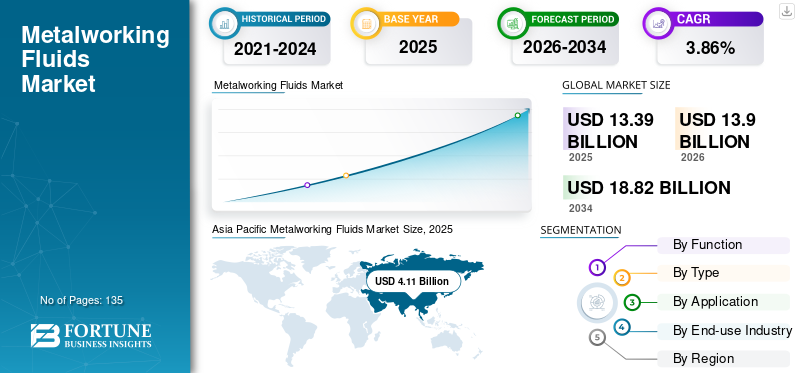
The global metalworking fluids market size was valued at USD 13.39 billion in 2025. The market is projected to grow from USD 13.90 billion in 2026 to USD 18.82 billion by 2034, exhibiting a CAGR of 3.86% during the forecast period. Asia Pacific dominated the metalworking fluids market with a market share of 40.1% in 2025. Moreover, the U.S. metalworking fluids market is projected to reach USD 2.82 million by 2027, fueled by the rising demand in machining, automotive, and manufacturing processes.
Metalworking fluids are used daily in several industries for operations such as milling, drilling, cutting, stamping, and grinding. Moreover, there is a constant change in the composition of these products due to the changing regulations, formulation, and also due to the pressure from regulatory bodies around the world.
Download Free sample to learn more about this report.
Global Metalworking Fluids Market Overview
Market Size & Forecast:
- 2025 Market Size: USD 13.39 billion
- 2026 Market Size: USD 13.9 billion
- 2034 Forecast Market Size: USD 18.82 billion
- CAGR: 3.86% (2026–2034)
Market Share:
- Asia Pacific dominated the metalworking fluids market with a 40.1% share in 2025, driven by robust demand across machining, automotive, and manufacturing sectors in China and India.
- The U.S. metalworking fluids market is projected to reach USD 2.82 million by 2027, supported by steady demand from metal cutting and forming operations in the automotive and industrial sectors.
Key Market Trends:
- Rising Adoption of Bio-based Fluids: Growing health and environmental concerns are shifting focus toward biodegradable, renewable fluids made from vegetable oils and synthetic esters. Major players like Shell, ExxonMobil, BP, and Total SA are investing in bio-based product lines.
Metalworking Fluids Market TRENDS
Download Free sample to learn more about this report.
Demand for Bio-based Fluids is Likely to rising Over the Forecast Period
Due to the restrictions imposed owing to ecological issues on human exposure of cutting fluids, meta removal fluids manufacturers, as well as consumers, are getting inclined towards bio-based products. It is fully biodegradable and renewable as its formulation is completely based on synthetic esters and vegetable oils. Moreover, they also fulfill the health and safety criteria set by various government bodies. Major players such as Shell, ExxonMobil, BP plc, and Total SA are already competing with their bio-based products. Now, bio-based fluids hold a low share but it is expected to expand in the upcoming years. Asia Pacific witnessed a metalworking fluids market growth from USD 3.94 billion in 2018 to USD 4.11 billion in 2019.
DRIVING FACTORS
Growing Demand from Automotive & Transportation Industry to Drive the Market
The recovery of the automotive sector, especially in the U.S. post-recession, is expected to augment the growth of metalworking fluids over the forecast period. As per JP Morgan, the US auto industry is making a V-shape recovery which is likely to support the overall recovery of the market. Moreover, emerging economies such as India, China, Russia, and Brazil have witnessed significant growth in the automotive and transportation industries, especially manufacturing sectors. The increasing production of vehicles is the major factor influencing the demand for these products. Besides automotive industries, aerospace, railways, marine, and defense industries are also contributing to the growth.
Furthermore, these fluids continue to be used extensively in the machinery industry. The machine shop is the core of the manufacturing sector, as manufacturers not only focus on productivity and cost-cutting but also on the adoption of sustainable processes and technologies for long term business. The latest machinery industry includes machine shops that are buckling up for the manufacturing of customized specialty products which are expected to drive revenue growth in the coming years.
RESTRAINING FACTORS
Stringent Regulations on the Usage of Metalworking Fluids to Confine Market Growth
The major goal and intention of the government agencies is to protect the people, environment and workers from hazards, which are closely related to industrial manufacturing. Thus, there are many agencies working for minimizing the environmental hazards caused by these fluids. Some of the agencies working closely on this include EPA (Environmental Protection Agency), OSHA (Occupational Safety and Health Administration), NIOSH (The National Institute for Occupational Safety and Health) and OSH (Canadian Centre for Occupational Health and Safety). These agencies have imposed several stringent regulations that are restricting production.
Metalworking Fluids Market SEGMENTATION Analysis
By Function Analysis
Neat Cutting Oils Segment to Generate the Highest Revenue During the Forecast Period
The neat cutting oils segment holds the largest metalworking fluids market share. Neat cutting oils are usually used for heavy-duty cutting gears such as tapping, broaching, hobbing, grinding, and drilling operations. They mainly act as lubricants, as fatty acids are mainly incorporated in it.
Water cutting oils segment holds a prominent share in the global market, as water is the best solution for cooling. Water is easily available and possesses the best heat-carrying capability. Unlike neat cutting fluids, water cutting oil does not possess lubrication properties and thus it can also lead to corrosion.
Corrosion prevention oils are an integral part of the market, as they are widely used for preventing rust formation and corrosion on workpieces, machine parts, machining tools, and metal tools. The chemical composition of corrosion prevention oils varies according to their chemical structure.
By Type Analysis
Synthetic Segment to Hold the Majority of Share
In terms of type, the market is segmented into mineral, synthetic, and bio-based. Mineral grade metalworking fluid is most commonly used as it is cost-effective than synthetic and bio-based fluids. Moreover, these fluids are predominantly used as a working fluid for lubricating and cooling purposes. Mineral oil generally consists of one or more refined mineral-based oil, together with pressure additives and anti-corrosion additives.
The synthetic segment holds the largest share in the global market. Synthetic fluids do not contain oil generated from petroleum. In synthetic oil, end-users mostly use detergent-like components and other types of additives to moisten the workpiece. Operations performed using synthetic and semi-synthetic oils are more pleasant to work with as the shop floors are less oily and slippery. Machines also stay cleaner as less dirt and oil are deposited on the surfaces.
The bio-based segment holds a smaller share in this market as the customers are not convinced using bio-based fluids. Moreover, its limitations such as inadequate availability and relatively high price are expected to affect the market for bio-based fluids and thus expected to grow at less CAGR.
By Application Analysis
Automotive & Transportation Segment to Exhibit a Significant Growth Rate
Automotive manufacturers extensively use metalworking fluids for the manufacturing of various automotive parts and equipment, and thus, the automotive & transportation segment holds the largest share in the metalworking fluid market. Further, they are closely connected to the automotive industry as large volumes of sheet metal and finished components are supplied to this industry. Other transportation industries such as marine and aerospace have several applications of these fluids for the manufacturing of their big parts or components.
The demand for these fluids for construction applications is increasing owing to the rise in building and construction activities. These fluids are extensively used in steel shaping and cutting processes. These products are also used in the manufacturing of construction equipment such as bulldozers and others. Thus, these products hold great significance in construction applications.
The other multiple applications include electrical & power, agriculture, telecommunication, and healthcare. Electrical & power also held a prominent share in the market due to the demand from applications such as gas & steam turbines, wind turbines, engines, and transformers.
By End-use Industry Analysis
To know how our report can help streamline your business, Speak to Analyst
Machinery Segment to Grow at an Impressive Rate
Metalworking fluids have major applications in the machinery segment. These fluids are majorly used in workshops for the forming and cutting of metals. The main purpose of the fluids is to cool the surface, lubricate tools, work-piece, and machinery. Several types of machinery operate in different industries such as automotive, electrical & power, construction and these fluids play an important role in overall manufacturing efficiency within these industries.
- The Machinery segment is expected to hold a 0.40% share in 2019.
Metalworking fluids are used in the manufacturing of various transport equipment such as cranes, conveyors, trucks, and others. An increase in demand for transportation equipment due to rising construction activities is augmenting the demand for these products. Furthermore, they are also used in metal fabrication operations such as metal shaping, surface finishing, and surface preparation for industries such as furniture, domestic appliances, defense, and others.
REGIONAL INSIGHTS
Asia Pacific
Asia Pacific Metalworking Fluids Market Size, 2025 (USD Billion)
To get more information on the regional analysis of this market, Download Free sample
Asia Pacific is anticipated to remain a key region in the market during the forecast period owing to the rising demand from the automotive & transportation industry. The market in this region holds the highest share owing to the robust manufacturing base in China and India. Strong support and initiatives taken by the governments of China and India for the manufacturing sector are aiding the dominance of the region in terms of the market share.
Emerging economies such as China and other Southeast Asian countries have witnessed significant growth in their manufacturing sectors. Growing consumption, coupled with favorable regulations, is likely to attract the market. Moreover, rise in demand from the automotive sector is expected to promote the demand in this region over the forecast period.
North America
North America is one of the prime consumers and it also follows strict environmental protection policies imposed by EU Ecolabel, and OSHA. On the other hand, Europe is projected to witness significant growth in the global metalworking fluids market. Robust automotive manufacturing base in Germany and Russia is the key factor driving the market for metalworking in Europe.
Latin America and the Middle East & Africa
Latin America and the Middle East & Africa would showcase lower growth in this market compared to the other regions owing to fewer manufacturing units and low demand due to less population in these regions.
KEY INDUSTRY PLAYERS
Market Players Such as Chevron Phillips Chemical and Exxon Mobil Corporation to Strengthen their Market Position with Novel Solutions
Several large-scale producers are located in Europe, but the demand is high from Asia Pacific leading to a fragmented market. The producers in North America and Europe are continuously engaged in mergers & acquisitions in order to strengthen their market position and to drive business growth. As a result, key players in the market have developed a strong regional presence, distribution channels, and product offerings.
LIST OF KEY COMPANIES PROFILED:
- Houghton International Inc. (U.S.)
- Castrol (UK)
- Chevron Phillips Chemical (U.S.)
- Exxon Mobil Corporation (U.S.)
- Total S.A. (France)
- Lubrizol (U.S.)
- Quaker Chemical Corporation (U.S.)
- Henkel (Germany)
- Fuchs Petrolub SE (Germany)
- BP plc. (UK)
- Other
KEY INDUSTRY DEVELOPMENTS
- October 2019: Master Fluid Solutions, a leading manufacturer in Perrysburg, Ohio, announced the acquisition of Wilhelm Dietz GmbH, a pipe and tube expansion, forming, wire drawing, and metalworking company based in Düsseldorf, Germany, to expand its global footprint and gain manufacturing capabilities in mainland Europe.
- December 2018: The European Commission approved the acquisition of Global Houghton, Ltd., a provider of specialty chemicals, oils and lubricants headquartered in the U.S by Quaker Chemical Corporation, a producer of process fluids and specialty lubricants. This acquisition was done to expand its production and marketing of products in the new regions.
REPORT COVERAGE
Request for Customization to gain extensive market insights.
The metalworking fluids market report includes a detailed analysis of the market and focuses on crucial aspects such as leading companies, function, application, types, end-use industry and distribution channels. Also, the report offers insights into market trends and highlights vital industry developments. In addition to the factors mentioned above, the report encompasses various factors that have contributed to the growth of the market over recent years.
Report Scope & Segmentation
|
ATTRIBUTE |
DETAILS |
|
Study Period |
2021-2034 |
|
Base Year |
2025 |
|
Forecast Period |
2026-2034 |
|
Historical Period |
2021-2024 |
|
Unit |
Value (USD Billion) and Volume (Kilo tons) |
|
Segmentation |
Function, Type, Application, End-use Industry and Geography |
|
By Function
|
|
|
By Type
|
|
|
By Application
|
|
|
By End-use Industry
|
|
|
By Geography
|
|
Frequently Asked Questions
According to Fortune Business Insights, the global metalworking fluids market was valued at USD 13.9 billion in 2026 and is projected to reach USD 18.82 billion by 2034, growing at a CAGR of 3.86%.
The market will exhibit a steady growth at a CAGR of 3.86% in the forecast period (2026-2034).
The rising demand from automotive, aerospace, and heavy machinery sectors is a major growth driver.
Asia Pacific leads the market due to a strong manufacturing base in China and India.
They are primarily used for cooling, lubrication, and corrosion prevention in metal machining processes
Neat cutting oils hold the largest share, especially for heavy-duty machining operations.
Major companies include ExxonMobil, Castrol, Quaker Chemical, Shell, and Total.



- 2021-2034
- 2025
- 2021-2024
- 135
Get 20% Free Customization
Expand Regional and Country Coverage, Segments Analysis, Company Profiles, Competitive Benchmarking, and End-user Insights.


















Related Reports
-
US +1 833 909 2966 ( Toll Free )
-
Get In Touch With Us