Anaerobic Digestion Market Size, Share & Industry Analysis, By Feedstock (Organic Residue and Waste, ({Biowaste, Municipal, and Sewage}, Agriculture Waste, and Others}, and Energy Crops), By Application (Electricity Generation, Heating, Combined Heat and Power (CHP), and Others), Regional Forecast, 2026-2034
 Download Free Sample
KEY MARKET INSIGHTS
 Listen to Audio Version
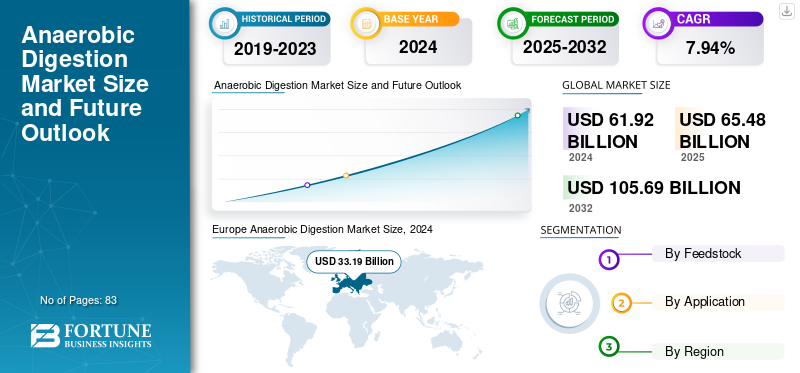
The global anaerobic digestion market size was valued at USD 65.48 billion in 2025. The market is projected to grow from USD 69.35 billion in 2026 to USD 113.24 billion by 2034, exhibiting a CAGR of 6.32% during the forecast period. Europe dominated the anaerobic digestion market with a market share of 53.25% in 2025.
Waste management and the circular economy drive anaerobic digestion by turning organic waste into valuable resources, renewable energy, and natural fertilizer, while helping cities, farms, and industries comply with landfill bans, emission targets, and resource recovery goals. Biogas and upgraded biomethane can replace natural gas, LPG, or diesel for power generation, heating, and transport. This helps countries lower fossil fuel imports and meet renewable energy targets. Renewable energy sources play a key role in the anaerobic digestion market, as AD itself is a renewable energy technology that converts organic waste into sustainable energy. The increasing adoption of anaerobic digestion (AD) is driven by a combination of environmental, economic, and policy factors that make it an attractive renewable energy and waste management solution.
The American Biogas Council (ABC) reports that there are currently over 2,200 digesters in operation in the U.S. with a total installed capacity of 977MW. Of these digesters, 1,269 are located at wastewater recovery facilities, 636 capture landfill gas, 259 process dairy or swine manure, 39 are dedicated solely to food waste, and the remainder treat industrial waste.
Adnams plc, Clarke Energy, and Biokraft AB are considered major players in the anaerobic digestion (AD) market as they each play a key role in different parts of the AD value chain, from technology and infrastructure to operations and energy utilization.
Download Free sample to learn more about this report.
Anaerobic Digestion Market KEY TAKEAWAYS
 Global Market Size & Forecast
- 2025 Market Size: USD 65.48 billion
- 2026 Market Size: USD 69.35 billion
- 2034 Forecast Market Size: USD 113.24 billion
- CAGR: 6.32% from 2026–2034
 Market Share
- Europe dominated the anaerobic digestion market with a 53.25% share in 2025
- The organic residue & waste segment is projected to hold the largest market share of 73.90% in 2026
- The electricity generation segment is projected to hold a 54.77% share in 2026
 Key Regional Highlights
Asia Pacific
Asia Pacific reached USD 19.57 billion in 2025, driven by renewable energy investments.
North America
North America reached USD 7.44 billion in 2025, supported by biogas and biomethane programs.
Europe
Europe reached USD 34.86 billion in 2025, driven by strong biomethane policies.
U.S.
U.S. is projected to reach USD 6.95 billion by 2026, fueled by renewable fuel initiatives.
Japan
Japan is projected to reach USD 0.12 billion by 2026, driven by growing biogas adoption.
Read More

MARKET DYNAMICS
MARKET DRIVERS
Increasing Industrial and Agricultural Adoption to Propel Market Growth
The food & beverage, breweries, and pulp & paper sectors generate tremendous amounts of organic waste and wastewater. Anaerobic digestion (AD) is helping these industries reduce waste disposal costs, meet sustainability targets by generating renewable energy, and comply with increasingly strict effluent treatment rules and regulations. A number of industries are also investing in on-site AD plants to generate power and heat for operations, reducing their reliance on fossil fuels. In October 2024, Bio Capital announced that it is going to partner with Adnams, an East Anglian brewery and hospitality group based in Southwold, to redevelop and upgrade the Anaerobic Digestion (AD) facility in Reydon, Suffolk.
Production of biogas can be upgraded to bio-CNG, electricity, or used for heating purposes. The production of digestate, an organic fertilizer, helps decrease dependency on chemical fertilizers. Anaerobic digestion also supports better waste management and provides more effective methods to reduce methane emissions using open manure storage. Furthermore, AD offers farmers an extra source of income, since they can sell energy or receive payments for supplying biomethane to the grids.
MARKET RESTRAINTS
High Capital and Operating Costs to Restrict Market Expansion
The initial investment required for an anaerobic digestion system includes the costs of the digester, biogas upgrading equipment, feedstock handling, and grid connection. For most small and medium farms and industries, these costs outweigh the short-term benefits. Therefore, such projects are unlikely to be pursued unless there is a significant subsidy for either capital expenditure or operating costs.
AD systems also have substantial operating costs that include costs associated with transporting and collecting feedstock, maintenance, skilled labor, benefits, and other operating processes. The economics become challenging when feedstock availability is inconsistent and resulting in diminished biogas output and profitability.
MARKET OPPORTUNITIES
Technological Advancements in Digester Design to Create Lucrative Growth Opportunities
The growth potential of the anaerobic digestion market is strong with ongoing technology enhancements in digester operation, design, and integration. High-efficiency systems are being designed to offer greater flexibility and scalability compared to traditional systems. Modern designs such as continuous stirred-tank reactors (CSTR), upflow anaerobic sludge blanket (UASB), and internal circulation (IC) reactors increase process stability and biogas production, even with complex feedstocks.
In March 2025, EnviTec Biogas achieved an important milestone in the U.S. market. With the recent commissioning of the company’s largest anaerobic digestion facility to date in the U.S., EnviTec Biogas, through its U.S. subsidiary, is reinforcing its strategic partnership with SJI Renewable Energy Ventures and local vendors. The facility, located in South Dakota, has been processing excess manure from more than 9,500 dairy cows on a daily basis and has reached over 300,000 gallons (1,100 cubic meters) per day of processing since the beginning of the year.
ANAEROBIC DIGESTION MARKET TRENDS
Growing Adoption of Biomethane as a Renewable Energy Source to Drive Market Growth
A major contributor to the anaerobic digester market growth is the increasing demand for biomethane (renewable natural gas, RNG). Biomass can be converted into biogas through anaerobic digestion, which can then be upgraded to biomethane by removing impurities (e.g., carbon dioxide, hydrogen sulfide, water, etc.). This gas is produced at high purity levels and has near-identical characteristics to fossil natural gas, allowing it to be injected into existing gas grids, utilized for industrial purposes, or used as a transport fuel.
The European Commission's goal to produce 35 billion cubic metres of biomethane annually by 2030 is considered "both unrealistic and unsustainable," as member states actively negotiate legislation to decarbonise the gas sector and consider alternatives such as green hydrogen. An assessment of the assumptions underpinning the EU's 35 billion cubic metres (bcm) biomethane (a type of renewable natural gas) target states that the target will, at best, be impossible to achieve and, at worst, detrimental to the environment.
Download Free sample to learn more about this report.
MARKET CHALLENGES
Competition from other Renewables to Hamper Market Growth
Although anaerobic digestion has the advantage of producing both renewable energy and waste management solutions, it faces limitations in market expansion due to the rapid growth of other renewable energy technologies. Wind, solar PV, and battery energy storage have all grown significantly over the last decade, with historic declines in capital costs making them cost-competitive for the first time and highly attractive to investors. Solar and wind energy projects can more readily attract capital and development than AD projects, as the latter require higher upfront capital investments (more than solar PV and battery storage solar energy projects) in addition to complex infrastructure. Furthermore, utility-scale solar and wind projects can be deployed significantly faster and at larger scales, whereas AD project capacity is constrained by feedstock, logistics, and operational limitations.
Segmentation Analysis
By Feedstock
Organic Residue and Waste Segment Dominates, Driven by its Affordability
Based on feedstock, the market is classified into Organic Residue & Waste ({Biowaste, Municipal, Sewage}, Agriculture Waste, and Others), and energy crops. Organic residue and waste dominate the segment with a market share of 73.90% in 2026. Organic waste such as food waste, agricultural residues, and municipal solid waste is generated in large quantities worldwide and is often available at little or no cost, making it the most economical feedstock option.
The energy crops segment is the second-dominant segment in the anaerobic digestion market due to its high biogas yield, consistent supply, and quality control advantages. Crop residues are also an important and growing feedstock in the anaerobic digestion (AD) market as they are abundant, renewable, and rich in organic material suitable for biogas production.
By Application
Electricity Generation Segment Leads due to Government Incentives
In terms of application, the market is categorized into the electricity generation, heating, combined heat and power (CHP), and Others.
The electricity generation is the dominant segment in the market with a share of 54.77% in 2026. Electricity is the most common and easily usable form of energy. Biogas from anaerobic digestion can be efficiently converted into electricity using combined heat and power (CHP) units. Many countries (such as the U.K., Germany, and Sweden) provide financial incentives, such as feed-in tariffs or renewable energy certificates, for electricity generated from biogas, making it more profitable.
To know how our report can help streamline your business, Speak to Analyst
The growth in the heating segment is driven by the need for reliable temperature control (for microbial performance), expansion into varied climates and waste streams, cost/efficiency optimization, advancements in heating/thermal technologies, and larger integration of AD into the energy & waste-management systems.
Anaerobic Digestion Market Regional Outlook
By geography, the market is categorized into Europe, North America, Asia Pacific, Latin America, and the Middle East & Africa.
Europe
Europe Anaerobic Digestion Market Size, 2025 (USD Billion)
To get more information on the regional analysis of this market, Download Free sample
The Europe market accounted for USD 34.86 Billion in 2025, representing 53.25% of the global industry, and is expected to reach USD 36.7 Billion in 2026. In Europe, the AD market is expanding due to ongoing policy support, the circular economy, increasing demand for biomethane, technological advancements, and full adoption across industry and agriculture. The region combines regulatory push for AD with economic and environmental incentives, making it the most developed and rapidly growing AD market in the world.
The U.K. market is projected to reach USD 1.67 billion by 2026, while the German market is projected to reach USD 12.98 billion by 2026. Germany aims to remarkably increase biomethane capacity by 2030 to replace fossil natural gas in the industrial and transport sectors.
- For instance, in December 2024, the biomethane sector in Europe is growing, with installed production capacity projected to be 7 billion cubic metres (bcm) on an annual basis, with the end of Q1 2025 a 9% increase from 2024. However, although investor confidence remained strong, growth is stalling, which the EBA attributes to the need for clearer policy guidance and stronger regulatory measures.
Asia Pacific
Other regions, such as North America and the Asia Pacific, are anticipated to witness a notable growth in the coming years. During the forecast period, Asia Pacific recorded a market size of USD 19.57 Billion in 2025, capturing 29.88% of the global market share, and is projected to reach USD 20.95 Billion in 2026. Countries including China, India, Japan, South Korea, and Australia are investing substantial amounts into renewable energy to lower fossil fuel consumption and reduce greenhouse gas emissions. Biogas and upgraded biomethane from AD are being increasingly used to generate electrical power, heat, and bio-CNG for transport. Backed by these factors, countries including the Japan market is projected to reach USD 0.12 billion by 2026, the China market is projected to reach USD 9.35 billion by 2026, and the India market is projected to reach USD 6.58 billion by 2026.
North America
After Asia Pacific, the market in In 2025, North America generated USD 7.44 Billion, contributing 11.36% to global market revenue, and is projected to grow to USD 7.95 billion in 2026. and secure the position of the third-largest region in the market. In the region, the U.S. market is projected to reach USD 6.95 billion by 2026. In North America, programs such as the U.S. Renewable Fuel Standard (RFS) and the California Low Carbon Fuel Standard (LCFS) are fostering the production of biogas and biomethane.
Latin America and Middle East & Africa
Over the forecast period, the Latin America and Middle East & Africa regions. Latin America's Anaerobic Digestion (AD) market is expanding due to an abundance of available feedstock, increasing demand for renewable energy, favorable policy conditions, industrial and agricultural adoption of more sustainable practices, and advances in technologies, positioning Latin America as a potential market for waste-to-energy solutions. Latin America accounted for USD 2.03 billion in 2025, representing 3.09% of the global market share, and is projected to reach USD 2.08 billion in 2026.
The industrial burner market in the MEA is developing owing to the widespread availability of organic waste, a desire for renewable energy, enhanced policies and regulations aimed at sustainable waste management and AD adoption, an increasing number of industrial and agricultural users in the region, and innovation in technologies. AD is increasingly becoming a leading solution for sustainable waste management and energy in the MEA. The Middle East & Africa market generated USD 1.58 Billion in 2025, representing 2.42% of the global market landscape, and is expected to reach USD 1.65 Billion in 2026.
COMPETITIVE LANDSCAPE
Key Industry Players:
Major Firms Focus on Partnerships to Broaden their Reach
Companies such as BioEnergy Devco and Biokraft AB are leading vendors in the anaerobic digestion market, offering together technical expertise, full-service solutions, scalability, and alignment with policy and sustainability goal. As a result, they are preferred partners for industrial, municipal, and agricultural AD projects.
In March 2025, St1 Biokraft, one of the most significant biomethane companies in the Nordic region, signed an agreement to acquire Södra Hallands Kraft Biogas AB, which operates a production facility in Laholm. St1 Biokraft already owns and operates an upgrading plant on the same property.
LIST OF KEY Anaerobic DigestionCOMPANIES PROFILED:
- Adnams plc (U.K.)
- Clarke Energy (U.K.)
- WELTEC BIOPOWER GMBH (Germany)
- EnviTec Biogas AG (Germany)
- Northern Biogas (U.S.)
- BTS Bioenergy (U.S.)
- AAT Wastewater and Waste Technology GmbH (Austria)
- Viessmann Climate Solutions SE (Germany)
- Agrinz Technologies GmbH (Austria)
- PlanET Biogas Group (Germany)
- Agraferm GmbH (Germany)
- Biokraft AB (Sweden)
- BDI-BioEnergy International GmbH (Austria)
- Gasum Ltd (Finland)
- ENGIE Group (France)
KEY INDUSTRY DEVELOPMENTS:
- In July 2025, BTS Bioenergy, based in Annapolis, Maryland, opened its Maryland Organics Recovery Center (MORC), a new satellite site to its flagship anaerobic digestion (AD) facility, the Maryland Bioenergy Center (MBC). The company, formerly known as Bioenergy Devco, indicated that this expansion is intended to satisfy the increasing demand from food distribution centers for a cost-effective and logistically clean way to manage significant amounts of inedible, expired, or recalled food waste products.
- In May 2025, Nordic energy firm Gasum signed and closed a share purchase agreement to aquire 100% of the shares in NSR Biogas AB and the remaining 1/3 of the shares in Liquidgas Biofuels Genesis AB. Gasum has been the majority owner of Liquidgas Biofuels Genesis AB since 2023 and would now take full ownership. NSR Biogas AB owns and operates a biogas production plant in Helsingborg, Southern Sweden.
- In February 2025, PlanET Biogas USA Inc. (PlanET) successfully delivered more than 60 Anaerobic Digesters (ADs) to clients in the United States over just three (3) years. The 60+ AD tanks delivered since 2021 are either under construction or in operation and comprise 32 projects across 10 U.S. States.
- In June 2023, TreaTech raised a total of USD 1.05 million in a financing round led by ENGIE New Ventures, Montrose Environmental Group, and EIC Fund, with participation from CMA CGM1, Sipchem, and Holdigaz. The funding will support the accelerated industrialization of its technology. The technology was developed at the Sustainable and Catalytic Processes Laboratory of Ecole Polytechnique Fédérale de Lausanne (EPFL), in conjunction with hydrothermal gasification developed at the Institut Paul Scherrer de Villigen (PSI), to convert industrial liquid organic waste and municipal wastewater into biogas.
- June 2025, Elevion Group, a prominent European provider of integrated energy solutions, partnered with Italian biogas and biomethane specialist AB to deliver five new biomethane plants in three European countries. The partnership is expected to stimulate sustainable energy infrastructure in Germany, Hungary and the Czech Republic.
REPORT COVERAGE
The global anaerobic digestion market analysis provides an in-depth study of the market size & forecast by all the market segments included in the report. It includes details on the market dynamics and market trends expected to drive the market in the forecast period. It offers information on the technological advancements, new product launches, key industry developments, and details on partnerships, mergers & acquisitions. The market research report also encompasses a detailed competitive landscape with information on the market share and profiles of key operating players.
Request for Customization to gain extensive market insights.
Report Scope & Segmentation:
| ATTRIBUTE | DATEILS |
|
Study Period |
2021-2034 |
|
Estimated Year |
2026 |
|
Base Year |
2025 |
|
Forecast Period |
2026-2034 |
|
Historical Period |
2021-2024 |
|
Growth Rate |
CAGR of 6.32% from 2026-2034 |
|
Unit |
Value (USD Billion) |
|
Segmentation
|
By Feedstock
By Application
By Geography
|
Frequently Asked Questions
Fortune Business Insights says that the global market value stood at USD 69.35 billion in 2026 and is projected to reach USD 113.24 billion by 2034.
In 2025, the market value stood at USD 34.86 billion.
The market is expected to exhibit a CAGR of 6.32% during the forecast period (2026-2034).
The electricity generation segment leads the market by application.
Increasing industrial and agricultural adoption are the key factors driving market growth.
Adnams plc, Clarke Energy, Northern Biogas, and others are some of the prominent players in the market.
Europe dominated the market in 2025
Adoption of biomethane as a renewable energy source is a major factor favoring product adoption.


- 2021-2034
- 2025
- 2021-2024
- 83
Get 30-60 hrs Free Customization
Expand Regional and Country Coverage, Segments Analysis, Company Profiles, Competitive Benchmarking, and End-user Insights.







Related Reports
-
US +1 833 909 2966 ( Toll Free )
-
Get In Touch With Us