Anti-Fatigue Mats Market Size, Share & Industry Analysis, By Material (Rubber, PVC (Vinyl), Polyurethane, and Others), By Application (Industrial, Commercial, and Residential), By Distribution Channel (Offline and Online), and Regional Forecast, 2026-2034
 Download Free Sample
(Offer valid till 15th Oct 2026)

KEY MARKET INSIGHTS
 Listen to Audio Version
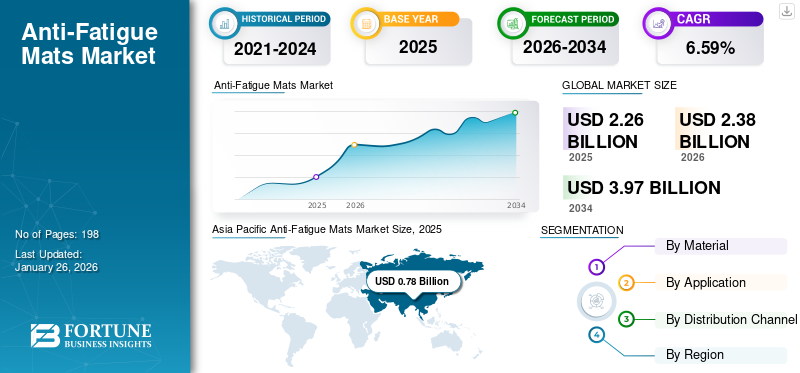
The global anti-fatigue mats market size was valued at USD 2.26 billion in 2025 and is projected to grow from USD 2.38 billion in 2026 to USD 3.97 billion by 2034, exhibiting a CAGR of 6.59% over the forecast period. Asia Pacific dominated the anti-fatigue mats market with a market share of 34.33% in 2025.
Anti-fatigue mats are specially designed mats that help reduce discomfort, fatigue, and strain caused by standing for long periods on a hard surface. Moreover, these mats are typically made using rubber, PVC, and polyurethane to provide support and cushioning. Furthermore, various prominent players are operating in the market, including Sheep Mats, Wearwell LLC, THE MAT GROUP, American Pro Marketing, LLC, and Sabafer Srl.
Download Free sample to learn more about this report.
ANTI-FATIGUE MATS MARKET TRENDS
Soaring Popularity of Customization to Provide Growth Opportunities
The popularity of customization and personalization is growing significantly across several countries. Consumers and businesses are increasingly seeking customized solutions tailored to their specific needs, including size, design, materials, and features, boosting the demand for customized products. Moreover, several major market players are introducing customization options and tools for consumers to provide products tailored to their preferences and requirements. For instance, in October 2024, AcroMat, a U.S.-based anti-fatigue mat company, launched its new custom mat-building tool, AcroSketch 2.0. According to the company, consumers can design custom mats to any shape, feature, and size according to their requirements.
- Asia Pacific witnessed anti-fatigue mats market growth from USD 0.69 Billion in 2023 to USD 0.73 Billion in 2024.
Anti-Fatigue Mats Market Key Takeaways
 Global Market Size & Forecast
- 2025 Market Size: USD 2.26 Billion
- 2026 Market Size: USD 2.38 Billion
- 2034 Forecast Market Size: USD 3.97 Billion
- CAGR: 6.59% from 2026–2034
 Market Share
- Asia Pacific dominated the anti-fatigue mats market with a 34.33% share in 2025.
- The rubber segment led the market by material with a 41.60% share.
- The industrial segment dominated the market by application with a 58.82% share.
 Key Regional Highlights
Asia Pacific
Asia Pacific led the market with USD 0.78 billion, accounting for 34.33% of global revenue in 2025.
Europe
Europe reached USD 0.67 billion, representing 29.78% of the global market in 2025.
North America
North America accounted for USD 0.61 billion and 26.80% of the global market in 2025.
U.S.
The anti-fatigue mats market is projected to reach USD 0.53 billion by 2026.
Japan
The anti-fatigue mats market is projected to reach USD 0.085 billion by 2026.
Read More

Download Free sample to learn more about this report.
MARKET DYNAMICS
Market Drivers
Growing Workplace Ergonomics Awareness Worldwide to Propel Market Growth
Increasing awareness regarding workplace ergonomics and overall employee well-being propels market growth. Corporate organizations across various countries are increasingly implementing wellness initiatives to reduce employee fatigue and work-related musculoskeletal disorders (WRMSDs) among working individuals, boosting product demand. Moreover, several prominent industry players are focusing on increasing health and product awareness through campaigns to boost product demand. For instance, in June 2023, Imprint Comfort Mats, a U.S.-based mats manufacturer, sponsored two campaigns, Get America Standing and Get Britain Standing, focused on increasing awareness of the dangers of sedentary working. According to the company, these campaigns will increase awareness of its CumulusPRO Comfort Mats, which are designed for standing desks. Furthermore, the increasing adoption of standing desks across offices and homes favors the global anti-fatigue mats market growth, helping them alleviate discomfort and improve blood circulation due to prolonged standing.
Increasing Health Awareness Among Workers to Fuel Market Growth
Increasing health awareness among workers worldwide and a growing focus on employee health to boost productivity fuels the market growth. Various government organizations, including the Occupational Safety and Health Administration (OSHA) and The National Institute for Occupational Safety and Health (NIOSH), are increasingly spreading awareness regarding the adverse effects of prolonged standing on worker's health.
Moreover, companies worldwide are increasingly focusing on reducing absenteeism, preventing musculoskeletal injuries, such as joint pains and enhancing worker's productivity by investing in preventive measures, propelling growth of the global anti fatigue mats market. Furthermore, various industries, such as healthcare, retail, food & service, and manufacturing, have prolonged requirements. This boosts the demand for anti-fatigue mats that offer comfort, minimize swelling & pain, and improve blood circulation among workers to enhance their productivity.
Market Restraints
Fluctuating Raw Material Costs to Limit Market Growth
Rubber, PVC, foam, and polyurethane are key raw materials used to manufacture anti-fatigue mats. These materials are subject to price volatility due to supply chain disruptions, geopolitical issues, and inconsistent crude oil prices. Manufacturers struggle to maintain stable pricing and increase product prices, limiting market growth. Moreover, the high cost of products may restrict the demand from budget-conscious consumers, decreasing the global anti-fatigue mats market share.
Market Opportunities
Introducing Products for Specific Applications to Drive Market Growth
The increasing availability of products designed for specific applications will boost product demand across various industries. Healthcare professionals and lab workers usually require mats that are sterile, snit-slip, and resistant to chemical spills. Moreover, food production facilities and hospitals usually need mats that are high temperature resistant, oil proof, and water resistant. Furthermore, several major market participants are focusing on launching new products for specific applications to diversify their portfolios. For instance, in July 2023, First Mats, a U.K.-based mats company, launched its new rubber anti-fatigue mats for kitchen and catering floors. According to the company, the new mats are water, oil, and grease-resistant, making them the preferred choice for food manufacturing environments.
Market Challenges
Lack of Product Awareness to Hamper Market Growth
Lack of product awareness among end-users is one of the significant market challenges. Several individuals and businesses are unaware of the health benefits provided by anti-fatigue mats, such as improved blood circulation, reduced muscle & joint stress, and lower back pain during prolonged standing. Moreover, various residential consumers perceive anti-fatigue mats as products meant exclusively for industrial or commercial use, leading to their limited product adoption.
Impact of COVID-19
COVID-19 Pandemic Negatively Influenced Product Sales owing to Lockdowns across Countries
The COVID-19 pandemic significantly impacted the market owing to lockdowns imposed by the governments worldwide in 2020. Lockdowns and restrictions led to a shortage of raw materials, such as rubber, foam, and gel, owing to shutdowns, closed import & export, and supply chain disruption across various countries.
Moreover, several industries, such as warehousing, manufacturing, and retail, were closed down due to the lockdown, negatively impacting product demand. Furthermore, with the shift to remote work due to office closures, the demand for anti-fatigue mats declined significantly in corporate settings.
SEGMENTATION ANALYSIS
By Material
Wide Availability of Rubber Mats to Drive Rubber Segment Growth
Based on material, the global market is segmented into rubber, PVC (vinyl), polyurethane, and others.
The rubber segment dominated the market in 2025 with the share of 41.60% owing to wide product availability and the durability, flexibility, and ability of the material to withstand heavy foot traffic and harsh conditions. Moreover, various innovations in rubber compounds, such as enhanced slip resistance and improved shock absorption, boost product demand.
- The rubber segment is expected to hold a 41.6% share in 2026.
The polyurethane segment is expected to grow significantly throughout the forecast period. Polyurethane materials are highly durable, resistant to wear & tear, and offer excellent cushioning. Moreover, their ability to maintain shape and performance over time is expected to fuel the segment growth over the coming years.
To know how our report can help streamline your business, Speak to Analyst
By Application Analysis
Increasing Usage in Industrial Settings to Fuel Industrial Segment Growth
Based on application, the global market is segmented into industrial, commercial, and residential.
The industrial segment dominated the market in 2024 owing to increasing usage in industrial settings to improve employee comfort, reduce fatigue, and enhance productivity. Moreover, industries such as manufacturing, warehousing, retail, and assembly lines require workers to stand for extended periods, boosting product demand. This segment is expected to gain 58.82% of the market share in 2026.
The commercial segment is expected to grow significantly with a CAGR of 6.28% during the forecast period (2026-2034), owing to the increasing health awareness among individuals and companies increasingly focusing on employee well-being. Moreover, the increasing popularity of stand desks across corporate settings, leading to prolonged standing, is expected to drive the segment growth over the coming years. Furthermore, hygienic anti fatigue mats are gaining significant popularity across hospitals.
By Distribution Channel Analysis
Strong Offline Distribution Presence across Various Countries to Favor Market Expansion
Based on distribution channel, the market is bifurcated into offline and online.
The offline segment dominated the market in 2024 owing to strong offline retail outlets presence, such as specialty retail stores, home improvement & hardware stores, furniture shops, ergonomic product retailers, and specialized wellness retailers. Moreover, in-store demonstrations, knowledgeable staff, and personalized customer services drive the segment's growth. The poised segment is expected to account for 68.91% of the market in 2026.
The online segment is expected to grow significantly with a CAGR of 6.29% over the forecast period (2026-2034), owing to the growing popularity of online shopping, offering attractive discounts, and availability of exclusive products. Moreover, the increasing availability of online customization tools on company websites offering personalized products tailored to client's specific requirements is expected to drive the segment growth through the forecast period.
Anti-Fatigue Mats Market Regional Outlook
Geographically, the global market is segmented into North America, Europe, Asia Pacific, South America, and the Middle East & Africa.
Asia Pacific
Asia Pacific Anti-Fatigue Mats Market Size, 2025 (USD Billion)
To get more information on the regional analysis of this market, Download Free sample
The Asia Pacific market was valued at USD 0.78 billion in 2025, capturing 34.33% of global revenue, and is estimated to reach USD 0.83 billion in 2026. The region will emerge as the fastest-growing regional market in the coming years owing to the high presence of prominent key players and the growth of the manufacturing industry and retail sector across countries. China is anticipated to reach a market value of USD 0.22 billion in 2025. Moreover, corporate companies increasingly focus on improving employee productivity and reducing absenteeism due to fatigue, which boosts product demand. Furthermore, the increasing number of working individuals across China, India, Japan, South Korea, and Australia facing overworking with rising musculoskeletal disorders due to prolonged sitting or standing boosts the product demand. According to the Government of China market is projected to reach USD 0.23 billion by 2026. India is set to be valued at USD 0.2 billion in 2026, while Japan is poised to hold USD 0.085 billion in the same year.
Europe
Europe accounted for USD 0.67 billion in 2025, representing 29.78% of the global market share, and is projected to reach USD 0.7 billion in 2026. The region is expected to grow significantly throughout the forecast period owing to the presence of prominent players and growing awareness about musculoskeletal disorders among workers in standing jobs. The U.K. market is expanding and is expected to stand at USD 0.09 billion in 2026. Moreover, stricter workplace safety regulations across various countries, including the U.K., Germany, France, Italy, and Spain, are expected to boost the demand for anti-fatigue mats over the coming years. Germany is poised to acquire USD 0.13 billion in 2026, while France is set to be worth USD 0.07 billion in 2025.
North America
North America contributed 26.80% to the global market in 2025, with a valuation of USD 0.61 billion, and is projected to reach USD 0.64 billion in 2026, owing to the increasing disposable income and increased awareness about workplace health & safety among individuals. Additionally, companies across the U.S. and Canada are increasingly adopting ergonomic solutions to improve productivity, propelling the regional market growth. Furthermore, regulatory frameworks, such as the Occupational Safety and Health Administration (OSHA) and The National Institute for Occupational Safety & Health (NIOSH), promote workplace safety, increasing product awareness, which drives the region's growth.
The U.S. is the most prominent country in the region owing to the wide product availability and high presence of prominent market players. Moreover, the increasing adoption of standing desks across corporate settings coupled with rising health awareness among working individuals boost product demand across the country. The U.S. market is estimated to be worth USD 0.53 billion in 2026.
South America
In 2025, South America generated USD 0.12 billion, contributing 5.26% to global market revenue, and is projected to grow to USD 0.12 billion in 2026. The Middle East & Africa is expected to grow considerably throughout the forecast period owing to the expansion of industrial, commercial, and healthcare sectors across the UAE, South Africa, and Saudi Arabia. Moreover, the increasing disposable income, especially in Gulf Cooperation Council (GCC) countries and the growing number of workers across the region boost product demand. The UAE market is inching to acquire USD 0.01 billion in 2025.
Middle East & Africa
The market in Middle East & Africa reached USD 0.09 billion in 2025, representing 3.84% of total market revenue, and is projected to reach USD 0.09 billion in 2026. The Middle East & Africa is expected to grow considerably throughout the forecast period owing to the expansion of industrial, commercial, and healthcare sectors across the UAE, South Africa, and Saudi Arabia. Moreover, the increasing disposable income, especially in Gulf Cooperation Council (GCC) countries and the growing number of workers across the region boost product demand.
COMPETITIVE LANDSCAPE
Key Industry Players
Prominent Players Focusing on Launching New Products to Diversify their Portfolios
Intense competitive rivalry characterizes the global market. International prominent market players leverage their strong brand loyalty and presence to stay ahead of the competition. Several key market players are focusing on launching new products designed for specific applications and industries to diversify their portfolios and boost product sales.
List of Key Anti-Fatigue Mats Companies Profiled
- Wearwell, LLC (U.S.)
- THE MAT GROUP (Australia)
- Crown Matting Technologies (U.S.)
- Sabafer Srl (Italy)
- COBA Europe Ltd. (U.K.)
- Durable Corporation (U.S.)
- VIKAS MATS (India)
- American Pro Marketing, LLC. (U.S.)
- Sheep Mats (China)
- Ansell Ltd. (India)
KEY INDUSTRY DEVELOPMENTS
- July 2024: Antistat, a U.K.-based ESD and production consumables company, announced Conard Sourcing Platform, a Germany-based technical supplies sourcing platform, as its authorized European distributor for all its product ranges.
- May 2023: Imprint Comfort Mats, a U.S.-based mats manufacturer, launched two new colors and patterns, the Burlap Cocoa design and Desert Palm Natural design, in the Professional series for its CumulusPRO Anti Fatigue Comfort Mat.
- November 2022: First Mats, a U.K.-based mats company, launched its new hygienic anti-fatigue mats. According to the company, the new mat is made from a specially formulated material that can be sterilized with steam and is oil-resistant, fire-tested, & slip-tested.
- October 2020: Antistat, a U.K.-based ESD and production consumables company, launched its new ESD Anti-fatigue Matting range. According to the company, the new product line is solder-splash resistant, has a non-slip finish, and has tapered edges.
REPORT COVERAGE
The report provides a detailed market analysis and focuses on key aspects, such as competition landscape, companies’ market shares, market dynamics, regional analysis, material categories, application, and distribution channel. Furthermore, the report offers insights into various market trends and highlights key industry developments. In addition, the anti-fatigue mats market report encompasses several other factors that have contributed to the growth of the market in recent years.
Request for Customization to gain extensive market insights.
Report Scope & Segmentation
|
ATTRIBUTE |
DETAILS |
|
Study Period |
2021-2034 |
|
Base Year |
2025 |
|
Estimated Year |
2026 |
|
Forecast Period |
2026-2034 |
|
Historical Period |
2021-2024 |
|
Growth Rate |
CAGR of 6.59% from 2026 to 2034 |
|
Unit |
Value (USD Billion) |
|
Segmentation |
By Material
|
|
By Application
|
|
|
By Distribution Channel
|
|
|
By Region
|
Frequently Asked Questions
According to Fortune Business Insights, the global anti-fatigue mats market size was valued at USD 2.26 billion in 2025 and is projected to reach USD 3.97 billion by 2034
Ascending at a CAGR of 6.59%, the global market will exhibit steady growth over the forecast period (2026-2034).
The key growth drivers include rising workplace ergonomics awareness, increasing adoption of standing desks, and corporate wellness initiatives aimed at reducing fatigue and musculoskeletal disorders among workers.
Asia Pacific led the market with a 34.33% share, driven by the expansion of the manufacturing sector, high employment rates, and increased corporate focus on employee well-being.
Anti-fatigue mats are primarily made from rubber, PVC (vinyl), and polyurethane. Rubber dominates due to its durability, while polyurethane is gaining popularity for its cushioning and longevity.
Major challenges include fluctuating raw material prices, particularly rubber and polyurethane, and low product awareness, especially in residential and small business sectors.
The industrial segment is the largest application category due to high usage in manufacturing, warehousing, and assembly lines, where workers stand for prolonged periods.
Key companies include Wearwell LLC (U.S.), THE MAT GROUP (Australia), Crown Matting Technologies (U.S.), COBA Europe Ltd. (U.K.), Sabafer Srl (Italy), and Sheep Mats (China).



- 2021-2034
- 2025
- 2021-2024
- 198
-
(Offer valid till 15th Oct 2026)
Get 30-60 hrs Free Customization
Expand Regional and Country Coverage, Segments Analysis, Company Profiles, Competitive Benchmarking, and End-user Insights.













Related Reports
-
US +1 833 909 2966 ( Toll Free )
-
Get In Touch With Us