Anti-snoring Devices Market Size, Share & Industry Analysis, By Device Type (Mandibular Advancement Devices, Tongue Retaining Devices (TRDs), Nasal devices, CPAP Machines & Accessories, and Others), By Distribution Channel (Hospital Pharmacies, Retail Pharmacies, and Online Pharmacies), and Regional Forecast, 2026-2034
 Download Free Sample
KEY MARKET INSIGHTS
 Listen to Audio Version
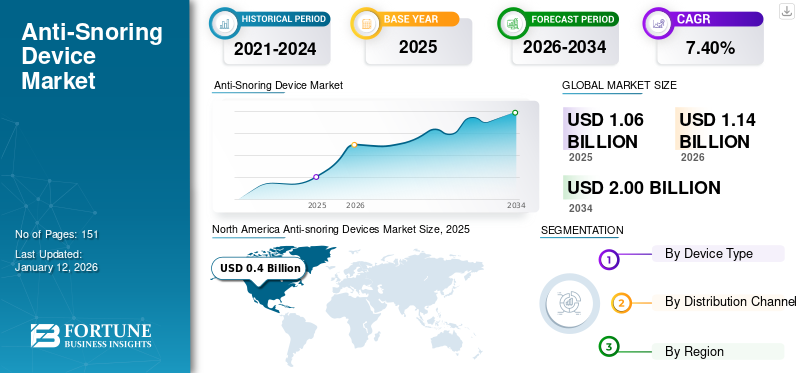
The global anti-snoring devices market size was valued at USD 1.06 billion in 2025 and is projected to grow from USD 1.14 billion in 2026 to USD 2 billion by 2032, exhibiting a CAGR of 7.36% during the forecast period. North America dominated the global anti-snoring devices market with a market share of 37.88% in 2025.
Anti-snoring devices help to reduce or prevent snoring by keeping the airway open during sleep. These are non-invasive devices that target key causes of snoring, such as airway obstruction or vibration of throat tissues. The most common types include mandibular advancement devices (MADs), tongue retaining devices (TRDs), chin straps, and nasal dilators. These devices are also used to manage both simple snoring and cases of obstructive sleep apnea (OSA). The increasing penetration of OTC anti-snoring devices among the regular snoring population, mainly due to sleep apnea and other conditions is supporting the market’s growth.
The market is dominated by major players such as ResMed, Fisher & Paykel Healthcare Limited, and SomnoMed due to a strong foothold globally and a diversified portfolio.
Download Free sample to learn more about this report.
Anti-snoring Devices Market Key Takeaways
 Global Market Size & Forecast
- 2025 Market Size: USD 1.06 billion
- 2026 Market Size: USD 1.14 billion
- 2034 Forecast Market Size: USD 2.00 billion
- CAGR: 7.36% from 2026–2034
 Market Share
- North America dominated the anti-snoring devices market with a 37.88% share in 2025.
- Mandibular advancement devices are expected to account for 42.23% of the global market in 2026.
- Retail pharmacies are projected to hold a 38.90% market share in 2026.
 Key Regional Highlights
North America
North America led with USD 0.40 billion and 37.88% market share in 2025.
Europe
Europe reached USD 0.30 billion with a 27.90% market share in 2025.
Asia Pacific
Asia Pacific accounted for USD 0.26 billion and 24.40% market share in 2025.
U.S
Market estimated at USD 0.41 billion in 2026.
Japan
Growth is supported by increasing adoption of anti-snoring devices.
Read More

MARKET DYNAMICS
MARKET DRIVERS
Rising Prevalence of Sleep Disorders to Propel Market Growth
The increasing prevalence of sleep disorders, such as obstructive sleep apnea (OSA) and snoring, is among the major drivers for the adoption of anti-snoring devices. Health organizations estimate that millions of individuals globally suffer from these disorders that lead to cardiovascular diseases, excessive daytime fatigue, as well as cognitive issues. Increasing awareness about associated complications from untreated snoring and apnea, enables more people to take effective measures that ensure good sleep.
Anti-snoring devices offer a less invasive and less expensive alternative therapy compared to airway pressure therapy and surgical interventions, increasing its popularity. Additionally, innovations that enhance comfort and efficacy are leading to wider use among customers, supporting the global anti-snoring devices market growth.
- For instance, according to the data from the National Center for Biotechnology Information (NCBI) in April 2025, an estimated 936.0 million adults aged 30-69 have mild to severe obstructive sleep apnea (OSA) globally.
MARKET RESTRAINTS
Limited Consumer Awareness and Adoption to Restrict Market Expansion
Despite the increasing prevalence of sleep disorders, one key deterrent to the anti-snoring devices is limited customer awareness and resistance toward such products. A large number of customers are unaware of snoring as a disease, and therefore feel less inclined to take measures to correct it. Customers also consider antisnoring devices as less comfortable or less effective by anecdotal experiences, restricting their wider acceptability.
Moreover, the lack of accessibility to proper diagnosis and limited knowledge about how to treat these conditions in developing and middle-income countries are also restricting its penetration.
- According to the data published by Sleep Doctor Holdings, LLC., in April 2023, around 40.3% of the U.S. individuals diagnosed with sleep apnea have not tried any treatment.
MARKET OPPORTUNITIES
Expansion into Emerging Markets will Assist Product Sales and Lucrative Growth
In recent years, there has been an increase in disposable income and awareness of sleep health in Asia Pacific, Latin America, and parts of Africa. In response, governments and healthcare organizations in these regions are also improving diagnostic facilities, boosting the diagnosis and treatment of sleep disorders. Moreover, the affordability of anti-snoring devices compared to clinical treatments is making them attractive for cost-sensitive markets. In addition, companies are focusing on localized awareness programs and adapting new marketing strategies, while launching affordable product lines to expand their regional presence. This is expected to offer opportunities for partnering with local healthcare providers and digital platforms, thereby helping manufacturers build trust and raise awareness of anti-snoring devices among consumers, and support the market expansion.
MARKET CHALLENGES
Competition from Airway Pressure Therapy Devices and Surgical Therapies Obstruct Growth
Despite high demand for nasal devices and oral appliances, positive airway pressure therapy devices remain the significant choice for treating obstructive sleep apnea (OSA), a major cause of chronic snoring. As a result, these devices are being widely prescribed by healthcare professionals. They are often covered by insurance, making them a preferred option for patients with moderate to severe obstructive sleep apnea (OSA).
Similarly, surgical interventions such as radiofrequency ablation, Uvulopalatopharyngoplasty (UPPP), or implant-based solutions offer long-term relief, reducing the reliance on over-the-counter anti-snoring devices. This is posing a major challenge for manufacturers to demonstrate efficacy, secure medical validations, and differentiate their products through advancements.
- For instance, according to the data from NCBI, in April 2025, there were around 18,526 surgical encounters for obstructive sleep apnea (OSA) across inpatient and outpatient settings in the U.S. in 2019.
ANTI-SNORING DEVICES MARKET TRENDS
Growing Demand for Non-Invasive Solutions is Emerge as a Key Trend
Recently, the incorporation of sensors, AI algorithms, and Bluetooth connectivity has enabled manufacturers to offer personalized treatment plans that adapt to an individual’s sleep patterns and snoring causes. Smart anti-snoring devices monitor sleep quality in real-time, adjust settings automatically for maximum comfort and effectiveness, and sync data with mobile apps for user feedback and health tracking.
- For instance, in November 2022, ProSomnus Sleep Technologies received FDA 510(k) clearance for its EVO [PH] sleep and snore device, designed to treat mild to moderate obstructive sleep apnea and snoring by precisely adjusting the jaw during sleep. The device is 13% smaller than the previous models, customizable, and optionally equipped with a DentiTrac micro-recorder for compliance monitoring.
This tech-driven innovation is appealing to health-conscious consumers who value data-driven solutions and convenience. Additionally, partnerships with telemedicine platforms are enhancing remote diagnosis and treatment, thereby expanding market reach. As a result, wearable health technology is gaining popularity, embedding smart features into anti-snoring devices that differentiate products and attract users.
Download Free sample to learn more about this report.
Segmentation Analysis
By Device Type
Mandibular Advancement Devices Lead Due to High Demand among OSA & Snoring Population
On the basis of device type, the market is classified into mandibular advancement devices, tongue retaining devices (TRDs), nasal devices, CPAP machines & accessories, and others.
To know how our report can help streamline your business, Speak to Analyst
The mandibular advancement devices segment is expected to lead the market, contributing 42.23% globally in 2026. The growth is attributed to its higher preference among the snoring population. Also, it is preferred in the OSA patients when continuous positive airway pressure (CPAP) therapy is non-tolerable. Moreover, players are investing in marketing of these devices to dentists/sleep clinics to increase their adoption among the snoring population.
- For instance, in August 2024, SomnoMed stated that its mandibular advancement devices have treated around 9.0 million patients worldwide in a year.
By Distribution Channel
Increasing Number of Retail Pharmacies Propelled Segment Growth
Based on distribution channel, the market is segmented into hospital pharmacies, retail pharmacies, and online pharmacies.
In 2026, the global market was dominated by retail pharmacies owing to the rising number of retail pharmacies worldwide, further increasing the availability and accessibility of anti-snoring devices. Moreover, increasing supply agreements directly between these channels and manufacturers is also expected to contribute to the segment’s expansion with an estimated 38.90% share in 2026.
- In October 2024, Amazon Pharmacy revealed plans to speed up its rollout by opening new pharmacy locations and introducing fast, free prescription medication delivery in 20 additional U.S. cities in 2025.
The online pharmacies segment is projected to grow at a CAGR of 8.3% during the forecast period.
Anti-snoring Devices Market Regional Outlook
By geography, the market is categorized into North America, Europe, Asia Pacific, Latin America, and the Middle East & Africa.
North America
North America Anti-snoring Devices Market Size, 2025 (USD Billion)
To get more information on the regional analysis of this market, Download Free sample
The North America market generated USD 0.4 billion in 2025, representing 37.88% of the global market landscape, and is expected to reach USD 0.43 billion in 2026. The growth is attributed to the significant treatment rate of obstructive sleep apnea and regular snoring patients in the U.S. and Canada due to higher prevalence of the snoring population. In 2026, the U.S. market is estimated to reach USD 0.41 billion.
- According to the data from the American Medical Association, in April 2024, around 90.0 million individuals in the U.S. snore at one time or another. However, 37.0 million of those adults snore regularly.
Europe
Europe contributed 27.90% to the global market in 2025, with a valuation of USD 0.3 billion, and is projected to reach USD 0.32 billion in 2026. This growth is primarily attributed to the established supply chain and presence of key players, contributing to significant availability and promotion of anti-snoring devices. Backed by these factors, the U.K. anticipates to record USD 0.07 billion, along with Germany and France to hit USD 0.07 billion in 2026 and USD 0.05 billion respectively in 2025.
Asia Pacifc
Asia Pacific accounted for USD 0.26 billion in 2025, representing 24.40% of the global market share, and is projected to reach USD 0.28 billion in 2026. India and China are both estimated to reach USD 0.04 billion and 0.11 billion, respectively in 2026.
Latin America
Latin America contributed approximately USD 0.06 billion to the global market in 2025, accounting for 5.92% share, and is expected to reach USD 0.07 billion in 2026.
Middle East & Africa
In 2025, Middle East & Africa held 3.99% of the global market, reaching a valuation of USD 0.04 billion, and is projected to grow to USD 0.04 billion in 2026. In the Middle East & Africa, GCC is set to attain the value of USD 0.02 billion in 2025.
COMPETITIVE LANDSCAPE
Key Industry Players
Strong Foothold and Diversified Product Offerings Strengthen Position of Key Players
In 2024, ResMed, Fisher & Paykel Healthcare Limited, and SomnoMed held the major global anti-snoring devices market share. These companies are focusing on entering the untapped markets through product promotions and awareness campaigns for sleep health. Moreover, they are involved in signing strategic agreements with dental clinics, distributors, and other activities to expand the reach of their product globally. SomnoMed, Glidewell, and ProSomnus Sleep Technologies, are expanding their product portfolio and focusing on increasing geographic presence to gain a significant portion of the market.
LIST OF KEY ANTI-SNORING DEVICES COMPANIES PROFILED
- SomnoMed (Australia)
- ResMed (U.S.)
- Glidewell (U.S.)
- PANTHERA DENTAL (Canada)
- Frantz Design Inc. (U.S.)
- BlueSleep (U.S.)
- ProSomnus Sleep Technologies (U.S.)
- Fisher & Paykel Healthcare Limited (New Zealand)
- Apnea Sciences (U.S.)
- DynaFlex (U.S.)
KEY INDUSTRY DEVELOPMENTS
- March 2025: Signifier Medical Technologies Limited announced a product update for its eXciteOSA device to meet CMS (Medicare & Medicaid) reimbursement requirements, expanding access.
- December 2024: Rotech Healthcare Inc. entered a supplier partnership with Signifier Medical Technologies Limited to distribute the FDA-approved eXciteOSA device to payers, providers, and patients.
- January 2024: SnoreLessNow launched the “Anti-Snore Mouth Guard+” (also known in Europe as SomnoFit-S) in the U.S., via partnership with Swiss manufacturer Oscimed SA, with FDA clearance.
- May 2022: Illusion Aligners introduced an innovative oral anti-snoring device that is simple to wear, comfortable, and effective. This device helps users enjoy a restful, uninterrupted sleep each night.
- February 2021: Signifier Medical Technologies Limited introduced the eXciteOSA device, an innovative anti-snoring solution that delivers electrical muscle stimulation to the tongue using a specially designed mouthpiece.
REPORT COVERAGE
Request for Customization to gain extensive market insights.
Report Scope & Segmentation
|
ATTRIBUTE |
DETAILS |
|
Study Period |
2021-2034 |
|
Base Year |
2025 |
|
Estimated Year |
2026 |
|
Forecast Period |
2026-2034 |
|
Historical Period |
2021-2024 |
|
Growth Rate |
CAGR of 7.36% from 2026-2034 |
|
Unit |
Value (USD Billion) |
|
Segmentation |
By Device Type, Distribution Channel, and Region |
|
By Device Type |
|
|
By Distribution Channel |
|
|
By Geography |
North America (By Device Type, Distribution Channel, and Country)
Europe (By Device Type, Distribution Channel, and Country/Sub-region)
Asia Pacific (By Device Type, Distribution Channel, and Country/Sub-region)
Latin America (By Device Type, Distribution Channel, and Country/Sub-region)
Middle East & Africa (By Device Type, Distribution Channel, and Country/Sub-region)
|
Frequently Asked Questions
Fortune Business Insights says that the global market value stood at USD 1.06 billion in 2025 and is projected to reach USD 2 billion by 2034.
In 2025, the market value stood at USD 0.4 billion.
The market is expected to exhibit a CAGR of 7.36% during the forecast period of 2026-2034.
The mandibular advancement devices segment led the market by device type.
The key factors driving the market are the increasing prevalence of sleep disorders and increasing awareness about sleep health.
ResMed, Fisher & Paykel Healthcare Limited, and SomnoMed are some of the prominent players in the market.
North America dominated the anti-snoring devices market with a market share of 37.88% in 2025.
Advancement of anti-snoring devices and new launches are favoring product adoption globally.



- 2021-2034
- 2025
- 2021-2024
- 151
Get 30-60 hrs Free Customization
Expand Regional and Country Coverage, Segments Analysis, Company Profiles, Competitive Benchmarking, and End-user Insights.













.webp)






-
US +1 833 909 2966 ( Toll Free )
-
Get In Touch With Us