Antiseptic And Disinfectant Market Size, Share & Industry Analysis, By Type (Quaternary Ammonium Compounds), By Product (Enzymatic Cleaners), By End-use, By Sales Channel, and Regional Forecast, 2026-2034
 Download Free Sample
Antiseptic And Disinfectant Market Overview
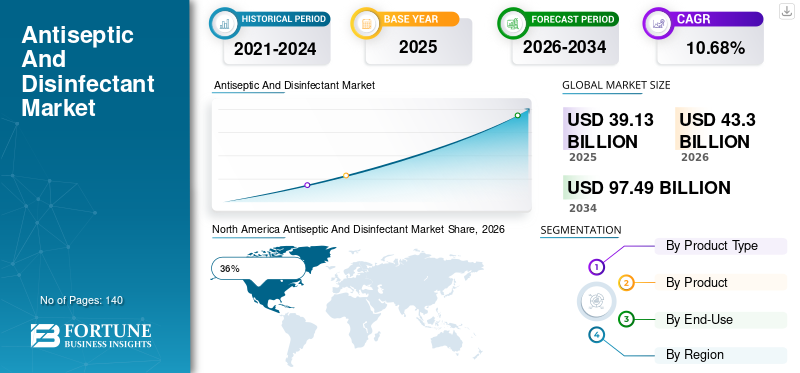
The antiseptic and disinfectant market size was valued at USD 39.13 Billion in 2025. The market is projected to grow from USD 43.3 Billion in 2026 to USD 97.49 Billion by 2034, exhibiting a CAGR of 10.68% during the forecast period.

The antiseptic and disinfectant market remains a critical component of global infection prevention strategies across healthcare facilities, pharmaceutical manufacturing units, food processing plants, laboratories, and commercial establishments. Growing awareness regarding hygiene standards, increasing surgical procedures, and stronger infection control protocols continue to support market expansion. Antiseptic and disinfectant products are widely used for surface sanitation, instrument sterilization, wound care, and hand hygiene applications. The antiseptic and disinfectant market Report highlights rising adoption of advanced formulations containing quaternary ammonium compounds, hydrogen peroxide, alcohol-based agents, and enzymatic technologies. Demand from hospitals, diagnostic centers, and industrial users continues to strengthen overall market penetration and product innovation.
Download Free sample to learn more about this report.
Key Takeaways
Market Size & Growth
- Global market size 2025: USD 39.13 Billion
- Global market size 2034: USD 97.49 Billion
- CAGR (2026–2034): 10.68%
Market Share – Regionals
- North America: 36 %
- Europe: 29%
- Asia-Pacific: 27%
- Rest of World: 8%
Country-Level Shares
- Germany: 24 % of Europe’s market
- United Kingdom: 19% of Europe’s market
- Japan: 16% of Asia-Pacific market
- China: 38% of Asia-Pacific market
USA Antiseptic And Disinfectant Market
The United States represents the largest national market within North America due to its extensive healthcare infrastructure and stringent infection prevention requirements. Hospitals, ambulatory surgical centers, diagnostic laboratories, pharmaceutical manufacturers, and long-term care facilities maintain high consumption of antiseptic and disinfectant products. The presence of strict sanitation standards and continuous monitoring of healthcare-associated infections has increased product utilization across clinical environments. The antiseptic and disinfectant industry analysis indicates that demand for medical device disinfectants, surface disinfectants, and hand antiseptics remains particularly strong. Increased awareness of hygiene in public facilities, educational institutions, transportation systems, and food production facilities further contributes to sustained market demand across the United States.
Antiseptic And Disinfectant Market Latest Trends
The antiseptic and disinfectant market trends indicate a strong shift toward broad-spectrum antimicrobial formulations capable of eliminating bacteria, fungi, and viruses within shorter contact times. Manufacturers are increasingly developing products with improved surface compatibility and lower residue accumulation. Quaternary ammonium compounds continue to dominate commercial and healthcare applications because of their effectiveness and cost efficiency. At the same time, enzyme-based and environmentally friendly disinfectants are gaining acceptance among institutional users seeking sustainable sanitation solutions.
Download Free sample to learn more about this report.
Another major trend in the antiseptic and disinfectant market research report is the rapid expansion of disinfectant wipes, ready-to-use sprays, and automated disinfection systems. Hospitals and pharmaceutical facilities are integrating digital hygiene monitoring solutions to improve compliance with infection control standards. Manufacturers are also investing in low-toxicity formulations suitable for food processing environments, veterinary applications, and public infrastructure. The increased use of reusable medical instruments has further accelerated demand for specialized disinfectants designed for high-level sterilization and medical device decontamination.
Antiseptic And Disinfectant Market Dynamics
DRIVER
Rising Focus on Infection Prevention and Healthcare Hygiene
The primary growth driver for the antiseptic and disinfectant market is the increasing emphasis on infection prevention across healthcare and industrial environments. Hospitals continue to implement strict sanitation programs to minimize healthcare-associated infections. Growing patient volumes, increasing surgical interventions, and expanding healthcare infrastructure have significantly increased the consumption of antiseptic and disinfectant products. Healthcare facilities require continuous disinfection of surfaces, instruments, and patient-contact areas, creating recurring product demand.
The pharmaceutical and biotechnology sectors also contribute substantially to market growth. Manufacturing facilities maintain stringent contamination-control standards, increasing the use of disinfectant formulations. Food processing plants, laboratories, and commercial institutions are adopting advanced hygiene protocols to maintain operational safety and regulatory compliance. Growing awareness among consumers regarding disease transmission and public health protection further supports product adoption. The antiseptic and disinfectant market outlook remains favorable because infection control continues to be a top operational priority across multiple industries.
RESTRAINT
Regulatory Pressure on Chemical Ingredients
One of the major restraints affecting the antiseptic and disinfectant market is the increasing scrutiny of chemical ingredients used in disinfectant formulations. Regulatory agencies across multiple countries continue to evaluate active ingredients for environmental safety, toxicity, and long-term health effects. Certain disinfectant chemicals face restrictions due to concerns regarding environmental persistence and antimicrobial resistance.
Compliance with evolving regulations requires manufacturers to conduct extensive testing and product reformulation. This process increases development costs and extends product approval timelines. Small and medium-sized manufacturers often face difficulties meeting complex regulatory requirements. In addition, concerns regarding occupational exposure among healthcare workers and industrial employees have encouraged end users to seek alternative products with reduced chemical intensity. These factors can slow product adoption in some market segments and increase operational challenges for suppliers operating in highly regulated environments.
OPPORTUNITY
Expansion of Sustainable and Enzyme-Based Disinfectants
The antiseptic and disinfectant market opportunities are expanding through the development of sustainable and enzyme-based disinfection technologies. Institutional buyers increasingly prefer products that deliver strong antimicrobial performance while minimizing environmental impact. This trend has encouraged manufacturers to invest in biodegradable ingredients and low-residue formulations.
Growing demand from food processing facilities, laboratories, and pharmaceutical plants has created opportunities for specialized disinfectants tailored to sensitive environments. Emerging economies are also investing heavily in healthcare infrastructure, creating additional demand for advanced sanitation solutions. Automated disinfection technologies, smart dispensing systems, and touchless hygiene solutions offer further growth potential. Companies capable of developing innovative products that combine effectiveness, safety, and sustainability are expected to strengthen their competitive position in the global antiseptic and disinfectant market Forecast.
CHALLENGE
Rising Antimicrobial Resistance Concerns
Antimicrobial resistance has emerged as a significant challenge for the antiseptic and disinfectant industry report. Continuous exposure to disinfectant chemicals may contribute to microbial adaptation, raising concerns among healthcare professionals and regulatory authorities. Manufacturers must continuously evaluate product effectiveness against evolving pathogens and emerging infection threats.
Another challenge involves maintaining efficacy across diverse application environments. Different surfaces, contamination levels, and environmental conditions can affect disinfectant performance. Hospitals and industrial facilities increasingly demand products capable of delivering rapid microbial elimination without damaging equipment or sensitive materials. Balancing performance, safety, cost efficiency, and environmental compliance remains a complex task for industry participants. These challenges require ongoing research investments and advanced formulation technologies to maintain market competitiveness and regulatory acceptance.
Antiseptic And Disinfectant Market Segmentation
By Product Type
Quaternary ammonium compounds represent the leading product segment in the antiseptic and disinfectant market share analysis, accounting for approximately 32% of the global market. These compounds are widely used across hospitals, commercial facilities, food processing plants, and household sanitation applications. Their popularity stems from broad-spectrum antimicrobial activity, surface compatibility, and relatively low toxicity compared with some alternative disinfectants.
The antiseptic and disinfectant market Insights indicate that quaternary ammonium compounds are frequently used for environmental surface disinfection, medical equipment sanitation, and institutional cleaning applications. Their residual antimicrobial activity provides ongoing protection after application, making them attractive for high-traffic environments. Demand continues to expand across healthcare facilities and industrial settings due to regulatory requirements related to infection control and sanitation management. Manufacturers continue introducing advanced formulations that improve cleaning performance while addressing environmental and safety concerns.
To know how our report can help streamline your business, Speak to Analyst
By Product
Enzymatic cleaners account for approximately 18% of the antiseptic and disinfectant market size and represent one of the most rapidly expanding segments. These products utilize biological enzymes to break down organic material, improving cleaning efficiency while reducing dependence on aggressive chemical agents. Their application is particularly important in healthcare environments where medical instruments require effective cleaning before sterilization.
The antiseptic and disinfectant market growth for enzymatic cleaners is supported by increasing adoption in hospitals, diagnostic laboratories, pharmaceutical facilities, and biotechnology research centers. These products are especially valuable for removing blood, tissue residues, and protein-based contaminants from reusable medical devices. Growing interest in sustainable and environmentally responsible cleaning solutions has further strengthened demand. Healthcare providers increasingly recognize enzymatic formulations as an effective complement to traditional disinfection protocols, supporting broader market expansion.
By End-Use
Hospitals remain the dominant end-use segment with approximately 46% market share. Continuous disinfection of patient rooms, operating theaters, intensive care units, and medical equipment drives substantial product consumption. Infection prevention programs implemented by healthcare facilities require extensive use of antiseptic and disinfectant products throughout daily operations.
The antiseptic and disinfectant market analysis demonstrates that hospitals prioritize high-level disinfection technologies capable of reducing healthcare-associated infections. Rising surgical volumes and expanding healthcare infrastructure continue to strengthen product demand. Regulatory requirements for patient safety and infection control further reinforce the importance of disinfectant products within healthcare settings. As hospitals increasingly adopt automated disinfection systems and advanced hygiene protocols, this segment is expected to maintain its leadership position.
Medical device disinfectants account for approximately 41% of application demand within the antiseptic and disinfectant market. These products are designed specifically for reusable medical instruments that require high-level decontamination between patient procedures. Growing utilization of surgical instruments, diagnostic devices, and endoscopic equipment has increased demand for specialized disinfectant formulations.
Healthcare providers increasingly focus on preventing cross-contamination and ensuring compliance with sterilization standards. This has encouraged the adoption of advanced disinfectants capable of delivering effective microbial elimination without damaging sensitive medical equipment. Product innovation within this segment includes rapid-action formulations, low-residue chemistries, and environmentally friendly alternatives. As healthcare systems continue expanding worldwide, demand for medical device disinfectants remains a significant growth opportunity for industry participants.
Antiseptic And Disinfectant Market Regional Outlook
North America
North America Antiseptic And Disinfectant Market Share, 2026 (%)
To get more information on the regional analysis of this market, Download Free sample
North America holds approximately 36% of the global antiseptic and disinfectant market share. The region benefits from advanced healthcare infrastructure, high awareness regarding infection prevention, and extensive regulatory oversight. Hospitals, diagnostic centers, pharmaceutical manufacturing facilities, and commercial institutions represent major consumers of antiseptic and disinfectant products. Continuous investments in healthcare modernization and patient safety initiatives support sustained product demand.
The region also demonstrates strong adoption of innovative technologies including automated disinfection systems, smart dispensing solutions, and environmentally responsible formulations. Growing concern regarding healthcare-associated infections encourages healthcare providers to maintain rigorous sanitation protocols. Strong purchasing power and well-established distribution networks further support market expansion throughout North America.
Europe
Europe accounts for approximately 29% of the global antiseptic and disinfectant market share. Regional demand is supported by comprehensive healthcare systems, strict hygiene regulations, and growing emphasis on infection control. Hospitals, nursing facilities, pharmaceutical manufacturers, and food processing companies maintain substantial demand for disinfectant products.
The European market increasingly favors sustainable formulations and environmentally friendly cleaning technologies. Regulatory authorities continue promoting high sanitation standards across healthcare and industrial sectors. Investments in public health infrastructure and laboratory modernization contribute to continued demand for advanced antiseptic and disinfectant solutions.
Germany Antiseptic And Disinfectant Market
Germany represents approximately 24% of the European market. The country maintains one of the region's largest healthcare systems, supporting substantial consumption of antiseptic and disinfectant products. Hospitals, medical laboratories, and pharmaceutical manufacturers utilize advanced sanitation technologies to comply with strict hygiene regulations.
German healthcare providers prioritize infection prevention through comprehensive disinfection programs. Demand for medical device disinfectants and surface sanitation products remains particularly strong. The country's pharmaceutical manufacturing sector further contributes to market growth by requiring contamination-control solutions for production facilities. Sustainable and environmentally responsible disinfectants are also gaining traction among institutional users.
United Kingdom Antiseptic And Disinfectant Market
The United Kingdom accounts for approximately 19% of the European market. Public healthcare institutions, private hospitals, research laboratories, and long-term care facilities represent key end users. Infection prevention remains a central focus within healthcare policy, supporting ongoing demand for disinfectant technologies.
Healthcare facilities continue investing in advanced hygiene management systems and disinfection protocols. Demand extends beyond healthcare into transportation infrastructure, educational institutions, and food processing operations. Growing awareness regarding pathogen control and sanitation compliance strengthens the market position of antiseptic and disinfectant manufacturers throughout the United Kingdom.
Asia-Pacific
Asia-Pacific holds approximately 27% of the global antiseptic and disinfectant market share. Rapid healthcare infrastructure expansion, increasing healthcare expenditures, and growing awareness regarding infection prevention drive regional demand. Hospitals, clinics, pharmaceutical facilities, and food processing companies represent major consumers.
Industrialization and urbanization have increased the need for effective sanitation solutions across commercial and public environments. Government investments in healthcare modernization and disease prevention programs further support market development. Regional manufacturers continue expanding production capacity to meet growing domestic and export demand.
Japan Antiseptic And Disinfectant Market
Japan accounts for approximately 16% of the Asia-Pacific market. The country maintains exceptionally high hygiene standards across healthcare, pharmaceutical, and public sectors. Hospitals and long-term care facilities are major consumers of antiseptic and disinfectant products due to the country's aging population and advanced healthcare system.
Japanese manufacturers emphasize product quality, safety, and technological innovation. Automated disinfection systems and specialized medical disinfectants are widely adopted across healthcare facilities. Demand for premium hygiene solutions continues to support market expansion.
China Antiseptic And Disinfectant Market
China represents approximately 38% of the Asia-Pacific market. Rapid expansion of healthcare infrastructure, pharmaceutical production, and industrial manufacturing has significantly increased disinfectant consumption. Hospitals and public institutions continue investing heavily in infection prevention measures.
Domestic manufacturers are expanding production capabilities while introducing innovative formulations tailored to local requirements. The food processing and pharmaceutical sectors also contribute strongly to demand. Continued urbanization and public health initiatives support sustained market growth throughout the country.
Rest of World
The Rest of World region accounts for approximately 8% of the global antiseptic and disinfectant market share. Demand is increasing across Latin America, the Middle East, and Africa as healthcare systems expand and hygiene awareness improves. Hospitals, diagnostic facilities, and food processing companies represent major end users.
Government investments in healthcare infrastructure and public health programs are creating opportunities for market participants. International manufacturers are expanding regional distribution networks to improve product accessibility. Increased adoption of infection prevention protocols continues supporting long-term demand growth throughout emerging markets.
List of Top Antiseptic And Disinfectant Companies
- 3M
- Reckitt Benckiser
- Steris Plc
- Kimberly-Clark Corporation
- Bio-Cide International, Inc.
- Cardinal Health
- BD
- Johnson & Johnson
Top Two Companies by Market Share
- Reckitt Benckiser – 14%
- 3M – 11%
Investment Analysis and Opportunities
Investment activity within the antiseptic and disinfectant market continues to focus on manufacturing expansion, sustainable chemistry development, and automation technologies. Companies are increasing capital expenditure to improve production efficiency and strengthen supply chain resilience. Investments in advanced formulation research have accelerated the commercialization of high-performance disinfectants suitable for healthcare, pharmaceutical, and industrial environments.
Emerging markets offer substantial opportunities due to healthcare infrastructure expansion and rising hygiene awareness. Strategic partnerships between manufacturers and healthcare providers are supporting product innovation and market penetration. Investors are increasingly interested in companies developing environmentally responsible disinfectants, smart hygiene monitoring systems, and automated sanitation technologies. These areas are expected to attract significant investment as organizations prioritize infection prevention and regulatory compliance.
New Product Development
Manufacturers are actively introducing disinfectants with improved antimicrobial efficacy, shorter contact times, and enhanced surface compatibility. New product development focuses on reducing environmental impact while maintaining high sanitation standards. Enzyme-based disinfectants, biodegradable formulations, and low-residue products are gaining significant attention.
Innovation also includes touchless dispensing technologies, smart monitoring systems, and disinfectant wipes designed for rapid application in healthcare settings. Medical device disinfectants with improved material compatibility are being developed to support reusable instrument sterilization. Companies continue investing in advanced research programs to create products capable of addressing emerging pathogens and evolving infection control requirements.
Recent Developments (2023-2025)
- Expansion of quaternary ammonium compound production capacity by major manufacturers.
- Introduction of biodegradable disinfectant formulations for healthcare and industrial applications.
- Launch of advanced disinfectant wipes with enhanced antimicrobial efficacy.
- Increased investment in automated room disinfection and hygiene monitoring technologies.
- Expansion of medical device disinfectant portfolios to support reusable surgical instruments.
Report Coverage
The antiseptic and disinfectant market report provides comprehensive analysis of product types, applications, end-use industries, competitive landscape, investment trends, and regional developments. The report evaluates demand patterns across hospitals, pharmaceutical manufacturing facilities, laboratories, food processing companies, and commercial institutions.
Request for Customization to gain extensive market insights.
Coverage includes detailed assessment of market drivers, restraints, opportunities, and challenges influencing industry performance. The report also examines technological innovations, regulatory developments, sustainability initiatives, and competitive strategies adopted by leading manufacturers. Regional analysis covers North America, Europe, Asia-Pacific, and Rest of World markets while highlighting country-level developments in major economies. The antiseptic and disinfectant market Research Report further analyzes market share distribution, product adoption trends, and emerging opportunities across key industry segments.



- 2021-2034
- 2025
- 2021-2024
- 140
-

(Offer valid till 30th Sep 2026)
Get 30-60 hrs Free Customization
Expand Regional and Country Coverage, Segments Analysis, Company Profiles, Competitive Benchmarking, and End-user Insights.













.webp)






-
US +1 833 909 2966 ( Toll Free )
-
Get In Touch With Us