API Security Market Size, Share & Industry Analysis, By Offerings (Platform and Services), By Deployment (On-premise, Cloud, and Hybrid), By Enterprise Type (Large Enterprises and Small and Medium Enterprises (SMEs)), By Security Function (API Discovery & Visibility, Authentication & Authorization, Threat Protection, Testing & Vulnerability Management, and Others), By Industry (BFSI, Government & Defense, Healthcare, Media & Entertainment, Retail & E-Commerce, IT & Telecom, and Others), and Regional Forecast, 2026 – 2034
 Download Free Sample
API SECURITY MARKET SIZE AND FUTURE OUTLOOK
 Listen to Audio Version
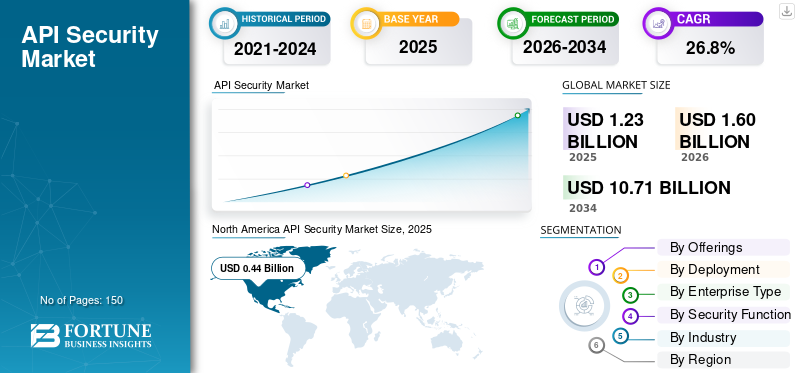
The global API security market size was valued at USD 1.23 billion in 2025. The market is projected to grow from USD 1.60 billion in 2026 to USD 10.71 billion by 2034, exhibiting a CAGR of 26.8% during the forecast period. North America dominated the API security market with a market share of 35.77% in 2025.
Application Programming Interfaces (API) security market has emerged as a critical segment within the broader cybersecurity landscape, driven by the increasing reliance of organizations on APIs to enable digital connectivity, application integration, and seamless data exchange. APIs have become the foundation of modern digital ecosystems, facilitating communication between applications, cloud services, mobile platforms, Internet of Things (IoT) devices, and enterprise systems. As organizations accelerate digital transformation initiatives and adopt cloud-native architectures, APIs are increasingly serving as strategic assets that support business agility, innovation, and customer engagement.
The increasing complexity of digital environments is further contributing to market growth. Many organizations operate thousands of APIs across on-premise infrastructure, cloud platforms, and hybrid environments. Managing visibility, governance, and security across these distributed ecosystems has become increasingly challenging. Consequently, enterprises are adopting robust API security platforms that provide continuous monitoring, threat detection, access control, and automated vulnerability management capabilities.
Major companies operating in the market include A10 Networks, Inc, Akamai Technologies, Check Point Software Technologies Ltd., Cloudflare, Inc., F5, Inc., Imperva (Thales), Palo Alto Networks, Inc., and Salt Security, Inc. These organizations are actively investing in research and development, strategic partnerships, product innovation, and commercialization initiatives aimed at strengthening their positions within the rapidly evolving cybersecurity ecosystem.
Download Free sample to learn more about this report.
API SECURITY MARKET KEY TAKEAWAYS
 Global Market Size & Forecast
- 2025 Market Size: USD 1.23 billion
- 2026 Market Size: USD 1.60 billion
- 2034 Forecast Market Size: USD 10.71 billion
- CAGR: 26.8% from 2026–2034
 Market Share
- North America dominated the market with a 35.77% share in 2025.
- The BFSI segment held the largest market share 28.2% in 2025.
- The Cloud deployment segment held the largest market share 55.1% in 2025.
 Key Regional Highlights
North America
Reached USD 0.44 billion in 2025, driven by advanced digital infrastructure, widespread cloud adoption, and strong investments in enterprise cybersecurity.
Europe
Witnessed strong growth, supported by increasing cybersecurity modernization, cloud-native application adoption, and regulatory initiatives such as NIS2 and the Cyber Resilience Act.
Asia Pacific
Projected to reach USD 0.43 billion by 2026, growing at the fastest 30.7% CAGR, driven by rapid digital transformation, expanding fintech ecosystems, and rising enterprise cybersecurity investments.
U.S.
Accounted for over 28.6% of global market revenue, supported by widespread adoption of Zero Trust security, DevSecOps, and cloud-native applications.
Japan
The market reached USD 0.05 billion in 2025, accounting for 4.3% of global revenue.
Read More

IMPACT OF GENERATIVE AI
Integration of Generative AI to Enhance API Security to Boost Industry Growth
Generative AI is transforming the market by enabling organizations to proactively identify vulnerabilities, automate security operations, and improve protection against increasingly sophisticated API attacks. Modern enterprises generate enormous volumes of API traffic across cloud environments, mobile applications, SaaS platforms, and interconnected digital services, making manual monitoring increasingly impractical. Generative AI enables security platforms to analyze massive datasets in real-time, identify behavioral anomalies, detect suspicious API requests, and accelerate incident response with greater speed and accuracy than traditional rule-based security systems. In addition, AI-powered behavioral analytics are strengthening runtime API protection by establishing normal communication baselines and detecting deviations that may indicate malicious activity. As enterprises continue expanding API ecosystems and integrating AI-powered applications, the convergence of generative AI and API security is expected to become a key differentiator for next-generation cybersecurity platforms.
- For instance, in April 2025, Akamai Technologies, Inc. released updates for API security versions 3.45 and 3.46, which are designed to provide support for LLM and Gen AI-based API solutions. The update includes API discovery, automated testing for discovered APIs, a compliance dashboard, new quick filtering capabilities, and others. These enhancements help eliminate visibility gaps and ensure that all AI-powered APIs are continuously monitored, reducing the risks of data leaks, shadow AI, and unauthorized access.
API SECURITY MARKET TRENDS
Growing Adoption of API-First Development Strategies to Drive Product Demand
The rapid adoption of API-first development methodologies has emerged as one of the most influential trends shaping the global market. Organizations are increasingly designing digital products, applications, and services around APIs to improve development agility, accelerate software delivery, and enable seamless integration across cloud-native ecosystems. The growing popularity of API-first development has also encouraged security teams to integrate API protection earlier within software development processes. As enterprises continue prioritizing digital transformation, cloud-native innovation, and connected business ecosystems, API-first development strategies are expected to remain a defining trend driving sustained demand for advanced security solutions throughout the forecast period.
- According to Postman State of the API Report 2025, over 82% of global organizations are adopting an API-first approach, with fully API-first organizations increasing to 25% this year, a 12% rise compared to the previous year. This report also signifies a growing shift toward treating APIs as durable products and a core foundation for AI agent integration.
MARKET DYNAMICS
MARKET DRIVERS
Download Free sample to learn more about this report.
Rising Volume and Sophistication of API-based Cyberattacks to Drive Market Growth
The rising volume and sophistication of API-targeted cyberattacks have become one of the primary factors accelerating the adoption of API-based security solutions worldwide. As organizations continue expanding digital services through APIs, cybercriminals are increasingly exploiting vulnerabilities within API architectures to gain unauthorized access to enterprise applications, sensitive customer information, payment systems, and business-critical data. The growing adoption of cloud-native applications, mobile banking, e-commerce platforms, IoT ecosystems, and Software-as-a-Service (SaaS) solutions has significantly increased API traffic volumes across enterprise networks. This rapid API proliferation has made traditional web application firewalls and network security tools insufficient for addressing API-specific threats, thereby encouraging enterprises to invest in dedicated API-security platforms.
- For instance, in January 2026, Radware announced the acquisition of Pynt, an Israel-based API-security testing company. Through this acquisition, the company aims to invest in expanding its API-security portfolio and provide testing capabilities to the customers, enabling them to identify and remediate API associated risk earlier in the development lifecycle.
MARKET RESTRAINTS
Limited Visibility Across Complex API Ecosystems Restrains Market Growth
Despite significant market opportunities, managing API security across increasingly distributed digital environments remains a major challenge for organizations. Modern enterprises frequently operate hundreds or even thousands of APIs spanning public clouds, private clouds, on-premise infrastructure, micro services architectures, third-party integrations, and legacy enterprise systems. Maintaining complete visibility across these rapidly evolving environments has become increasingly difficult, limiting organizations' ability to identify vulnerabilities and enforce consistent security policies. Additionally, the complexity associated with integrating API security solutions into existing cybersecurity infrastructures further restricts API security market growth.
MARKET OPPORTUNITIES
Growing Integration of AI and Machine Learning into API Security to Create Significant Market Opportunities
The increasing integration of artificial intelligence and machine learning into cybersecurity platforms is creating substantial growth opportunities within the market. As API ecosystems continue expanding across cloud environments, mobile applications, and digital platforms, organizations require intelligent security solutions capable of identifying sophisticated threats, automating security operations, and reducing incident response times. AI-powered API security platforms are emerging as a critical technology for addressing these evolving enterprise requirements. In addition, the rapid adoption of multi-cloud architectures, hybrid IT environments, edge computing, and AI-powered applications is increasing demand for scalable security platforms capable of providing centralized governance across highly distributed digital ecosystems. Vendors offering intelligent, cloud-native API security solutions integrated with automation, analytics, and threat intelligence capabilities are expected to benefit significantly from these evolving enterprise requirements.
- For instance, in June 2026, F5, Inc. launched an AI-powered Web Application and API Protection (WAAP) security platform. The solution expands the AI capabilities of F5 Distributed Cloud Services to help organizations counter an evolving threat landscape in which attackers use AI to exploit vulnerabilities faster.
SEGMENTATION ANALYSIS
By Industry
Increasing Expansion of Digital Financial Services Boosted BFSI Segment Growth
By industry, the market is segmented into BFSI, government & defense, healthcare, media & entertainment, retail & e-commerce, IT & telecom, and others (energy & utilities, manufacturing, etc.).
The BFSI segment held the largest market share of 28.2% in 2025. Financial institutions have become among the largest consumers of APIs as they continue expanding digital banking platforms, mobile payment applications, open banking ecosystems, embedded finance solutions, wealth management services, and real-time payment infrastructures. Consequently, protecting these APIs has become essential for maintaining customer trust, ensuring business continuity, and complying with increasingly stringent financial regulations.
The healthcare segment is expected to witness the highest CAGR of 34.9% during the projected period. The growth is owing to the rapid digitization of clinical operations and the need to enable secure interoperability through electronic health records (EHRs), telemedicine platforms, connected medical devices, patient engagement applications, healthcare analytics systems, and cloud-based healthcare services.
To know how our report can help streamline your business, Speak to Analyst
By Offerings
Increasing Demand for End-to-End API Lifecycle Protection Encouraged Platform Segment Growth
Based on offerings, the market is divided into platforms and services.
The platform segment dominated the market share in 2025 and is expected to account for the largest share of the global market during the forecast period. This dominance is attributed to increasing investments in cloud-native security architectures, Zero Trust frameworks, and automated security operations, which continue to strengthen demand for comprehensive security platforms capable of protecting APIs deployed across hybrid and multi-cloud environments. Additionally, the rising priority integration of API platforms by organizations to support end-to-end protection across the entire API lifecycle, including API discovery, authentication, and threat detection, will further propel the segment’s growth.
The services segment is expected to grow at a CAGR of 24.7% during the projected timeline. This growth is attributed to the growing demand for consulting and managed services due to the shortage of skilled professionals and increased cybersecurity complexity. Professional and managed security service providers assist enterprises in conducting API risk assessments, implementing security strategies, performing security testing, managing compliance, responding to incidents, and providing continuous monitoring.
By Deployment
Accelerating Adoption of Cloud-Native Applications Boosted Cloud Segment Growth
Based on deployment, the market is divided into on-premise, cloud, and hybrid.
The cloud segment dominated the market with a 55.1% share in 2025. Rapid enterprise migration toward cloud-native applications, SaaS platforms, and containerized workloads has significantly increased the deployment of APIs within cloud environments. Organizations increasingly prefer cloud-based API solutions due to their scalability, centralized management capabilities, rapid deployment, automatic updates, and ability to provide real-time visibility across distributed API ecosystems. As enterprises continue modernizing their IT infrastructure through cloud transformation initiatives, demand for cloud-deployed security platforms is expected to remain strong.
The hybrid segment is expected to grow at the fastest CAGR of 29.2% throughout the forecast period. This growth is attributed to the flexibility and cost-effectiveness of hybrid deployment models, particularly for enterprises that operate on mission-critical applications. Hybrid deployments enable organizations to maintain regulatory compliance, protect sensitive workloads, and support business continuity while benefiting from greater control over critical data and infrastructure.
By Enterprise Type
Growing Reliance on API-Driven Business Models Fueled Large Enterprise Segment Growth
Based on enterprise type, the market is segmented into large enterprises and small and medium enterprises (SMEs).
The large enterprise segment led the market in 2025 and is expected to hold its largest market share throughout the forecast period. This dominance is due to the increasing dependence on API-driven business models, which have significantly expanded enterprise attack surfaces, compelling organizations to implement advanced API-security platforms capable of providing continuous discovery, runtime monitoring, threat intelligence, and automated policy enforcement.
The small and medium enterprises (SMEs) segment is expected to grow at the highest CAGR of 29.8% during the forecast period. SMEs are increasingly embracing digital transformation by adopting cloud-based applications, SaaS platforms, e-commerce solutions, mobile applications, and digital payment systems that rely extensively on APIs. While these technologies improve operational efficiency and customer engagement, they also expose smaller organizations to evolving cybersecurity risks.
By Security Function
Rising Sophistication of API Targeted Cyberattacks Encouraged Threat Protection Segment Growth
Based on security function, the market is segmented into API discovery & visibility, authentication & authorization, threat protection, testing & vulnerability management, and others.
The threat protection segment led the market with 33.7% market share in 2025 and is expected to maintain its largest market share throughout the forecast period. This is due to the increasing need for real-time threat detection and prevention as API-targeted cyberattacks become more sophisticated and frequent. Advanced API threat protection solutions leverage artificial intelligence, behavioral analytics, machine learning, and threat intelligence to distinguish legitimate API traffic from malicious activities.
API discovery & visibility is expected to grow at the highest CAGR of 30.68% during the forecast period. The growth is fueled by the growing need to complete API visibility across an expanding digital ecosystem. The growing emphasis on API governance, compliance management, and attack surface reduction is expected to significantly accelerate the adoption of API discovery and visibility solutions during the forecast period.
API Security Market Regional Outlook
By geography, the market is categorized into North America, South America, Europe, the Middle East and Africa, and Asia Pacific.
North America
North America API Security Market Size, 2025 (USD Billion)
To get more information on the regional analysis of this market, Download Free sample
North America held the largest API security market share in 2024, valued at USD 0.34 billion, and also maintained its leading share in 2025, with USD 0.44 billion. The region has established itself as a global leader in cybersecurity innovation due to the presence of advanced digital infrastructure, widespread cloud adoption, mature enterprise cybersecurity practices, and leading technology companies continuously investing in application security solutions. Organizations across banking, healthcare, retail, government, telecommunications, and technology sectors have significantly increased their reliance on APIs to support digital transformation initiatives, creating substantial demand for advanced security platforms.
U.S. API Security Market
The U.S. market is estimated to hold over 28.6% of global sales, owing to its highly developed digital economy and extensive adoption of cloud-native applications, Software-as-a-Service platforms, artificial intelligence technologies, and microservices architectures. Enterprises are increasingly implementing Zero Trust security frameworks and DevSecOps practices, driving investments in API discovery, runtime protection, threat intelligence, and vulnerability management solutions. Furthermore, growing regulatory requirements surrounding consumer privacy, financial data protection, and critical infrastructure security continue to encourage organizations to strengthen security capabilities.
- For instance, in January 2025, the Cybersecurity and Infrastructure Security Agency (CISA) collaborated with the Federal Bureau of Investigation to update its Secure by Design guidance, urging software manufacturers to strengthen product security throughout the development lifecycle. The guidance emphasizes eliminating insecure software practices, improving authentication mechanisms, and reducing exploitable vulnerabilities, reinforcing the growing importance of securing APIs and application interfaces across U.S. digital infrastructure.
Europe
Europe is expected to account for a significant global API security market share during the forecast period, supported by increasing investments in cybersecurity modernization, digital transformation, and cloud-native application development. Organizations across the region are rapidly embracing APIs to facilitate digital banking, e-commerce, industrial automation, connected healthcare, and public sector digitalization. As API adoption continues to expand across enterprise environments, the need to protect sensitive business information and customer data has become a critical priority.
- For instance, in May 2025, the European Union Agency for Cybersecurity (ENISA) launched the European Vulnerability Database (EUVD) to strengthen vulnerability management and cybersecurity resilience across the European Union. The initiative supports compliance with the NIS2 Directive and the Cyber Resilience Act, reinforcing secure software development and vulnerability monitoring across digital infrastructure, including API-driven applications.
U.K. API Security Market
The U.K. market stood at around USD 0.07 billion in 2025, representing roughly 5.5% of global revenues.
Germany API Security Market
Germany’s market reached approximately USD 0.06 billion in 2025, equivalent to around 4.7% of global sales.
Asia Pacific
The Asia Pacific region is estimated to reach USD 0.43 billion in 2026 and is expected to grow at the highest CAGR of 30.7% during the forecast period. This growth is due to rapid digital transformation, increasing cloud adoption, expanding fintech ecosystems, and growing investments in enterprise cybersecurity. Countries across the region are experiencing significant growth in digital commerce, online banking, mobile applications, digital government initiatives, and connected services, all of which rely extensively on APIs to facilitate secure communication between applications and digital platforms.
- For instance, in March 2025, the Australian Cyber Security Centre expanded its guidance on securing cloud environments and Application Programming Interfaces (APIs), encouraging organizations to implement stronger authentication, continuous monitoring, and Zero Trust security principles to mitigate evolving cyber threats.
China API Security Market
China's market in 2025 stood at approximately USD 0.09 billion, representing roughly 7.53% of global revenues. This growth is due to the growing implementation of smart cities, digital identity platforms, e-government services, Industry 4.0 technologies, and next-generation telecommunications networks, which are expected to create substantial demand for security solutions capable of protecting highly interconnected digital ecosystems.
Japan API Security Market
The Japanese market in 2025 stood at around USD 0.05 billion, accounting for roughly 4.3% of global revenues.
India API Security Market
The Indian market in 2025 stood at around USD 0.05 billion, accounting for roughly 4.4% of global revenues.
Middle East & Africa
The Middle East & Africa region is expected to grow at the second-fastest CAGR of 28.4% during the forecast period. This is due to increasing investments from governments and enterprises in digital transformation and cybersecurity modernization. Organizations across the region are increasingly adopting APIs to support digital banking, government services, telecommunications, healthcare, and smart city development projects. As API usage continues expanding across critical infrastructure, protecting digital interfaces has become an essential component of broader cybersecurity strategies.
GCC API Security Market
The GCC market is projected to reach around USD 0.03 billion in 2025, representing roughly 2.8% of global revenues.
South America
South America is projected to grow from 0.05 billion in 2025 to 0.42 billion in 2034 during the forecast period. This growth is supported by increasing digitalization across banking, retail, telecommunications, healthcare, and government sectors. Organizations are accelerating cloud migration initiatives while expanding digital customer engagement platforms, mobile banking applications, e-commerce services, and enterprise integration projects that rely extensively on APIs.
Brazil API Security Market
The Brazilian market in 2025 stood at around USD 0.03 billion, accounting for roughly 2.5% of global revenues.
COMPETITIVE LANDSCAPE
Key Industry Players
Continuous Product Innovation and Strategic Partnerships Strengthening Competition among Market Providers
The global API security market is defined by intense competition among established cybersecurity companies, cloud security vendors, application security specialists, and emerging solution providers focused on protecting modern digital ecosystems. Market participants are increasingly investing in artificial intelligence, machine learning, behavioral analytics, and automation technologies to strengthen API discovery, runtime protection, threat intelligence, and vulnerability management capabilities. As organizations continue expanding API-first architectures and cloud-native applications, vendors are prioritizing product innovation to provide comprehensive security solutions capable of protecting APIs throughout their lifecycle.
LIST OF KEY API SECURITY COMPANIES PROFILED
- 42Crunch Ltd. (France)
- A10 Networks, Inc. (U.S.)
- Akamai Technologies (U.S.)
- Cequence Security, Inc. (U.S.)
- Check Point Software Technologies Ltd. (Israel)
- Cloudflare, Inc. (U.S.)
- Data Theorem, Inc. (U.S.)
- F5, Inc. (U.S.)
- Fortinet, Inc. (U.S.)
- Imperva (Thales) (U.S.)
- Palo Alto Networks (U.S.)
- Salt Security, Inc. (U.S.)
- StackHawk (U.S.)
- Traceable AI (Harness Inc.) (U.S.)
- Wallarm Inc. (U.S.)
KEY INDUSTRY DEVELOPMENTS
- June 2026: 42Crunch Ltd. announced the availability of a new API-Security Testing Plugin for GitHub Copilot. This is developed to allow developers to audit, test, remediate, and validate the API vulnerabilities with the help of AI-assisted development workflows.
- June 2026: A10 Networks, Inc. announced that they have completed the acquisition of TrojAI, which is an AI Security provider, allowing the organizations to test, secure, and govern the AI workflows and applications. The company aims to integrate TrojAI’s capability with its API security portfolio to provide enhanced AI-powered threat protection.
- September 2025: Astra Security announced the launch of a new security platform that is able to uncover undocumented and shadow APIs. It provides active automated protection against hackers using application programming interfaces (APIs) to compromise systems.
- June 2025: Thales announced the upgrade of Imperva’s application security platform with new detection and response capabilities for enhanced API security. This would protect against a wide range of business logic attacks, including Broken Object Level Authorization (BOLA), the ranked threat in the OWASP API Security.
- April 2025: Cequence Security and Inspira Enterprise, Inc. signed a strategic partnership agreement to develop an advanced API secured solution. This collaboration helps organizations to defend against the full spectrum of API based threats, including automated threats, ranging from malicious bots to business logic abuse, while maintaining frictionless digital experiences.
- May 2024: Akamai Technologies, Inc. announced the acquisition of Noname Security for USD 450 million. The goal of this acquisition is to expand and strengthen the protection capabilities across all types of API traffic.
- August 2023: Akamai Technologies, Inc. introduced its API-security solution that is designed to fight API attacks and detect business logic abuse inside. Additionally, it discovers, audits, and monitors API activity using behavioral analytics to rapidly respond to threats and abuse.
- May 2021: Cequence Security announced the release of API Sentinel 2.0, which is an addition to the existing protection features of API security. The prominent feature includes reducing the risk of data loss and compliance, eliminating API discovery surprises, and strengthening the run-time of API protections.
REPORT COVERAGE
The global API security market report provides a comprehensive analysis of the industry's current landscape, future growth prospects, and emerging business opportunities across key market segments. The study evaluates market dynamics, technological advancements, competitive developments, regulatory landscape, and evolving cybersecurity requirements influencing API-security adoption across multiple industries.
Request for Customization to gain extensive market insights.
REPORT SCOPE & SEGMENTATION
| ATTRIBUTE | DETAILS |
| Study Period | 2021-2034 |
| Base Year | 2025 |
| Estimated Year | 2026 |
| Forecast Period | 2026-2034 |
| Historical Period | 2021-2024 |
| Growth Rate | CAGR of 26.8% from 2026 to 2034 |
| Unit | Value (USD Billion) |
| Segmentation | By Offerings, By Deployment, By Enterprise Type, By Security Function, By Industry, and By Region |
| By Offerings |
|
| By Deployment |
|
| By Enterprise Type |
|
| By Security Function |
|
| By Industry |
|
| By Region |
|
Frequently Asked Questions
Fortune Business Insights says that the global market value stood at USD 1.23 billion in 2025 and is projected to reach USD 10.71 billion by 2034.
In 2025, the market value stood at USD 0.44 billion.
The market is expected to grow at a CAGR of 26.8% over the forecast period.
By security function, the threat protection segment led the market in 2025.
The rising volume and sophistication of API-targeted cyberattacks are the key factors driving the market.
Major companies operating in the market include Akamai Technologies, Cequence Security, Imperva, Cloudflare, Inc., F5, Inc., Salt Security, Traceable AI, and Wallarm.
North America dominated the market in 2025.



- 2021-2034
- 2025
- 2021-2024
- 150
Get 30-60 hrs Free Customization
Expand Regional and Country Coverage, Segments Analysis, Company Profiles, Competitive Benchmarking, and End-user Insights.




















Related Reports
-
US +1 833 909 2966 ( Toll Free )
-
Get In Touch With Us