Apron Bus Market Size, Share & Industry Analysis, By Propulsion Type (Diesel Apron Bus, Electric Apron Bus, Hybrid Apron Bus, and CNG / LPG Apron Bus), By Bus Type (Standard Apron Bus, Low-Floor Apron Bus, Wide-Body Apron Bus, and Compact Apron Bus), By Passenger Capacity (Below 50 Passengers, 50-80 Passengers, 81-110 Passengers, and Above 110 Passengers), By Application (Passenger Transfer, Crew Transfer, Airport Staff Movement, and Remote Stand Operations), By End User (Commercial Airports, Airlines, Ground Handling Companies, and Military Airbases), and Regional Forecast, 2026-2034
 Download Free Sample
Apron Bus Market Size and Future Outlook
 Listen to Audio Version
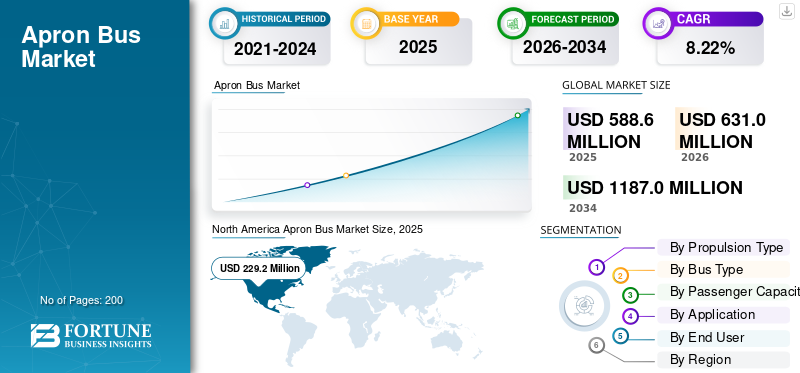
The global apron bus market size was valued at USD 588.6 million in 2025. The market is projected to grow from USD 631.0 million in 2026 to USD 1187.0 million by 2034, exhibiting a CAGR of 8.22% during the forecast period. North America dominated the apron bus market with a market share of 38.94% in 2025.
The market covers specialized airside buses used to move passengers, crew, airport staff, and ground handlers between terminals, remote aircraft stands, gates, and apron-side operating zones. It includes diesel, electric, hybrid, CNG/LPG, low-floor, wide-body, compact, and high-capacity buses used mainly by international airports, airlines, and ground handling companies. Demand is linked to passenger traffic growth, remote stand operations, terminal congestion, airport expansion, and fleet electrification. ACI announced global passenger traffic reached 9.8 billion in 2025, supporting equipment demand across airports. Key players include COBUS Industries, Yutong, MAN Truck & Bus, TAM-Europe, and BYD, which are supplying airport buses, electric apron buses, HVO-compatible units, and airport mobility solutions.
Download Free sample to learn more about this report.
APRON BUS MARKET KEY TAKEAWAYS
 Global Market Size & Forecast
- 2025 Market Size: USD 588.6 million
- 2026 Market Size: USD 631.0 million
- 2034 Forecast Market Size: USD 1,187.0 million
- CAGR: 8.22% from 2026–2034
 Market Share
- North America dominated the market with a 38.94% share in 2025.
- The Passenger Transfer segment held the largest market share in 2025.
- The Commercial Airports segment held the largest market share in 2025.
 Key Regional Highlights
North America
North America reached USD 229.2 million in 2025, driven by airport modernization, airside congestion, and replacement of aging ground mobility fleets.
Europe
Europe projected to reach USD 151.9 million by 2026, growing at an 8.26% CAGR, supported by airport decarbonization targets and increasing adoption of electric ground support equipment.
Asia Pacific
Asia Pacific projected to reach USD 139.3 million by 2026, emerging as the fastest-growing region due to airport expansion, passenger traffic recovery, and new terminal development.
U.S.
The market is projected to reach USD 153.5 million by 2026, growing at an 8.47% CAGR, supported by airport infrastructure upgrades and strong domestic air travel demand.
Japan
Japan growth is supported by airport modernization, rising passenger traffic, remote stand operations, and increasing adoption of electric and low-emission airside mobility solutions.
Read More

APRON BUS MARKET TRENDS
Electrification and Airside Fleet Modernization are Reshaping Apron Bus Procurement
The major trend in the market is the shift from conventional diesel fleets to electric and alternative-fuel buses. Airports are under pressure to reduce apron emissions, noise, and local air-quality impact, especially at large hubs where buses operate throughout the day. IATA states that electric GSE can reduce CO₂ emissions by 35–52% and noise by 5.5–8.3 dB (A) compared with traditional GSE per turnaround. This is pushing buyers to evaluate vehicles, charging infrastructure, battery management, and depot planning together. Munich Airport’s order for 49 all-electric MAN buses, with an option for 25 more, shows this transition moving from pilot projects to fleet-scale procurement
MARKET DYNAMICS
MARKET DRIVERS
Download Free sample to learn more about this report.
Passenger Recovery and Airport Congestion Drive Demand for Market
Passenger traffic recovery is the strongest demand driver for apron bus market growth. As aircraft movements rise and airports operate closer to capacity, remote stands become a practical solution for handling additional flights, especially during peak hours, terminal expansion work, or gate shortages. Apron buses support aircraft boarding, deboarding, crew transfer, and staff movement without requiring every aircraft to use a passenger boarding bridge. COBUS states that its COBUS 3000 can carry up to 110 passengers and is designed to connect passengers quickly to remote positions, which directly supports airport throughput. As passenger volumes rise, airports and handlers need larger, more reliable, and more efficient bus fleets.
MARKET RESTRAINTS
High Upfront Cost and Charging Readiness Limit Faster Electric Adoption
Aviation manufacturers face significant challenges due to the increasing complexity of avionics software systems, global supply chain issues that have delayed implementation and testing processes, and a diminishing pool of testing engineers in the workforce. Completing DO-178C certification for all avionics software components could take five or more years and, for more complex airport transport systems, the initial cost becomes a burden that weighs heavily on smaller avionics developers and deters new market entrants. These combined cost and talent constraints slow the pace at which innovative EFIS solutions can progress from development to certified deployment aboard commercial or military aircraft.
MARKET OPPORTUNITIES
Airport Expansion and Remote Stand Growth Create Scope for Larger Fleets
The key opportunity for the market is closely tied to airport expansion, particularly across Asia Pacific, the Middle East, and major European hubs where passenger growth is putting pressure on terminal and gate capacity. Many airports are using remote stands as a practical way to handle more aircraft without waiting for large-scale terminal or boarding-bridge expansion. This creates steady demand for reliable apron bus fleets that can maintain smooth passenger movement and protect aircraft turnaround times. Furthermore, Airports will increasingly need high-capacity and electric apron buses to reduce trip frequency, enhance passenger handling, and support cleaner airside operations during peak periods.
MARKET CHALLENGES
Operational Reliability, Battery Duty Cycle, and Mixed Fleets Remain Difficult
The core challenge is maintaining apron-bus reliability while airports transition from diesel to electric and alternative-fuel fleets. Apron buses work in short, repetitive duty cycles with waiting time, airside security rules, passenger peaks, weather exposure, and irregular flight schedules. Electric fleets add complexity as operators must manage charging windows, state of charge, battery health, route allocation, and charger availability without disrupting aircraft turnaround. IATA’s electric GSE guidance highlights the need for ramp-operation review, safety assessment, and economic planning. This means the market will grow, but adoption will be uneven between large hubs with capital and smaller airports with limited grid and fleet-management capacity.
Segmentation Analysis
By Propulsion Type
Established Fueling Infrastructure to Strengthen Diesel Apron Bus Segment
Based on propulsion type, the market is segmented into diesel apron bus, electric apron bus, hybrid apron bus, CNG / LPG apron bus, and others.
The diesel apron bus segment is anticipated to account for the largest market share as most airports already have fuel supply, maintenance capacity, and operating procedures built around diesel fleets. Its wide installed base and dependable performance make it the primary choice for routine airside passenger and crew movement.
The electric apron bus segment is anticipated to rise with a high CAGR of 8.70% over the forecast period.
By Bus Type
Operational Versatility Positioned Standard Apron Bus as Leading Bus Type
Based on bus type, the market is segmented into standard apron bus, low-floor apron bus, wide-body apron bus, compact apron bus, and others.
In 2025, the standard apron bus segment dominated the global market due to its suitability across passenger transfer, crew movement, and routine airside mobility. Its practical design, reliable capacity, and compatibility with different airport layouts make it the most widely deployed apron bus type.
The wide-body apron bus segment is projected to grow at a high CAGR of 8.81% over the forecast period.
By Passenger Capacity
Balanced Capacity and Maneuverability to Boost Leadership of 81–110 Passenger Segment
Based on passenger capacity, the market is segmented into below 50 passengers, 50–80 passengers, 81–110 passengers, and above 110 passengers.
The 81–110 passenger segment is anticipated to witness a dominating market share over the forecast period as it offers an efficient balance between high passenger capacity and apron maneuverability. Airports use this capacity range to move more passengers per trip, reduce boarding delays, and support faster aircraft turnaround at remote stands.
The above 110 passengers segment is projected to grow at a high CAGR of 8.66% over the forecast period.
By Application
Core Terminal-to-Aircraft Mobility Led to Dominance of Passenger Transfer Segment
Based on application, the market is segmented into passenger transfer, crew transfer, airport staff movement, remote stand operations, and others.
The passenger transfer segment dominated the segmental market share as apron buses are primarily used to move passengers between terminals and aircraft parked at remote stands. Rising passenger traffic, gate congestion, and remote boarding operations keep this application at the center of apron bus demand.
In addition, remote stand operations segment is projected to grow at a high CAGR of 8.81% during the forecast period.
By End User
To know how our report can help streamline your business, Speak to Analyst
High Passenger Throughput Positioned Commercial Airports Segment as Leading End User
Based on end user, the market is segmented into commercial airports, airlines, ground handling companies, military airbases, and others.
The commercial airports segment dominated the segmental market share as airports manage passenger flow, remote stand operations, terminal expansion, and airside mobility infrastructure. Their large passenger volumes and fleet replacement needs make them the leading buyers of apron buses globally.
In addition, ground handling companies segment is projected to grow at a CAGR of 8.61% during the projected period.
Apron Bus Market Regional Outlook
By geography, the market is categorized into Europe, North America, Asia Pacific, and the rest of the world.
North America
North America Apron Bus Market Size, 2025 (USD Million)
To get more information on the regional analysis of this market, Download Free sample
North America held the dominant share in 2024, valuing at USD 209.4 million, and also maintained the leading share in 2025, with USD 229.2 million. North America’s market is driven by airport modernization, airside congestion, and replacement of aging ground mobility fleets. Large hub airports continue to upgrade terminals, taxiways, gates, and sustainability systems, which indirectly supports demand for apron-side passenger transfer vehicles. COBUS has an active airport mobility presence across the region, while electrification is becoming a stronger procurement theme at large airports.
U.S. Apron Bus Market
Based on North America’s strong contribution and the U.S. dominance within the region, the U.S. market can be analytically approximated at around USD 153.5 billion in 2026, accounting for roughly 8.47% CAGR during the forecast period. The U.S. market benefits from continuous airport infrastructure upgrades, strong domestic air travel demand, and large hub operations where remote stands and terminal expansion programs require dependable passenger transfer fleets.
Europe
Europe is projected to record a steady growth rate of 8.26% during the forecast period, which is the second highest among all regions, and is set to reach a valuation of USD 151.9 billion by 2026. The growth is due to airport decarbonization targets, strict emissions expectations, and high use of electric ground support equipment. Airports are replacing conventional airside fleets with cleaner buses to reduce apron emissions and noise while improving passenger experience. COBUS, MAN, TAM-Europe, and Yutong are relevant suppliers in the region through electric, low-floor, and high-capacity apron bus offerings.
U.K. Apron Bus Market
The U.K. market is estimated at around USD 48.1 billion in 2026, representing roughly 8.64% of CAGR during the projected period. The market is supported by high-capacity airport operations, gate constraints, and the need to move passengers efficiently between terminals and remote stands. Heathrow and other large airports are focusing on operational resilience and lower-emission ground fleets. British Airways’ COBUS fleet modernization at Heathrow shows how airlines are using electric vehicle and alternative-fuel apron buses to support cleaner airside operations.
Germany Apron Bus Market
Germany’s market is projected to reach approximately USD 42.1 billion in 2026. Germany is a strong market as major airports are actively linking fleet renewal with sustainability programs. Munich Airport’s electric passenger-bus deployment with MAN shows direct movement toward cleaner apron transportation, while Frankfurt and Munich’s hub roles support continued demand for reliable airside passenger mobility.
Asia Pacific
Asia Pacific region is estimated to reach USD 139.3 million in 2026 and secure the position of the third-largest region in the market and fastest growing during the forecast period. The growth is attributed to airport expansion, passenger recovery, and new terminal development are increasing the need for airside passenger movement systems. Many airports in the region use remote stands during capacity expansion, creating demand for high-capacity, and low-floor apron buses. Yutong and COBUS both have relevant regional presence, especially in electric airport bus and high-capacity apron mobility solutions.
China Apron Bus Market
China’s market is projected to be one of the largest in Asia Pacific, with 2026 revenues estimated at around USD 44.1 million. China’s market is supported by continued airport network expansion, large domestic aviation demand, and government-led civil aviation planning. As new airports and expanded terminals are developed, remote stand operations, and passenger transfer requirements create demand for high-capacity apron buses.
India Apron Bus Market
The market is estimated at around USD 38.6 million in 2026. India’s apron bus demand is rising as airport development expands beyond metro hubs and more cities are connected through civil aviation growth programs. New terminals, greenfield airports, and phased capacity expansion increase the use of remote stands, especially where passenger volumes rise faster than contact-gate availability.
Rest of the World
The rest of the world include Middle East & Africa and Latin America. Rest of the world’s demand is led by airport expansion in the Middle East, traffic recovery in Latin America, and capacity upgrades across selected African airports. Dubai’s Al Maktoum expansion and Saudi Arabia’s aviation strategy show how the Middle East is building large-scale hub capacity, which will require efficient apron-side passenger movement. The Middle East & Africa and Latin America market is set to reach a valuation of USD 57.2 million and USD 37.3 million in 2026.
COMPETITIVE LANDSCAPE
Key Industry Players
Fleet Electrification and Airport Mobility Partnerships by Key Players to Strengthen Market Share
The apron bus market is moderately consolidated, with a small group of specialized airport-bus manufacturers and commercial bus OEMs competing across airport operators, airlines, and ground handling companies. Key companies in the market include COBUS Industries, Yutong, MAN Truck & Bus, TAM-Europe, and BYD. Leading suppliers are investing in electric apron buses, low-floor wide-body designs, larger passenger capacity, improved HVAC, battery management, telematics, and charging-compatible operating models. MAN’s electric bus deployment at Munich Airport shows how airport authority and operators are linking apron bus renewal with charging infrastructure and sustainability programs, while TAM-Europe’s VivAir airport bus range highlights continued demand for configurable, IATA-aligned airport bus platforms. As airports modernize airside operations, suppliers with strong service networks, electric product readiness, and proven airport references are better positioned to win long-term replacement and fleet-expansion contracts.
LIST OF KEY APRON BUS COMPANIES PROFILED IN REPORT
- COBUS Industries GmbH (Germany)
- Yutong Bus Co., Ltd. (China)
- MAN Truck & Bus SE (Germany)
- TAM-Europe (Slovenia)
- BYD Company Ltd. (China)
- VE Commercial Vehicles Ltd. (India)
- Irizar e-mobility S.L. (Spain)
- Ebusco Holding N.V. (Netherlands)
- Aurrigo International plc (U.K.)
- Mallaghan Engineering Ltd. (U.K.)
KEY INDUSTRY DEVELOPMENTS
- May 2026: Copenhagen Airports A/S launched a re-tender for the procurement of electric apron buses for Copenhagen Airport, with the EU TED notice listing an estimated contract value of USD 34.25 million.
- February 2026: Yutong delivered 16 apron buses to Jazeera Airways in Kuwait, marking Yutong’s first entry into Kuwait’s apron bus market and strengthening its airport-bus presence across Middle Eastern aviation hubs.
- September 2025: COBUS Industries delivered its 5,000th apron bus, a fully electric e.COBUS 2700S, to British Airways. The vehicle formed part of British Airways’ order for 38 right-hand-drive COBUS apron buses for Heathrow, including 23 fully electric buses and 15 HVO-powered buses.
- September 2025: Eicher Trucks & Buses delivered the first lot of six fully built electric Eicher Skyline Pro-E 12m tarmac buses to IndiGo at Kempegowda International Airport, Bengaluru, under a strategic partnership focused on clean airport ground mobility.
- April 2025: Fusion Processing partnered with Construct Invest to deliver fully automated Level 4 electric buses for airport passenger transport, using Fusion’s CAVstar automated driving system for zero-emission airport mobility applications.
REPORT COVERAGE
The global apron bus market analysis includes a comprehensive study of the market size & forecast by all the market segments included in the report. It includes details on the market dynamics and market trends driving the market over the forecast period. It provides information on key aspects, including an overview of advancements in technology, the regulatory environment, porter’s five forces analysis, company profiles and retrofitting program. Additionally, it details partnerships, mergers & acquisitions, as well as key aviation industry developments and prevalence by key regions. The global market report also provides a depth competitive landscape with information on the market share and profiles of key operating players.
Request for Customization to gain extensive market insights.
Report Scope & Segmentation
| ATTRIBUTE | DETAILS |
| Study Period | 2021-2034 |
| Base Year | 2025 |
| Estimated Year | 2026 |
| Forecast Period | 2026-2034 |
| Historical Period | 2021-2024 |
| Growth Rate | CAGR of 8.22% from 2026-2034 |
| Unit | Value (USD Million) |
| Segmentation | By Propulsion Type, Bus Type, Passenger Capacity, Application, End User, and Region |
| By Propulsion Type |
|
| By Bus Type |
|
| By Passenger Capacity |
|
| By Application |
|
| By End User |
|
| By Region |
|
Frequently Asked Questions
According to Fortune Business Insights, the global market value stood at USD 588.6 million in 2025 and is projected to reach USD 1187.0 million by 2034.
In 2025, the North America’s market value stood at USD 229.2 million.
The market is expected to exhibit a CAGR of 8.22% during the forecast period of 2026-2034.
By propulsion type, the diesel apron bus segment is expected to dominate the market.
Passenger recovery and airport congestion drive demand for market.
COBUS Industries, Yutong, MAN Truck & Bus, TAM-Europe, are BYD are few key market players.
North America held the largest market share in 2025.



- 2021-2034
- 2025
- 2021-2024
- 200
Get 30-60 hrs Free Customization
Expand Regional and Country Coverage, Segments Analysis, Company Profiles, Competitive Benchmarking, and End-user Insights.




















Related Reports
-
US +1 833 909 2966 ( Toll Free )
-
Get In Touch With Us