Aseptic Carton Packaging Market Size, Share & Industry Analysis, By Material (Paper & Paperboard, Plastic, and Aluminium), By Application (Dairy Products, Juices & RTD Beverages, Soups, Sauces & Purees, and Others), and Regional Forecast, 2026-2034
 Download Free Sample
(Offer valid till 30th Sep 2026)

Aseptic Carton Packaging Market Size and Future Outlook
 Listen to Audio Version
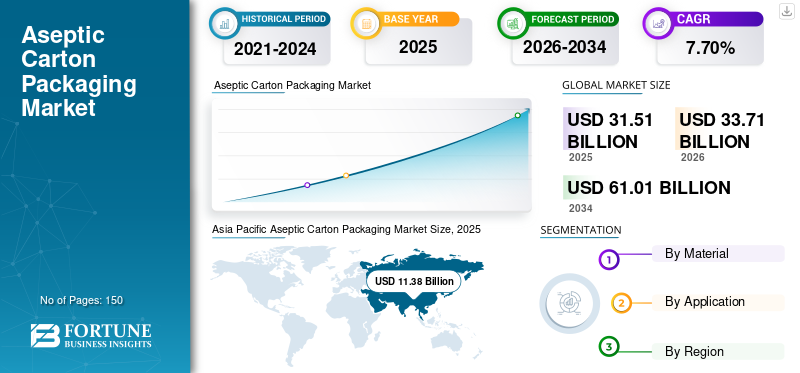
The global aseptic carton packaging market size was valued at USD 31.51 billion in 2025 and is projected to grow from USD 33.71 billion in 2026 to USD 61.01 billion by 2034, exhibiting a CAGR of 7.70% during the forecast period. Asia Pacific dominated the aseptic carton packaging market with a market share of 36.11% in 2025.
The global market for aseptic carton packaging includes the manufacturing and distribution of multilayer paperboard cartons intended for the packaging of liquid and semi-liquid food and beverage items in sterile environments. The increasing consumer preference for shelf-stable dairy products, beverages, and ready-to-eat foods is propelling the growth of the market. The demand for longer product shelf life, decreased reliance on cold-chain logistics, minimized food waste, and the convenience of lightweight packaging is further driving adoption in both developed and developing markets, and boosting the global market growth.
Furthermore, many key industry players, such as Tetra Pak International S.A., Mondi, and SIG, are focusing on developing innovative aseptic carton packages and conducting R&D.
Download Free sample to learn more about this report.
ASEPTIC CARTON PACKAGING MARKET TRENDS
Rising Adoption of Renewable and Recyclable Carton Materials is a Major Trend Observed in Market
A significant trend observed in the global market is the rising use of renewable and recyclable packaging materials. Manufacturers are substituting fossil-based polymers with bio-based options and enhancing the proportion of responsibly sourced paperboard that is certified by sustainable forestry initiatives. Additionally, companies are creating cartons with diminished aluminium content and enhanced recyclability to comply with circular economy objectives and rigorous environmental regulations. Brand owners within the food and beverage sector are emphasizing low-carbon aseptic packaging solutions to fulfill corporate sustainability pledges and meet increasing consumer demands. This trend is fostering ongoing innovation in carton designs, material science, and recycling systems, thereby reinforcing the long-term attractiveness of aseptic carton packaging.
MARKET DYNAMICS
MARKET DRIVERS
Download Free sample to learn more about this report.
Growing Demand for Shelf-Stable Dairy Products, Juices, and Ready-to-Drink Beverages is Driving Market Growth
The increasing demand for shelf stable dairy items, juices, and ready-to-drink (RTD) beverages is the primary factor propelling the global aseptic carton packaging market growth. Rapid urbanization, evolving lifestyles, and a growing consumer inclination toward convenient, long-lasting food, and beverage options are driving the uptake of aseptic packaging. Aseptic cartons allow products to stay safe and fresh for several months without refrigeration prior to opening, which significantly minimizes food waste and distribution expenses. This feature is especially beneficial in areas with inadequate cold-chain facilities. Additionally, the rising consumption of UHT milk, flavored drinks, plant-based beverage packaging, and nutritional drinks in both developed and developing markets continues to bolster the demand for aseptic packaging.
|
Rank |
Market Drivers |
Overall Impact Rank |
CAGR Contribution (2026-2034) |
Impact: 2026-2028 |
Impact: 2029-2031 |
Impact: 2032-2034 |
|
1 |
Growing demand for shelf-stable dairy products, juices, and ready-to-drink beverages |
High |
+3.1% |
High |
High |
High |
|
2 |
Rising adoption of sustainable, renewable, and fiber-based packaging solutions |
High |
+2.4% |
Medium |
High |
High |
|
3 |
Expansion of aseptic food & beverage processing capacity in emerging economies |
Medium-High |
+1.9% |
Medium |
High |
High |
|
4 |
Increasing consumption of plant-based beverages and functional nutrition products |
Medium |
+1.4% |
Medium |
Medium |
High |
|
5 |
Continuous advancements in aseptic carton materials, barrier technologies, and filling systems |
Medium-Low |
+1.0% |
Low |
Medium |
Medium |
|
6 |
Others (growth of organized retail, expansion of UHT milk consumption, e-commerce grocery, favorable sustainability regulations, increasing urbanization, product innovation, etc.) |
Low |
+0.7% |
Low |
Low |
Medium |
|
|
Total Positive Growth Contribution |
|
+10.5% |
|
|
|
MARKET RESTRAINTS
High Capital Investment Required for Aseptic Filling Equipment and Production Lines Restricts Market Growth
The substantial capital investment needed for aseptic filling equipment and production lines is the primary constraint impacting the global market. Setting up aseptic packaging operations necessitates advanced sterilization technologies, automated filling systems, specialized multilayer carton processing machinery, and rigorous contamination control protocols, leading to considerable initial capital outlay. Beyond installation expenses, manufacturers are also required to allocate funds for ongoing maintenance, operator training, quality assurance systems, and adherence to regulatory standards to maintain sterile production conditions. These financial obligations pose significant challenges for small and medium-sized food and beverage producers, especially in developing regions, thereby hindering the rate of aseptic technology adoption despite the increasing demand for shelf-stable packaged goods.
|
Rank |
Market Restraints |
Overall Impact Rank |
Negative CAGR Contribution (2026-2034) |
Impact: 2026-2028 |
Impact: 2029-2031 |
Impact: 2032-2034 |
|
1 |
High capital investment required for aseptic filling equipment and production lines |
High |
-1.2% |
High |
High |
Medium |
|
2 |
Limited recycling infrastructure for multilayer aseptic cartons in developing regions |
Medium-High |
-0.8% |
Medium |
Medium |
Low |
|
3 |
Competition from alternative packaging formats such as PET bottles, HDPE containers, and flexible pouches |
Medium |
-0.5% |
Medium |
Low |
Low |
|
4 |
Others (volatile raw material prices, supply chain disruptions, regulatory compliance costs, availability of substitute packaging, operational complexity, etc.) |
Low |
-0.3% |
Low |
Low |
Low |
|
|
Total Negative Growth Impact |
|
-2.8% |
|
|
|
MARKET OPPORTUNITIES
Expanding Demand for Plant-Based and Functional Beverages Offers Potential Growth Opportunities
The swift growth of plant-based drinks, protein beverages, fortified dairy substitutes, and functional nutrition items offers a considerable opportunity for the sector. Consumers are increasingly inclined toward health-oriented beverages that necessitate packaging capable of preserving nutrients and ensuring product stability over prolonged durations. Aseptic cartons deliver exceptional protection against oxygen, moisture, and light, rendering them suitable for sensitive formulations. As sterile beverage packaging producers launch innovative products in both developed and emerging markets, the demand for high-performance aseptic packaging continues to rise. This trend creates opportunities for packaging firms to design customized carton formats, lightweight structures, and sustainable carton materials that cater to the changing beverage categories.
MARKET CHALLENGES
Limited Recycling Infrastructure in Developing Regions Poses a Critical Challenge to Market Growth
A significant challenge confronting the global industry is the insufficient recycling infrastructure for multilayer laminate packaging in numerous developing nations. Given that aseptic cartons are composed of layers of paperboard, polymer, and aluminium, specialized recycling facilities are necessary to separate and recover these materials effectively. Many areas are deficient in adequate collection systems, sorting capabilities, and recycling technologies, leading to lower recycling rates despite the potential for recycling these cartons. This situation raises environmental issues and heightens scrutiny from both regulators and consumers. To tackle this challenge and promote sustainable market growth, it is crucial to expand recycling networks, invest in advanced material recovery technologies, and enhance collaborations throughout the packaging value chain.
Segmentation Analysis
By Material
Renewable Composition, Superior Barrier Performance, and Sustainability Goals Drive Dominance of Paper & Paperboard Segment
Based on material, the market is divided into paper & paperboard, plastic, and aluminium.
The paper & paperboard segment is expected to account for the largest aseptic carton packaging market share. As it constitutes the main structural element of aseptic cartons, offering strength, rigidity, lightweight characteristics, and superior printability. This material is derived from renewable wood fibers and aligns with sustainability efforts through responsible forestry certification and recyclability. When combined with thin layers of polymer and aluminium, paperboard provides the necessary mechanical strength to safeguard liquid food and beverages during transportation and storage. Furthermore, the increasing regulatory focus on minimizing plastic usage and the rising preference for fiber-based packaging among food and beverage manufacturers further solidify the dominant role of the paper and paperboard segment in the global market.
The plastic segment is expected to grow at a CAGR of 7.42% over the forecast period.
By Application
To know how our report can help streamline your business, Speak to Analyst
Freshness, Convenience, and High Consumption, Pushes Dairy Products Application
Based on application, the market is segmented into dairy products, juices & RTD beverages, soups, sauces, & purees, and others.
The dairy products segment is expected to hold a dominant market share over the forecast period. This is primarily due to the substantial global consumption of milk, flavored milk, cream, drinking yogurt, and other liquid dairy items that necessitate safe, hygienic, and durable packaging. This greatly diminishes reliance on cold-chain logistics, reduces transportation and storage expenses, and lessens food spoilage, especially in developing markets with inadequate refrigeration facilities. Furthermore, the rising demand for value-added dairy products, along with consumer preferences for convenient, lightweight, and sustainable packaging, has prompted dairy producers to increasingly utilize aseptic cartons, thereby solidifying the segment's dominant role in the global market.
The juices & RTD beverages segment is projected to grow at a CAGR of 5.69% over the forecast period.
Aseptic Carton Packaging Market Regional Outlook
By geography, the market is categorized into Europe, North America, Asia Pacific, Latin America, and the Middle East & Africa.
North America
Asia Pacific Aseptic Carton Packaging Market Size, 2025 (USD Billion)
To get more information on the regional analysis of this market, Download Free sample
North America held the second-dominant share in 2024, valued at USD 7.21 billion, and maintained its second-leading position in 2025, with a value of USD 7.71 billion. The growing demand for high-quality dairy products, plant-based drinks, and ready-to-drink nutritional beverages mainly propels the market in North America. Consumers are progressively favoring sustainable packaging options that have a reduced carbon footprint, while food manufacturers are turning to aseptic cartons to lower logistics expenses, enhance shelf life, and adhere to changing environmental regulations and the sustainability commitments of retailers.
U.S. Aseptic Carton Packaging Market
Based on North America’s strong contribution and the U.S.’ dominance within the region, the U.S. market was valued at USD 6.05 billion in 2025, accounting for roughly 19.20% of global sales. The U.S. market is propelled by robust demand for shelf-stable milk, coffee drinks, protein beverages, and functional drinks. Heightened consumer awareness regarding recyclable packaging, along with rising investments in aseptic processing capabilities and the growth of e-commerce grocery distribution, are fostering the widespread use of aseptic carton packaging throughout the nation's food and beverage industry.
Europe
Europe is projected to grow at 7.25% CAGR in the coming years, the third-highest among all regions, and reached a valuation of USD 5.65 billion in 2025. The market in Europe is driven by strict environmental regulations, initiatives promoting a circular economy, and a significant consumer preference for fiber-based packaging. A robust recycling infrastructure, ambitious sustainability goals set by corporations, and the prevalent consumption of dairy and juice products motivate manufacturers to transition toward renewable paperboard cartons, thereby minimizing plastic usage and lowering greenhouse gas emissions.
U.K. Aseptic Carton Packaging Market
The U.K. market reached a valuation of USD 0.83 billion in 2025, representing approximately 2.65% of global revenues.
Germany Aseptic Carton Packaging Market
Germany’s market reached USD 1.32 billion in 2025, equivalent to around 4.20% of global sales.
Asia Pacific
Asia Pacific reached USD 11.38 billion in 2025 and secured the dominating position in the market. The region is experiencing the most rapid growth among markets, driven by swift urbanization, increasing disposable incomes, a rise in dairy consumption, and heightened demand for packaged beverages. The limitations in developing cold-chain infrastructure render aseptic cartons especially appealing. At the same time, the surge in investments in food processing, modern retail, and sustainable packaging technologies further propels the growth of the regional market.
Japan Aseptic Carton Packaging Market
The Japanese market was valued at USD 1.45 billion in 2025, accounting for roughly 4.61% of global revenues. The market in Japan is propelled by the demand for high-quality, convenient, and hygienically packaged beverages within a well-established consumer market. Factors such as an aging demographic, a preference for smaller single-serve packages, advancements in packaging technology, and heightened environmental consciousness motivate beverage manufacturers to utilize lightweight, recyclable aseptic cartons that offer enhanced product protection.
China Aseptic Carton Packaging Market
China’s market is projected to be one of the largest globally, with 2025 revenues valued at USD 3.97 billion, representing roughly 12.60% of global sales.
India Aseptic Carton Packaging Market
The Indian market reached USD 3.30 billion in 2025, accounting for roughly 10.49% of global high-revenue markets.
Latin America and Middle East & Africa
The Latin America and Middle East & Africa regions are expected to witness moderate growth in this market during the forecast period. The Latin America market reached USD 3.85 billion in 2025. The Latin American market benefits from the rising demand for UHT milk, fruit juices, and dairy beverages, especially in nations with varying access to refrigeration. The growth of food processing industries, enhanced retail penetration, and the necessity for economical distribution over long distances render aseptic carton packaging a compelling packaging option across the region.
In the Middle East & Africa, the market is propelled by a growing demand for shelf-stable dairy and beverage items, swift urban population expansion, and inadequate cold-chain infrastructure in various nations.
South Africa Aseptic Carton Packaging Market
South Africa reached USD 0.68 billion in 2025.
Saudi Arabia Aseptic Carton Packaging Market
The Saudi Arabian market reached USD 1.02 billion in 2025, accounting for roughly 3.25% of global revenues.
COMPETITIVE LANDSCAPE
Key Industry Players
Focus on Expanding Product Launch and Acquisitions by Key Players to Propel Market Progress
The global market has a semi-consolidated structure, with prominent players including Tetra Pak International S.A., Mondi, and SIG. The significant market share of these companies is due to numerous strategic initiatives, including collaborations among operating entities to advance research.
- For instance, in February 2026, SIG declared an increase in its manufacturing capacity for aseptic carton packaging in India to meet the swiftly rising demand for dairy products, juices, and plant-based beverages throughout South Asia. This investment encompasses the addition of new production lines for aseptic carton sleeves, as well as upgraded digital manufacturing capabilities designed to enhance production efficiency and minimize lead times.
Other notable players in the global market include Elopak, LAMIPAK, and NewJF Group. These companies are expected to prioritize new product launches and collaborations to increase their global market share during the forecast period.
LIST OF KEY ASEPTIC CARTON PACKAGING COMPANIES PROFILED IN REPORT
- Tetra Pak International S.A. (Switzerland)
- Mondi (U.K.)
- SIG (Switzerland)
- Elopak (Norway)
- LAMIPAK (Turkey)
- NewJF Group (China)
- UFlex Limited (India)
- IPI S.r.l. (Italy)
- Greatview Aseptic Packaging Company (China)
- Nippon Paper Group (Japan)
- Ecolean (Sweden)
- Xiamen Jihong Group Co., Ltd. (China)
- Shanghai Zijiang Enterprise Group (China)
- TCPL Packaging Limited (India)
- WINTIPAK AG (Switzerland)
KEY INDUSTRY DEVELOPMENTS
- October 2025: Tetra Pak has broadened its range of aseptic Tetra Pak carton packaging by launching materials that include certified recycled polymers through mass-balance certification. This innovation aims to assist food and beverage manufacturers in decreasing their reliance on virgin fossil-based plastics while ensuring food safety and product efficacy.
- June 2025: Ecolean has announced to invest in increasing its manufacturing capacity for lightweight aseptic packaging systems, responding to rising demand from dairy and liquid food producers. This expansion is centered on enhancing operational efficiency, shortening production lead times, and aiding customers in the introduction of new shelf-stable packaging solutions.
- September 2024: Greatview Aseptic Packaging has bolstered its international manufacturing and supply capabilities to cater to multinational dairy and beverage companies in search of alternative suppliers for aseptic cartons. The company has made investments to enhance production efficiency, quality systems, and logistics capabilities, while also broadening its customer base across Europe, Asia, and emerging markets.
- April 2024: Elopak has continued to advance its sustainability strategy by launching beverage cartons that feature enhanced fiber-based barrier technologies, aimed at reducing dependence on aluminium while ensuring shelf-life performance for aseptic products. This innovation supports customers who are focused on lowering carbon emissions and enhancing carton recyclability.
- November 2023: LAMIPAK has expanded its aseptic carton production capabilities to meet the increasing demand from dairy, juice, and beverage manufacturers across Asia, the Middle East, and Latin America. This expansion includes investments in advanced converting technologies, quality assurance systems, and increased production capacity for multilayer carton materials.
REPORT COVERAGE
The market analysis includes a comprehensive study of market size & forecast across all market segments included in the report. It includes details on the market dynamics and market trends expected to drive the market over the forecast period. It provides information on key aspects, including pipeline candidates, the regulatory environment, regional insights, and product launches. Additionally, it details partnerships, mergers & acquisitions, and key industry developments. The global market research report also provides a detailed competitive landscape, including market share and profiles of key operating players.
Request for Customization to gain extensive market insights.
Report Scope & Segmentation
| ATTRIBUTE | DETAILS |
| Study Period | 2021-2034 |
| Base Year | 2025 |
| Estimated Year | 2026 |
| Forecast Period | 2026-2034 |
| Historical Period | 2021-2024 |
| Growth Rate | CAGR of 7.70% from 2026-2034 |
| Unit | Value (USD Billion) |
| Segmentation | By Material, Application, and Region |
| By Material |
|
| By Application |
|
| By Region |
|
Frequently Asked Questions
According to Fortune Business Insights, the global market value stood at USD 31.51 billion in 2025 and is projected to reach USD 61.01 billion by 2034.
In 2025, Asia Pacific’s market value stood at USD 11.38 billion.
The market is expected to grow at a CAGR of 7.70% over the forecast period of 2026-2034.
By material, the paper & paperboard segment is expected to lead the market.
By material, the paper & paperboard segment is expected to lead the market.
Growing demand for shelf-stable dairy products, juices, and ready-to-drink beverages is driving market growth.
Tetra Pak International S.A., Mondi, and SIG are the major players in the global market.
Asia Pacific held the largest market share in 2025.



- 2021-2034
- 2025
- 2021-2024
- 150
-
(Offer valid till 30th Sep 2026)
Get 30-60 hrs Free Customization
Expand Regional and Country Coverage, Segments Analysis, Company Profiles, Competitive Benchmarking, and End-user Insights.










-
US +1 833 909 2966 ( Toll Free )
-
Get In Touch With Us