Medical Plastics Market Size, Share & Industry Analysis, By Application (Medical Disposables, Medical Instruments, Prosthetics & Implants, Drugs Packaging, and Others), and Regional Forecast, 2026-2034
 Download Free Sample
(Offer valid till 30th Sep 2026)

Medical Plastics Market Size and Future Outlook
 Listen to Audio Version
The global medical plastics market size was valued at USD 35.93 billion in 2025 and is projected to grow from USD 39.05 billion in 2026 to USD 67.45 billion by 2034, exhibiting a CAGR of 7.1% during the forecast period. North America dominated the medical plastics market with a market share of 36.93% in 2025.
Medical plastics are specialized polymer materials used in healthcare applications due to their biocompatibility, lightweight nature, chemical resistance, and sterilization compatibility. Common materials include polyvinyl chloride, polypropylene, polyethylene, polycarbonate, polystyrene, and high-performance engineering plastics. These materials are widely utilized in medical disposables, surgical instruments, prosthetics, implants, and pharmaceutical packaging. The globally growing healthcare expenditure, expanding hospital infrastructure, and increasing surgical procedures significantly support market demand.
Additionally, the rising emphasis on infection prevention and single-use disposable products has accelerated plastic consumption in medical applications. Aging population and the growing prevalence of chronic diseases further strengthen the demand for advanced medical devices and implants. As healthcare systems prioritize safety, efficiency, and cost-effectiveness, medical plastics continue to play a crucial role in modern medical equipment manufacturing, reinforcing long-term market expansion. The major players operating in the market are SABIC, Celanese Corporation, BASF SE, Evonik, and Covestro AG.
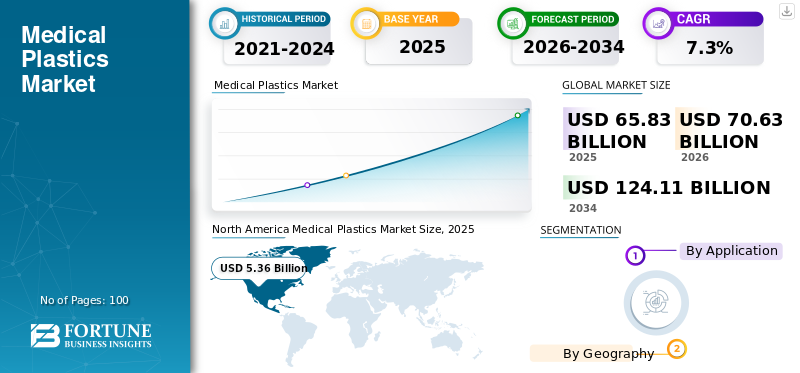
Download Free sample to learn more about this report.
Medical Plastics Market Key Takeaways
 Global Market Size & Forecast
- 2025 Market Size: USD 35.93 billion
- 2026 Market Size: USD 39.05 billion
- 2034 Forecast Market Size: USD 67.45 billion
- CAGR: 7.1% from 2026–2034
 Market Share
- North America dominated the medical plastics market with a 36.93% share in 2025.
- The medical disposables segment held the largest market share in 2025.
- The medical instruments segment is projected to grow at a 6.9% CAGR during the forecast period.
 Key Regional Highlights
North America
Led the market with a 36.93% share in 2025.
Asia Pacific
Held a significant share, driven by healthcare expansion.
Europe
Growth is supported by aging populations and advanced healthcare.
U.S
Reached USD 11.81 billion in 2025
Japan
Growth is driven by rising demand for advanced medical devices.
Read More

MEDICAL PLASTICS MARKET TRENDS
Shift toward Single-Use Devices and Advanced Polymer Innovation to Reshape Industry Dynamics
The medical plastics market is experiencing transformation due to the increasing adoption of single-use disposable devices aimed at minimizing hospital-acquired infections. Hospitals and clinics are increasingly favoring lightweight, sterilizable, and cost-efficient plastic components over traditional materials such as glass and metal. Additionally, advancements in bio-based and recyclable medical-grade polymers are reshaping sustainability initiatives within the healthcare sector. The growing use of high-performance plastics in minimally invasive surgical tools and implantable devices further strengthens innovation trends. Regulatory compliance requirements are encouraging the development of high-purity, medical-grade resins. Furthermore, the integration of smart medical devices and wearable healthcare equipment is increasing the demand for durable yet flexible polymers. These infection-control priorities and material innovations are redefining manufacturing standards, supporting steady evolution in the market.
MARKET DYNAMICS
MARKET DRIVERS
Download Free sample to learn more about this report.
Increasing Surgical Procedures and Chronic Disease Prevalence to Impel Product Demand
The primary driver of the medical plastics market growth is the increasing number of surgical procedures and medical interventions globally. The rising prevalence of chronic diseases such as diabetes, cardiovascular disorders, and orthopedic conditions necessitates advanced medical devices and disposable tools. Medical plastics offer advantages including cost efficiency, design flexibility, and resistance to sterilization processes. Additionally, the growing emphasis on infection prevention in hospitals encourages the use of single-use plastic-based products. Expanding pharmaceutical production also drives the demand for safe and durable drug packaging solutions. Improvements in healthcare accessibility and insurance coverage in emerging economies further strengthen consumption. These healthcare expansion and disease management factors collectively sustain robust demand, maintaining steady market growth.
MARKET RESTRAINTS
Environmental Concerns and Regulatory Compliance Pressures May Limit Market Expansion
The market is expected to face restraints related to environmental concerns surrounding plastic waste management. The globally increasing focus on sustainability and the reduction of single-use plastics creates regulatory pressure on manufacturers. Strict medical-grade quality standards and regulatory approvals increase production costs and time-to-market. Additionally, volatility in raw material prices derived from petrochemicals can affect profit margins. Disposal challenges for contaminated medical waste further complicate environmental compliance. These environmental and regulatory pressures create operational constraints, impacting growth potential in certain regions.
MARKET OPPORTUNITIES
Expanding Healthcare Infrastructure and Aging Population to Create Long-Term Growth Potential
Significant growth opportunities arise from expanding healthcare infrastructure in emerging economies and rising demand for advanced medical treatments. Rapid urbanization and government investments in hospitals and diagnostic centers are increasing the demand for disposable syringes, tubing, IV bags, and packaging materials. Additionally, the global aging population is driving higher demand for prosthetics, orthopedic implants, and cardiovascular devices, many of which rely heavily on specialized medical plastics. Technological advances in 3D printing for custom prosthetics and implants present additional expansion avenues. Growth in home healthcare and wearable medical devices further boosts polymer consumption. As healthcare systems worldwide emphasize patient safety and device efficiency, the demand for high-quality, compliant medical plastics is expected to grow steadily, strengthening long-term market prospects.
MARKET CHALLENGES
Waste Management Complexity and High Compliance Costs May Influence Industry Expansion
A major challenge in the market is managing biomedical waste generated from disposable products. Proper disposal and recycling systems require investment and regulatory adherence. Maintaining consistent material quality and sterility standards also demands advanced manufacturing processes and quality control systems. The increasing scrutiny from regulatory bodies regarding biocompatibility and chemical safety adds compliance complexity. Additionally, balancing sustainability goals with infection control priorities presents strategic challenges for manufacturers. These operational and regulatory hurdles shape competitive positioning, therefore influencing long-term stability in the market.
Segmentation Analysis
By Application
Infection Prevention Protocols Driving Dominant Share of Medical Disposables Segment
In terms of application, the market is categorized into medical disposables, medical instruments, prosthetics & implants, drugs packaging, and others.
The medical disposables segment accounted for the largest medical plastics market share in 2025 due to widespread use in hospitals and clinics. Products such as syringes, catheters, IV bags, surgical gloves, tubing, and masks rely heavily on plastic materials for cost efficiency and sterility. Rising patient admissions and surgical procedures significantly increase demand. The growing focus on infection control and cross-contamination prevention strongly supports single-use product adoption. Additionally, vaccination programs and diagnostic testing further strengthen consumption. These high-volume, recurring applications sustain dominant market share, reinforcing medical disposables as the leading segment.
To know how our report can help streamline your business, Speak to Analyst
Medical instruments increasingly incorporate plastics to reduce weight and improve handling. Components in diagnostic devices, surgical tools, and monitoring equipment utilize high-performance polymers for durability and chemical resistance. Expanding minimally invasive procedures further strengthen the demand for specialized plastic components. The segment is anticipated to grow at a CAGR of 6.9% during the forecast period.
High-performance medical plastics are used in orthopedic implants, dental prosthetics, and cardiovascular devices. Rising aging populations and increased joint replacement surgeries significantly support growth of the prosthetics & implants segment. The segment is poised to grow at a CAGR of 6.7% during the forecast period.
Medical Plastics Market Regional Outlook
By geography, the market is categorized into North America, Europe, Asia Pacific, Latin America, and the Middle East & Africa.
North America
North America Medical Plastics Market Size, 2025 (USD Billion)
To get more information on the regional analysis of this market, Download Free sample
North America dominates the global market and represents a mature and technologically advanced market driven by well-established healthcare systems and high surgical procedure volumes. The U.S. dominates regional demand due to strong hospital infrastructure, high healthcare expenditure, and advanced medical device manufacturing. The increasing adoption of minimally invasive surgical instruments and implantable devices significantly supports high-performance polymer usage.
U.S. Medical Plastics Market
The U.S. market touched the value of USD 11.81 billion in 2025, representing approximately 32.9% of global revenues. The market growth is fueled by high surgical procedure volumes, advanced medical technology adoption, and strong pharmaceutical packaging demand.
To know how our report can help streamline your business, Speak to Analyst
Asia Pacific
Asia Pacific holds a significant share in the global market due to rapid healthcare infrastructure expansion and growing domestic medical device manufacturing. Countries such as China, India, Japan, and South Korea are investing heavily in hospital construction, diagnostic centers, and pharmaceutical production facilities. Rising population levels and increasing prevalence of chronic diseases are driving higher demand for disposable syringes, IV components, and drug packaging solutions. Additionally, government initiatives to promote local manufacturing of medical devices under self-reliance programs are strengthening polymer consumption. The region also benefits from cost-efficient production and expanding export-oriented medical device industries. Growing middle-class populations and improving access to healthcare services further support demand for prosthetics and minimally invasive surgical tools. These healthcare investments and manufacturing expansion trends collectively sustain strong growth, reinforcing Asia Pacific’s importance in the global market.
China Medical Plastics Market
Based on Asia Pacific’s strong contribution and China’s large industrial base, the China market reached USD 3.40 billion in 2025, accounting for approximately 9.5% of global revenues. Growth is driven by expanding domestic medical device manufacturing and rising hospital infrastructure investments.
India Medical Plastics Market
The India market touched a value of around USD 2.60 billion in 2025. Expansion is supported by increasing healthcare access, growing vaccination programs, and government-backed medical device production initiatives.
Europe
The Europe market is supported by aging population and advanced healthcare systems. Countries such as Germany, France, and the U.K. exhibit strong demand for prosthetics, implants, and disposable medical devices due to rising elderly population requiring long-term treatment. Stringent EU medical device regulations influence product quality, sterilization standards, and biocompatibility requirements. Pharmaceutical manufacturing and vaccine distribution programs also contribute to steady drug packaging demand.
Germany Medical Plastics Market
The Germany market reached approximately USD 2.38 billion in 2025, equivalent to around 6.6% of the global market. The product demand is driven by an aging population requiring implants and prosthetics, along with strong medical engineering capabilities.
Latin America and the Middle East & Africa
The Latin America market is witnessing gradual growth in the market driven by improving healthcare access and expanding pharmaceutical production. Brazil and Mexico are major contributors due to increasing investments in hospital infrastructure and domestic medical device manufacturing. The rising awareness regarding infection control and vaccination programs supports disposable product demand. The growing middle-income population and government healthcare reforms further stimulate the demand for affordable medical devices and packaging materials.
On the other hand, the Middle East & Africa region is experiencing steady growth in medical plastics consumption due to healthcare modernization and infrastructure investments. The GCC countries are investing significantly in hospital expansion, medical tourism, and pharmaceutical manufacturing, increasing the demand for disposable devices and packaging materials. Growing chronic disease prevalence and improving healthcare accessibility contribute to prosthetics and implant demand. In Africa, gradual improvements in vaccination programs and public health infrastructure support incremental disposable usage.
Saudi Arabia Medical Plastics Market
The Saudi Arabia market accounted for around USD 0.51 billion in 2025, representing approximately 1.4% of regional revenues. Growth is supported by healthcare infrastructure modernization, rising medical tourism, and expanding hospital construction projects.
COMPETITIVE LANDSCAPE
Key Industry Players
Regulatory Compliance and High-Performance Polymer Innovation to Shape Market Leadership
The global medical plastics market is moderately consolidated, with competition driven by regulatory compliance capabilities and advanced material innovation. Leading players focus on producing medical-grade polymers that meet stringent biocompatibility, sterilization, and safety standards required by regulatory authorities such as the FDA and EMA. Companies with strong R&D capabilities develop high-performance, antimicrobial, and lightweight polymers for disposables, implants, and drug packaging applications. Vertical integration and global distribution networks provide supply chain stability and cost advantages. Strategic partnerships with medical device manufacturers further strengthen competitive positioning. High regulatory barriers and quality certification requirements limit new entrants, reinforcing the dominance of established multinational polymer producers.
LIST OF KEY MEDICAL PLASTICS COMPANIES PROFILED
- SABIC (Saudi Arabia)
- Celanese Corporation (U.S.)
- BASF SE (Germany)
- Evonik Industries AG (Germany)
- Syensqo SA (Belgium)
- Covestro AG (Germany)
- Röchling SE & Co. KG (Germany)
- Eastman Chemical Company (U.S.)
- DuPont (U.S.)
- Victrex plc (U.K.)
KEY INDUSTRY DEVELOPMENTS
- April 2026: Syensqo’s Zeniva PEEK biomaterial enabled Shanghai REACH Medical Instrument Ltd. to launch a spinal fusion cage incorporating calcium silicate, designed to improve bone integration and patient recovery. This development strengthens Syensqo’s position in implantable orthopedic biomaterials.
- March 2026: BASF expanded its Ultrason portfolio with Ultrason P 3010 BMB, a biomass-balanced polyphenylsulfone (PPSU) grade with 20% attributed bio-circular feedstock. The grade offers the same performance, processability, and certification status as standard Ultrason P 3010, supporting demanding applications such as medical devices while helping customers reduce reliance on fossil resources.
- February 2026: Syensqo joined MedTech Innovator, a major accelerator for medical device, digital health, and diagnostic companies. The move is aimed at supporting early-stage medical device innovation with materials expertise and healthcare technology collaboration.
- February 2026: SABIC showcased medical-grade thermoplastics at MD&M West 2026, including biocompatible materials and fluoropolymer alternatives for drug delivery, patient testing, surgery, medical tubing, and device housing applications. This development strengthens SABIC’s position in advanced medical plastics for regulated healthcare applications.
- November 2025: BASF scaled up its Ultradur PBT specialty grades in India, making flame-retardant and hydrolysis-resistant grades locally available. This move improved regional supply reliability and faster response times for high-performance engineering plastics, strengthening BASF’s material platform for precision components, including applications aligned with its Ultradur PRO medical plastics offering.
- October 2025: SABIC collaborated with Zuyderland Medical Center and ecosystem partners to recycle non-contaminated hospital plastic waste into new healthcare packaging and surgical drape material applications. This development supports circularity in the medical plastics value chain through certified circular polyethylene solutions.
- September 2025: Evonik launched a clinical-grade version of VECOLLAN recombinant collagen for use in clinical studies, with validated material planned from 2026. The development supports medical device applications in orthopedics, medical aesthetics, and sports medicine, signalling progress in non-animal-derived biomaterials for next-generation medical devices.
REPORT COVERAGE
The global medical plastics market analysis provides an in-depth study of market size and forecast by all the market segments included in the report. It includes details on market dynamics and trends expected to drive the market during the forecast period. It offers information on technological advancements, new product launches, key industry developments, and partnerships, mergers, and acquisitions. The market research report also includes a detailed competitive landscape, including market share and profiles of key players.
Request for Customization to gain extensive market insights.
Report Scope & Segmentation
| ATTRIBUTE | DETAILS |
| Study Period | 2021-2034 |
| Base Year | 2025 |
| Estimated Year | 2026 |
| Forecast Period | 2026-2034 |
| Historical Period | 2021-2024 |
| Growth Rate | CAGR of 7.1% from 2026-2034 |
| Unit | Value (USD Billion), Volume (Million Ton) |
| Segmentation | By Application and Region |
| By Application |
|
| By Region |
|
Frequently Asked Questions
Fortune Business Insights says that the global market size was valued at USD 35.93 billion in 2025 and is projected to reach USD 67.45 billion by 2034.
The market is slated to exhibit steady growth at a CAGR of 7.1% during the forecast period of 2026-2034.
By application, the medical disposables segment led the market in 2025.
North America held the highest market share in 2025.
An increase in surgical procedures and chronic disease prevalence are key factors driving market expansion.



- 2021-2034
- 2025
- 2021-2024
- 200
-
(Offer valid till 30th Sep 2026)
Get 30-60 hrs Free Customization
Expand Regional and Country Coverage, Segments Analysis, Company Profiles, Competitive Benchmarking, and End-user Insights.


















Related Reports
-
US +1 833 909 2966 ( Toll Free )
-
Get In Touch With Us