Automotive Interior Materials Market Size, Share & Industry Analysis, By Material (Plastics, Fabrics, Composites, Leather {Synthetic and Natural}, and Others), By Application (Dashboard, Seats, Airbags & Seat belts, Door panel & trims, Carpet and headliners, and Others), and Regional Forecast, 2026-2034
 Download Free Sample
Automotive Interior Materials Market Size & Industry Analysis
 Listen to Audio Version
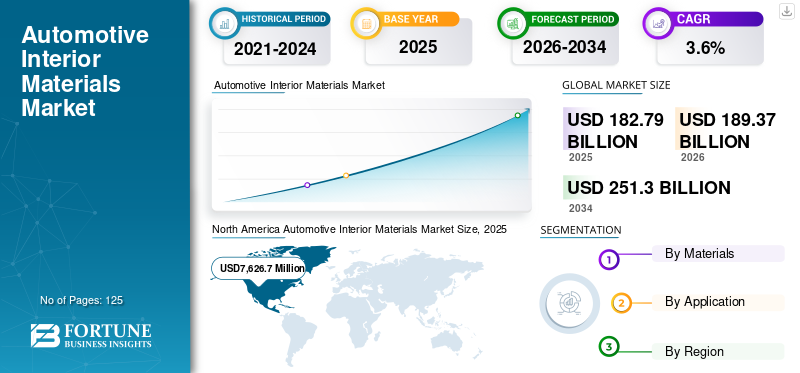
The global automotive interior materials market size was valued at USD 182.79 billion in 2025 and is projected to grow from USD 189.37 billion in 2026 to USD 251.30 billion by 2034, exhibiting a CAGR of 3.60% during the forecast period. North America dominated the automotive interior materials market with a market share of 14.93% in 2025. Moreover, the U.S. automotive interior materials market is projected to reach USD 7.76 billion by 2026, fueled by increasing demand for premium, lightweight, and sustainable interiors.
The automotive interior is one of the most important factors that pleases and attracts a consumer’s attention towards a vehicle. Thus, proper selection of materials for appealing automotive interiors is very crucial. A variety of materials such as plastics, composites, wood, fabrics, rubber, and numerous others are used in the automotive interior as per comfort.
Moreover, these materials have to meet certain industry standards such as fire safety standards for interior materials. Different countries have different limits on the flammability of automotive interior materials. For instance, GB-Standard 8410-2006 is a Chinese standard that defines the requirements for CCC-Certification (China Compulsory Certificate) of automotive interior materials to be used in the Chinese market. As per National Fire Protection Association, USA, more than 25% of vehicle fires originate from the interior and to safeguard the passengers, automotive interior materials have to be properly chosen to ensure both comfort and safety.
Download Free sample to learn more about this report.
Automotive Interior Materials Market Key Takeaways
 Global Market Size & Forecast
- 2025 Market Size: USD 182.79 billion
- 2026 Market Size: USD 189.37 billion
- 2034 Forecast Market Size: USD 251.30 billion
- CAGR: 3.60% from 2026–2034
 Market Share
- North America dominated the market with a 14.93% share in 2025.
- Plastics segment held a 37.10% share, owing to its lightweight properties and wide automotive interior applications.
- Door Panels & Trims segment held the largest market share.
 Key Regional Highlights
North America
The market reached USD 7.63 billion in 2025 and is projected to reach USD 7.76 billion by 2026.
Asia Pacific
The market dominated globally, driven by strong automotive production and rising EV adoption across China, India, Japan, South Korea, and Thailand.
Europe
The market is expected to witness moderate growth, supported by the expanding electric vehicle industry.
U.S.
The market is projected to reach USD 7.76 billion by 2026.
Japan
The market is driven by the growing adoption of advanced and sustainable interior materials in the automotive industry.
Read More

AUTOMOTIVE INTERIOR MATERIALS MARKET TRENDS
Rising Adoption of Bioplastics & ‘Veganism’ is Poised to Fuel the Market Growth
The automotive industry for a long time has adopted plastics for a variety of applications including interior, exterior, under the hood, and others as plastics offer several benefits such as reduced weight, flexibility, and design. With fossil fuel as a dwindling resource for plastics, the industry is now adopting bio-based plastics to continue the use of automobiles for ensuring weight reduction and strong performance. For instance, the interiors of Lexus HS 250h are made of bioplastics. Major car manufacturers such as Toyota, have adopted a variety of bio-based plastics such as bio-polyesters, bio-PET (polyethylene terephthalate), as well as PLA-blends (polylactic acid) in various interior components of the vehicle. Toyota Prius and Toyota SAI models have headliners, sun visors, floor mats, and several other parts that are made of bio-plastics.
Moreover, the concept of ‘veganism’ has been introduced in the automotive industry. Vehicle manufacturers are now offering vegan interior leather to their customers as the demand is rising. For example, German Automaker Volkswagen unveiled its full-size electric vehicle ‘ID Roomzz’ that features interiors made from apple leather at the Shanghai Motor Show in 2019. Similarly, other automakers such as Volvo and Audi have also announced upcoming projects that will feature vegan interiors.
Download Free sample to learn more about this report.
AUTOMOTIVE INTERIOR MATERIALS MARKET GROWTH FACTORS
Changing Regulatory Landscape Coupled with Reduction in Weight is boosting the Market Growth
Increasing fuel efficiency and reducing emissions by reducing the weight of the vehicle is the central objective of the automotive industry. Therefore, consumers are adopting various lightweight materials that are anticipated to promote market growth. With the imposition of stringent norms such as CAFE (Corporate Average Fuel Economy), automakers are aiming for heavy consumption of light-weight materials such as plastics, composites and fabrics in vehicles. For instance, the 2025 CAFE standards in North America require automakers to deliver a fleet average of at least 54.5 mpg. Moreover, automakers also get more freedom to modify the design in order to maximize performance by adopting materials like plastics and composite. Further, increasing awareness and PETA (People for the Ethical Treatment of Animals) regulations on the use of natural leather are propelling the demand for lightweight synthetic leather in the automotive industry.
Rapidly Expanding E-vehicles Market to Spur the Demand for Automotive Interior Materials
The electric vehicles market is rapidly expanding across the globe with rising environmental concerns and fast depleting fossil resources. Electric vehicles are largely made of plastics and other light-weight materials in order to provide better fuel efficiency and reduce recharge timings. Lawmakers around the world are promoting electric vehicles as an economical and eco-friendly option as compared to traditional vehicle technology. Various schemes and subsidies are being provided to e-vehicle customers to increase the adoption of cleaner technology. This has indeed boosted the sales of e-vehicles and a number of customers are encouraged to join the clean league in the upcoming years. For instance, the number of e-vehicles sold worldwide rose by 73% in 2018.
RESTRAINING FACTORS
Uncertainty in the Global Automotive Industry to Confine Market Expansion.
The slow or flat growth of the major automotive markets in the world has impacted the expansion of the automotive interior materials market in recent years. Countries like China, Spain, Turkey, Canada, South Korea, etc. registered negative growth rates in the automotive industry in 2018 as per OICA (Organisation Internationale des Constructeurs d'Automobiles) statistics. In 2019, countries like India too registered negative growth that largely affected the regional market revenue. The Coronavirus Outbreak in China has further weakened the growth of the automotive industry in the nation as well as several other regions. For instance, Hyundai, a South Korean automaker, suspended vehicle production for several days in February 2020, owing to the interrupted supply of automotive parts from China, further attributed to the coronavirus outbreak. The situation may further hinder market growth in 2020. Furthermore, changing regulatory norms on vehicle emissions such as BSIV (India) {Bharat Stage 6}, Euro6, etc. has disrupted the automotive industry across the globe. Thus, with the increasing number of such disruptions in the automotive industry the market growth is expected to be hampered during the forecast period.
AUTOMOTIVE INTERIOR MATERIALS MARKET SEGMENTATION ANALYSIS
By Material Analysis
To know how our report can help streamline your business, Speak to Analyst
Plastics & Leather Dominate the Global Market
Plastic is the highly used material in the automotive interiors materials market owing to a number of applications such as interior panels, dashboard, seats, interior trim, etc. Injection moulded components are common in automotive interior trim enabling the reduction in noise, vibration, and harshness (NVH) within the cabin. On the other hand, the leather segment dominates the market in terms of value. Natural leather is heavily priced as compared to synthetic leather. Luxury & premium vehicle customers demand genuine leather seating and interiors that drives the market for natural leather in the automotive interior. Mid-sized premium vehicles also consume a considerable amount of natural leather. However, with the improving performance and look of synthetic leather as well as the introduction of vegan leather, the demand for a natural leather segment may witness slow growth in the automotive industry. The Plastics segment is expected to hold a 37.1% share in 2018.
By Application Analysis
Door Panel & Trims is Anticipated to be Lucrative Growth Segment
Automotive door panels and interior trim segments account for the lion’s share in the market owing to the ease of processing and application of these materials. In a typical vehicle, the average consumption of plastic in interior trim accounts for around 40% of the total plastics used. Moreover, the door panel & trims account for a major share in the area of automotive interiors giving manufacturers the space for customizing and significantly reducing the weight as compared to other components. Different materials used in these applications include, not limiting to, ABS (acrylonitrile butadiene styrene), PP (polypropylene), PET (polyethylene terephthalate), POM (polyoxymethylene), PVC (polyvinyl chloride), and others. The automotive carpet & headliners segment is the fastest-growing segment as the customers often customize them as per their requirements.
REGIONAL AUTOMOTIVE INTERIOR MATERIALS MARKET ANALYSIS
Asia-Pacific
North America Automotive Interior Materials Market Size, 2025 (USD Million)
To get more information on the regional analysis of this market, Download Free sample
Asia-Pacific leads the global automotive interior materials market driven by a strong automotive industry in China, India, South Korea, Japan, and Thailand. Moreover, the region is anticipated to grow rapidly over the forecast period owing to the fast expansion of middle-class people in emerging economies such as India, China, Taiwan, Thailand and others. Furthermore, the rising sales and adoption of e-vehicles in the region is likely to boost the market growth during the foreseeable period.
Europe
Europe has secured the second position in the market and is expected to witness moderate growth on the back of the rising e-vehicles market. Major countries such as Germany, UK, Spain and Italy witnessed negative growth in the automotive industry in 2018. North America is also expected to witness a moderate growth owing to the steadily improving automotive industry in the region. The rising adoption of electric vehicles in the region is likely to provide impetus to market growth in the upcoming years.
Latin America
Latin America has been poised to witness healthy growth attributed to the expanding automotive industries in Brazil & Mexico. However, large areas of the region such as Venezuela, Honduras, Ecuador, and others are currently under economic instability and political turmoil which is anticipated to hinder the market growth over the forecast period.
- North America witnessed a growth from USD 7764.0 Million in 2017 to USD 7626.7 Million in 2018.
Middle East & Africa
The Middle East & Africa too is facing economic instability and high political turbulence. Civilian and international crises such as the Yemen crises, the Libyan Crises, the US-Iran conflict, and others are likely to hamper the market growth in the region.
KEY INDUSTRY PLAYERS
Players Such as DuPont are Restructuring the Market
The competitive landscape of the automotive interior materials market depicts a segregated market. A diversified product portfolio is the key feature adopted by the majority of the players in the market giving auto manufacturers a wide range of choice and options for specific applications. Players such as DuPont have launched a completely new series of renewably sourced automotive interior materials that includes Sorona fibre for carpeting, headliners, and seat fabrics; Hytrel RS thermoplastic elastomer for airbag systems and Sorona EP thermoplastic polymer for electronic components, headlight bezels and air ventilation louvres. With rising environmental concerns along with a shift in consumer preference from non-renewable to renewable products, the market is expected to restructure itself in the upcoming years and grow towards sustainability.
LIST OF KEY PLAYERS PROFILED IN AUTOMOTIVE INTERIOR MATERIALS MARKET:
- Faurecia
- Adient plc
- TOYOTA BOSHOKU CORPORATION
- DuPont de Nemours, Inc.
- Sage Automotive Interiors
- Grupo Antolin
- Yanfeng Automotive Interiors
- Stahl Holdings B.V.
- SEIREN Co., Ltd.
- DK-Schweizer
- Freudenberg Performance Materials
- Lear Corporation
- Others
KEY INDUSTRY DEVELOPMENTS:
- January 2020 – FAURECIA, a manufacturer of a wide range of automotive system and components headquartered in France, successfully completed the acquisition of SAS, a key player in the complex assembly and logistics of interior modules.
- October 2018 – Asahi Kasei, a manufacturer of a wide range of chemicals & materials headquartered in Japan, successfully completed the acquisition of Sage Automotive Interiors, a US-based manufacturer of automotive interiors.
REPORT COVERAGE
Request for Customization to gain extensive market insights.
The automotive interior materials market report provides a detailed analysis of the market and focuses on key aspects such as leading companies, product types, and leading applications of the product. Besides this, the report offers insights into the market, current trends, and highlights key industry developments. In addition to the aforementioned factors, the report encompasses several factors that have contributed to the growth of the market over recent years.
Report Scope & Segmentation
|
ATTRIBUTE |
DETAILS |
|
Study Period |
2021-2034 |
|
Base Year |
2025 |
|
Forecast Period |
2026-2034 |
|
Historical Period |
2021-2024 |
|
Unit |
Value (USD billion) |
|
Segmentation |
By Materials
|
|
By Application
|
|
|
By Geography
|
Frequently Asked Questions
Fortune Business Insights says that the Market was USD 189.37 billion in 2026 and is projected to reach USD 251.3 billion by 2034.
In 2025, the Market value stood at USD 182.79 billion.
Growing at a CAGR of 3.6%, the Market will exhibit steady growth in the forecast period (2026-2034).
Plastics and leather are expected to be the leading segment in this market during the forecast period.
Weight reduction and changing regulatory landscape on vehicle emissions are the key factors driving the market.
Asia-Pacific dominated the market share in 2025.



- 2021-2034
- 2025
- 2021-2024
- 125
Get 30-60 hrs Free Customization
Expand Regional and Country Coverage, Segments Analysis, Company Profiles, Competitive Benchmarking, and End-user Insights.


















Related Reports
-
US +1 833 909 2966 ( Toll Free )
-
Get In Touch With Us