Barrier Packaging Market Size, Share & Industry Analysis, By Material (Plastic, Paper & Paperboard, Metal, Glass, Others), By Packaging Type (Bags & Pouches, Films & Wraps, Trays & Clamshells, Boxes & Cartons, Bottles & Jars, Others), By End-use Industry (Food & Beverages, Pharmaceuticals, Personal Care & Cosmetics, Home Care, Agriculture, Others), and Regional Forecast, 2026-2034
 Download Free Sample
(Offer valid till 15th Oct 2026)

Barrier Packaging Market Size and Future Outlook
 Listen to Audio Version
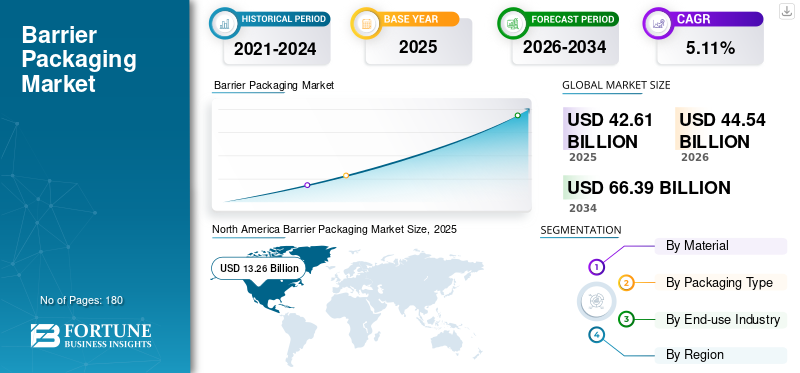
The global barrier packaging market size was valued at USD 42.61 billion in 2025 and is projected to grow from USD 44.54 billion in 2026 to USD 66.39 billion by 2034, exhibiting a CAGR of 5.11% during the forecast period. North America dominated the global barrier packaging market with a market share of 31.12% in 2025.
The global barrier packaging market refers to the worldwide sector dedicated to the production and provision of packaging materials and solutions designed to safeguard against external environmental elements, including oxygen, moisture, light, gases, aromas, grease, bacteria, and chemicals that may compromise or spoil the packaged goods.
Furthermore, the market is dominated by several major players, including Amcor Plc, Tetra Pak, and Gerresheimer AG, at the forefront. A broad portfolio, innovative product launches, and strong geographic presence expansion have supported the dominance of these companies in the global market.
Download Free sample to learn more about this report.
Barrier Packaging Market Key Takeaways
 Market Size & Forecast
- 2025 Market Size: USD 42.61 billion
- 2026 Market Size: USD 44.54 billion
- 2034 Forecast Market Size: USD 66.39 billion
- CAGR: 5.11% from 2026–2034
 Market Share
- North America dominated the barrier packaging market with a 31.12% share in 2025.
- Plastic segment accounted for 39.30% market share in 2025.
- Bags & Pouches segment is projected to hold 38.46% market share in 2025.
 Key Regional Highlights
North America
North America held 31.12% share in 2025, valued at USD 13.26 billion.
Asia Pacific
Asia Pacific market valued at USD 11.68 billion in 2025.
Europe
Europe market valued at USD 8.56 billion in 2025.
U.S.
Market is valued at USD 10.19 billion in 2025.
Germany
Market valued at USD 1.92 billion in 2025.
Read More

MARKET DYNAMICS
MARKET DRIVERS:
Rising Demand for Extended Shelf-Life & Product Protection Propels the Market Expansion
A significant factor which is driving the global barrier packaging market growth is the rising demand from consumers and industries for packaging solutions that provide extended shelf life, prevent contamination, and ensure product integrity. As manufacturers in the food, pharmaceutical, and personal care sectors expand their global distribution networks, the need for packaging that can withstand oxygen, moisture, light, aromas, and chemical migration becomes increasingly crucial. Moreover, the swift expansion of e-commerce and international trade necessitates robust and protective packaging that can endure lengthy logistics cycles, which further drives adoption. The increasing emphasis on reducing food waste and improving supply chain efficiency also propels the demand for high-performance barrier materials.
MARKET RESTRAINTS:
Environmental Pressures and Regulatory Restrictions on Plastics Impede the Market Growth
One of the significant constraints affecting the barrier packaging market is the growing global demand to minimize plastic waste and transition towards sustainable packaging options. Numerous barrier materials, particularly multilayer structures, present recycling challenges due to their complex polymer compositions, which complicates waste management efforts. Regulatory authorities in Europe, North America, and select Asian Pacific countries are enforcing stricter regulations concerning single-use plastics, chemical additives, and non-recyclable laminate materials. This situation presents challenges for manufacturers that rely on traditional barrier materials.
MARKET OPPORTUNITIES:
Rapid Growth in Sustainable & Mono-Material Barrier Solutions Provides Potential Opportunities
A considerable opportunity exists in creating recyclable, compostable, and mono-material barrier packaging solutions. The transition from conventional multilayer laminates to single-material structures such as mono-PE, mono-PP, or paper-based barrier coatings initiates a new era of innovation within the industry. Brands are increasingly embracing bio-based high-barrier materials, including PLA blends, PHA, cellulose films, and water-based coatings, to achieve sustainability objectives and comply with regulations. Furthermore, the increasing demand for high-barrier packaging in emerging markets, spurred by urbanization and a rise in packaged food consumption, presents significant growth prospects. Technological innovations such as nanotechnology, vacuum metallization, plasma coatings, and intelligent barrier materials also offer opportunities for improved performance and premium product differentiation.
BARRIER PACKAGING MARKET TRENDS:
Shift Toward Sustainable, High-Performance, and Functional Barrier Packaging Appears as a Market Trend
A significant trend influencing the market is the shift towards sustainable barrier formats, which include recyclable laminates, biodegradable films, and paper-based barrier solutions. Businesses are increasingly embracing mono-material films that offer improved oxygen and moisture resistance, supporting circular economy initiatives.
Another key trend is the emergence of functional and active barrier packaging that features antimicrobial, antioxidant, or moisture-control barrier properties to enhance shelf stability. The increasing adoption of smart packaging, featuring QR codes, freshness indicators, and track-and-trace technologies, also plays a vital role in the market's evolution.
Download Free sample to learn more about this report.
MARKET CHALLENGES:
Complex Manufacturing Processes & Recycling Limitations Pose Key Challenges
The production of high-barrier packaging often involves technically complex and capital-intensive processes, including multilayer extrusion, sophisticated coating technologies, and precise lamination. These processes necessitate specialized equipment and premium raw materials, leading to increased manufacturing expenses and restricted scalability for smaller producers. A significant challenge lies in the end-of-life management of multilayer barrier packaging, which is generally unsuitable for conventional recycling systems. This situation intensifies the pressure on manufacturers to innovate materials while maintaining barrier efficacy.
Segmentation Analysis
By Material
Plastic’s Superior Versatility Fuels Its Dominance in the Barrier Packaging Market
In terms of material, the market is categorized as plastic, paper & paperboard, metal, glass, and others.
The plastic segment captured the largest barrier packaging market share of 39.30% in 2025. The segment of plastic materials leads the global barrier packaging market mainly due to its unparalleled versatility, affordability, and capacity to provide high-performance barrier characteristics suited for a diverse array of applications. Plastic materials exhibit outstanding resistance to moisture, oxygen, aroma, light, and chemical migration, rendering them perfect for safeguarding perishable food, pharmaceuticals, and delicate consumer products. Additionally, their compatibility with various packaging formats, including pouches, films, trays, bottles, and laminates, further reinforces their leading position.
The paper and paperboard material segment is expected to grow at a CAGR of 5.24% over the forecast period.
By Packaging Type
Lightweight Efficiency and High Functionality Drive the Dominance of Bags & Pouches Segment
In terms of packaging type, the market is categorized into bags & pouches, films & wraps, trays & clamshells, boxes & cartons, bottles & jars, and others.
The bags and pouches segment captured the largest share of the market in 2025. In 2025, the segment is anticipated to dominate with a 38.46% share. The segment of bags and pouches leads the barrier packaging market due to its optimal blend of cost-effectiveness, high-barrier functionality, and convenience for consumers. These formats are naturally lightweight, utilizing considerably less material compared to rigid packaging, yet they still offer robust barrier protection against moisture, oxygen, UV light, and contaminants. Their flexible design accommodates both advanced multilayer and mono-material barrier films, facilitating enhanced shelf-life extension for food, beverages, pharmaceuticals, and personal care products.
The films and wraps packaging type segment is expected to grow at a CAGR of 5.24% over the forecast period.
By End-use Industry
Rising Health Awareness and Preventive Nutrition Trends Propel Segment Dominance
Based on end-use industry, the market is segmented into food & beverages, pharmaceuticals, personal care & cosmetics, home care, agriculture, and others.
To know how our report can help streamline your business, Speak to Analyst
In 2024, the global market was dominated by the food and beverages industry in terms of end-use. Furthermore, the segment is set to hold a 36.02% share in 2025. The food and beverage (F&B) end-use sector leads the barrier packaging market due to the high sensitivity of these food products to oxygen, moisture, light, aroma loss, and microbial contamination, all of which significantly affect freshness, flavor, safety, and shelf life. Barrier packaging materials play a crucial role in safeguarding perishable items, including foods, dairy products, meats, snacks, ready-to-eat meals, and beverages, from spoilage and deterioration in quality.
As global consumption of packaged and processed foods continues to rise—prompted by urbanization, hectic lifestyles, and expanding retail formats—the need for dependable, high-barrier solutions has increased.
Additionally, the pharmaceuticals end-use industry is projected to grow at a CAGR of 5.27% during the study period.
Barrier Packaging Market Regional Outlook
By region, the market is categorized into Europe, North America, Asia Pacific, Latin America, and the Middle East & Africa.
North America Barrier Packaging Market Size, 2025 (USD Billion)
To get more information on the regional analysis of this market, Download Free sample
North America
North America held the dominant share in 2024, valued at USD 12.67 billion, and maintained its leading position in 2025, with a value of USD 13.26 billion. In North America, the market's growth is primarily driven by the increasing demand for packaged, processed, and ready-to-eat foods, which necessitates the use of advanced barrier solutions to preserve product freshness and comply with regulatory standards. Stringent FDA regulations concerning food safety, pharmaceutical packaging, and material migration compel brands to utilize high-performance barrier materials.
In 2025, the U.S. market is estimated to reach USD 10.19 billion.
Asia Pacific
Other regions, such as the Asia Pacific and Europe, are anticipated to experience notable growth in the coming years. During the forecast period, the Asia Pacific region is projected to record a growth rate of 5.88%, the second-highest among all regions, and reach a valuation of USD 11.68 billion by 2025. The Asia Pacific region is experiencing significant growth, driven by increasing urban populations, higher disposable incomes, and a substantial shift towards packaged and convenience foods. The elevated consumption of snacks, beverages, meat, and dairy products, particularly in China, India, Indonesia, and Vietnam, generates a robust demand for efficient oxygen and moisture barriers.
In the region, China and India are both estimated to reach USD 3.98 billion and USD 3.33 billion, respectively, in 2025.
Europe
After Asia Pacific, the market in Europe is estimated to reach USD 8.56 billion in 2025 and secure the position of the third-largest region in the market. Europe enforces some of the most stringent regulations regarding packaging waste and recycling globally, including the EU Packaging and Packaging Waste Directive (PPWD) and forthcoming requirements for complete recyclability by 2030. These regulations significantly drive the transition towards recyclable mono-material structures, paper-based barrier formats, and compostable films.
Backed by these factors, countries including Germany are expected to record valuations of USD 1.92 billion, the U.K. USD 1.65 billion, and France USD 1.46 billion in 2025.
Latin America
Over the forecast period, the Latin America and Middle East & Africa regions are expected to witness moderate growth in this market space. The Latin America market in 2025 is expected to reach a valuation of USD 5.14 billion. In Latin America, the growth is bolstered by the expansion of local food and beverage processing industries, particularly in Brazil, Mexico, Argentina, and Chile. As an increasing number of consumers transition from fresh products to packaged goods due to urbanization and hectic lifestyles, the adoption of barrier packaging rises considerably.
Middle East & Africa
In the Middle East & Africa, South Africa is expected to reach a value of USD 0.98 billion by 2025. The demand for barrier packaging in the Middle East & Africa is significantly affected by its dependence on imported packaged foods, which necessitate high-performance barrier materials capable of enduring long-distance transportation. Moreover, the emerging pharmaceutical industry, particularly in Gulf nations, is driving the need for sterile blister packs and high-barrier laminates.
COMPETITIVE LANDSCAPE
Key Industry Players:
A Wide Range of Product Offerings, coupled with a Strong Distribution Network of Key Companies, supported their Leading Position.
The global barrier packaging market exhibits a semi-concentrated structure, with numerous small to mid-size companies actively operating worldwide. These players are actively involved in product innovation, strategic partnerships, and geographic expansion.
Amcor, Sealed Air, and Graphic Packaging International, LLC are among the leading players in the market. A comprehensive range of Barrier Packaging products, a global presence through a strong distribution network, and collaborations with research and academic institutes are a few characteristics that support the dominance of these players.
Apart from this, other prominent players in the market include Mondi, Huhtamaki, ProAmpac, and others. These companies are undertaking various strategic initiatives, including investments in research and development (R&D) and partnerships with pharmaceutical companies, to enhance their market presence.
LIST OF KEY BARRIER PACKAGING COMPANIES PROFILED:
- Amcor (Switzerland)
- Sealed Air (U.S.)
- Graphic Packaging International, LLC (U.S.)
- Mondi (U.K.)
- Huhtamaki (Finland)
- ProAmpac (U.S.)
- DS Smith (U.K.)
- Coveris (Austria)
- C-P Flexible Packaging (U.S.)
- TOPPAN Inc. (Japan)
- Toray Plastics (U.S.)
- Uflex Limited (India)
- Constantia Flexibles (Austria)
- Innovia Films (U.K.)
- ALPLA (Austria)
KEY INDUSTRY DEVELOPMENTS:
- October 2024: Klöckner Pentaplast (KP), a German producer of plastic packaging solutions, introduced two new recyclable barrier flow wrap films: KP FlexiFlow EH 155 R and KP FlexiFlow PH 255 R. These films are capable of decreasing packaging weight by as much as 75% in comparison to other options, which the company claims signify "a major advancement in sustainable food packaging design".
- March 2024: TOPPAN Inc. and TOPPAN Speciality Films Private Limited (TSF), based in India, collaborated to create GL-SP, a barrier film utilizing biaxially oriented polypropylene (BOPP) as its substrate, and are preparing to commence production and sales. GL-SP represents a novel entry in the TOPPAN Group’s GL BARRIER1 series of transparent, vapor-deposited barrier films, which hold a significant share in the global sustainable packaging market.
- March 2024: Greif, Inc., a worldwide leader in industrial packaging solutions and services, has declared the successful completion of its previously disclosed acquisition of Ipackchem Group SAS. As a Platinum EcoVadis-rated company, Ipackchem engages in plastics circularity by manufacturing barrier packaging that is entirely recyclable and can incorporate up to 50% post-consumer recycled polymer.
- August 2023: Amcor, a worldwide leader in the development and production of sustainable packaging solutions, announced the launch of curbside-recyclable AmFiber Performance Paper packaging in North America, which is included in the company’s AmFiber portfolio. AmFiber Performance Paper is a high-barrier laminated paper that can be recycled in the majority of paper recycling streams, achieving the How2Recycle prequalification status of "widely recyclable."
- July 2023: Mondi, a global leader in packaging and paper, invested USD 16.81 million in new and advanced technologies to develop a new packaging range called FunctionalBarrier Paper Ultimate. The ultra-high-barrier paper-based food solution meets the growing customer demand for sustainable packaging that contributes to a circular economy.
REPORT COVERAGE
The global barrier packaging market analysis provides an in-depth study of the market size & forecast by all the market segments included in the report. It includes details on market dynamics and trends expected to drive the market during the forecast period. It offers information on the technological advancements, new product launches, key industry developments, and details on partnerships, mergers & acquisitions. The barrier packaging market research report also encompasses a detailed competitive landscape, including market share and profiles of key operating players.
Request for Customization to gain extensive market insights.
Report Scope & Segmentation
| ATTRIBUTE | DETAILS |
| Study Period | 2021-2034 |
| Base Year | 2025 |
| Forecast Period | 2026-2034 |
| Historical Period | 2021-2024 |
| Growth Rate | CAGR of 5.11% from 2026-2034 |
| Unit | Value (USD Billion) |
| Segmentation | By Material, Packaging Type, End-use Industry, and Region |
| By Material |
|
| By Packaging Type |
|
| By End-use Industry |
|
| By Region |
|
Frequently Asked Questions
Fortune Business Insights says that the global market value stood at USD 42.61 billion in 2025 and is projected to reach USD 66.39 billion by 2034.
In 2025, the market value stood at USD 13.26 billion.
The market is expected to exhibit a CAGR of 5.11% during the forecast period of 2026-2034.
The bottles and jars segment led the market by packaging type.
The key factors driving market growth are the rising demand for extended shelf life and product protection.
Amcor, Sealed Air, Graphic Packaging International, LLC, Mondi, Huhtamaki, and ProAmpac are some of the prominent players in the market.
North America dominated the market in 2025.
The growing demand for extended shelf-life products is one factor expected to favor product adoption.



- 2021-2034
- 2025
- 2021-2024
- 180
-
(Offer valid till 15th Oct 2026)
Get 30-60 hrs Free Customization
Expand Regional and Country Coverage, Segments Analysis, Company Profiles, Competitive Benchmarking, and End-user Insights.






Related Reports
-
US +1 833 909 2966 ( Toll Free )
-
Get In Touch With Us